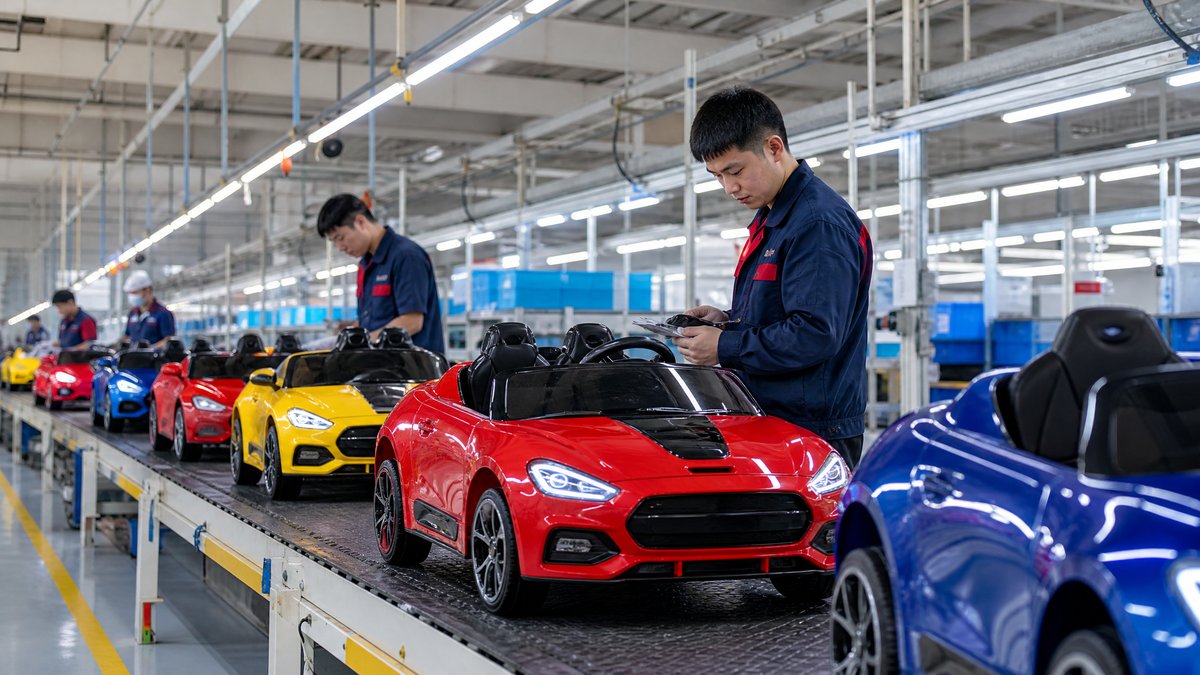
Importers should compare factory sample, pilot run, and mass production quality against one controlled specification set, rather than treating each stage as an informal approval. The factory sample proves whether the proposed product can meet the buyer’s requirements; the pilot run proves that the factory can repeat that result with production tooling, people, and materials; and mass-production controls prove that every shipment continues to match the approved standard. Establish measurable quality gates, retain approved reference units and records, define what may change, and do not let a later stage begin before the previous stage is signed off.
For kids ride-on cars and related battery-powered products, small differences in fit, packaging, labels, or accessories can become costly at container scale. Staged comparison makes the buyer-factory discussion evidence-based.
Why the Three Stages Must Not Be Treated as the Same Thing
A sample, a pilot run, and full production answer different procurement questions. Confusion occurs when a buyer approves a visually appealing sample and assumes that this is evidence of stable manufacturing quality. It is not. The sample may be hand-finished, assembled by a highly experienced technician, built from different materials, or packed with extra care. It can be a valuable development tool while still being a poor predictor of the goods that will ultimately ship.
Think of the three stages as a sequence of risk reduction:
| Stage | Main question for the importer | What is being evaluated |
|---|---|---|
| Factory sample | Can the supplier make the requested product? | Product design, appearance, features, specification interpretation |
| Pilot run | Can the supplier make it repeatedly under production conditions? | Process capability, assembly consistency, materials, work instructions, packaging flow |
| Mass production | Is the approved process being followed consistently? | Ongoing conformance, defect control, traceability, shipment readiness |
The standard should become more operational as the project progresses. By pilot, product decisions should be largely frozen; by production, the focus is conformance, controlled exceptions, and completed checks.
Create One Master Quality File Before Comparing Anything
The most reliable comparison begins before a sample is dispatched. Prepare a master quality file that states exactly what the factory is expected to build and how the buyer will judge it. This is more reliable than scattered email threads, annotated photos, and verbal promises.
Keep the file concise but unambiguous: model or SKU, target market, photos, color references, key dimensions, functions, accessories, artwork, carton configuration, labels, and revision. Name the buyer contact authorized to approve changes, and require written notice before a material, component, tooling, packaging, or process change.
For ride-on products, define observable checks such as panel fit, steering and wheel alignment, seat installation, control operation, accessory completeness, carton protection, document inclusion, and cosmetic condition. “Good quality” is not an acceptance criterion.
Build a Critical-to-Quality List
A critical-to-quality (CTQ) list prioritizes what must be right. Divide it into three practical groups:
- Safety- and compliance-relevant items: Use model-neutral language and ask the supplier to provide the product information and documents needed for your market assessment. Verify current destination-market requirements with the responsible authorities, testing bodies, or qualified advisers; do not assume that documentation acceptable in one market is sufficient in another.
- Functional items: Define expected operation and the inspection method, such as whether a control responds, a drive mode engages, or a supplied component matches the ordered configuration. The exact test method should follow the manufacturer’s instructions and approved product documentation.
- Commercial and cosmetic items: Set standards for color, logos, surface finish, accessory count, retail-carton print, barcode placement, and pack-out.
Give each item an owner, acceptance method, and record type. A labeled physical reference may control color; approved artwork and a packing list may control cartons; documented procedures may control functions. The aim is that buyer, inspector, and factory reach the same conclusion.
Gate 1: Evaluate the Factory Sample as a Product-Definition Test
The factory sample confirms that the supplier has understood the requested product. Request a review package with dated photos, model and revision identification, a component list, deviations, carton artwork, and a statement on whether production-intended materials and tooling were used.
Inspect against the master file. Photograph the carton, labels, accessories, and any transit damage; assess appearance in consistent lighting; compare key dimensions where a target exists; and run only ordinary user-facing functions in the manufacturer’s instructions. Record findings in a sample approval report.
Use three outcomes: approved, approved with specified changes, or rejected. “Approved with changes” must identify the change, owner, closure evidence, and need for a further sample. Do not approve by silence or vague comments; give a precise reference for every required correction.
Questions Importers Should Ask at Sample Stage
Ask questions that reveal how representative the sample is:
1. Were production-intended components, materials, suppliers, and tooling used?
2. Which steps or features remain provisional or were specially handled for this unit?
3. How are drawings, artwork, substitutions, and work instructions revision-controlled?
The goal is to identify the gap between a prototype-quality result and a production-ready result. Do not assume an unexplained gap is small.
Gate 2: Use the Pilot Run to Validate Repeatability
A pilot run is the bridge between a single approved unit and regular output. It should be assembled in a way that resembles planned production, using the intended materials, component sources, tooling, workstations, and packaging process as far as practical. The pilot reveals hidden variation: a part may fit a hand-built unit but be difficult to align on a line; carton inserts may fail at normal packing speed.
Agree pilot scope in advance. It should show variation across multiple units and normal assembly and packing activities. Where its system supports it, ask the factory to identify units by serial, batch, or internal lot and retain incoming, in-process, rework, and final-inspection records.
Compare pilot units to the sample and to each other. Look for variation in panel alignment, printed details, wheel and seat fit, accessory completeness, carton condition, and operation. Check whether written instructions match actual practices; recurring reliance on operator judgment is a process risk.
Pilot-Run Review Checklist
A practical pilot review should cover the following areas:
- Material consistency: Confirm visible and specified production-intended parts match the approved reference, and ask for approval before any substitution.
- Assembly flow: Observe whether parts fit without improvised adjustment, avoidable force, or undocumented rework.
- Function checks: Confirm that the factory performs the agreed routine checks according to approved procedures and records the results.
- Packaging flow: Review carton, inserts, protective materials, accessory bags, documents, labels, and closure method under normal pack-out conditions.
- Defect learning: Classify defects, identify the root cause, assign corrective actions, and require evidence that actions were checked on a repeat build.
- Traceability: Confirm the factory can link a problem unit, where applicable, to a production date, component lot, or work order in a way that supports investigation.
Use the pilot to prove that CTQs are controlled and defects are captured before escape. A documented corrective-action process is more useful than a promise that an issue “will not happen again.” For each notable defect, ask what caused it, what changed, who verifies it, and how recurrence is prevented.
Gate 3: Control Mass Production Against the Frozen Reference
Mass production should not reopen product development. Once the pilot gate is approved, issue a frozen specification package. This package should include the final approved sample or retained “golden sample,” final photos, revision-controlled artwork, packing standard, CTQ list, inspection plan, and approved deviation log. Both the factory and importer should know which document revision governs the order.
Label the golden sample with model, revision, approval date, and approval reference, and protect it from damage or mix-ups. If both parties cannot retain a unit, create a detailed photo and measurement record, while recognizing that photos do not fully capture texture, gloss, fit, or feel.
For production, agree checkpoints: incoming materials, line-start verification, in-process checks, finished-goods checks, and pre-shipment inspection. The factory, a qualified independent provider, or both may conduct them. Specify the sampling plan, defect classifications, report format, and escalation route in the order or quality agreement.
Separate Defects by Decision Impact
A useful defect classification keeps disputes focused. Use definitions tailored to your product and market obligations rather than copying generic terminology without thought.
| Classification | Typical decision impact | Importer response |
|---|---|---|
| Critical | Could affect safety, legal market access, or make the product unacceptable to ship | Stop release; investigate, correct, and re-verify before shipment decisions |
| Major | Materially affects function, appearance, pack-out, or customer experience | Require containment and corrective action; decide acceptance only against the agreed plan |
| Minor | Does not materially affect intended use or presentation but departs from the standard | Record trend, correct where practical, and prevent recurrence |
These labels do not replace destination-market obligations or risk assessment. Promptly review concerns involving electrical parts, batteries, labeling, or intended use with responsible parties. Never instruct buyers or end users to alter battery systems, wiring, guards, or other components. Changes need manufacturer approval and, where relevant, assessment against applicable requirements.
Compare Evidence, Not Just Units
At each gate, use the same evidence categories so trends are easy to spot. A simple comparison matrix can show whether the factory is progressing or drifting:
| Evidence category | Sample | Pilot run | Mass production |
|---|---|---|---|
| Product configuration | Proposed and reviewed | Confirmed against final intended configuration | Controlled to frozen revision |
| Process evidence | Limited; explain non-production steps | Work instructions, in-process findings, corrective actions | Routine inspection and traceability records |
| Packaging evidence | Prototype or proposed pack-out | Normal-flow pack-out validated | Final packing standard applied |
| Approval decision | Define product changes | Approve repeatability and close actions | Release, hold, or rework based on agreed criteria |
Require dated reports identifying the purchase order, SKU, date or lot where available, inspector, quantity checked, findings, and disposition. Treat a changed charger, wheel material, carton print, accessory, label, or battery-related component as a deviation: pause, document, assess, and obtain approval through change control.
For battery-powered goods, include logistics in the quality conversation. Confirm that the supplied battery configuration, packaging, marks, documents, and shipping preparation are aligned with the transportation route being used. Battery-transport rules and carrier practices can change, and importers should verify current requirements with the responsible authorities, freight forwarder, and carrier before booking. Do not rely on old shipments or informal statements as proof of present compliance.
Put the Quality Gates Into the Purchase Order
A quality gate works best when it is commercially connected to the order. The purchase order or a referenced quality agreement should identify the approved specification revision, inspection points, acceptance process, nonconformance reporting expectation, change-notification requirement, and the party authorized to release shipment. It should also state how a hold is communicated and what evidence is required to close it.
Define when the supplier must notify the buyer of a schedule risk rather than claiming a guaranteed lead time. Ask for current, product-specific evidence relevant to the planned market and independently verify its suitability. Share gate templates early and close actions promptly; the purpose is to prevent late surprises, not to create paperwork.
FAQ: Factory Sample, Pilot Run, and Production Quality
Is an approved factory sample enough to approve mass production?
No. An approved sample establishes the desired product reference, but it does not by itself prove that the factory can produce consistent units at normal operating conditions. Use a pilot run to assess repeatability, then control production against the frozen specification and agreed inspection plan.
What should an importer do when the pilot differs from the approved sample?
Document each difference against the master quality file, determine whether it is an approved change or a nonconformance, and ask the factory for cause, containment, corrective action, and verification evidence. Do not accept a permanent material or process change solely because it appears on a pilot unit. Use the agreed written change-control process.
How can a buyer prevent unapproved component substitutions?
Identify critical components and visible materials in the specification, require advance written notification of proposed substitutions, retain an approved reference, and compare incoming, in-process, and finished-goods evidence. Factory records and lot traceability can support investigation, but the required level should be agreed realistically for the product and supplier.
Who should perform the final inspection?
The right choice depends on product risk, supplier track record, market needs, and the buyer’s internal quality capability. The factory should maintain its own controls; an importer may also use a qualified independent inspector. In either case, inspectors need the same approved specification, defect definitions, sample plan, and authority to escalate a discrepancy.
Are battery checks only a shipping issue?
No. Battery configuration, charger, labels, packaging, and shipping preparation affect both product readiness and logistics. Verify current destination-market and battery-transport requirements with responsible authorities and carriers for the actual route. Adult supervision should follow the manufacturer’s age, use, charging, and safety instructions.
Conclusion: Make Quality Approval a Controlled Handover
The strongest import programs do not ask whether the sample, pilot, or production run is simply “good.” They ask what each stage proves, what evidence supports that conclusion, and whether the next stage may proceed. The sample locks down the intended product. The pilot proves whether the process can repeat it. Mass-production checks verify that the approved process and specification are still being followed.
For KidsRideCar buyers, this turns quality from a late inspection event into a purchasing discipline. Use a precise master file, measurable CTQs, an approved reference, written change control, and evidence at every gate. It gives teams a clearer release basis and helps suppliers address problems early.
For support with a sourcing discussion or an order-specific quality checklist, email KidsRideCar’s team.
To discuss factory sample, pilot-run, and production expectations for your next program, contact KidsRideCar.
Official references
Explore these external resources for current regulatory and trade guidance. Confirm requirements with the relevant authority before placing an order.
Ready to Start?
Factory-Direct · CE & ASTM Certified · MOQ from 50 Units
Our export team works with buyers in 60+ countries. Get a quote within 24 hours.
KR
Written by KidsRideCar
China's leading kids electric ride-on car manufacturer. 500,000+ units shipped annually to 60+ countries. CE, ASTM & EN71 certified.