Introduction
One of the most common questions we receive from wholesale buyers is: "What can I customize, and what will it cost?" The answer depends on how much you want to change and how many units you are ordering. Customization options for kids electric ride-on cars exist on a spectrum — from simple logo application at low MOQ, to full product development with custom tooling at high MOQ.
This guide maps out the full customization spectrum, with realistic cost and MOQ expectations at each level.
The Customization Spectrum
| Level | What Changes | MOQ | Additional Cost | Lead Time Impact |
|---|---|---|---|---|
| 1. Logo/sticker | Brand sticker or decal on body | 50 units | $1–3/unit | None |
| 2. Branded packaging | Custom box with your brand | 100 units | $3–8/unit | +1–2 weeks |
| 3. Color customization | Non-standard body color | 100–200 units | $5–15/unit | +1–2 weeks |
| 4. Feature customization | Different seat, wheels, accessories | 200 units | $8–20/unit | +2–4 weeks |
| 5. Logo embossing | Brand name molded into body | 200–500 units | $10–25/unit | +2–3 weeks |
| 6. Full OEM | New tooling, unique design | 500–1000 units | $15,000–50,000 tooling | +8–16 weeks |
Most wholesale buyers operate at Levels 1–4. Full OEM development (Level 6) is typically reserved for established brands with proven demand and the capital to invest in tooling.
Level 1–2: Logo and Packaging Customization
This is the entry point for private label. At this level, you are applying your brand identity to an existing product platform without changing the product itself.
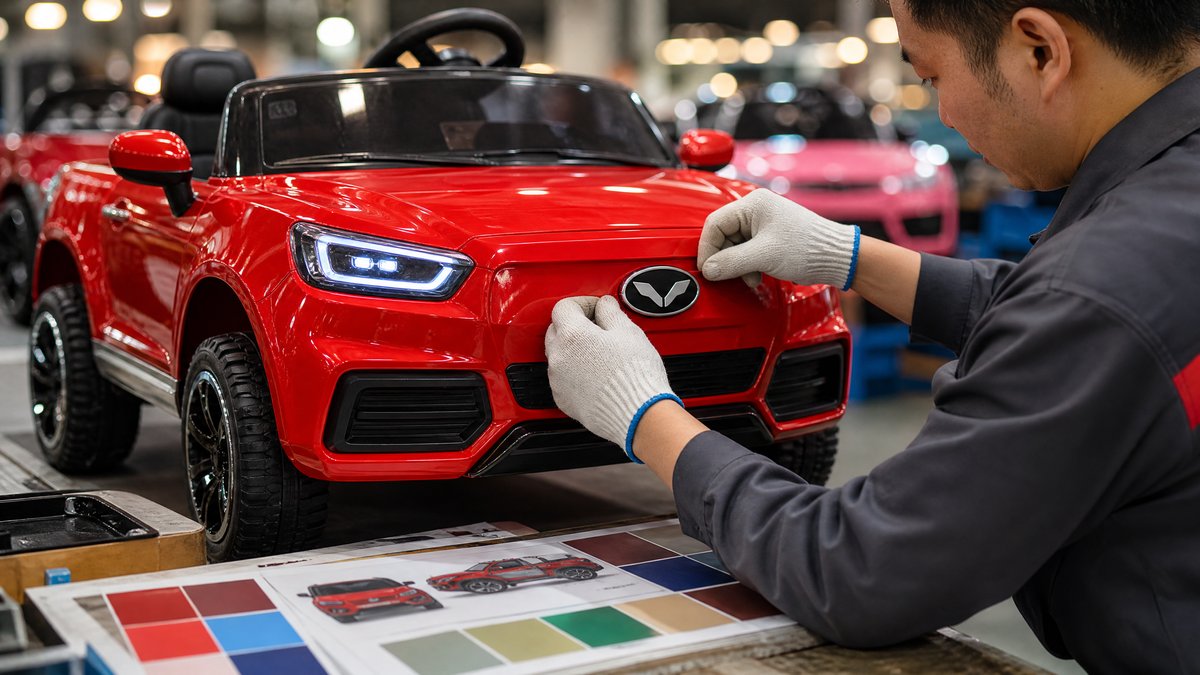
Logo/sticker application involves printing your brand name and logo on a vinyl decal or sticker and applying it to the vehicle body. This is the lowest-cost, lowest-MOQ customization option. The result is a product that carries your brand but is otherwise identical to the factory's standard model.
Custom packaging involves designing and printing a retail box with your brand identity. This requires a minimum print run (typically 100–200 units) to make the printing economically viable. Custom packaging significantly improves the perceived value of the product and is essential for retail channel distribution.
What to specify: Logo files (vector format), brand colors (Pantone references), packaging dimensions, and regulatory text requirements for your target market.
Level 3: Color Customization
Most factories offer a range of standard colors (typically red, white, black, blue, pink). If you want a non-standard color — for example, a specific shade of green that matches your brand identity — this requires a custom paint batch.
Custom colors require a minimum batch size to be economically viable for the factory's paint line. Typical MOQ for a custom color is 100–200 units. The additional cost covers paint setup, color matching, and the risk of leftover paint.
Important: Color matching between different production runs can vary slightly. If color consistency is critical (e.g., for brand identity reasons), specify a Pantone reference and request a color approval sample before mass production.
Level 4: Feature Customization
At this level, you are changing specific components of the product — for example, upgrading the seat material, adding a different wheel style, changing the remote control frequency, or adding a Bluetooth speaker.
Feature customization is possible when the factory has alternative components available in their supply chain. It becomes more complex (and expensive) when it requires sourcing new components from external suppliers.
Common feature customizations:
- Seat upgrade (standard foam to memory foam, or different upholstery fabric)
- Wheel style change (standard plastic to rubber-coated or EVA foam)
- Battery upgrade (lead-acid to lithium)
- Remote control upgrade (2.4GHz digital vs. standard 27MHz)
- Audio system upgrade (Bluetooth speaker, MP3 player)
Level 5: Logo Embossing
Embossing your brand name or logo into the vehicle body (rather than applying a sticker) creates a more premium, permanent brand presence. This requires modifying the injection molding tooling to add the embossed text or logo.
Tooling modification cost: $500–2,000 depending on complexity. This is a one-time cost, not a per-unit cost. The modification is permanent — the embossed logo will appear on every unit produced from that tooling.
MOQ for embossed logo: typically 200–500 units, to justify the tooling modification cost.
Level 6: Full OEM Development
Full OEM development means creating a new product from scratch — new body design, new tooling, new features. This is the highest investment level and the highest reward level.
Tooling cost: $15,000–50,000 for a complete new vehicle body (multiple molds required for different body panels)
Development timeline: 8–16 weeks from design approval to first production sample
MOQ: 500–1,000 units per production run to amortize tooling costs
Full OEM is appropriate for brands that have validated demand for a specific product concept that does not exist in the market, have the capital to invest in tooling, and are committed to a long-term product line.
FAQ
Can I customize a licensed model (e.g., a BMW or Lamborghini replica)?
No. Licensed models are produced under agreements with the brand owner (BMW, Lamborghini, etc.). The factory cannot modify the design, branding, or colors of a licensed model without violating the licensing agreement. Customization is only possible on non-licensed (generic) models.
Who owns the tooling for a custom OEM product?
This depends on the agreement with the factory. In most cases, the buyer pays for the tooling and owns it. However, the tooling remains at the factory for production purposes. If you switch factories, you have the right to transfer the tooling — but this is logistically complex and factories may resist. Clarify tooling ownership in writing before committing to OEM development.
Can I add my own safety certifications to a customized product?
Yes, but customization may require re-testing. If you change materials, components, or design in ways that affect safety-relevant characteristics, new test reports are required. Budget for re-testing as part of your customization cost.
Conclusion
Customization is a spectrum, not a binary choice. Most wholesale buyers start at Level 1–2 (logo and packaging) and progress to higher levels as their volume and confidence in the product grow. The key is to match your customization level to your current order volume and business stage — over-investing in customization before you have validated demand is a common and costly mistake.
If you want to discuss customization options for a specific model or volume, our OEM team is available to provide a detailed quote.
*Ready to customize? Contact us to discuss your requirements.*
Official references
Explore these external resources for current regulatory and trade guidance. Confirm requirements with the relevant authority before placing an order.
Ready to Start?
Factory-Direct · CE & ASTM Certified · MOQ from 50 Units
Our export team works with buyers in 60+ countries. Get a quote within 24 hours.
KR
Written by KidsRideCar
China's leading kids electric ride-on car manufacturer. 500,000+ units shipped annually to 60+ countries. CE, ASTM & EN71 certified.
