Introduction
“How quickly does it stop?” is a sensible question, but it does not have one honest answer for every ride-on car. Stopping behavior can change with speed setting, battery charge, payload, tire condition, surface texture, slope, motor control design and whether the vehicle is being operated by pedal or parental remote. A short stopping-distance number without those conditions is not a reliable buying guide.
This article explains how to assess stop behavior responsibly. It is not a substitute for the product manual, required safety testing or adult supervision. It provides a framework for comparing models, creating a factory inspection point and teaching safe use after delivery.
Understand the Vehicle's Stop System
Many battery ride-on vehicles do not use a mechanical foot brake like an adult bicycle. Instead, they may slow when the accelerator pedal is released, use electronic motor control, or provide a remote-control stop function. The exact design must be described in the model documentation.
| Operating situation | Buyer question | Responsible action |
|---|---|---|
| Pedal released | Does the vehicle slow as described in the manual? | Demonstrate in a clear, level area |
| Remote stop pressed | Is the function documented and easy to identify? | Test without a child in the path |
| Low battery | Does behavior remain within the documented operating range? | Recharge rather than forcing continued use |
| Slope or wet surface | Is the vehicle approved for the condition? | Avoid if not explicitly approved |
The goal is predictable operation, not aggressive performance. A child's ride-on car should be used at the manufacturer-approved setting and in a controlled environment.
A Safe Assessment Sequence
> Never conduct a stop assessment near traffic, water, stairs, drop-offs or people. Keep the test area level, dry and clear.
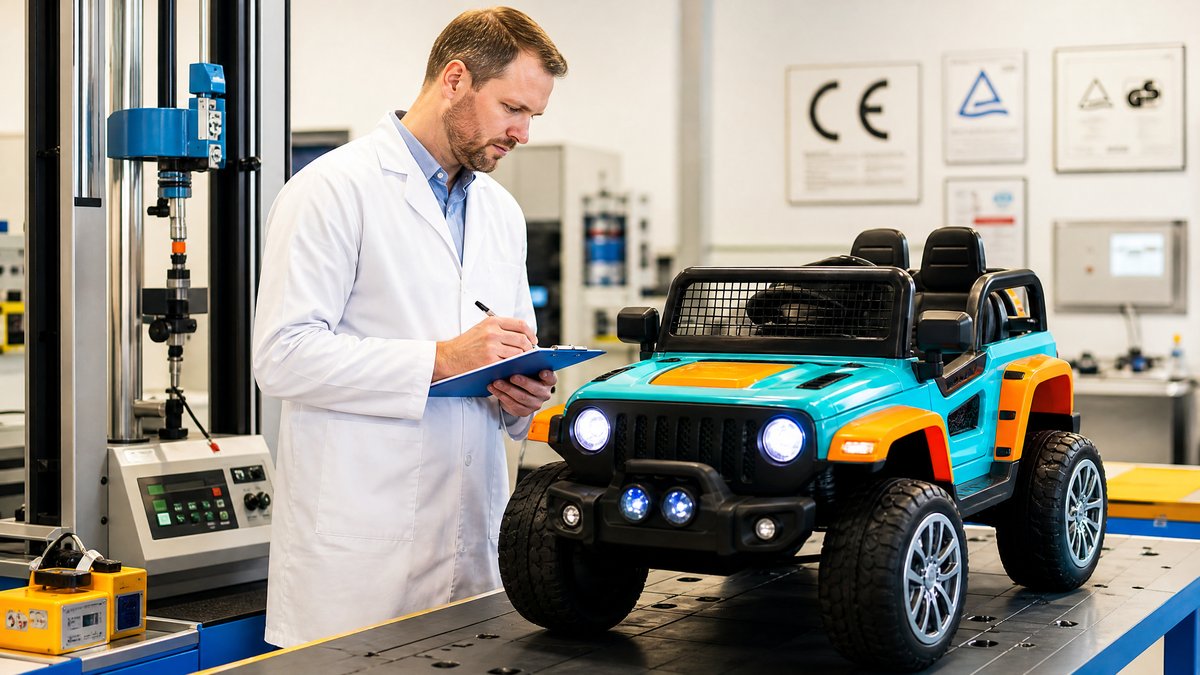
First read the manual to identify the correct control mode and any warnings. Check wheel attachment, battery connection and tire condition. With no child in the vehicle, operate the unit at the lowest available setting and observe how it responds when the pedal is released or the documented stop control is used.
If the model includes a parental remote, verify that the adult understands which button or mode is intended to halt movement. Do not assume that every remote has the same behavior. Some systems prioritize gradual motor release; others may use a dedicated stop command. Only the supplied manual and current vehicle specification should guide operation.
What Wholesale Buyers Should Specify
For a product range, request the factory's written explanation of drive and stop behavior. Include the check in a pre-shipment inspection: verify pedal release response, remote-control functions where supplied, wheel assembly and control labeling. The inspection should record whether functions match the approved sample and user manual, rather than making unsupported claims about universal stopping distance.
For OEM projects, ensure packaging and instructions clearly state recommended surfaces, age range, maximum load, charging guidance and supervision expectations. A product with clear documentation is easier for retailers to explain and easier for customers to use correctly.
Safety Checklist
- Read and retain the model-specific manual.
- Use the ride-on car only on a level, dry area unless the manufacturer explicitly permits other conditions.
- Inspect wheels, fasteners and controls before use.
- Keep an adult close enough to intervene.
- Do not rely on a remote as the only safety measure.
- Stop using the vehicle if control behavior changes and consult the supplier or service guidance.
FAQ
Is a remote stop button the same as a mechanical brake?
No. Remote-control functions depend on the product’s electronic system. Review the manual for the exact behavior of that model.
Can braking be tested on a hill?
Testing or using a ride-on car on slopes can introduce risks. Use only the conditions approved in the manufacturer’s instructions.
What should a factory inspection report include?
It should confirm that functional controls work as specified on the approved sample, that labels are present and that the manual corresponds to the supplied configuration.
Conclusion
The right way to assess ride-on car braking is to focus on documented, repeatable control behavior in safe conditions. Parents benefit from clear operating instructions, while B2B buyers benefit from treating stop functions as a defined quality-control point rather than an unsupported marketing claim.
Request Safety Documentation
Contact KidsRideCar for model-specific operation information, inspection checklists and OEM support for product manuals and warning labels.
Official references
Explore these external resources for current regulatory and trade guidance. Confirm requirements with the relevant authority before placing an order.
Ready to Start?
Factory-Direct · CE & ASTM Certified · MOQ from 50 Units
Our export team works with buyers in 60+ countries. Get a quote within 24 hours.
KR
Written by KidsRideCar
China's leading kids electric ride-on car manufacturer. 500,000+ units shipped annually to 60+ countries. CE, ASTM & EN71 certified.