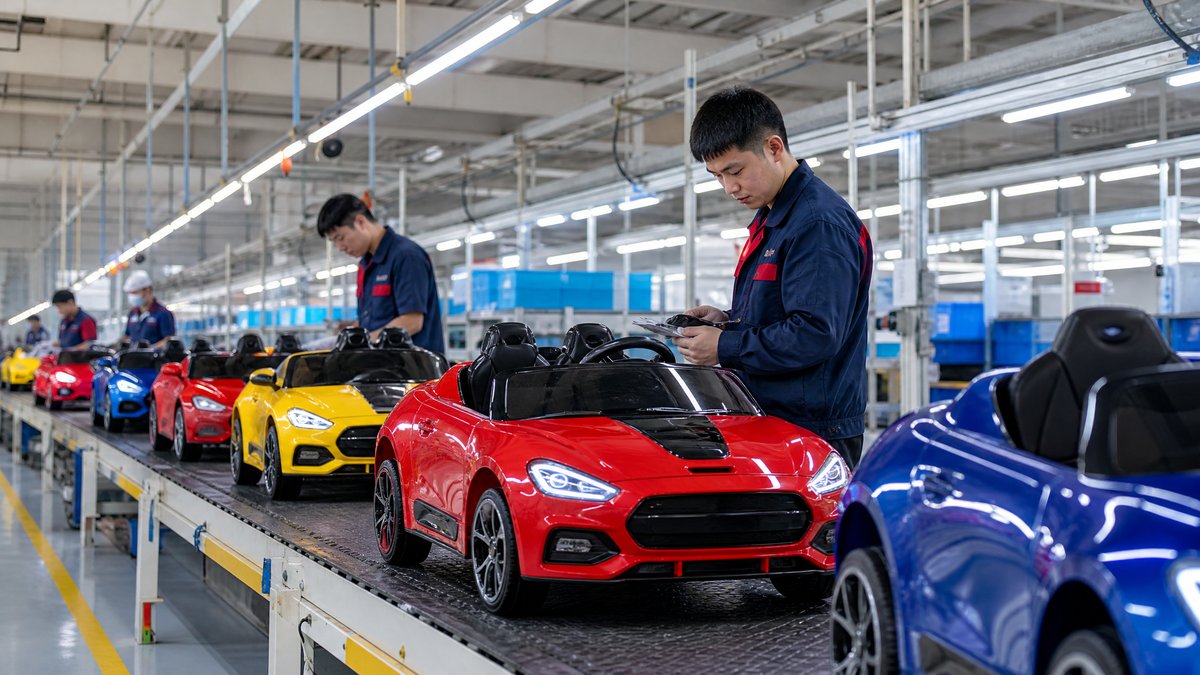
Buyers should use the external packed-carton dimensions, not the assembled vehicle size: multiply length × width × height, convert the result to cubic metres (CBM), then multiply by carton quantity. A 120 × 65 × 40 cm carton equals 0.312 CBM (120 × 65 × 40 ÷ 1,000,000). Use the supplier’s current packing specification, validate it against final packing, and record each SKU and carton revision separately. This supports more reliable freight, container, warehouse, and delivered-cost planning.
Start With the Right Dimensions
A ride-on car is commonly shipped partly disassembled, so assembled dimensions do not establish shipping cube. Ask for the outer dimensions of the sealed finished carton as length × width × height, and confirm the unit. Centimetres are common in packing lists; some freight systems use metres or inches.
Use the carton’s widest finished points. Do not substitute inner dimensions, a packaging drawing, or an older model’s figures. Changes to an accessory pack, protective inserts, or carton board can change dimensions and weight.
A useful RFQ or purchase-order data line is:
> SKU / revision | units per carton | outer carton L × W × H | gross weight | net weight | CBM per carton | carton count | total CBM
Request the information for every SKU, colour variation, or bundle that has different packing. This avoids applying one convenient figure across a mixed order when cartons are not identical.
Calculate CBM Step by Step
Use one consistent formula
When dimensions are in centimetres, calculate one-carton CBM as:
Length (cm) × Width (cm) × Height (cm) ÷ 1,000,000 = CBM per carton
When dimensions are already in metres, multiply the three figures directly:
Length (m) × Width (m) × Height (m) = CBM per carton
For example, if one kids ride-on car carton measures 120 × 65 × 40 cm:
- 120 × 65 × 40 = 312,000 cubic centimetres
- 312,000 ÷ 1,000,000 = 0.312 CBM per carton
- For 180 cartons: 0.312 × 180 = 56.16 CBM total
Keep more decimal places in the working file, then apply the rounding convention used by the freight forwarder or supplier only in the relevant quote. Premature rounding across many cartons can make an order look smaller or larger than it is.
Separate units, cartons, and order totals
A carton may contain one vehicle, but that should be confirmed rather than assumed. If two units are packed in one carton, the CBM is still calculated per carton first; the number of cartons is then determined from the ordered units divided by units per carton. Round any partial carton according to the agreed order and packing arrangement.
For a mixed order, calculate each SKU separately and add the totals:
| SKU | Carton size (cm) | Cartons | CBM/carton | Subtotal CBM |
|---|---|---|---|---|
| Model A | 120 × 65 × 40 | 180 | 0.312 | 56.160 |
| Model B | 110 × 60 × 38 | 60 | 0.251 | 15.048 |
| Order total | — | 240 | — | 71.208 |
The example is an illustration, not a loading guarantee. Actual usable capacity can depend on carton orientation, stacking limits, loading method, other cargo, and operational requirements.
Convert Carton Cube Into Procurement Decisions
CBM is a planning input, not the whole freight calculation. Send forwarders the full packing list so they can consider route, mode, weight, handling, and current tariff rules. Chargeable-volume rules can differ from physical CBM. Before comparing offers, ask which basis, minimum charge, rounding increment, and surcharges apply.
For container planning, compare total CBM with the logistics provider’s stated usable capacity, then allow for imperfect carton fit and any stacking, payload, or weight-distribution limits. Do not promise a container fit until the factory and logistics provider review final carton data and the loading plan.
For LCL shipments, carton volume helps compare consolidation choices and estimate landed cost. It also informs warehouse-space and channel decisions: a lower purchase price can still lead to a higher delivered cost when packaging uses more cube.
Verify Supplier Data Before You Commit
Ask for a dated packing specification for the approved production version. Compare carton dimensions, weights, units per carton, and accessories with the quotation, pro forma invoice, and purchase order. A product photo is not adequate documentation.
Before final freight booking, confirm the figures against a production sample, packing trial, or inspection record. If final cartons differ from the freight-budget figures, update the cube calculation, logistics plan, and channel pricing before shipment approval.
Questions that improve the packing brief
Include these questions in supplier communication:
- Are the stated measurements external finished-carton dimensions, and what unit is used?
- Does the figure apply to the exact approved SKU, colour, voltage configuration, and accessory set?
- How many saleable units are in each carton?
- What are the net and gross weights per carton?
- Can cartons be oriented or stacked only in a specified way?
- Has packaging changed since the last quote or sample?
For OEM work, treat packing changes as controlled product changes. Record revised dimensions, the effective date, and updated CBM in writing.
Build a Reusable Carton-Volume Worksheet
A simple spreadsheet makes repeat purchasing faster. Use a row for each distinct carton: supplier, SKU, revision, dimensions, unit, units per carton, weight, carton count, CBM per carton, total CBM, source, and verification date. Retain both the supplier figure and your calculation. If they differ, seek clarification; an entry error is magnified across a wholesale order. Store the approved packing list with the shipment file.
Need help preparing an SKU-by-SKU packing data request? Email KidsRideCar with your target market and planned assortment.
FAQ
Is CBM the same as freight chargeable volume?
Not always. CBM is physical volume, while a quote may use its own chargeable-volume conversion, minimum charge, rounding, and fees. Give the forwarder dimensions and weights, and request the quote basis in writing.
Should buyers use internal or external carton dimensions?
Use external finished-carton dimensions for transport and storage planning. Inner dimensions can be useful for package engineering, but they do not represent the cube occupied by the packed carton in a shipment or warehouse.
How often should carton volume be reconfirmed?
Reconfirm it when a model, accessory bundle, packaging design, carton material, or production revision changes, and before major orders or freight bookings if data is old.
Can a buyer calculate how many cartons fit in a container from CBM alone?
CBM is only an initial estimate. It cannot show carton fit, permitted orientation, stacking limits, or payload and weight distribution. Obtain a final loading review using current carton specifications.
Does carton size affect retail and compliance preparation?
Yes. Carton dimensions affect storage, e-commerce fulfilment, freight, and handling. Packaging artwork, warnings, labels, manuals, and product requirements can be destination-specific. Verify current destination-market requirements and obtain appropriate documentation before placing goods on the market. Where safety or age grading information is used, follow manufacturer instructions and communicate adult-supervision boundaries.
For a packing-list template or a review of the data needed for a freight inquiry, contact KidsRideCar by email.
Conclusion
To calculate carton volume for kids ride-on cars, multiply the external carton length, width, and height, convert the result to CBM, and total it by the actual carton count for each SKU. The arithmetic is straightforward; reliable procurement depends on using current, approved packing data and checking it against final production. Pair the CBM worksheet with carton weights, packing revisions, and a logistics review to make freight budgets, container decisions, warehouse plans, and wholesale pricing more dependable.
Official references
Explore these external resources for current regulatory and trade guidance. Confirm requirements with the relevant authority before placing an order.
Ready to Start?
Factory-Direct · CE & ASTM Certified · MOQ from 50 Units
Our export team works with buyers in 60+ countries. Get a quote within 24 hours.
KR
Written by KidsRideCar
China's leading kids electric ride-on car manufacturer. 500,000+ units shipped annually to 60+ countries. CE, ASTM & EN71 certified.