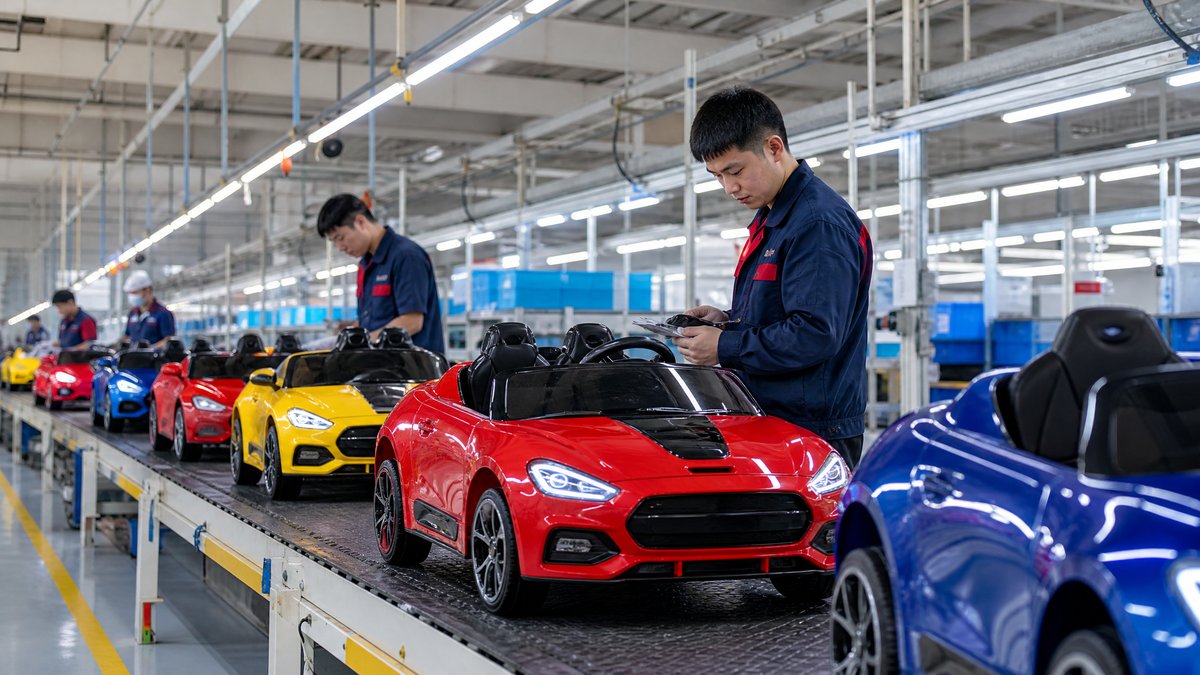
Importers should build a kids ride-on car demand forecast from SKU-level sales evidence, current channel commitments, available inventory, seasonal timing, and the realistic time needed to receive and launch an order. Build a clear baseline, separate solid demand signals from assumptions, and test the result before a purchase order is released.
For a bulky, assortment-driven category, the forecast must link sales expectations to carton volume, supply timing, compliance readiness, and replenishment ability.
Define the Buying Decision First
Set the scope before compiling numbers. A forecast for an initial launch, a replenishment order, or a full season is not the same decision. Record these points for each cycle:
- Coverage period: when incoming units must be available for sale.
- Sales channels: every channel drawing from the same inventory.
- Planning level: SKU, color, configuration, and carton version where relevant.
- Unit measure: sellable units first, then cartons and loading requirements.
- Data cut-off: the date of the information used.
This prevents a common error: using strong category sales to justify a large buy of one model, color, or configuration with no comparable demand history.
Build an Evidence-Based Baseline
Clean historical sell-through before averaging it
Where prior sales exist, begin with fulfilled or invoiced units by SKU and by week or month. Flag events that distort normal demand, including clearance, a one-off bulk order, cancellations, or an out-of-stock period. A zero-sales week may represent unavailable product rather than no interest.
Calculate a run rate from comparable periods. Give recent sales more weight if price, assortment, or channel mix has changed. For a new SKU, use a close analogue with a similar price position, size, target age range, and channel; do not assume a new design will match a previous bestseller.
Separate commitments from sales ambition
Add current evidence to the baseline, but do not value all evidence equally. A paid retailer order, signed allocation, or qualified preorder is stronger than an enquiry or general market-trend claim.
| Demand bucket | Evidence | Planning approach |
|---|---|---|
| Committed | Paid order, contract, or written allocation | Include the documented quantity, subject to agreed terms |
| Probable | Qualified pipeline or funded launch activity | Include only a share supported by your conversion history |
| Uncertain | General interest or unqualified leads | Use for an upside scenario, not the base order |
This distinction prevents an optimistic launch target from becoming an irreversible inventory commitment.
Map Demand to the Real Supply Window
Demand can change around gift-giving periods, weather, and retailer promotional calendars, but the pattern varies by destination and channel. Use your own monthly history where available. For a new market, plan cautiously and validate early results rather than applying another market’s pattern without adjustment.
Work backward from the date stock must be ready for sale. Allow for production, quality review, booking, transit, destination handling, customs clearance, warehouse receiving, and listing or retailer setup. Confirm current timing with the supplier and logistics providers instead of relying on an old quote or generic estimate.
Use an arrival range rather than one assumed arrival day. If missing the selling window would cause a serious problem, discuss an earlier release date, a smaller first commitment, or split shipments. The appropriate choice depends on cash flow, storage capacity, supplier terms, and replenishment ability.
Convert the Forecast Into an Order Quantity
For each SKU, use a transparent calculation:
> Suggested order = forecast demand during the coverage period + target buffer stock − usable inventory − confirmed inbound units
Usable inventory should exclude damaged, reserved, aged, or channel-restricted units. Reconsider inbound units if delivery status is uncertain. A buffer is not a standard percentage: it should reflect forecast uncertainty, replenishment time, margin exposure, and the cost of being out of stock.
Test three views before committing:
1. Conservative: lower conversion or slower sell-through; identifies downside exposure.
2. Base: the outcome best supported by current evidence.
3. Upside: stronger campaign or seasonal demand; prepares options, not an automatic larger order.
Do not select the upside quantity merely to improve loading efficiency or reduce a quoted unit cost. Compare storage, financing, potential markdowns, and the margin impact of a stockout. In a mixed load, protect proven core SKUs first and limit exposure on unproven variants.
Stress-Test the SKU Mix Before Releasing the PO
A sensible total can still be a poor order when the mix is wrong. Review each SKU’s expected channel, price band, color, packaging, and compatible replacement-parts requirements. Closely check the few SKUs that make up most forecast units; one weak high-volume assumption can alter the order materially.
Then test the plan against operational constraints:
- Can the warehouse safely receive and store the proposed carton volume?
- Does the mix cover retailer commitments without locking all inventory into one channel?
- Are product data, manuals, labels, and approved packaging ready for the destination market?
- Has the buyer verified current destination-market product, battery, transport, labeling, and import requirements?
- Can the supplier produce the approved specification and quantity in the required window?
Forecasting supports procurement; it does not replace sample approval, quality controls, a detailed purchase order, or destination-market verification.
> Planning a new order window? Share your target market, SKU list, and required arrival period with KidsRideCar to discuss available product information and ordering considerations.
Use a Short Review Cycle and Learn From Variance
Assign one forecast owner, while involving sales, purchasing, finance, operations, and customer service. In a short recurring review, track forecast versus actual units, stockouts, cancellations, inbound delays, returns patterns, and aged inventory by SKU.
After the selling period, record material variances—unavailable stock, late delivery, a promotion, incorrect listing content, or a poor demand assumption—and apply the lesson to the next cycle. Retain the approved forecast and identify later revisions separately.
FAQ
How much sales history is enough to forecast a ride-on car SKU?
There is no universal minimum. A comparable seasonal cycle is valuable, but shorter history can inform a forecast when its limitations are clear. Combine it with current inventory, confirmed demand, and a close analogue. Do not treat a brief launch spike or clearance period as normal demand.
Should buyers forecast by model or by the whole category?
Use both levels. Category demand informs budget and capacity planning, while SKU forecasting protects the product mix. Forecast by SKU whenever color, configuration, price, carton, or channel allocation can change the inventory decision.
How can a new importer forecast without sales history?
Start with a narrower assortment and a conservative base case. Use documented commitments and realistic channel capacity, then test the quantity against storage and working-capital limits. A measurable first order creates evidence for the next buy; unvalidated interest is not confirmed demand.
Is a larger order always better if the unit cost is lower?
No. A lower unit cost may be outweighed by financing, storage, discounting, and aged-stock risk if sell-through is slow. Compare the complete commercial result of each option, including the ability to replenish if demand is stronger than planned.
When should the forecast be updated before issuing a purchase order?
Update it when material evidence changes, such as a retailer commitment, stockout, supply delay, or revised launch plan. Complete a final cross-functional review immediately before release, then save that version so the team can assess its assumptions later.
Conclusion
A useful kids ride-on car demand forecast is SKU-specific, evidence-based, and explicit about uncertainty. Build a clean baseline, distinguish commitments from weaker signals, work backward from the required selling window, and review conservative, base, and upside outcomes. Only then convert demand into an order after accounting for usable stock, inbound units, supply capacity, compliance readiness, cash, and warehouse limits.
This process will not remove uncertainty, but it gives every purchase quantity a clear commercial rationale and makes future orders easier to improve. For a supplier discussion aligned to your planned order window, contact KidsRideCar.
Official references
Explore these external resources for current regulatory and trade guidance. Confirm requirements with the relevant authority before placing an order.
Ready to Start?
Factory-Direct · CE & ASTM Certified · MOQ from 50 Units
Our export team works with buyers in 60+ countries. Get a quote within 24 hours.
KR
Written by KidsRideCar
China's leading kids electric ride-on car manufacturer. 500,000+ units shipped annually to 60+ countries. CE, ASTM & EN71 certified.