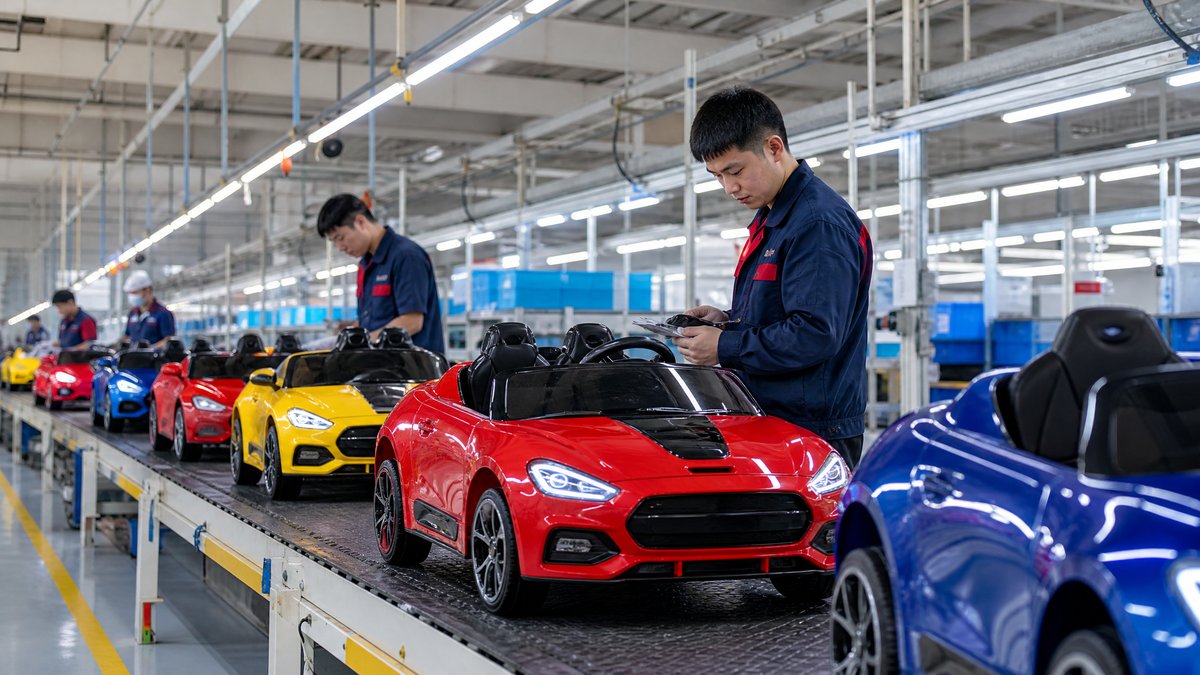
Retailers should build a kids electric ride-on car assortment around verified age-fit and use conditions first, then use voltage, body style, seating, and price architecture to create choice. Do not treat 6V, 12V, or 24V as a universal age ladder: the selected model’s stated age range, maximum user weight, controls, battery/charger system, instructions, warnings, and destination-market requirements determine whether it is appropriate to list and sell.
For importers, wholesalers, distributors, and retailers, the practical goal is a balanced, easy-to-explain range: an entry offer for supervised younger users, a broad core range for mainstream family demand, and selective larger or more feature-led models for shoppers who need more room, a different body style, or a higher-specification proposition. Every SKU should pass a model-specific compliance and usability screen before the purchase order—not merely fit a voltage label.
> Assortment rule: Stock age-fit *bands*, not assumptions. Merchandise each vehicle against the manufacturer’s verified labeling and documentation, then teach consumers how adult supervision, surface choice, charging, and rider fit affect safe use.
Start With Age-Fit Screening, Not Voltage
A responsible range begins with a SKU review sheet. Age is only one field. The retailer should document the model’s intended age grade and compare it with the physical fit, control complexity, seating arrangement, and selling market.
For U.S. toy sales, the Consumer Product Safety Commission (CPSC) notes that battery-operated toys have requirements that can include battery accessibility, labeling, overheating, and supplied chargers; it also identifies age grading and instructional literature as relevant labeling/instruction areas.[^cpsc-toy-safety] This is a useful reminder that an assortment decision is not just a styling or power decision. Requirements vary by jurisdiction and product configuration.
The model-level age-fit screen
Before approving a vehicle, request and retain the selected model’s current documentation. Confirm the following with the supplier, testing body where applicable, and your destination-market compliance adviser or regulator:
1. Manufacturer-stated intended age range and warnings — Use the exact, current model documentation. Do not broaden an age range in product copy because a comparable-looking model has a wider range.
2. Maximum user weight and real rider fit — Check seat width/depth, footwell reach, pedal reach, steering reach, head clearance where relevant, and whether a child can enter and exit as intended. These are model-specific checks.
3. Controls and supervision features — Identify the available operating modes, any parental remote-control function, start/stop behavior, speed-selection settings, and instructions for adult supervision. Never market a feature that is not verified for that exact SKU.
4. Seating and occupancy — Count only the designed seats. A two-seat body does not automatically mean two riders may use it together; confirm the label, combined weight limit, instructions, and intended use.
5. Battery, charger, and access protection — Verify the battery chemistry, voltage, capacity specification, charger match, battery-compartment construction, supplied warnings, and charging instructions for the exact configuration.
6. Market documentation and traceability — Check required test reports, declarations, markings, warnings, importer/distributor information, packaging, and instructions for the destination. Keep version control so the documents match the production model.
In Great Britain, official guidance says toy safety must consider intended and foreseeable use, the ability of users and—where appropriate—supervisors, as well as specified age groups. It also describes importer and distributor duties, including checking certain information, markings, and safety instructions.[^gb-toy-safety] Buyers selling elsewhere should consult the corresponding local authority or qualified compliance professional rather than assuming GB, EU, U.S., or any other market rules are interchangeable.
Use merchandising bands—not universal age claims
A retailer can organize its navigation and buying guide around developmental shopping needs while preserving model-specific labels:
- First ride-on / younger-child band: Prioritize compact proportions, simple operation, clear adult-supervision messaging, and models whose verified labeling supports this positioning.
- Core family band: Build the widest choice here, with familiar car, SUV, truck, or themed forms, practical feature differentiation, and clear single- versus two-seat explanations.
- Older/taller-child and feature-upgrade band: Use selected larger-format, roomier, or more feature-led models only where the manufacturer’s stated age/weight/rider-fit information supports it. Explain that adult supervision remains part of intended use where the instructions require it.
These bands are a retail planning framework, not a substitute for the product’s official age grade. On every product page, display the exact age and weight information supplied for the selected model, together with key warnings and instructions.
Position 6V, 12V, and 24V as Model-Dependent Configurations
Voltage is a useful filter for a buying conversation, but it is not a safety rating, an age rating, or a universal proxy for speed, ride time, hill ability, torque, or product quality. Motor setup, controller, gearing, wheel material, load, battery condition, surface, temperature, and software/settings can all affect the user experience. Never promise exact performance without the selected model’s verified specifications.
A buyer-facing voltage positioning table
| Assortment position | How 6V, 12V, or 24V may be discussed | What the listing and buying team must verify | Retail use case |
|---|---|---|---|
| Entry / compact | A 6V configuration may appear in smaller, simpler ride-on formats. | Exact intended age and weight range; rider fit; battery and charger details; seat count; instructions; market documentation. | A tightly curated entry option where model labeling and supervision guidance support it. |
| Core / broad choice | A 12V configuration is commonly used across many ride-on styles, but it is not inherently “standard” or suitable for every child. | The complete configuration, control modes, charger, use warnings, and model-specific age/weight information. | The main comparison set across popular single-seat cars, SUVs, trucks, or specialty bodies. |
| Upgrade / selected larger formats | A 24V configuration may be offered on selected models. It should be explained by the complete vehicle design—not as an automatic step-up for every child. | Whether the exact model’s rider fit, operating instructions, supervision guidance, controls, component specification, and market requirements support the intended positioning. | A selective upgrade tier for shoppers who want a particular compatible body style, size, seating design, or feature package. |
Merchandising language that reduces confusion: “Compare the complete vehicle specification, stated age/weight limits, seating, controls, and included charger—not voltage alone.”
For a deeper side-by-side purchasing framework, link shoppers and trade buyers to KidsRideCar’s existing guide: [12V vs 24V Kids Electric Ride-On Cars: Which Should You Stock?](/blog/12v-vs-24v-kids-electric-ride-on-cars-wholesale-comparison). The final choice still requires verification against the exact SKU and destination market.
What not to say
Avoid generic statements such as “24V is for older kids,” “12V is safe for every child,” or “higher voltage means faster.” Those claims can be misleading when model design and controls differ. Instead, publish the exact approved specifications and direct customers to the model instructions and warnings.
Build Choice Through Body Styles and Seating
Body style helps a buyer understand the vehicle’s purpose and shelf appeal. It should be planned alongside physical size, rider access, storage footprint, packaging, and after-sales parts—not independently from age fit.
Create a body-style ladder
A balanced range often includes a controlled selection from the categories below. The right mix depends on local demand, channel strategy, available warehouse space, and supplier capability.
| Body style | Buyer appeal | Assortment role | Questions to settle before stocking |
|---|---|---|---|
| Sport car / coupe | Compact, aspirational, giftable visual appeal | A recognizable single-seat or compact anchor, subject to the model’s approved rider-fit data | Is entry/exit practical? Does the selected model’s age/weight guidance support the intended placement? |
| SUV / off-road-inspired vehicle | Larger visual presence and outdoor-play association | A versatile core option; do not imply off-road capability beyond the verified instructions | What surfaces are permitted? What do the tires, controls, warnings, and manual actually specify? |
| Pickup / utility truck | Rugged styling and cargo-play appeal | A differentiator in the core or upgrade tier | Is the cargo area decorative or load-rated? What are the intended occupancy and total weight limits? |
| Luxury / licensed-look cruiser | Premium visual merchandising | A selective trade-up option based on validated features and brand rights, if applicable | Is every claimed feature and any licensing representation documented for the precise SKU? |
| Motorcycle / kart / specialty vehicle | A distinct riding posture or play theme | A specialist SKU rather than an automatic substitute for a car | Is the balance, protective-equipment guidance, age fit, and intended use clearly understood? |
| Service / role-play vehicle | Themed play and seasonal promotion potential | A small differentiator to prevent a car-only lineup | Are lights, sounds, tools, and accessories all correctly described and compliant for the market? |
A useful internal-link suggestion for retailers comparing formats is [What Is the Difference Between a Ride-On Car and a Go Kart?](/blog/what-is-the-difference-between-a-ride-on-car-and-a-go-kart). Use it as a category-education link, not as a replacement for each model’s instructions.
Seat count is a safety, space, and expectation decision
Single-seat models can be easier to merchandise as a clear personal-ride option. Two-seat or wider-cabin designs may attract families shopping for shared play, but they require especially careful copy:
- State the manufacturer’s permitted occupancy exactly.
- Show the model’s total weight limit—not an estimate based on two children.
- Do not assume that a second seat, decorative bench, or wide cabin authorizes two simultaneous riders.
- Confirm whether all controls, restraint elements if included, and supervision instructions apply equally to the advertised use.
- Consider carton size, showroom space, and delivery damage risk, since larger bodies can change logistics and return handling.
This clarity helps reduce the common mismatch between a buyer’s expectation of “two seats” and the vehicle’s official intended-use information.
Make Supervision Part of the Product Story
Retailers should treat supervision as a use condition, not a footnote. Product pages, carton copy, sales training, and post-purchase messages should direct adults to read and follow the supplied instructions and warnings.
Where present on a specific model, describe parental remote-control functions, speed settings, or other controls accurately. Do not imply that a remote-control function eliminates the need for adult supervision, or that any feature guarantees safety. Recommended use surfaces, weather limitations, proximity to traffic, slopes, water, stairs, pools, and charging locations must follow the selected model’s manual and the applicable local guidance.
A practical product-page block may include:
> Before use: Confirm the rider fits the model’s stated age and weight limits. An adult should read the supplied instructions and warnings, supervise use as directed, select an appropriate area, and use only the supplied or approved charging arrangement.
That is general operational guidance, not a legal conclusion. Destination-market warning, instruction, and labeling requirements must be verified for the selected model and market.
Plan a Balanced SKU Mix Instead of Buying Every Variant
A strong assortment offers meaningful choice without multiplying slow-moving near-duplicates. Start with the demand you can serve—then add SKU depth only when it improves a customer decision.
A practical balanced-mix blueprint
Rather than prescribing a fixed percentage split, use the following portfolio roles:
1. Entry anchors: A limited number of compact, clearly age-fit models with simple product-page explanations.
2. Core volume models: The largest group. Cover the body styles and features most relevant to your customers, with clear distinctions rather than cosmetic duplication.
3. Trade-up models: Select larger, roomier, premium-looking, or feature-led vehicles whose documentation supports their positioning.
4. Specialty differentiators: A small number of motorcycles, karts, service vehicles, or other themed designs that broaden discovery without fragmenting inventory.
5. Continuity and service SKUs: Approved chargers, replacement parts, and packaging/service processes that support the models you carry, where available and market-appropriate.
A retailer with limited space may begin with one or two verified options in each role instead of a broad catalog. Use sales data, customer questions, returns, and service requests to refine the mix; do not expand only because a supplier offers many color or body variants.
Assortment approval checklist
| Checkpoint | Questions for the buyer | Evidence to collect |
|---|---|---|
| Age-fit | Does the official age grade, weight limit, rider fit, and intended use support the assigned assortment band? | Current model manual, labeling artwork, specification sheet, and approved product copy. |
| Electrical configuration | Are battery, charger, voltage, and component details confirmed for the exact production configuration? | Current specification, battery/charger documentation, and model-specific test/compliance records where required. |
| Seating | Is occupancy represented exactly as the manufacturer permits? | Instructions, labeling, seat/weight information, and product imagery matching the final SKU. |
| Controls and supervision | Are control functions and supervision wording accurate and not overstated? | Manual, operating instructions, product demonstration/approval materials, and warnings. |
| Destination market | Are required safety, conformity, labeling, language, importer/distributor, and traceability obligations checked? | Market-specific compliance file, declarations/certificates where applicable, label and packaging approval. |
| Logistics | Are battery shipment classification, packaging, carton dimensions, and carrier rules verified? | Battery transport documentation, packaging specification, and forwarder/carrier confirmation. |
| After-sales | Can the team support common replacement/service needs for this exact model? | Spare-parts list, service procedure, warranty/returns policy, and supplier escalation contact. |
For pre-shipment process guidance, an appropriate internal link is [Quality Inspection for Kids Electric Ride-On Cars: A Buyer’s Guide to Pre-Shipment Checks in China](/blog/kids-electric-ride-on-car-quality-inspection-guide-china).
Verify Battery Transport and Market Requirements Before You Commit
Battery transport is configuration- and route-dependent. Do not assume a battery can move by sea, air, courier, or in equipment under the same documents or packing method as another SKU. IATA explains that lithium battery air carriage depends on configuration and rating, and that shippers must understand applicable identification, packing, marking, labeling, and documentation requirements.[^iata-batteries] Requirements can also change, and carriers or forwarders may impose conditions.
Before booking or importing, have the selected model’s battery type, test/report status where required, classification, packing configuration, and route-specific rules reviewed with your freight forwarder/carrier and relevant regulatory resources. Verify whether the vehicle is shipped with a battery installed, packed with equipment, separately, or under another arrangement. Battery transport rules and destination-market requirements must be verified for the selected model and destination market.
For EU-focused trade teams, [EU Toy Safety Directive & EN 71: What Every Importer of Kids Electric Ride-On Cars Needs to Know](/blog/eu-toy-safety-directive-en71-kids-electric-ride-on-cars-importers-guide) is a relevant internal starting point. It is educational content; complete your own current, product-specific compliance review before placing goods on the market.
> Need an assortment review? Send your target market, channel, planned age bands, and desired body styles to info@kidsridecar.com. Ask for current model sheets, instructions, seating/weight information, battery and charger details, and documentation relevant to your destination market.
Create Product Pages That Help a Buyer Choose Correctly
A clear retail page reduces avoidable returns and makes staff conversations more consistent. Lead with the model’s official age/weight guidance and intended seating, then show body style, controls, battery/charger configuration, included items, dimensions, and current warnings/instructions.
Recommended comparison filters
Use filters that describe verified facts:
- Official stated age range
- Maximum user weight or combined permitted load, where supplied
- Seating / permitted occupancy
- Body style
- Battery configuration (6V, 12V, 24V, or other exact model specification)
- Charging arrangement and supplied charger, where verified
- Control features actually present on the SKU
- Dimensions/carton information for trade buyers
Avoid filter names that imply unverified outcomes—such as “fastest,” “best for hills,” “safest,” or “for any age.” If your platform supports it, put a prominent “read instructions and warnings” link near the purchase decision, not only in a downloadable manual.
FAQ: Kids Electric Ride-On Car Assortment by Age
1. Is 24V automatically for older children?
No. Voltage alone does not establish age suitability. Assess the exact model’s official age grade, maximum user weight, physical fit, controls, operating instructions, warnings, and destination-market requirements. A 24V configuration should be positioned only according to those verified details.
2. Should a retailer stock 6V, 12V, and 24V models?
Not necessarily. Choose configurations that create clear customer choices in your market. A smaller retailer may operate effectively with a focused range if it covers verified entry, core, and trade-up needs. Avoid stocking a voltage merely to complete a numeric ladder.
3. Can we describe a two-seat ride-on as suitable for two children?
Only if the selected model’s official labeling and instructions permit that use and the combined load remains within its stated limit. A wide body or two visible seats is not enough evidence on its own.
4. How should we present parental remote control?
Describe it only when it is included in the exact SKU, and follow the manufacturer’s terminology and instructions. It should not be promoted as removing the need for adult supervision or as a guarantee of safety.
5. What documents should an importer request before placing an order?
At minimum, request current model-specific specifications, age/weight and seating information, instructions and warnings, battery/charger details, packaging artwork, relevant declarations/test documentation, and traceability information required for the destination. The exact documentation depends on the product and market; verify it with the relevant authority or qualified adviser.
6. Do battery shipping rules stay the same for every ride-on car?
No. Transport treatment can depend on battery chemistry, rating, configuration, packing, route, transport mode, and carrier requirements. Confirm the selected model’s battery transport documents and shipment arrangement with an appropriate freight forwarder or carrier before booking.[^iata-batteries]
Conclusion
The best kids electric ride-on car assortment is not the one with the most variants or the highest voltage labels. It is a model-verified portfolio that gives customers understandable options by rider fit, intended age range, seating, body style, controls, and supervision needs—while keeping compliance, battery transport, and after-sales planning visible from the start.
Build the range in layers: focused entry choices, a strong core of differentiated body styles, carefully screened trade-up models, and a small set of specialty products. Keep every age, seating, battery, and performance statement tied to the exact model documentation. Before ordering or listing, verify specifications, battery transport rules, and market requirements for the selected model and destination market.
Ready to map a focused wholesale assortment? Contact info@kidsridecar.com with your market, retail channel, projected volume, age bands, and body-style brief.
Image Planning
| Image | Suggested dimensions | Placement | English caption | Alt text | English AI prompt |
|---|---|---|---|---|---|
| 1. Age-fit assortment overview | 1600 × 900 px | Below the introduction | “Build the range around verified age fit, seating, supervision, and model documentation—not voltage alone.” | “Retail shelf display of kids electric ride-on cars grouped by compact, core, and larger model categories with adult buyer reviewing specification cards.” | “Photorealistic B2B retail showroom scene, diverse unbranded kids electric ride-on cars arranged in three clearly separated size and body-style groups, adult retail buyer reviewing neutral specification cards, bright professional lighting, clean white and soft blue palette, no logos, no text overlays, wide 16:9 composition.” |
| 2. Model-screening checklist | 1200 × 1200 px | In the “Start With Age-Fit Screening” section | “A model-level screen connects rider fit, occupancy, controls, instructions, and market documentation.” | “Flat-lay of a ride-on car specification sheet, instruction manual, battery charger label, measuring tape, and retailer checklist.” | “High-end editorial flat lay for a B2B toy sourcing article: generic children’s electric ride-on car specification sheet, instruction booklet, battery charger label, seating diagram, measuring tape and clipboard checklist, no readable brand names, realistic paper and product textures, balanced square composition, no text overlays.” |
| 3. Body style and seating comparison | 1600 × 1000 px | After the body-style table | “Body style creates choice; seating must always follow the selected model’s approved occupancy and load information.” | “Unbranded single-seat sport ride-on car, SUV ride-on, pickup ride-on, and wider two-seat-style ride-on displayed side by side.” | “Photorealistic studio lineup of four unbranded children’s electric ride-on vehicles: compact sport car, SUV, pickup truck, and wider two-seat-style vehicle, side-by-side on a clean light-gray background, accurate scale variation, no children riding, no logos or badges, premium catalog lighting, 8:5 composition.” |
| 4. Wholesale assortment planning | 1600 × 900 px | Before the conclusion | “A balanced SKU mix limits duplication while covering entry, core, trade-up, and specialty roles.” | “Wholesale buyer and product manager reviewing a category plan with miniature unbranded ride-on car models and inventory notes.” | “Photorealistic B2B planning meeting, two retail product managers at a table with small unbranded kids electric ride-on car samples, neutral category-planning board with colored blocks but no readable text, cartons in the background, professional daylight, no logos, wide 16:9 composition.” |
Official References
[^cpsc-toy-safety]: U.S. Consumer Product Safety Commission, “Toy Safety Business Guidance”. Verified for general U.S. toy-safety guidance on battery-operated toys, labeling, instructional literature, and certification context. Consult current, product-specific requirements before market placement.
[^gb-toy-safety]: UK Government, “Toys (Safety) Regulations 2011: Great Britain”. Verified for GB guidance on essential safety requirements and manufacturer, importer, and distributor obligations. This article does not provide legal advice.
[^iata-batteries]: International Air Transport Association, “Batteries”. Verified for general battery air-transport guidance and the need to consider configuration, rating, packing, marking, labeling, and documentation.
Official references
Explore these external resources for current regulatory and trade guidance. Confirm requirements with the relevant authority before placing an order.
Ready to Start?
Factory-Direct · CE & ASTM Certified · MOQ from 50 Units
Our export team works with buyers in 60+ countries. Get a quote within 24 hours.
KR
Written by KidsRideCar
China's leading kids electric ride-on car manufacturer. 500,000+ units shipped annually to 60+ countries. CE, ASTM & EN71 certified.