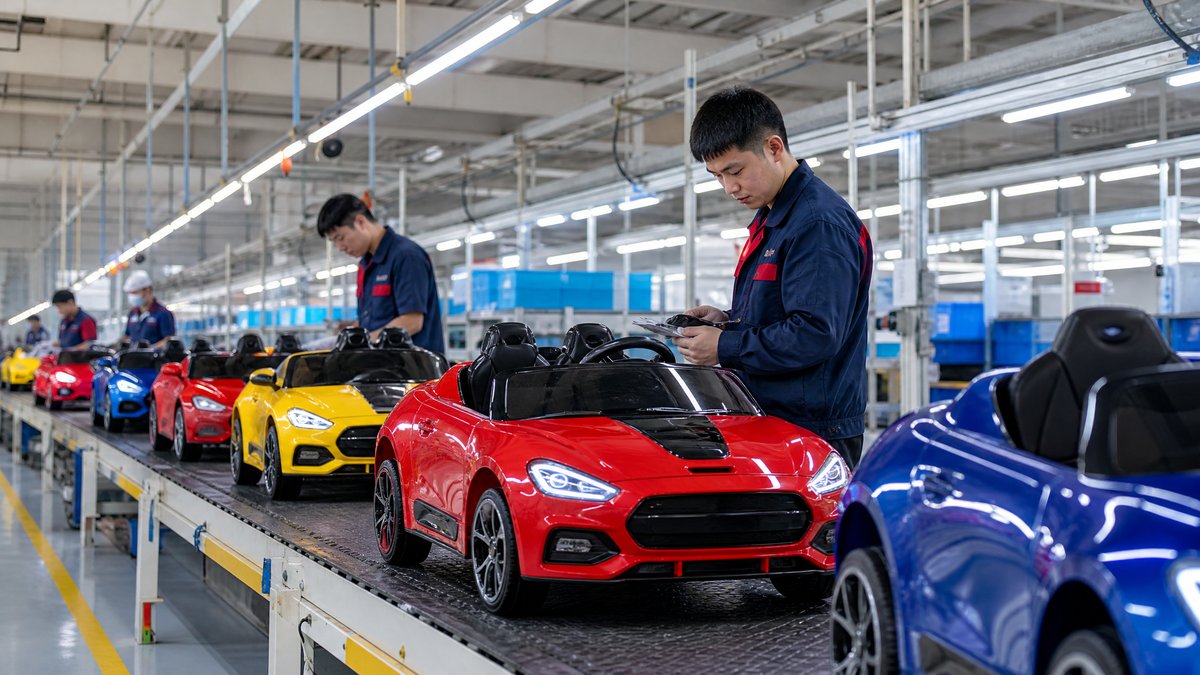
A minimum order quantity (MOQ) can decide whether a new ride-on car range is a manageable launch or an expensive inventory commitment. For distributors, the most productive negotiation is not simply asking a supplier to “lower the MOQ.” It is showing the supplier how a smaller initial commitment can still fit its production, packaging, component, and planning constraints.
> Concise answer: Distributors can negotiate ride-on car MOQ by separating the factory’s real constraints—model, color, packaging, components, and production run—then offering value in return. Standard specifications, a balanced model mix, a documented reorder plan, flexible packaging, and a phased purchasing agreement are usually stronger than a last-minute request for fewer units.
Start With the Supplier’s Definition of MOQ
“MOQ” is not always one number. A quote may have different minimums for a model, a color, a carton design, a battery configuration, a logo application, or the total production batch. If a buyer negotiates only the headline number, both sides may talk past each other.
Before requesting a reduction, ask the supplier to state the MOQ basis in writing:
- Is the minimum per model, per color, per carton artwork, or per purchase order?
- Does it change when the buyer requests a nonstandard battery, wheel, seat, remote, or accessory?
- Is the constraint related to molded parts, printed materials, component purchasing, line setup, or container loading?
- Which versions are currently standard production items and which require a separate run?
- Can multiple stock colors or compatible variants be counted together?
- What must remain unchanged for the supplier to accept a lower opening order?
The answers reveal where a supplier has room to move. For example, a factory may be unable to combine custom printed cartons but may accept a mixed assortment when the product configuration and plain export carton remain standard. Another supplier may be able to mix colors but not models that use different critical components. Neither outcome is a refusal; both identify the variable to negotiate.
Review the [KidsRideCar product range](/products/) first so your inquiry refers to specific models and configurations rather than a broad request for “popular cars.” A focused request reduces back-and-forth and makes an alternative MOQ proposal easier to evaluate.
Build a Negotiation Case Before You Ask
A lower MOQ is more credible when the buyer can explain how it will sell, how it will be handled, and what happens after the first order. Prepare a short internal brief before contacting a supplier.
Define the launch assortment
Choose a small, purposeful assortment rather than listing every available style. Identify the intended channel—specialty retail, online sales, wholesale resellers, showroom sales, or a combination—and the role of each proposed SKU. A distributor may need one entry-level option, one feature-led option, and one larger format rather than several near-identical models.
For every proposed SKU, document the desired color, retail packaging requirement, required market information, and whether branding is essential at launch. This helps distinguish a must-have requirement from a preference that can be traded for MOQ flexibility.
Know your non-negotiables
List the requirements that cannot be traded away: applicable product documentation, clear user information, agreed product specification, safe packaging expectations, and any essential brand or channel requirement. Then list variables that can be flexible: color allocation, carton artwork, model mix, accessories, or timing of a later phase.
That distinction protects the buyer from winning a lower MOQ by weakening the product brief. It also gives the supplier legitimate choices to propose.
Negotiate the MOQ as a Package of Trade-Offs
The strongest conversations exchange value rather than pressure the supplier for a unilateral concession. State the business objective, explain the reason for the opening quantity, and invite alternatives.
Use standard configurations where possible
A standard model in an existing color with existing components is generally easier to place into a supplier’s plan than a newly customized specification. Ask which selections are currently standard, but confirm the actual specification on the quotation and purchase order; “standard” should not be left as an undefined verbal term.
If your private-label program is important, consider whether it can be staged. The opening order may use a standard product and compliant neutral presentation where suitable for the target channel, while custom packaging or brand assets begin only when the agreed commercial threshold is reached. This must still meet your channel, labeling, and market obligations; it is not a reason to omit necessary information.
Consolidate volume across compatible SKUs
Ask whether the supplier can assess MOQ at a family or production-batch level. Compatible models, common colors, or common packaging formats may be easier to combine than unrelated items. Give the supplier a clear allocation proposal instead of asking vaguely for a mixed container.
Procurement example: A distributor wants several visual styles for a retail launch but cannot commit to a full standalone run of each color. Rather than demand that every color receive the same small allocation, the buyer asks the supplier which colors, variants, and cartons can be combined without a separate setup. The buyer then concentrates the launch order on those compatible choices and postpones the remaining color options. The result is a range with differentiation while avoiding unnecessary complexity.
Exchange flexibility for a phased commitment
A phased order can work when both parties can define it precisely. The first phase launches the core assortment. A second phase is conditional on an agreed review, subject to acceptable sample approval, commercial performance, and the supplier’s capacity at the time of confirmation.
Do not call a hoped-for reorder a commitment. If you want the supplier to make a concession based on future business, specify what can actually be promised: a forecast-sharing cadence, an option to reserve common components where feasible, or a planned quotation review. If a binding follow-on order is agreed, record its model, configuration, timing conditions, price basis, and consequences if circumstances change.
Compare the total commercial effect
A lower MOQ may carry a different unit price, packaging charge, component charge, or handling arrangement. Ask for each option to be quoted separately and compare the total impact on your landed-cost model, cash exposure, storage, expected after-sales support, and assortment strategy. Use the same product specification when comparing options; otherwise the apparent MOQ saving may hide a product change.
For a broader procurement checklist, see the [KidsRideCar blog](/blog/). Keep supplier quotations and subsequent revisions together so the negotiated version is traceable.
A Practical MOQ Conversation Sequence
Use a structured sequence instead of negotiating through scattered chat messages.
1. Send a concise request for quotation. Name the models, expected market, required configuration, packaging need, target order structure, and requested delivery terms. Ask the supplier to show MOQ by model, color, packaging, and total order where relevant.
2. Confirm the approved product basis. Resolve material differences, accessories, packaging contents, manual requirements, warnings, and branding scope before debating final quantities. MOQ is hard to negotiate when the product itself is still moving.
3. Ask for two or three workable scenarios. For example: standard configuration with mixed eligible colors; a reduced opening order with neutral cartons; or a full branded order at the supplier’s normal MOQ. This turns “no” into comparable options.
4. Make one evidence-based counterproposal. State the exact allocation you can support and the concession you offer in exchange. Do not keep changing quantity, colors, and artwork simultaneously without a clear revision record.
5. Confirm the final deal in the commercial documents. Transfer the agreed terms into the quotation, pro forma invoice, purchase order, and any applicable quality or packaging agreement.
What to Put in Writing When MOQ Changes
A lower MOQ approved in a message is not enough. The final documents should describe the deal so that a production team, warehouse, and accounts team can follow it without interpreting negotiation history.
Include at least:
- model name or code, product configuration, color, and quantity allocation;
- whether the MOQ exception applies only to this order or to future orders;
- carton type, carton artwork status, labels, and included accessories;
- approved sample or reference version and the process for proposed changes;
- unit price and every separately quoted charge, if any;
- the agreed payment and shipment terms;
- document, user-information, and packaging responsibilities for the intended market;
- quality review, pre-shipment inspection, and escalation contacts; and
- any forecast-sharing, reorder discussion, or phased-order language, clearly marked as binding or non-binding.
A written record is especially important if a sales representative grants an exception that must later be understood by production planning. Do not treat a screenshot as the only source of truth.
Use Different Tactics for Different Buyer Types
Importers and distributors launching a new range
Prioritize a narrow core assortment, standard components, and colors the supplier can combine. Offer a sensible review point after launch instead of attempting to customize every element before demand is known. The negotiation aim is a repeatable first transaction, not the maximum number of SKUs.
OEM and private-label buyers
Custom tooling, distinct components, unique molds, bespoke colors, and custom printed packaging often create real fixed costs and higher MOQ pressure. Ask the supplier to separate these drivers instead of treating “OEM MOQ” as one opaque figure. You may be able to phase branding, use common components, or approve one artwork format across a family of products. Protect brand consistency and product requirements; do not use MOQ negotiations to accept an unapproved substitution.
Safety and Compliance Must Not Be Bargaining Chips
MOQ flexibility should never be obtained by reducing safety controls, omitting required product information, accepting an unapproved component change, or bypassing the supplier’s quality process. Keep requirements model-neutral and tied to the actual product and destination market.
Ask for the correct product documents and warnings for your market, review the final configuration against the approved sample, and maintain clear traceability for components and packaging. For battery-powered products, follow the supplier’s supplied charging, storage, transport, and user instructions. Do not advise customers or staff to bypass protections, rewire, solder, open batteries, or perform internal repairs. Route faults to qualified service support and use supplier-approved replacement processes.
A lower MOQ that creates later safety, returns, or documentation problems is not a commercial win.
Common MOQ Negotiation Mistakes
- Overcommitting future orders. A promise that cannot be honored damages trust and weakens future negotiating power.
- Accepting a verbal exception. If it is not documented, it can be lost during handover.
- Treating MOQ as the only cost driver. Small orders may affect unit cost, packaging, freight efficiency, warehouse handling, and spare-parts planning.
- Trading away required safeguards. Product integrity, instructions, and agreed quality controls must remain intact.
Frequently Asked Questions
Can a distributor negotiate a lower MOQ for a first order?
Sometimes, yes. A supplier may consider a smaller opening order when the buyer selects standard configurations, compatible colors, simple packaging, and a credible process for reviewing replenishment. The supplier may also decline if the request would create a separate production run or uneconomic component purchase. Ask for alternatives rather than assuming there is only one acceptable answer.
Is a mixed-model order always the best way to reduce MOQ?
No. A mixed order helps only when the selected models, colors, components, and cartons are compatible with the supplier’s production plan. It can also complicate your warehouse and after-sales process. Request a written allocation and confirm which minimum applies to each element.
Should buyers accept a higher unit price for a lower MOQ?
It can be reasonable, but only after comparing the full commercial effect. Consider total cash tied up, storage, packaging, freight, potential markdown risk, product support, and the opportunity to learn from the launch. Ask for a transparent quote for each scenario and keep the product specification identical during comparison.
How should an OEM buyer negotiate MOQ without weakening the brand brief?
Break the brief into fixed and flexible elements. Keep essential product specifications, approved artwork controls, required information, and brand standards fixed. Explore flexibility in common components, the number of colors, packaging format, or the sequence in which customization is introduced. Record every approved deviation in the purchase documents.
What should a distributor do if the supplier will not reduce MOQ?
Do not force an unsuitable deal. Ask whether there is a standard model, compatible color, existing packaging format, or scheduled production run that better fits your opening order. You can also reconsider the launch assortment, postpone customization, or compare other qualified suppliers on an equivalent specification and service scope.
Conclusion: Negotiate for a Repeatable Purchase, Not Just a Smaller Number
Distributors negotiate MOQ most effectively when they understand the supplier’s operational constraints and offer a plan that reduces uncertainty on both sides. Define the MOQ basis, narrow the first assortment, trade flexibility deliberately, compare complete commercial scenarios, and document every exception.
The result should be more than a smaller first order. It should be a clear, safe, and commercially practical route to a replenishment relationship. To discuss a model mix, packaging approach, or distributor quotation, contact KidsRideCar by email or [send an inquiry](/inquiry).
Official references
Explore these external resources for current regulatory and trade guidance. Confirm requirements with the relevant authority before placing an order.
Ready to Start?
Factory-Direct · CE & ASTM Certified · MOQ from 50 Units
Our export team works with buyers in 60+ countries. Get a quote within 24 hours.
KR
Written by KidsRideCar
China's leading kids electric ride-on car manufacturer. 500,000+ units shipped annually to 60+ countries. CE, ASTM & EN71 certified.