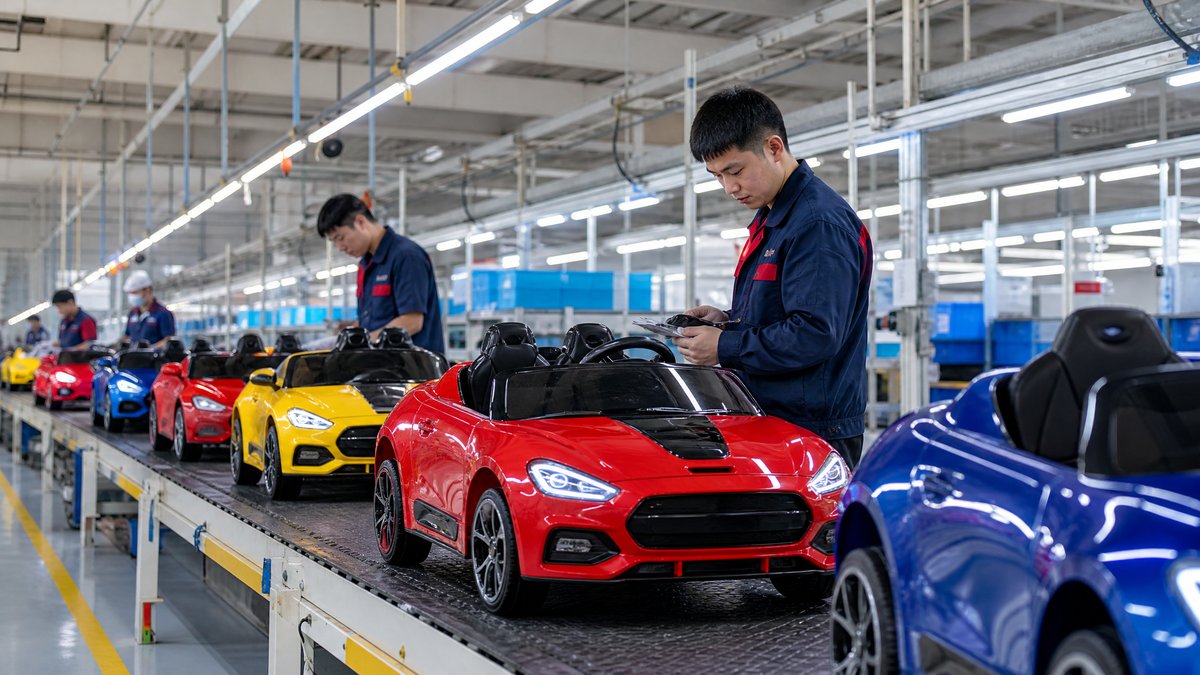
Before paying a kids ride-on car supplier deposit, request a written quotation, SKU-level specification, supplier and beneficiary verification, sample-status record, product-documentation plan, packaging brief, and a purchase order or accepted pro forma invoice. These documents should identify the supplier, define what will be made, and show how approvals and later changes will be handled.
For overseas importers, wholesalers, distributors, retailers, and OEM buyers, a deposit is where a sales conversation becomes a production commitment. A catalog image, a fast response, or a low quote does not establish the exact product that will be supplied. A controlled order pack does.
This guide focuses on deposit readiness, rather than payment-term negotiation or final pre-shipment inspection.
The pre-deposit request list at a glance
Use this checklist before approving a deposit:
1. Supplier identity and payment confirmation — legal entity, operating contact, beneficiary name, and verified bank instructions.
2. Itemized quotation or pro forma invoice — model, quantities, currency, deposit reference, inclusions, exclusions, and agreed trade terms where applicable.
3. SKU-level specification sheet — the product configuration, included accessories, selected options, carton needs, and buyer-requested labeling.
4. Sample and approval record — reference sample, photos or video, revision, approved changes, and anything still pending.
5. Product and safety documentation plan — documents available for the actual product version and responsibilities for destination-market review.
6. Packaging, artwork, and labeling brief — carton marks, language, barcodes, inserts, brand assets, and approval milestones.
7. Quality and change-control plan — review points, evidence expected, and written treatment of any proposed substitution or change.
8. Order document linking the set — a purchase order or mutually accepted pro forma invoice that references the agreed attachments.
The objective is not paperwork for its own sake. It is a traceable commercial baseline. A supplier should know which document controls the order, and the buyer should be able to find the decisions without reconstructing them from chat messages.
Why buyers should define the order before paying
A deposit may support an agreed production slot or materials arrangement, but it should not be the first time core choices are made. Paying while the model, power-system configuration, remote-control version, carton artwork, or target-market requirements are unresolved invites avoidable disagreement later.
Before releasing funds, make these questions answerable in writing:
- Which exact model and variations are ordered?
- Which features and accessories are included, optional, or excluded?
- Which sample, drawings, photographs, or specification govern the order?
- Which points require buyer approval before production or printing?
- What documentation is expected for the intended market, and who will review it?
- Who may authorize a bank-account, specification, or artwork change?
That clarity protects both parties: the supplier receives an actionable production brief, while the buyer has a record for review, inspection, and receiving.
1. Verify the supplier identity and payment instructions
Ask for the legal entity name used for the transaction, operating address, primary business contacts, and the beneficiary name that will appear on the payment request. Retain the quotation, order document, payment instructions, and verification record in one procurement file.
Verify any bank-detail change independently
Do not treat an email containing revised bank instructions as self-authenticating. Establish an internal procedure to verify new or changed payment instructions through a known, independently confirmed supplier contact route. Record who completed the check and require any difference between the beneficiary and contracting party to be explained in writing. Do not rely only on a reply to the message that announced the change.
Finance teams should also apply their own onboarding, authorization, and fraud-prevention procedures.
Procurement example: A distributor may know the supplier's sales representative, while accounts payable matches the beneficiary name to the accepted order paperwork. If the names differ, the buyer requests an explanation and confirms it through an established management contact before processing the transfer.
2. Request an itemized quotation that can become the order baseline
“Ride-on car, assorted colors” is not a sufficient deposit description. Ask for a quotation or pro forma invoice with line items that identify what you intend to buy. It should normally include:
- Supplier and buyer names, document number, date, and currency
- Product model or internal SKU, description, quantity, color, or variation where relevant
- Unit price, line total, and separately identified optional items
- Agreed Incoterm and named place, if trade terms are already agreed
- Deposit amount or basis, payment reference, quote validity, and stated exclusions
- Packaging assumptions, artwork or tooling charges where relevant, and the attachments forming part of the quote
Ask the supplier to mark open points as open. A visible unresolved item can be owned and closed; an assumption based on a catalog image or prior model can become a later dispute.
3. Obtain a SKU-level specification sheet
The specification sheet turns a product description into a usable production reference. For each kids ride-on car SKU, request a dated version covering the agreed configuration. Depending on the product, it can address body style, color and finish, seating, wheel type, controls, lights or audio features, power-system configuration, charger and accessories, assembly materials, and retail-pack contents.
Distinguish standard features from buyer-selected options and items not included. If the order depends on a particular control option, carton format, or branded insert, state it explicitly. “Same as sample” is not sufficiently precise when the sample has unrecorded variations.
Review the [KidsRideCar product range](/products/) when building your model brief. OEM teams can also use the [OEM customization guide](/blog/oem-kids-electric-ride-on-cars-complete-customization-guide) to convert brand and packaging requirements into a structured request.
Add a version and approval block
| Field | What to record |
|---|---|
| Document ID and revision | Unique reference and date |
| Applicable SKU(s) | Model and variation covered |
| Reference material | Sample ID, photos, drawing, or approved artwork |
| Open points | Outstanding item, owner, and due date |
| Buyer approval | Name, role, date, and exceptions |
| Supplier acknowledgement | Name, role, date, and exceptions |
This prevents an old attachment or informal message from becoming the source of truth.
4. Confirm sample status—not just sample existence
A sample is useful evidence, but it is not automatically a full production specification. Before paying, ask which sample version is relevant and whether it represents the proposed production configuration. Request clearly labeled photos or video and a written list of differences if the order will vary from the sample.
Record the outcome as approved, approved with written changes, rejected, or pending. For remote review, preserve the files and dated response. Receiving or discussing a sample is not the same as approving it.
Compare the sample with the order pack: model identity, selected features, color, included parts, packaging concept, instructions, and brand elements. If an element is not ready to review, list it as an outstanding approval instead of assuming it will be corrected later. See the [sample approval process for wholesale buyers](/blog/what-is-a-practical-ride-on-car-sample-approval-process-for-buyers) for a useful follow-on workflow.
5. Request a product and safety documentation plan for the target market
Kids ride-on cars are products for children, so documentation and safety preparation should begin before the deposit. Requirements depend on the final product configuration and destination. Ask the supplier for a written list of documents it can provide or support, the product version to which each document relates, and the market information it needs from you.
Request document dates, model identifiers, and any configuration limits. Review the material with the appropriate people in your organization and, where needed, qualified local compliance or legal advisers. Do not assume that a certificate image, sales claim, or document for another model covers the SKU you plan to order.
Keep customer-facing safety guidance model-neutral and consistent with approved documentation and the requirements you have determined. Provide appropriate age, supervision, use, charging, and maintenance instructions. Do not alter safety systems, batteries, chargers, wiring, or internal components; end users should follow supplied instructions and seek appropriate authorized support.
6. Lock packaging, artwork, labeling, and retail-content roles
For wholesalers and retailers, packaging is part of the product offer. For OEM buyers, it is a common source of avoidable delay. Before the deposit, submit a packaging brief covering carton layout or concept, brand assets, label languages, barcode needs, shipping marks, inserts, assembly instructions, and buyer-supplied warning content. Identify the responsible party for every asset.
Agree on a proof-approval sequence. The supplier may issue a dieline or draft layout; the buyer checks factual content and brand use; the supplier revises it; then both sides record approval before printing. A logo file alone does not authorize a retail carton.
Procurement example: An OEM retailer can attach an “artwork pending” register to the accepted pro forma invoice. The register names each carton, manual, label, and insert; records the file revision and owner; and states that printing requires written buyer approval. The deposit can proceed while artwork remains controlled rather than implied.
7. Agree on quality checks and change control
Do not wait for a final inspection to decide what happens if goods differ from the agreed specification. Before payment, align on review points, evidence expected, how issues will be reported, and how proposed changes will be controlled.
A practical rule is that a change to an agreed product, component, packaging item, or document is not accepted unless the buyer receives it in writing, assesses the impact, and approves it when required. Apply this rule to purportedly “equivalent” substitutions too. Equivalence should be tested against the agreed specification and destination-market needs, not merely availability.
Name supplier and buyer contacts who can manage changes. Keep a log with date, source document, decision, and revised attachment. For an inspection-stage complement to this process, see the [ride-on car quality inspection checklist](/blog/what-is-a-practical-quality-inspection-checklist-before-ride-on-car-shipment).
8. Link the deposit to an accepted order pack
The final pre-payment step is to link the deposit to the controlled record. Your purchase order or mutually accepted pro forma invoice should reference the quotation, specification revision, sample status, packaging brief, documentation plan, and any open-point register. It should identify the deposit reference and how later approvals or changes will be managed.
A workable order pack may contain:
1. Purchase order or accepted pro forma invoice
2. Itemized commercial quotation
3. SKU specification and revision log
4. Sample approval record or status note
5. Packaging/artwork brief and asset register
6. Destination-market documentation plan
7. Quality and change-control contact list
8. Verified payment-instruction record under your internal process
A practical internal deposit-approval workflow
1. Create an order brief with destination market, SKUs, sales channel, and packaging requirements.
2. Collect the quotation and specification attachments; highlight incomplete or open points.
3. Have procurement, product, operations, compliance, and finance owners record approval, question, or condition.
4. Consolidate the controlled order pack and assign owners to any open items.
5. Verify payment details through the agreed finance protocol.
6. Release the deposit only when an authorized buyer can identify what the payment funds.
7. Require written acknowledgement and the agreed change-control path for later variations.
The essential elements are decision ownership and a durable record.
Frequently Asked Questions
Is a quotation enough before paying a ride-on car supplier deposit?
Usually not by itself. Pair it with a SKU specification, sample-status record, packaging requirements where relevant, verified payment details, and an accepted order document. Label key unresolved points clearly with owners and approval conditions.
Should buyers request safety documents before placing the deposit?
Yes—request a documentation plan and review available product-specific material before committing. The documents and evaluation process depend on the destination market and final configuration. Do not assume material for another model or variation covers the order; obtain appropriate professional advice where needed.
What if the supplier proposes a substitution after the deposit?
Request the proposed change in writing, including the affected SKU and documents. Compare it to the approved baseline and your market needs, then record the buyer decision before treating it as accepted. “Same quality” is not a sufficient specification.
Can a buyer approve a sample through photos or video?
Remote review can support an approval process when records are clear, but it does not replace a complete specification or suitable validation. Label the files, date the response, record the reviewed items, and list exceptions or items still pending.
Conclusion: make the deposit a controlled commitment
Before paying a kids ride-on car supplier deposit, confirm who is being paid, what exact product is being ordered, and how changes will be controlled. An itemized quote, verified payment instructions, SKU specification, sample record, documentation plan, packaging brief, and accepted order pack give buyers a reliable foundation.
This preparation turns assumptions into documented decisions. To structure your next sourcing request, [send KidsRideCar an inquiry](/inquiry) or email info@kidsridecar.com.
Official references
Explore these external resources for current regulatory and trade guidance. Confirm requirements with the relevant authority before placing an order.
Ready to Start?
Factory-Direct · CE & ASTM Certified · MOQ from 50 Units
Our export team works with buyers in 60+ countries. Get a quote within 24 hours.
KR
Written by KidsRideCar
China's leading kids electric ride-on car manufacturer. 500,000+ units shipped annually to 60+ countries. CE, ASTM & EN71 certified.