Introduction
A parental remote can be one of the most important decision points for a toddler-focused ride-on car. It gives an adult a way to guide the vehicle while a child is still learning steering, pedal coordination and spatial awareness. However, the phrase “remote control” does not guarantee a particular level of response, range, braking behavior or interference resistance. These characteristics vary by vehicle electronics, battery condition, pairing design, surroundings and the way a distributor specifies the product.
This is not a claim that one remote system is universally faster or safer than another. Instead, it is a practical assessment guide for parents, retailers and B2B buyers who need to compare systems before selecting a model. The goal is to ask useful questions, inspect the right functions and create a responsible operating procedure.
What “Responsive” Should Mean
For a parental remote, response is more than the time between a button press and wheel movement. A useful system should provide predictable control in the conditions shown in its manual. Buyers should consider pairing stability, start and stop behavior, steering consistency, signal-loss behavior and how easily an adult can understand the controls.
| Assessment area | What to observe | Why it matters |
|---|---|---|
| Pairing | Remote connects reliably after the documented setup | Reduces confusion before use |
| Direction control | Forward, reverse and steering commands are clear and consistent | Helps adults anticipate movement |
| Stop behavior | The vehicle follows its documented stop or brake function | Supports supervised operation |
| Signal loss | The system behaves as described if connection is interrupted | Important for risk review |
| Ergonomics | Buttons are distinguishable and comfortable for an adult hand | Helps prevent input mistakes |
Do not judge response only by a short indoor demonstration. A remote may behave differently when the vehicle battery is low, when it is near other wireless devices, or when terrain creates additional rolling resistance.
A Safe Evaluation Method
> Evaluate remote functions with the child away from the vehicle's path. Use a level, dry, open area and follow the model's manual.
Start with the manufacturer’s pairing instructions. Confirm that the vehicle is fully assembled, its drive mode is correctly selected and the remote batteries are fresh if the product uses replaceable cells. With no child seated, test each documented movement at low speed. Observe whether the controls are intuitive and whether the vehicle stops where expected according to the instructions.
Next, repeat the assessment with normal payload only if the manual permits it, using close adult supervision. Avoid testing beside roads, stairs, pools, slopes, parked cars or wet surfaces. A remote should never be treated as permission to operate a ride-on car without an adult nearby.
Questions for Product Buyers and Importers
For wholesale selection, request the remote-control specification rather than relying on a catalog icon. Ask whether the system uses a dedicated pairing method, what modes are available, how the vehicle handles connection loss, whether the remote can override pedal input, and whether the remote is included with every SKU.
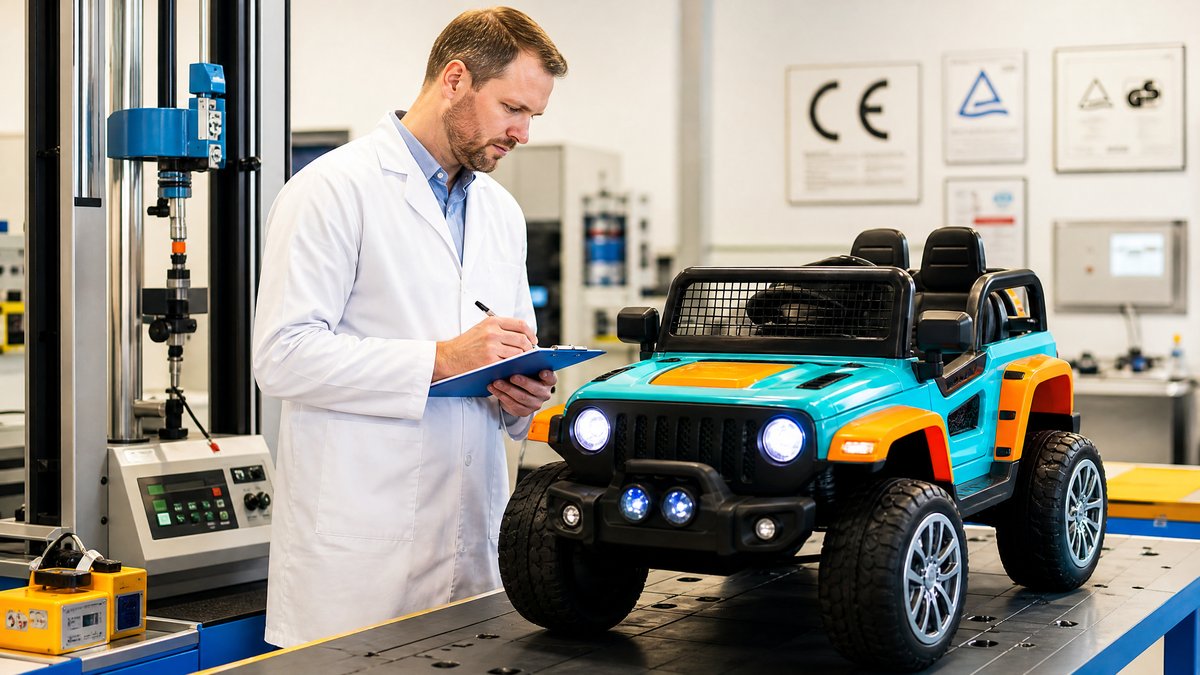
Ask the factory to include a functional remote-control check in the pre-shipment inspection plan. The inspection should confirm that the remote pairs, each primary command works and the supplied manual uses the same labels found on the remote. For private-label projects, confirm whether button graphics, language, packaging instructions and warning labels can be adapted for the intended market.
Procurement Checklist
- Obtain the current remote-control manual and pairing instructions.
- Confirm the remote is included in the quoted configuration rather than shown as an optional feature.
- Verify the vehicle's behavior if the remote connection ends.
- Request a functional inspection point for pairing, direction and stop controls.
- Check that the receiver, remote and user manual use consistent terminology.
- Plan spare remotes or replacement procedures for after-sales support.
FAQ
Can a parental remote replace adult supervision?
No. The remote is an assistance feature. Children should be supervised closely and use the vehicle only in a suitable area described by the manufacturer.
Does a higher-voltage car always need a better remote?
Not necessarily. Voltage, motors, speed programming and remote electronics are separate specifications. Evaluate the complete system for the intended age group and operating area.
What should a retailer explain to customers?
Retailers should demonstrate pairing, mode selection, charging checks and safe-use boundaries. Clear setup information can reduce avoidable support requests.
Conclusion
The best parental remote is not defined by a marketing label. It is defined by documented functions, predictable handling, clear setup and an operating process that keeps an adult responsible for the environment. For B2B buyers, treating the remote as an inspectable component of the vehicle specification creates a stronger product brief and more reliable after-sales plan.
Request a Remote-Control Specification
Contact KidsRideCar for current model configurations, remote-control options, age guidance and OEM documentation support. We can help wholesale buyers compare available control systems before selecting a product range.
Official references
Explore these external resources for current regulatory and trade guidance. Confirm requirements with the relevant authority before placing an order.
Ready to Start?
Factory-Direct · CE & ASTM Certified · MOQ from 50 Units
Our export team works with buyers in 60+ countries. Get a quote within 24 hours.
KR
Written by KidsRideCar
China's leading kids electric ride-on car manufacturer. 500,000+ units shipped annually to 60+ countries. CE, ASTM & EN71 certified.