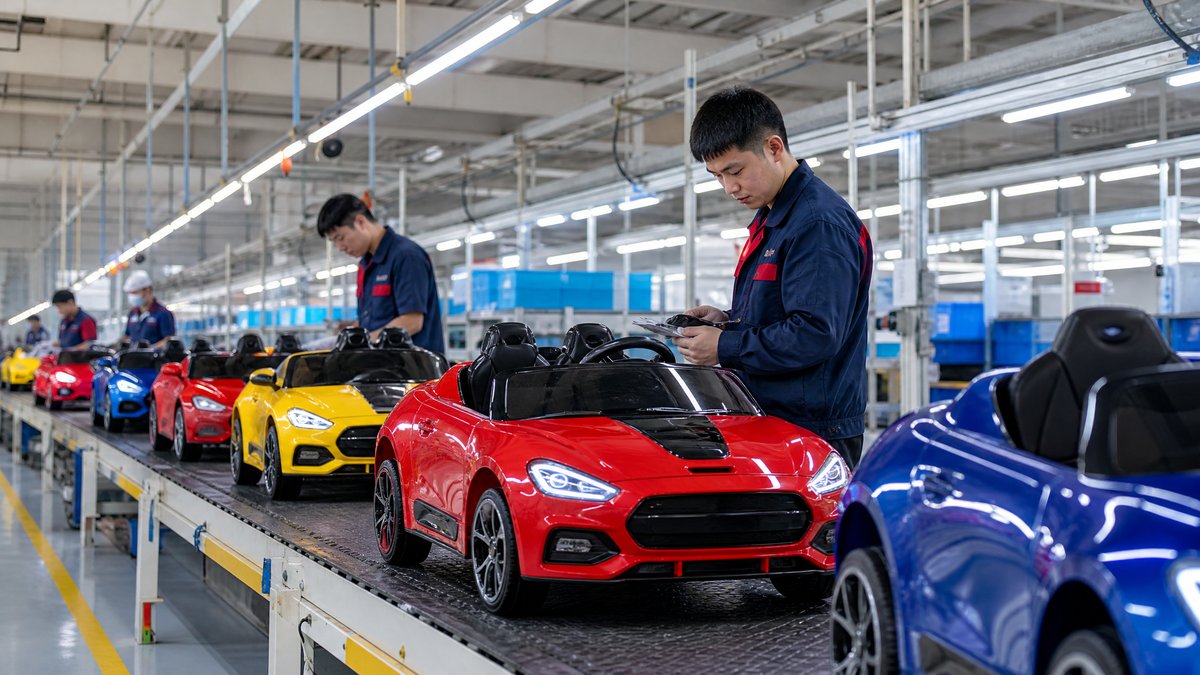
Retailers should choose kids ride-on car models around their store format—not simply select the widest supplier catalog. Space, shopping behavior, delivery method, staff knowledge, and after-sales capacity determine which models can be supported responsibly. A compact toy shop, specialist baby retailer, department store, and online-first business may all sell to families, but each needs a different assortment plan.
For B2B buyers, begin with differentiated models, accurate product information, manageable cartons, and a workable service path. Before ordering, verify current destination-market requirements for the exact configuration being purchased.
Begin With a Store-Format Brief
Turn the buying decision into a short internal brief before reviewing models. Define the following:
- Selling setting: local toy store, shopping-centre unit, department store, warehouse format, or ecommerce business.
- Space and handling limits: assembled display area, stockroom capacity, carton dimensions, receiving access, and local-delivery capability.
- Customer journey: quick gift purchase, assisted comparison, seasonal promotion, or online research and home delivery.
- Range role: entry option, core seller, feature-led choice, or premium display item.
- Support capacity: assembly handoff, staff training, customer service, warranty administration, and manufacturer-approved replacement parts.
This brief turns a broad catalog into relevant supplier questions. Request specifications, assembled and carton dimensions, the manual, stated guidance, packaging details, parts list, battery and charger information, approved images, and destination-market documentation. Confirm that files apply to the exact configuration ordered.
Choose Models for Each Retail Environment
Small independent toy stores
Small stores usually benefit from a focused range rather than several similar vehicles. An accessible single-seat choice, a parent-oriented option where appropriate, and a distinctive step-up model may give shoppers meaningful comparison without overwhelming space. The number should follow storage and service capacity, not a generic rule.
Prioritize clear product information and cartons staff can move safely. An assembled sample can help families judge size, but it needs controlled placement. Do not allow children to operate a display model without active adult supervision.
Specialist baby and juvenile-product retailers
Specialist retailers can explain dimensions, seating, stated age guidance, supervision, assembly, storage, and charging. Their range may compare parent-control availability, supplied restraints, or starting behavior. Describe features only as documented, never as a substitute for adult supervision or manufacturer instructions.
Prepare an approved comparison card for each SKU. Do not recommend rewiring, bypasses, disassembly, non-approved chargers, or modifications. For special-needs questions, avoid broad suitability claims: needs vary, adult supervision remains necessary, and only manufacturer-approved guidance should be used.
Department stores and multi-category retailers
Department stores need a simple range for a busy toy or seasonal department. A good-better-best structure can help if every model has a distinct role. Use reliable product data and shelf communication for dimensions, included items, stated age guidance, assembly, and service contact.
Confirm barcode format, carton markings, image assets, lead times, and replenishment. One supported display sample can be more useful than multiple assembled units. Any in-store demo needs a suitable area, trained staff, and adult supervision.
Warehouse clubs, value retailers, and promotional formats
Value-led formats need limited, easy-to-understand SKUs and disciplined operations. Choose differences shoppers can identify from approved packaging rather than a complex feature matrix. Assess carton and pallet handling, store receiving, delivery, and returns before confirming the range.
Do not omit essential instructions, labels, battery information, or charging guidance to simplify a promotion. Agree in advance how damaged cartons, missing components, and claims will be handled. Each item still needs appropriate documentation and support.
Online-first retailers and marketplaces
Online retailers must make differences clear without an in-store demonstration. Use accurate names, dimensions, carton information, stated age guidance, assembly expectations, and images of the actual configuration. Do not combine models when seating, controls, accessories, appearance, or battery information could confuse shoppers.
Include measurement visuals and state that use must follow manufacturer instructions under adult supervision. Confirm delivery, stock location, returns, customer-service ownership, and parts workflow. Do not promise speed, runtime, terrain performance, or compatibility beyond verified model-specific information.
Build a Range That Your Team Can Operate
Assign every proposed SKU a role: entry, core, feature-led, or premium. Then document why it belongs in the range—for example, a compact footprint, a different seating arrangement, a distinct age-guidance need, or a seasonal merchandising role. If two vehicles serve the same shopper at a similar position, one may be enough.
Color options can provide choice, but they also increase forecasting, stock, listing, and service complexity. Ask whether proposed models share approved components, manuals, chargers, or packaging formats; never assume parts are interchangeable. Create a SKU card recording the model code, color, dimensions, stated guidance, included equipment, carton data, approved claims, service route, and current documentation status.
> Procurement principle: Carry the smallest assortment that meets distinct shopper needs and that your business can explain, fulfil, and support responsibly.
Turn the Assortment Into a Controlled Purchase Order
Before issuing a purchase order, connect the commercial plan to the production standard. Confirm the approved sample reference, exact model and color quantities, artwork version, packaging requirements, labeling language, inspection plan, delivery terms, and documentation handover. Include a written process for product changes, including components, manuals, packaging, or product features.
Also establish the after-sales process before launch. Ask how parts are identified, what information is required for a claim, which components are manufacturer-approved, and how orders for those parts are managed. Keep a traceable support plan that reflects what the retailer can safely offer. Review destination-market requirements with qualified local resources and verify applicable product files, labels, testing, and importer obligations before import or sale. Requirements vary and may change.
Start with a controlled launch where feasible. Categorize customer questions and claims—for example, sizing, assembly, transit damage, missing items, or listing clarity—and use those records to improve content and future orders. Do not turn isolated feedback into performance claims.
FAQ
How many kids ride-on car models should a small retailer start with?
There is no universal number. Begin with the fewest models that give customers genuinely different choices while fitting display, storage, delivery, and after-sales capacity. Add variants only when sales evidence and support capability justify them.
Should every store display an assembled ride-on car?
No. An assembled sample can show scale and appearance, but it needs space, safe positioning, cleaning, staff oversight, and a plan for replacement or sale. Stores that cannot support this can use approved images, dimensions, and clear ordering tools. Any demo must follow manufacturer instructions with active adult supervision.
What should an online retailer request before listing a model?
Request final product specifications, assembled and carton dimensions, approved images, instructions, labeling details, battery and charger information, parts list, warranty or claims process, and documentation relevant to the target market. Verify that the files apply to the exact configuration being listed.
Can a retailer market one model as suitable for all children with special needs?
No. A retailer should not make universal suitability claims. Present manufacturer-approved, product-specific information only, recognize that individual needs differ, and state that adult supervision and the manufacturer’s instructions apply. Do not modify controls, restraints, electrical systems, or other components to create an unapproved adaptation.
How should buyers compare two similar supplier models?
Compare exact model codes and configurations side by side: dimensions, stated age and load guidance, included equipment, carton data, instructions, labels, current documentation, parts availability, lead time, and service requirements. Choose both only when each has a clear role in the intended store format.
Conclusion
The right range is format-specific. Small stores need efficient choice; specialists need comparison tools; broad retailers need simple merchandising; value formats need operational clarity; online sellers need transparent listings. Source models only when product information and after-sales plans match the retailer’s capabilities.
To discuss a store-format assortment brief, email KidsRideCar’s B2B team. For model data, sample planning, or sourcing questions, contact us by email.
Official references
Explore these external resources for current regulatory and trade guidance. Confirm requirements with the relevant authority before placing an order.
Ready to Start?
Factory-Direct · CE & ASTM Certified · MOQ from 50 Units
Our export team works with buyers in 60+ countries. Get a quote within 24 hours.
KR
Written by KidsRideCar
China's leading kids electric ride-on car manufacturer. 500,000+ units shipped annually to 60+ countries. CE, ASTM & EN71 certified.