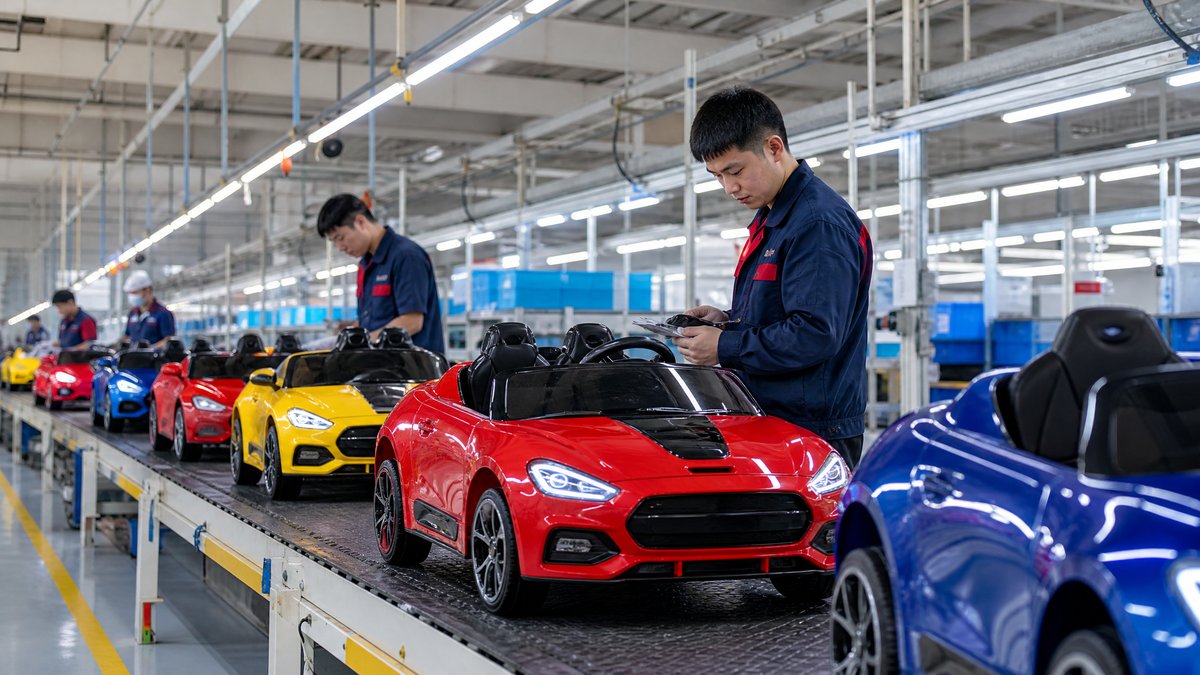
Short answer: Calculate landed cost at shipment level first, then allocate it to each sellable unit using a consistent method. Start with the agreed factory/supply price and add packaging, origin charges, international freight, cargo insurance if purchased, customs duty and import taxes, brokerage, inspection, destination charges, and delivery to your warehouse. Do not use a supplier quotation, tariff rate, or freight estimate as a permanent number: confirm the selected model’s specification, battery transport status, tariff classification, origin, Incoterm, and destination-market requirements before placing the order.
For importers, wholesalers, distributors, and retailers, the goal is not a single “perfect” pre-order figure. It is a documented landed-cost range that can be updated when the commercial invoice, packing list, freight booking, customs entry, and final delivery invoices arrive.
> Request a quote package that supports a real landed-cost model: email KidsRideCar for the selected model’s quotation, packing details, and available product documentation.
What Landed Cost Means for a Ride-On Car Import
Landed cost is the total cost to make inventory available at the destination point you define—usually your warehouse, but sometimes a fulfilment centre or retail distribution hub. It is broader than the factory price and often broader than the customs value used by the authorities.
A practical shipment-level formula is:
```text
Landed cost = product supply price
+ export/origin and packaging costs not already included
+ international freight and insurance, where applicable
+ customs duty and non-recoverable import taxes/charges
+ customs brokerage and clearance-related charges
+ inspection and compliance-document costs allocated to the shipment
+ destination port/terminal, handling, storage or examination costs, if incurred
+ inland delivery to the defined destination
+ approved contingency for identifiable uncertainty
```
Then calculate:
```text
Landed cost per sellable unit = total landed cost for the shipment ÷ sellable units received
```
Use sellable units received, not merely units ordered, when you finalize the cost. Segregate samples, replacement parts, free-of-charge goods, damaged cartons, or non-sellable units so they do not obscure the true cost of inventory available to sell.
Separate Three Numbers That Are Often Confused
| Number | What it answers | Include | Do not assume |
|---|---|---|---|
| Supplier / factory price | What do the goods cost under the agreed Incoterm? | The components explicitly stated in the quotation or proforma invoice | That it includes export formalities, freight, insurance, destination fees, duty, or delivery unless the agreement says so |
| Customs value | What value will customs use as the basis for duty or other border calculations? | Values and additions required by the destination authority | That your accounting landed cost and customs value are identical |
| Landed cost | What did it cost to place sellable inventory at the chosen destination? | All relevant, evidenced supply-chain costs to that point | That recoverable tax, selling expense, or a future warranty cost should automatically be included without an accounting policy |
The World Trade Organization customs valuation framework generally uses the transaction value as the primary basis and allows only specified additions in the customs calculation.[1] Actual valuation treatment is jurisdiction- and transaction-specific. Give your broker the invoice, purchase order, Incoterm, packing information, and any separately billed assists, royalties, commissions, or tooling arrangements rather than trying to infer the customs value from a freight quote.
1. Lock the Scope Before You Build the Spreadsheet
A reliable worksheet starts with a one-line scope statement, for example: “Delivered, cleared, and received at our [city] warehouse, excluding recoverable import VAT and domestic onward parcel fulfilment.” Change the statement if your business wants a different cost boundary, but do not change it between scenarios without marking the change.
Capture the Commercial and Physical Inputs
Create one input sheet per proposed model and shipment. At minimum, record:
- Product/SKU or model code, variant, colour mix, accessories, and quantity ordered.
- Agreed Incoterm® rule, named place/port, and version used in the contract. Incoterms allocate defined delivery obligations, but they do not set the destination’s duty rate or make a freight quote fixed.[2]
- Quoted unit price and currency; show discounts, tooling, samples, and any separately invoiced packaging or export charges on separate rows.
- Outer-carton dimensions, gross and net weight, units per carton, carton count, pallet plan if any, and total chargeable shipment measure. Verify whether measurements are estimated or final.
- Battery chemistry, battery configuration (installed, packed with equipment, or separate), battery rating information, and any carrier/forwarder documentation request. Battery transport rules must be verified for the selected model, route, transport mode, and carrier. IATA notes that air carriage of lithium batteries depends on configuration and watt-hour rating, and it publishes dedicated shipper guidance.[3]
- Production-ready date, cargo-ready date, proposed port/airport, destination warehouse postcode, and required arrival window.
Do not use a generic carton size from another vehicle. Packaging affects container utilization, LCL chargeable volume, handling exposure, storage space, final-mile vehicle selection, and sometimes the freight route available.
Treat Specifications and Market Access as Pre-Costing Checks
Before you ask a forwarder for a quote, confirm the actual specification and documentation package for the chosen model—not a similar model. Battery information, labels, instructions, electrical components, age grading, packaging, and test/documentation expectations can vary by model and destination market.
Market requirements are not an optional line item to discover after sailing. In the EU, for example, the Commission advises importers to check product-specific import conditions, tariffs, and technical requirements; it also notes that product and packaging/labelling requirements may apply.[2] In the United States, CPSC business guidance describes third-party testing and certification obligations for children’s products.[4] These examples are not a compliance determination for any ride-on car. Importers should verify the applicable rules with the destination-market regulator, customs authority, accredited testing provider where needed, and their compliance adviser.
2. Build Every Cost Bucket—Without Hiding Costs in “Freight”
Use invoice-backed actuals after shipment; use dated quotations and clearly labelled assumptions before ordering. This buyer-facing checklist can become the rows of your cost model.
| Cost bucket | What to collect or ask | Common omission to avoid | How to allocate |
|---|---|---|---|
| Product supply price | Proforma invoice, currency, quantity, model/variant, agreed Incoterm | Treating a quoted unit price as a delivered warehouse price | Per unit or actual invoice value |
| Packaging and origin preparation | Retail carton specification, export carton/pallet plan, marking/labeling, origin handling and export documentation | Missing custom retail packaging, palletisation, export packing, or packing changes after sampling | Per carton, per unit, or actual invoice line |
| International freight | Mode, route, quote validity, equipment/LCL basis, surcharges, chargeable weight/volume, insurance scope | Comparing sea, air, rail, or courier figures without comparing service scope and destination charges | Actual freight; for mixed SKUs use documented volume, weight, or value basis |
| Customs duty and border taxes | Proposed tariff classification, country of origin, customs value approach, trade remedies, tax treatment | Applying a web-search rate to every model or assuming a preferential rate without origin proof | Usually shipment entry-specific; document broker method |
| Brokerage and clearance | Broker quote, declaration/entry fee, disbursement/advance fees, bond or local filing needs where applicable | Leaving “brokerage” as a blank because it is not on the supplier quote | Per entry, then allocate across shipment |
| Inspection and documentation | Scope, timing, sampling, reinspection, laboratory/document review, translation or labeling review if required | Counting only a factory inspection while excluding destination-market documentation work | Per shipment, model, or unit, according to benefit |
| Destination and local delivery | Terminal/port charges, handling, appointment needs, demurrage/detention/storage terms, drayage and delivery quote to postcode | Quoting only port-to-port freight; omitting warehouse delivery, unloading, or appointment fees | Per shipment, pallet, carton, or delivery |
| Contingency and finance policy items | A management-approved buffer for known uncertain cost types; currency-conversion method | Inventing a percentage or blending expected retail returns into import cost without policy approval | Retain separately; release or true-up after actual invoices |
Use a Clear Allocation Method for Mixed Loads
If one container or consolidated shipment contains multiple SKUs, allocate shared costs consistently. There is no universal “best” basis:
- Carton volume / cubic measure: often useful when freight is primarily space-driven.
- Chargeable or gross weight: can be appropriate where carrier billing or handling is weight-driven.
- Declared or invoice value: may suit cargo insurance or a cost category that tracks value.
- Units: simplest for a uniform model shipment, but can distort results for very different carton sizes or values.
Record the basis on the worksheet and keep it unchanged for comparable purchase decisions. Allocate a product-specific test, custom carton charge, or reinspection directly to the affected SKU, not across the whole container merely for convenience.
3. Price Freight From the Actual Packing List, Not an Assumption
Freight is a service bundle, not one universal rate. Ask for a written quotation that states the origin point, destination point, mode, equipment or LCL basis, cargo-ready date, validity date, inclusions, exclusions, free-time assumptions, and battery-related acceptance conditions. Compare quotes on the same end point and service scope.
Packaging Data That Changes the Freight Math
For kids electric ride-on cars, a buyer should ask the supplier to verify:
1. Finished outer-carton length, width, and height for every selected model.
2. Gross weight per carton and carton count, rather than only net vehicle weight.
3. Whether batteries and accessories are installed, packed separately within the carton, or supplied under another arrangement.
4. Any changes caused by OEM branding, printed boxes, inserts, protective materials, or palletisation.
5. Whether carton strength, markings, labels, and handling instructions meet the agreed transport and retail channel needs.
6. The final packing list before booking, plus photographs or inspection confirmation where appropriate.
For a retailer using marketplace fulfilment, destination carton/label and appointment rules can create costs after customs clearance. Plan them before production; do not assume the export carton will meet every downstream channel requirement. See the existing [KidsRideCar packaging guide for Amazon FBA and retail](/blog/kids-electric-ride-on-car-packaging-guide-amazon-fba-retail) for a related planning topic.
Battery Transport Is a Quote Gate, Not a Footnote
Tell the forwarder the exact battery information and configuration before accepting the transport plan. Do not describe a ride-on car simply as “with battery” and assume all routes, carriers, or modes have identical handling requirements. IATA’s guidance covers classification, packing, marking, labelling, and documentation considerations for air transport; applicable rules can change and carrier acceptance may be more restrictive.[3]
Verify battery transport rules for the selected model and destination market with the carrier/forwarder and competent authorities. This article does not determine dangerous-goods classification, packaging instruction, documentation, or transport eligibility.
4. Calculate Duties, Taxes, and Brokerage With Destination-Specific Evidence
Do not insert an unverified duty percentage into a business case. Obtain a provisional classification and origin assessment from a qualified customs broker or customs adviser for the actual product description, construction, use, battery configuration, and documentation. Check the official tariff tool or customs authority for the destination market, and recheck before entry.
For EU imports, the European Commission’s Access2Markets guidance directs businesses to product- and market-specific rules, including tariffs, origin conditions, potential additional duties, and import VAT treatment.[2] Other markets have their own tariff schedules, declarations, taxes, exemptions, and border fees. A trade agreement may not reduce duty unless its rules of origin and proof requirements are met.
Model Duties and Taxes Separately From Recoverable Tax
Your finance team should decide how to present import taxes under local accounting and cash-flow practice. A useful approach is to show two views:
| View | Purpose | Treatment note |
|---|---|---|
| Inventory landed cost | Gross-margin and replenishment decisions | Include duty and non-recoverable charges; handle recoverable import tax according to your accounting policy |
| Import cash requirement | Funding and payment timing | Show duty, import tax, brokerage advances, and other amounts that must be paid even if some tax may later be recoverable |
Never assume import tax is recoverable—or non-recoverable—without confirmation from your tax adviser and local rules. Keep it visible as its own row so management can see both the inventory-cost effect and the cash requirement.
Brokerage Is More Than the Broker’s Headline Fee
Ask whether the quote covers declaration preparation, entry filing, classification assistance, document correction, disbursement/advance charges, delivery-order release, bond arrangements where relevant, and any examination, storage, or post-entry work. A broker cannot guarantee that an authority will not inspect or query a shipment. Carry these as separate risk lines when they are plausible rather than silently assuming zero.
For related reading, link internally to [Understanding HS Codes and Import Duties for Kids Electric Ride-On Cars](/blog/understanding-hs-codes-and-import-duties-for-kids-electric-ride-on-cars) and the [complete logistics guide](/blog/shipping-kids-electric-ride-on-cars-from-china-complete-logistics-guide).
5. Budget Inspection, Compliance, and Delivery as Decision Costs
Inspection can reduce uncertainty, but its scope should match the order and risk. Define in writing whether the service checks quantity, model/colour mix, packaging, visible workmanship, functionality, documentation presence, loading, or another agreed scope. A pre-shipment inspection does not replace destination-market legal compliance, laboratory testing, customs verification, or a full production audit.
For each order, consider a separate line for:
- Sample review and pre-production approval.
- Pre-shipment or loading inspection.
- Reinspection if defects, packaging revisions, or corrective action require it.
- Document review, market-specific labeling/instruction review, testing, or certification work when applicable.
- Local warehouse receiving and discrepancy checks.
- Replacement-parts or remedy logistics if included in the commercial plan.
Ask the factory for the selected model’s current specification and available documentation, then independently verify what the destination market requires. The existing [KidsRideCar quality inspection guide](/blog/kids-electric-ride-on-car-quality-inspection-guide-china) and [safety certifications guide](/blog/kids-electric-ride-on-car-safety-certifications-guide) are useful internal-reading suggestions; neither substitutes for a destination-market compliance assessment.
6. Use Scenario Planning Instead of One Fragile Estimate
A single quote is a snapshot. Build at least three cases with the same cost boundary and no invented rates:
| Scenario | Use evidence from | Change only documented drivers | Decision use |
|---|---|---|---|
| Base case | Current supplier quotation, final or estimated packing data, dated forwarder/broker indications | Normal route, currency convention, and delivery plan | Baseline purchase approval and target margin |
| Downside case | A conservative but explainable alternative from the forwarder/broker/operations team | Freight validity expiry, carton-volume increase, inspection/rework, destination handling, delay/storage exposure, currency movement, or a different verified tariff outcome | Cash buffer and minimum acceptable selling price |
| Alternative supply-chain case | A different mode, shipment size, port, consolidation plan, or SKU mix that can actually be quoted | Service scope and arrival timing, with all changed costs re-priced | Compare speed, cash tied up, and cost per sellable unit |
For every scenario, list the source, date, owner, currency, assumptions, and exclusions next to each input. A scenario is not a prediction. Its value is showing which assumptions materially change the cost per unit and what must be reconfirmed before a purchase order or shipping release.
A Simple Blank Worksheet Structure
| Section | Suggested rows | Evidence to attach |
|---|---|---|
| Order data | Model, quantity, Incoterm, currency, supplier price | Quotation/proforma invoice and PO |
| Pack data | Cartons, dimensions, gross weight, battery configuration | Final packing list and model specification |
| Origin | Packaging, export handling, origin transport/documents | Supplier or forwarder quotation |
| Main transport | Freight, insurance, applicable surcharges | Dated forwarder quote and booking confirmation |
| Border | Customs value input, duty, tax, brokerage, clearance | Broker calculation, entry documents, official tariff result |
| Destination | Terminal/handling, storage if incurred, local delivery, receiving | Terminal, carrier, warehouse, and delivery invoices/quotes |
| Quality/compliance | Inspection, testing/document work, reinspection | Service scope, report, invoice |
| Summary | Total, sellable units, landed cost per unit, cash requirement | Approval record and final invoice reconciliation |
7. Reconcile Actuals and Feed the Next Purchase Order
Once the goods arrive, close the loop. Match supplier invoices, freight invoices, customs entry, broker invoice, inspection invoice, and local-delivery invoice to the shipment record. Record variance by cause: carton-data change, route change, customs treatment, currency conversion, service add-on, inspection outcome, delay, or an incomplete quote.
This turns landed costing into a purchasing capability rather than a one-time spreadsheet. It also helps buyers compare models fairly: a model with a lower factory price may have a different carton profile, transport requirement, documentation need, or handling cost. Compare total cost per sellable unit at the same warehouse boundary, not factory price alone.
> Need a quote-ready input pack for a specific vehicle mix? Contact KidsRideCar to request model-specific quotation, packing information, and available documentation for your freight, broker, and compliance review.
Internal-Link Suggestions
Use these existing KidsRideCar paths only where they add context to the reader journey:
- [How to Source Kids Electric Ride-On Cars from China](/blog/how-to-source-kids-electric-ride-on-cars-from-china) — supplier-selection and sourcing-process context.
- [Shipping Kids Electric Ride-On Cars from China: Complete Logistics Guide](/blog/shipping-kids-electric-ride-on-cars-from-china-complete-logistics-guide) — transport-planning follow-up.
- [Understanding HS Codes and Import Duties for Kids Electric Ride-On Cars](/blog/understanding-hs-codes-and-import-duties-for-kids-electric-ride-on-cars) — tariff and classification follow-up.
- [Kids Electric Ride-On Car Battery Guide: Lead Acid vs Lithium](/blog/kids-electric-ride-on-car-battery-guide-lead-acid-vs-lithium) — battery-specification context; transport acceptance must still be verified for the exact shipment.
Image Planning
| Placement | Suggested dimensions | English caption | Alt text | English AI prompt |
|---|---|---|---|---|
| Below the introduction | 1600 × 900 px | “A landed-cost worksheet connects product, freight, customs, and warehouse-delivery inputs.” | “Importer reviewing a landed-cost worksheet beside boxed kids electric ride-on cars in a warehouse.” | “Editorial B2B logistics photograph, diverse import manager reviewing a printed landed-cost spreadsheet at a warehouse desk, neatly stacked unbranded cartons containing children’s electric ride-on cars in the background, shipping documents and calculator, realistic natural light, no logos, no readable personal data, wide 16:9 composition.” |
| In the packaging and freight section | 1400 × 900 px | “Final carton dimensions and gross weight are essential inputs to transport costing.” | “Measuring an unbranded export carton for a kids electric ride-on car with a tape measure.” | “Commercial product logistics scene, warehouse worker measuring a plain export carton for a children’s electric ride-on car with a tape measure, shipping scale and clipboard nearby, carton labels intentionally generic and unreadable, clean industrial environment, photorealistic, landscape.” |
| In the duties and brokerage section | 1400 × 900 px | “Confirm classification, origin, and border charges with destination-specific evidence.” | “Customs broker reviewing invoice, packing list, and transport documents.” | “Professional customs brokerage office scene, import specialist reviewing commercial invoice, packing list, and customs checklist on desk, neutral documents with no readable data, subtle cargo terminal background through window, photorealistic business editorial style, landscape.” |
| Before the scenario-planning section | 1600 × 900 px | “Scenario planning makes cost uncertainty visible before the purchase order is released.” | “Team comparing base, downside, and alternative landed-cost scenarios on a screen.” | “Modern B2B planning meeting, three colleagues comparing base case downside case and alternative supply chain scenarios on a large dashboard screen, charts contain abstract nonnumeric lines and blocks, no brand logos, calm professional mood, realistic editorial photography, 16:9.” |
FAQ
1. What is the simplest landed-cost formula for kids electric ride-on cars?
Add the documented product supply price and all costs needed to receive sellable inventory at your chosen destination, then divide by sellable units received. Keep duty, tax, brokerage, inspection, freight, packaging, and local delivery in separate rows so assumptions can be checked and updated.
2. Should freight be calculated per unit or per carton?
Start with the freight provider’s charge basis for the shipment. For allocation across multiple models, use a documented basis such as carton volume, chargeable weight, gross weight, or invoice value. A uniform one-model shipment can often be divided by sellable units after total freight is known. Do not allocate by unit count alone if carton sizes vary materially.
3. Is the supplier’s factory price the same as landed cost?
No. The factory/supply price reflects the agreed commercial term and inclusions. Landed cost also captures the costs to bring, clear, and deliver inventory to the defined destination. Confirm the Incoterm and the quotation inclusions rather than assuming a factory price contains export, freight, customs, and local delivery costs.
4. Can we use an online duty rate in our purchase calculation?
Use official tariff resources only as a starting point and have the actual model, origin, and transaction reviewed by a qualified customs broker or adviser. Classification, origin, trade measures, valuation, and destination rules can change the result. Do not publish or approve a rate as final without destination-specific verification.
5. Do batteries change the landed cost?
They can affect documentation, packaging, carrier acceptance, route options, and transport quotations. Verify the selected model’s battery specification and shipping configuration with the supplier, carrier/forwarder, and relevant authorities. Do not assume that requirements applying to one battery or one transport mode apply to another.
6. Which costs should be excluded from landed cost?
That depends on the cost boundary and your accounting policy. Selling commissions, advertising, onward parcel fulfilment, customer returns, and recoverable taxes may be managed separately, while local warehouse delivery may be included. State the boundary clearly and show excluded costs separately when they affect the commercial decision.
Conclusion
The most defensible landed-cost calculation is evidence-led: a model-specific supply quotation, final packing data, comparable transport quotes, a destination-specific customs review, defined inspection scope, and delivery pricing to the actual warehouse. Keep customs value, cash requirements, and inventory landed cost separate; plan a base, downside, and alternative case; and reconcile final invoices so the next order starts with better data. Above all, verify specifications, battery transport rules, and market requirements for the selected model and destination market before committing inventory or a selling price.
References
[1]: https://www.trade.gov/trade-guide-customs-valuation "U.S. International Trade Administration — Trade Guide: Customs Valuation (verified)"
[2]: https://trade.ec.europa.eu/access-to-markets/en/content/guide-import-goods "European Commission Access2Markets — Guide for Import of Goods (verified)"
[3]: https://www.iata.org/en/programs/cargo/dangerous-goods/lithium-batteries/ "International Air Transport Association — Batteries guidance (verified)"
[4]: https://www.cpsc.gov/Business--Manufacturing/Business-Education/Childrens-Products "U.S. Consumer Product Safety Commission — Children's Products business guidance (verified)"
Official references
Explore these external resources for current regulatory and trade guidance. Confirm requirements with the relevant authority before placing an order.
Ready to Start?
Factory-Direct · CE & ASTM Certified · MOQ from 50 Units
Our export team works with buyers in 60+ countries. Get a quote within 24 hours.
KR
Written by KidsRideCar
China's leading kids electric ride-on car manufacturer. 500,000+ units shipped annually to 60+ countries. CE, ASTM & EN71 certified.