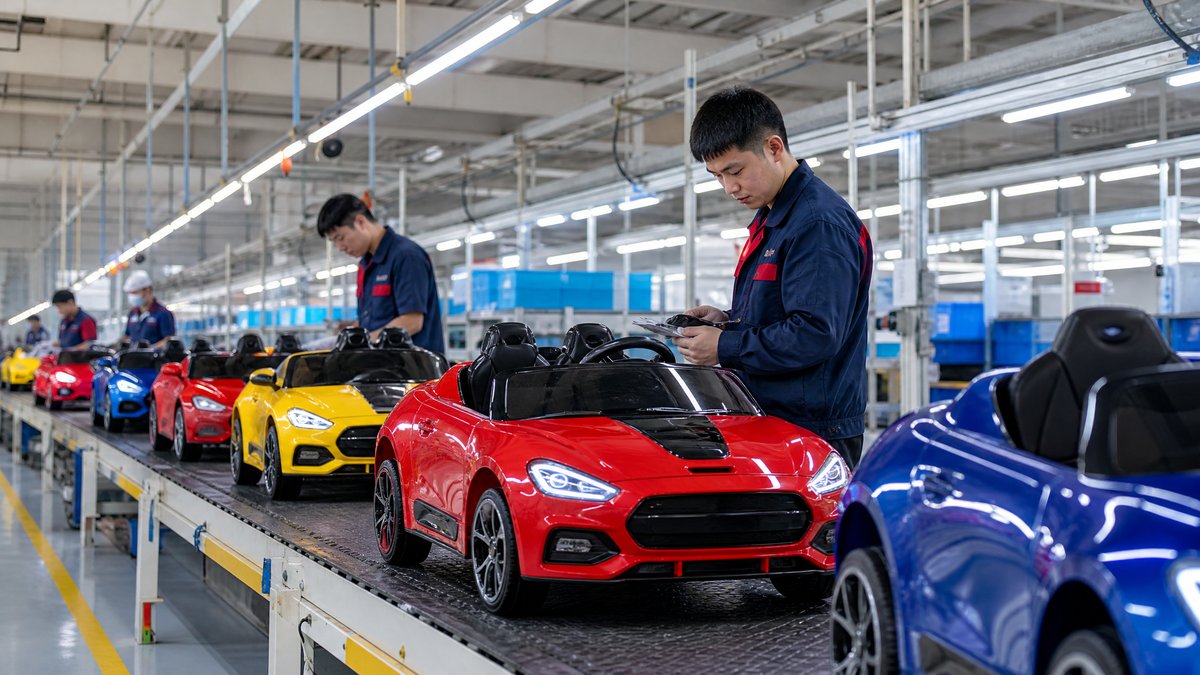
B2B buyers should evaluate a ride-on car supplier’s sample room as a controlled evidence center, not as a display area. The key question is not whether the room looks impressive. It is whether each displayed ride-on car can be identified, demonstrated consistently, linked to current specifications and records, and traced to a production-ready version. A well-managed sample room helps an importer, wholesaler, distributor, retailer, or OEM buyer determine whether the supplier can control changes before those changes reach an order.
A useful visit combines observation with disciplined questions. Ask to see the sample, its identification, its bill of materials or controlled specification, its latest change record, the associated packaging and instructions, and the evidence used to release the version for production. The supplier does not need to reveal unrelated confidential business information. It should, however, be able to present a coherent trail for the product you may purchase.
Start with a buyer-defined evaluation scope
Before touring the room, state which commercial configuration you are assessing. Name the model family, intended destination market, target customer, proposed age grading, battery type, sales channel, branding level, and any requested OEM elements. This prevents a common error: evaluating a standard sample while assuming that the conclusion applies to a modified private-label version.
A practical opening question is: “Please show the exact sample or closest controlled configuration for our proposed order, and identify every difference.” The answer should distinguish between current features, optional features, buyer-specific changes, and ideas that have not been engineered or validated. A supplier that clearly separates these categories makes purchasing decisions easier.
Assess organization before product appearance
A sample room should make it easy to find, identify, and compare products. Buyers do not need a luxury showroom. They need order, visibility, and a system that survives staff changes and busy production periods.
Look for a logical physical layout
Samples should be grouped consistently, with safe storage and a designated place for accessories. The supplier should clearly separate current production and approved reference samples from development, obsolete, and buyer-specific samples. A visible status tag prevents a prototype or retired configuration from being mistaken for a production-ready item.
Each vehicle needs a durable identifier: model or internal code, sample status, revision, and review date. That identifier should link to a controlled digital or paper record rather than one person’s memory.
Check for a complete sample set, not only a vehicle
A ride-on car is more than the assembled unit. Ask to see the product set that the end customer and the supply chain will encounter: the vehicle, remote where applicable, charger, battery information where supplied with the product, instruction literature, warning and rating labels, packaging, inner protection, and relevant hardware or accessories.
This exposes mismatches early. A polished vehicle paired with an old carton artwork or a generic instruction booklet is not a fully released commercial configuration. Likewise, a sample room that can produce the matching packaging and documents promptly is better positioned to demonstrate coordination between design, purchasing, quality, and export teams.
For U.S. programs, buyers should recognize that CPSC guidance identifies labeling requirements for battery-operated toys and instructional-literature requirements for certain ride-on toys, among other categories. The applicable requirements depend on the product and market, so buyers should verify the current rules for their exact configuration rather than infer compliance from a sample-room label alone.[1]
Test version control, not just product knowledge
Version control is the strongest indicator that a sample room supports repeatable supply. A sales representative may know the visible differences between two models. Product readiness requires a system that tells everyone which configuration is approved and prevents an old component or document from being used by mistake.
Request the sample’s identity chain
Choose one target sample and ask the supplier to walk through its identity chain. The demonstration should connect:
1. the model or project code;
2. the revision number or issue date;
3. the approved specification or product data sheet;
4. the major component list and approved options;
5. the artwork or label version where relevant;
6. the packaging and instruction version; and
7. the record of changes since the prior version.
Do not demand an overwhelming binder if a controlled digital system is used. Instead, test whether the underlying records agree. The model code on the vehicle should align with the specification. A revision date should be understandable. The carton, manual, labels, and supplied accessories should match the stated configuration or be clearly labeled as exceptions.
Review change discipline with a real example
The most revealing question is often: “Show us the last meaningful change to this model and how the sample room was updated.” A meaningful change could involve a battery supplier, harness, remote function, molded component, wheel material, charger, packaging, label, or instruction. The supplier should be able to explain the reason, change date, affected versions, approvals, and implementation point.
Good change discipline normally includes a change request, technical review, risk review appropriate to the change, sample or validation plan where needed, buyer approval when contractually required, and retirement or relabeling of the superseded sample. It also includes an effective date or batch boundary so production does not blend old and new configurations without authorization.
Avoid treating test reports or declarations as universal passports. The European Commission publishes toy-safety guidance, including technical-documentation guidance, to assist manufacturers, importers, distributors, and authorities; the guidance itself is not legally binding.[2] A document’s relevance must be checked against the actual product version, destination market, and date. The sample room should help you make that comparison, not replace it.
Observe the demonstration as a controlled test
What a disciplined demonstration should cover
The demonstration should show normal, intended functions relevant to the configuration: power on and off, steering response, forward and reverse selection where applicable, pedal response, braking or stop behavior according to the design, remote-control pairing and control where included, lighting or sound functions where included, and charger-interface identification. It should also show what is not included or not activated on the sample.
Observe whether staff explain the normal operating boundaries found in current instructions and labels. They should not encourage misuse, overloading, operation near traffic, slopes, water, stairs, or other unsuitable areas. Ride-on products should be used under responsible adult supervision in accordance with the manufacturer’s instructions. A demonstration that normalizes unsafe use is poor evidence of a controlled product culture.
Do not ask personnel to bypass guards, defeat electrical protections, open battery packs, improvise wiring, or modify the sample to “prove” a feature. Any product, battery, electrical, software, or structural change should be reviewed and approved by the manufacturer through its documented process before it is represented as part of the sellable configuration.
Examine records that turn a sample into evidence
Ask for a controlled index or product file that identifies the latest available versions of the key records. It may include a specification sheet, bill of materials summary, drawings or approved images, color or finish reference, packaging specification, instruction and label artwork, inspection criteria, sample approvals, change log, and relevant test or assessment records. The expected content will vary by market and contract.
Review dates and scope carefully. A report may relate to a previous version, a component, a model family, or a test sample with a different configuration. Confirm the product identifier, applicant or manufacturer information, testing scope, issue date, laboratory where relevant, and whether later changes could affect its relevance. Avoid accepting a certificate image without knowing what it covers.
For U.S. children’s-toy programs, CPSC states that ASTM F963 is a mandatory consumer-product safety standard and explains that applicable certification and testing requirements depend on the product’s classification and requirements.[1] This is a reason to request version-specific documentation, not a reason to make a legal conclusion during a supplier tour. Obtain appropriate professional and regulatory advice for the market in which you will place the product.
Battery transport documentation deserves its own check. The U.S. PHMSA states that lithium cells and batteries offered for transport must have passed the UN Manual of Tests and Criteria, Section 38.3 design tests, and that manufacturers must make test summaries available upon request.[3] The shipping classification, packaging, marks, documentation, and carrier acceptance can vary with battery chemistry, configuration, transport mode, and destination. Buyers should verify current destination-market and battery-transport requirements with the responsible authorities and their selected carriers before shipment.
Distinguish readiness from presentation
A supplier’s sample room supports product readiness when it shows that the product can move from approved sample to controlled production without losing its identity. Look for four connected forms of evidence: physical control, document control, demonstration control, and change control.
Physical control means the correct sample and accessories are identifiable and protected from mix-up. Document control means specifications, packaging, manuals, labels, and evidence records point to the same version. Demonstration control means staff can show normal functions safely and consistently. Change control means the supplier can explain what changed, why it changed, who approved it, and when the new version took effect.
A basic buyer scorecard can use these questions:
- Can the supplier identify the target sample and distinguish it from prototypes or obsolete versions?
- Does the displayed product set match the proposed commercial configuration, including package and literature?
- Can staff retrieve current records and explain the revision status without relying on memory?
- Is the demonstration repeatable, within intended use, and recorded when issues occur?
- Is there a documented route for buyer approval and implementation of OEM changes?
- Can the supplier state what evidence exists, what it covers, and what must still be verified for the destination market?
A “no” answer does not always end a supplier relationship. It should create a corrective action, a responsible owner, a due date, and a recheck before purchase-order release. For a new supplier or a high-risk OEM program, make sample-room findings part of your qualification record and align them with pre-production approval, inspection, and document review milestones.
If you would like a structured sample-room review checklist for a prospective ride-on car program, email KidsRideCar with your target market and configuration questions.
Questions to ask during the visit
The quality of buyer questions matters as much as the quality of the display. Start with the evidence trail, then test it in real time. Ask the person leading the visit to show the record rather than simply state that it exists.
First, ask: “Which sample is the current approved reference for this exact model?” Then ask: “What makes it different from the nearest version?” Follow with: “Where are the linked packaging, instructions, labels, and change history?” These questions reveal whether the room supports a real release process.
Next, ask the supplier to explain how a custom request is translated into production. A sound answer identifies the design input, review owners, approval point, updated records, sample confirmation, and implementation control. A vague promise to “customize anything” without discussing version and evidence control should be explored carefully.
Finally, ask what the supplier does when a displayed sample and the latest document disagree. The preferred response is not a quick verbal correction. It is to quarantine or label the sample, investigate the discrepancy, update the controlled record or sample as appropriate, and document the resolution.
For help framing a model-specific evidence request before a supplier visit, contact KidsRideCar’s B2B team.
FAQ
Is a well-decorated sample room proof that a ride-on car supplier is qualified?
No. Presentation can make comparison easier, but qualification depends on traceability, version status, controlled documentation, disciplined demonstrations, and a credible approach to changes. Use the room as one input to a broader supplier and product evaluation.
What is a golden sample, and what should buyers verify?
A golden sample is commonly used as an approved physical reference for an agreed configuration. Buyers should confirm its identifier, approval status, revision, storage control, associated records, ownership terms where applicable, and how it is protected from unapproved changes. Define in writing whether it is a visual reference, functional reference, inspection reference, or all three.
Can a test report for one sample cover every color or OEM variation?
Do not assume so. Relevance depends on what the report tested, the applicable rules, the product configuration, materials, components, age grading, labeling, and later changes. Ask the supplier and qualified compliance professionals to assess the exact variation and destination-market requirements.
What sample-room records should an importer request before placing an order?
Request a controlled specification, product and package identifiers, revision history, approved artwork or document versions, key component information, sample-approval record, inspection criteria, and relevant evidence records. Tailor the request to the product, contract, and destination market rather than using one generic list for every program.
How should buyers handle a desired change discovered during the demonstration?
Record the request precisely, including the current version, requested result, reason, and market. Ask the supplier to review it through its change process. Do not rely on verbal confirmation or treat a modified demonstration unit as approved until the updated configuration and required evidence have been formally reviewed.
Conclusion
The right sample-room evaluation asks one practical question: Can this supplier prove that the product being shown is the product it can control and deliver? A positive answer comes from organized samples, clear version identity, safe and repeatable demonstrations, accessible records, and documented change discipline.
For B2B buyers of ride-on cars, this reduces ambiguity before sourcing decisions become production commitments. Evaluate the room alongside commercial terms, manufacturing capability, quality controls, and market-specific obligations. When the physical sample, its records, and the supplier’s explanation align, you have stronger evidence of product readiness.
References
[1]: https://www.cpsc.gov/Business--Manufacturing/Business-Education/Toy-Safety "CPSC Toy Safety Business Guidance"
[2]: https://single-market-economy.ec.europa.eu/sectors/toys/toy-safety/guidance_en "European Commission Guidance on Toy Safety"
[3]: https://www.phmsa.dot.gov/lithiumbatteries "PHMSA Transporting Lithium Batteries"
Official references
Explore these external resources for current regulatory and trade guidance. Confirm requirements with the relevant authority before placing an order.
Ready to Start?
Factory-Direct · CE & ASTM Certified · MOQ from 50 Units
Our export team works with buyers in 60+ countries. Get a quote within 24 hours.
KR
Written by KidsRideCar
China's leading kids electric ride-on car manufacturer. 500,000+ units shipped annually to 60+ countries. CE, ASTM & EN71 certified.