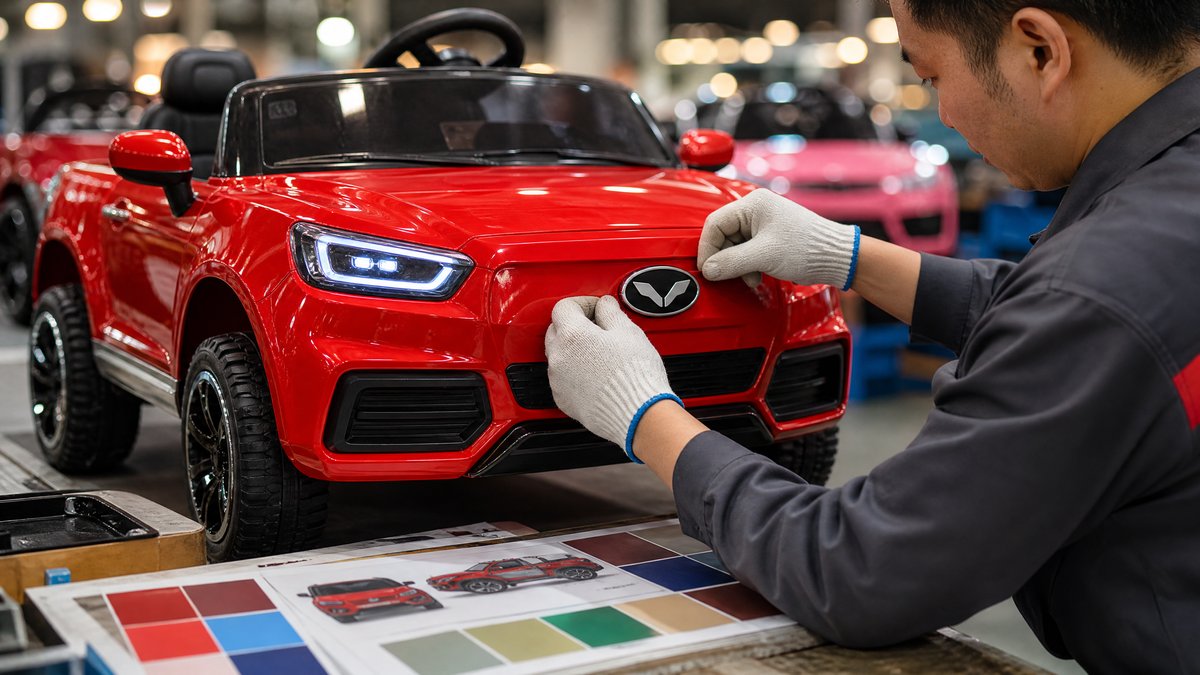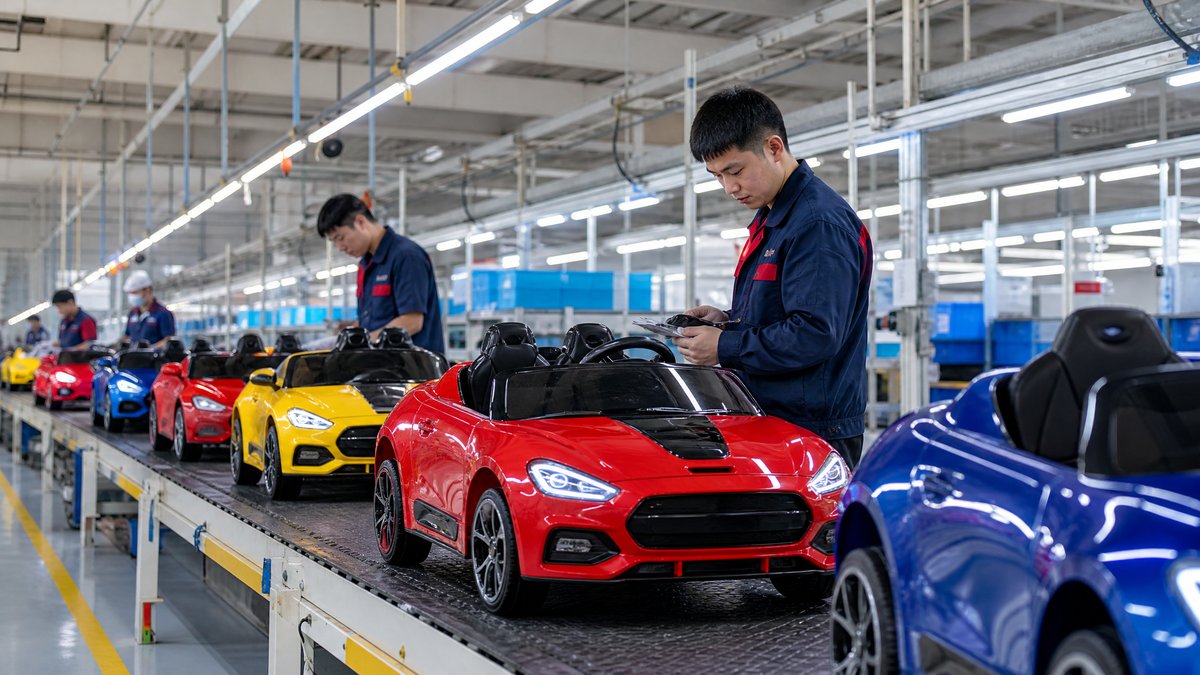
Private labeling lets an importer, wholesaler, distributor, or retailer sell a selected ride-on car model under its own brand while working with a manufacturer on branding, packaging, product documentation, sample approval, and export delivery. The practical sequence is: choose a suitable base model, define the destination-market requirements, provide brand assets, approve artwork and a physical sample, lock the production specification, inspect the finished order, and ship with the right documents. The most reliable projects treat the approved sample and written specification as the production baseline—not a rough visual concept.
For a practical starting point, email KidsRideCar to discuss a private-label brief with your target country, preferred product type, sales channel, estimated quantity, and launch window.
What private labeling means for ride-on car buyers
In a private-label program, the buyer normally starts with an existing vehicle platform and customizes the elements that will represent its brand. This differs from developing a completely new product, which may require new engineering, tooling, validation, and a longer decision process.
Common private-label elements include:
- A logo on the vehicle, seat, steering wheel badge, dashboard decal, or carton;
- A selected body color or approved color combination;
- Retail packaging artwork, master-carton marks, and shipping marks;
- An instruction manual, warning labels, and warranty or after-sales inserts adapted for the intended market; and
- Spare-parts labeling, SKU conventions, barcode placement, and batch-identification requirements.
The level of customization should fit the commercial objective. A retailer testing a new branded category may prioritize a clean logo application and retail-ready carton. A distributor building a long-term range may need a coordinated manual, carton system, replacement-parts list, and consistent packaging across multiple models.
> Important: Private labeling does not automatically make a model ready for every country. Product specifications, labeling, instructions, documentation, battery transport rules, and destination-market requirements must be verified for the selected model and the destination market before production and shipment.
Private label vs. deeper OEM/ODM customization
Use the following comparison to decide what to request before artwork begins.
| Buying route | Typical scope | Best when | Buyer decisions to lock early | Main watch-out |
|---|---|---|---|---|
| Private label on an existing model | Brand identity, decals, color options where available, packaging, inserts | You want a faster route to a branded range using an established platform | Model, target market, logo position, packaging level, quantity | Do not assume a visual change is the only change needed for market readiness |
| OEM customization | Private label plus a broader set of specified product or packaging changes within an existing platform | You need differentiated features or a distinct retail presentation | Detailed specification, component requests, artwork, sample and acceptance criteria | Each requested change can affect cost, lead time, documentation, or validation needs |
| ODM / new development | A new or substantially redesigned product concept | Your program needs proprietary design direction or product differentiation beyond existing platforms | Product brief, target user, markets, design ownership terms, tooling and validation plan | Requires a separate development, approval, and market-compliance plan |
If you are comparing established product options, use the [KidsRideCar product lineup](/) to shortlist body styles before requesting an OEM/ODM discussion. For private label, it is usually more efficient to narrow the shortlist to a manageable set of models and identify the intended market for each one.
The end-to-end private-label workflow
1. Build a buyer brief before requesting a quotation
A clear brief reduces avoidable revisions. It should describe the commercial program as well as the product.
Include these essentials:
- Destination market(s): country or region, plus intended language(s);
- Sales channel: wholesale, store retail, e-commerce, marketplace, promotional program, or another channel;
- Product shortlist: preferred body style, age positioning, seating configuration, and feature priorities;
- Brand assets: logo files, color references, brand guidelines, packaging references, and barcode requirements;
- Order structure: estimated quantity by model/color, target launch date, and whether mixed models or spare parts are needed;
- Service plan: warranty wording, spare-parts approach, support contact, and any return-handling process; and
- Market-readiness questions: required labels, instructions, documentation, import marks, and battery transport route.
Ask the supplier to respond model by model. A specification that works for one platform may not apply to another configuration or market.
2. Select the base model and freeze the commercial specification
Product selection comes before branding because the vehicle’s construction, features, carton format, and intended age positioning influence the rest of the project. At this stage, compare the models against your actual assortment and logistics needs—not only product photographs.
A useful model-selection discussion covers:
- The available versions, color choices, and optional components for that specific model;
- Whether branding locations are molded, printed, labeled, or applied as decals;
- Pack-out configuration, assembly expectations, and carton dimensions for the selected version;
- The supplied battery and charger configuration, plus compatible replacements;
- Available documentation and the need to adapt it for your market; and
- Proposed quality checks and spare-parts support.
Record the agreed configuration in a product specification sheet. It should identify the model code, color, approved components, logo locations, packaging version, label text, instruction-manual version, and the documents expected at shipment. Keep revisions controlled; an untracked change to a battery, charger, label, or component can make the sample no longer representative of production.
3. Confirm market requirements before finalizing labels or packaging
A brand mark, retail claim, or package redesign should not be approved in isolation. The importer or brand owner should establish which requirements apply in its destination market and obtain appropriate professional or regulatory guidance where needed.
For example, the U.S. Consumer Product Safety Commission (CPSC) explains that children’s toys subject to its requirements may involve testing, certification, producer markings, tracking labels, labeling, and instructional literature; its guidance specifically discusses battery-operated toys and certain ride-on toys.[CPSC Toy Safety Guidance][cpsc-toy-safety] In the EU, the European Commission states that toys placed on the EU market must be safe and bear CE marking, and describes responsibilities involving safety assessment, technical documentation, traceability, instructions, safety information, and warnings.[European Commission: Placing Toys on the EU Market][eu-toys]
These official sources are starting points, not a blanket approval for any ride-on car. The product’s classification, intended age, product configuration, wireless or electronic functions, applicable standards, local language rules, importer details, and national requirements can all matter. Verify the current requirements with the relevant destination-market authority or qualified compliance adviser for the selected model.
#### Market-readiness checklist
| Item to verify | Questions the buyer should answer | Evidence or output to request/control |
|---|---|---|
| Intended market and product scope | Where will the product be offered? How is it marketed and age-graded? | Destination-market requirement list and internal compliance decision record |
| Product configuration | Which battery, charger, electronics, remote control, and accessories are included? | Locked model specification and bill-of-material/change-control confirmation |
| Labels and warnings | Which warnings, languages, traceability details, importer details, and marks are required? | Approved label artwork and placement map |
| Instructions | Who assembles, charges, supervises, maintains, and disposes of the product? Which languages are required? | Approved market-specific manual and warning copy |
| Documentation | What technical, declaration, test, certification, or shipment documents are needed? | Document checklist tied to model and destination market |
| Transport | Is the battery installed, packed with the equipment, supplied separately, or shipped by another route? | Freight-forwarder confirmation and applicable battery shipping documentation |
| Retail data | What SKU, barcode, country-of-origin statement, carton marks, and listings data are needed? | Retail data sheet and approved carton/shipping-mark artwork |
4. Prepare artwork that production can use
Private-label artwork is more than a logo file. It is a controlled package of files and instructions that tells production exactly what to print, apply, and include.
Provide editable vector logo files when possible, the approved brand colors, and minimum-size or clear-space rules. Then ask for a visual proof that shows each branding element in context. Review it at normal viewing scale and at close range; a mark that looks fine on a large carton may be unreadable on a small dashboard decal.
The artwork pack should normally distinguish between the following pieces:
| Artwork component | What should be specified | Why it matters |
|---|---|---|
| Vehicle branding | Logo file, size, color, finish, exact position, and orientation | Avoids inconsistent placement across units |
| Product and compliance labels | Approved text, languages, required information, substrate, and placement | Connects market requirements to the actual product build |
| Retail carton | Front/side panels, product name, feature copy, warnings, barcode zone, and approved proof | Aligns shelf presentation with regulatory and retail needs |
| Master carton and shipping marks | SKU, quantity, carton numbering, handling marks, destination and purchase-order information | Supports receiving, warehousing, and traceability |
| Manuals and inserts | Final text, translations, diagrams, revision code, warranty/support details | Helps ensure customers receive the intended instructions and after-sales information |
Avoid unverified claims in artwork. Do not add certifications, standards, safety claims, battery claims, licensing references, performance claims, or compatibility statements unless they have been confirmed for the selected product and destination market. Also confirm that your brand assets and any supplied images or character/design references are authorized for your planned use.
5. Approve pre-production artwork and packaging samples
Before a physical product sample is built, approve the digital proofs that form the production artwork package. This is the moment to catch incorrect contact details, missing languages, wrong barcode placement, unsuitable translations, or a logo color that does not reproduce as intended.
For packaging, ask to see how the physical carton proof or sample reflects the final print method, finishes, inserts, labels, and pack-out arrangement. If your channel has retailer-specific carton, pallet, labeling, or electronic-data requirements, include them at this stage rather than after mass-production cartons are printed.
6. Review a physical sample against a written acceptance checklist
The physical sample is the buyer’s opportunity to confirm that the selected model and custom work match the written specification. It should be checked as a complete package: vehicle, decals, labels, charger/battery configuration, manual, inserts, retail carton, and relevant shipping marks.
Use an approval sheet rather than relying on informal messages. The sheet can include photos, revision codes, dates, and a clear decision: approved, approved with documented corrections, or not approved.
#### Sample approval checklist
- [ ] Model and approved configuration match the purchase specification.
- [ ] Brand marks, colors, decals, and placement match the approved artwork.
- [ ] Product labels show the approved wording, languages, and location.
- [ ] Instructions, safety information, warranty/support insert, and revision number are correct.
- [ ] Retail carton, master-carton marks, SKU, barcode area, and pack-out match approved proofs.
- [ ] Assembly, charging, operating, and supervision information is complete for the intended market.
- [ ] The battery, charger, remote control, and included accessories match the specified configuration.
- [ ] Required documents have been reviewed for applicability to the selected model and market.
- [ ] Any defects, changes, or open points are recorded and resolved before mass production.
- [ ] The signed sample-approval record defines the mass-production reference.
A sample is not a substitute for the buyer’s destination-market due diligence. If a component or label changes after approval, revisit the relevant documentation, labels, packaging, and required checks before authorizing production.
7. Convert approval into production controls
Once the sample is approved, both parties should confirm a production pack that includes the final specification, artwork files, packaging version, approved sample photos, inspection criteria, document list, shipment terms, and change-control process.
For buyers, a practical quality plan can include:
1. Pre-production confirmation: Verify the model, materials/components requested, branding files, labels, and packaging version before the line begins.
2. In-process review: Check early units and printed materials against the approved sample, especially items that cannot be economically corrected later, such as printed cartons and permanently applied labels.
3. Pre-shipment inspection: Compare finished units, pack-out, markings, quantities, and visible workmanship with the approved sample and purchase specification.
4. Document reconciliation: Match the final model/configuration and shipment details to the documents requested for your market and transport route.
The exact inspection approach should be agreed in the purchase terms. Define how deviations will be reported and who can authorize a production change. A written process is especially valuable when the order includes several models, colors, or markets.
8. Plan shipment and battery transport early
Battery-powered goods require logistics planning before cargo is booked. The transport route, battery chemistry, rating, battery condition, and whether batteries are contained in, packed with, or shipped separately from equipment can affect packaging, marks, labels, documentation, and carrier acceptance.
The International Air Transport Association (IATA) notes that whether lithium batteries can be carried by air depends on configuration and relevant battery rating information, and directs shippers to current battery guidance and dangerous-goods requirements.[IATA battery guidance][iata-batteries] Do not apply a generic battery-shipping assumption from another product or prior order. Have the appointed freight forwarder or carrier confirm the current, route-specific requirements for the selected model and battery arrangement before shipment.
Your shipping handover should reconcile at least:
- Final commercial invoice and packing list;
- Purchase-order, SKU, carton, and quantity information;
- Destination-specific documents requested for the selected model;
- Battery and dangerous-goods documents or declarations, when applicable;
- Bill of lading or air waybill instructions, consignee details, and shipping marks; and
- Spare-parts and after-sales documentation, if ordered.
Common private-label mistakes—and how to prevent them
Approving visuals without defining the product version
A branded rendering may not show the exact charger, battery, seat material, remote control, or included accessory. Prevent this by approving the artwork and a model-specific product specification.
Treating certifications as transferable marketing artwork
A test report, certificate, mark, or declaration may be product-, configuration-, production-, or market-specific. Never copy a logo or claim onto a package merely because a similar model or a previous order had it. Verify applicability for the selected model and destination market with the relevant authority or qualified adviser.
Leaving translations and warnings until the carton is printed
Late language changes can affect labels, manuals, carton panels, and inserts. Identify required languages, required information, and your importer/distributor details before final proof approval.
Failing to freeze the approved sample
If logos, components, packaging, or battery configuration change after sample approval, the original sample may no longer represent production. Use revision codes and require written approval for changes.
Booking freight before confirming battery handling
A forwarder needs accurate data about the selected battery configuration and shipping arrangement. Confirm current requirements early; this reduces the risk of late repacking, document corrections, or a missed sailing/flight.
FAQ: private labeling kids electric ride-on cars
1. What is the minimum information needed to start a private-label inquiry?
Provide your target country, estimated quantity, product type or shortlist, target sales channel, branding scope, and expected launch date. Include logo files or reference images if available. The supplier can then indicate which customization options may be available for the specific models.
2. Can I put my logo on both the ride-on car and the packaging?
Usually, a private-label brief can request branding on the product and packaging, subject to the selected model and the manufacturer’s production options. Confirm the exact logo locations, print method, artwork format, minimum quantities, and final proof before approval.
3. Do I need a product sample before placing a bulk order?
A physical sample is strongly recommended when branding, packaging, labels, manuals, or product options are being customized. It gives the buyer a reference for approving the complete product presentation and documentation. Agree in writing which sample details constitute the mass-production standard.
4. Who is responsible for destination-market compliance?
Responsibilities vary by jurisdiction and supply-chain role. Importers, manufacturers, distributors, and brand owners may each have obligations. The buyer should verify the applicable requirements with the destination-market regulator or a qualified compliance professional for the selected model; the supplier should provide accurate model-specific information and documentation within the agreed scope. For U.S. and EU starting points, see the official [CPSC guidance][cpsc-toy-safety] and [European Commission guidance][eu-toys].
5. Can a battery-powered ride-on car ship by air?
It depends on the battery type, rating, configuration, packaging, carrier, and route. IATA maintains [battery transport guidance][iata-batteries], but the buyer should obtain current confirmation from its freight forwarder or carrier for the exact battery arrangement and shipment route.
6. What should I keep after shipment for future reorders?
Keep the approved sample record, final specification, artwork source files, packaging and manual revisions, inspection records, shipment documents, and any market-relevant documentation. These records make reorders, spare-parts planning, and controlled product updates more manageable.
Build a private-label program that is ready to scale
Private labeling works best when each decision connects to the next: the chosen model drives the specification; the specification informs labels, packaging, and documents; the approved sample sets the production reference; and the confirmed battery/logistics plan supports a clean shipment handover. Start with an existing model when speed and brand consistency matter, then add customization only where it supports your market and channel.
Ready to map your product shortlist, branding scope, sample plan, and shipment requirements? Contact KidsRideCar at info@kidsridecar.com and include your target market, expected volume, desired model type, and brand assets. You can also explore the [KidsRideCar blog](/blog) for related sourcing and product-planning topics.
Image planning
| Suggested dimensions | Placement | English caption | Alt text | English AI prompt |
|---|---|---|---|---|
| 1600 × 900 px | Below the introduction | “From base model to branded retail-ready shipment: a structured private-label workflow.” | “Private-label workflow for kids electric ride-on cars from model selection to shipment.” | “Clean editorial B2B infographic, horizontal 16:9, showing a kids electric ride-on car private-label workflow with seven connected stages: model selection, market requirements, logo artwork, packaging, physical sample, production approval, global shipment. Modern blue and white manufacturing aesthetic, generic unbranded ride-on vehicle, clear icons, no company logos, no certification marks, no readable small text.” |
| 1400 × 900 px | In the “Prepare artwork” section | “Artwork approval turns brand assets into controlled production instructions.” | “Designer reviewing branded packaging and decal proofs for a kids ride-on car.” | “Professional B2B product-development scene in a bright office: a designer and sourcing manager reviewing generic ride-on car decal sheets, carton dielines, instruction manual pages, color swatches, and a small unbranded kids electric ride-on car sample. Realistic editorial photography, clean modern composition, no visible trademarks, no fake certification logos, 3:2 landscape.” |
| 1400 × 900 px | In the “Review a physical sample” section | “A physical sample should be reviewed as a complete product, packaging, and documentation set.” | “Quality inspector comparing a branded kids ride-on car sample with packaging and checklist.” | “Factory quality-control scene, landscape 3:2: inspector reviewing a generic kids electric ride-on car sample beside an open retail carton, user manual, label-placement diagram, and printed checklist on a clipboard. Professional industrial lighting, realistic, no company logos, no readable certifications or misleading labels.” |
| 1600 × 900 px | In the “Plan shipment and battery transport” section | “Shipment planning links the finished product, packaging, documents, and confirmed battery handling route.” | “Palletized cartons of generic kids electric ride-on cars prepared for export shipment.” | “Realistic B2B logistics photo, horizontal 16:9: neatly palletized plain cartons for generic kids electric ride-on cars in a warehouse loading area, a shipping coordinator checking a packing list and cargo labels at a distance. Clean export logistics setting, no brand logos, no hazardous-goods labels shown in close-up, no readable small text.” |
Official sources
[cpsc-toy-safety]: https://www.cpsc.gov/Business--Manufacturing/Business-Education/Toy-Safety "U.S. Consumer Product Safety Commission: Toy Safety Business Guidance"
[eu-toys]: https://single-market-economy.ec.europa.eu/sectors/toys/placing-toys-eu-market_en "European Commission: Placing toys on the EU market"
[iata-batteries]: https://www.iata.org/en/programs/cargo/dangerous-goods/lithium-batteries/ "International Air Transport Association: Batteries"
Official references
Explore these external resources for current regulatory and trade guidance. Confirm requirements with the relevant authority before placing an order.
Ready to Start?
Factory-Direct · CE & ASTM Certified · MOQ from 50 Units
Our export team works with buyers in 60+ countries. Get a quote within 24 hours.
KR
Written by KidsRideCar
China's leading kids electric ride-on car manufacturer. 500,000+ units shipped annually to 60+ countries. CE, ASTM & EN71 certified.