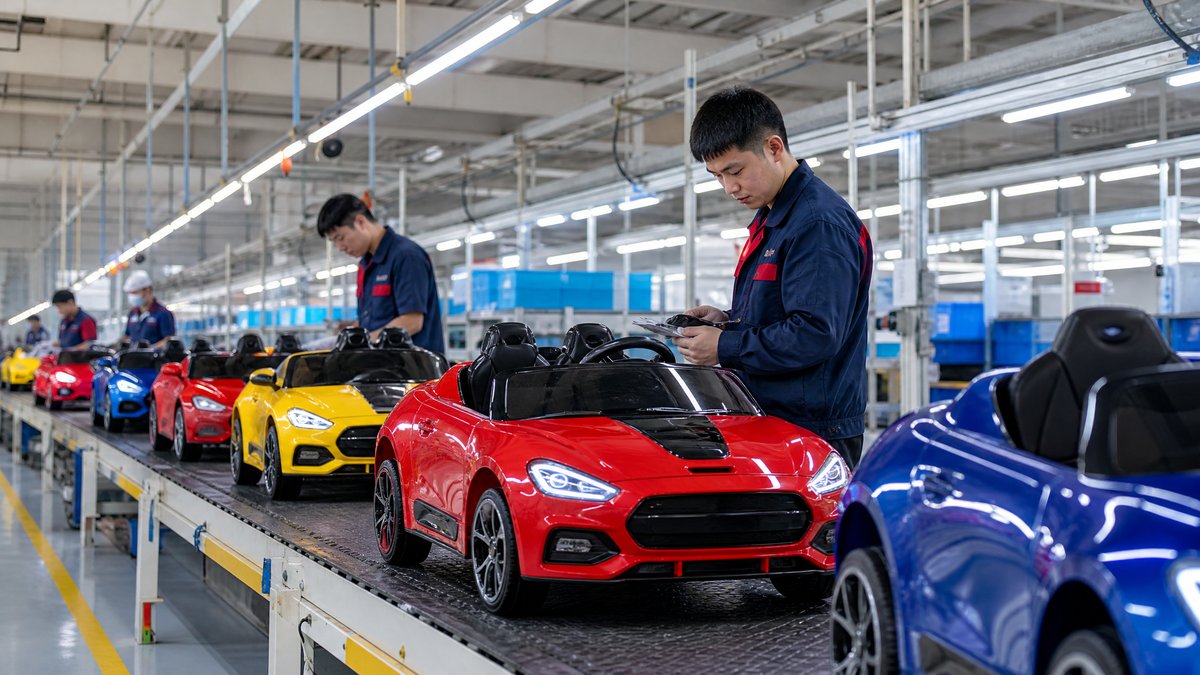
For an importer, wholesaler, distributor, retailer, or OEM buyer, assembly instructions are more than an insert in a carton. They influence warehouse labor, returns, support tickets, retailer training, and product consistency. Two suppliers may quote similar vehicles, yet one may provide a clear, model-specific manual while the other sends a generic document with missing steps and unlabeled hardware.
A useful comparison therefore looks beyond page count or graphic design. Buyers should assess whether the instructions match the approved model, show the actual parts, explain safety-critical checks without inviting unsafe repairs, and can be localized for the destination market. Request the latest draft before purchase, compare it with a physical sample, and make manual approval part of the same process as product, packaging, and compliance-file approval.
1. Confirm that the manual is model-specific and revision-controlled
Start with identity. The manual should state the supplier name or brand, product/model code, revision or issue date, and any relevant voltage or configuration distinction. A document labeled only “kids car manual” is difficult to control when a factory offers several bodies, wheel types, battery systems, or dashboard layouts.
Compare the manual against the approved sample and packing list. Check the body shape, seat, wheels, steering wheel, dashboard, charger connection, remote control, and accessory layout. Illustrations do not need to be photographic, but they should make the correct part recognizable. If a diagram shows a connector, screw location, or wheel style that is absent from the sample, ask for correction rather than asking downstream teams to interpret it.
Ask how changes are handled. A supplier should be able to identify what happens when a connector, fastener, control panel, packaging configuration, or accessory changes. A simple revision table can record the date, affected model, change summary, and approval status. Set a rule that no revised manual is packed until the buyer approves the new version. Keep the approved PDF and editable source, where available, in the product data folder with the purchase order and sample record.
2. Score assembly clarity, sequence, and hardware identification
A strong manual lets a reasonably trained adult assemble the product in the intended order without guessing. Review whether it begins with a parts inventory, tools list, and preparation notes, then progresses through a logical sequence. Typical steps may include fitting wheels, steering components, seat or trim parts, and other external accessories. The document should distinguish left and right parts, front and rear orientation, and hardware sizes where those distinctions matter.
Use a practical clarity test with people who were not involved in sample approval. Give them the manual and unpacked parts without coaching, and record where they hesitate. Look for ambiguous arrows, crowded drawings, tiny labels, missing views, and unexplained abbreviations. The goal is to identify preventable assembly questions.
Hardware control deserves special attention. The manual should show or name screws, washers, nuts, clips, and caps in a way that matches the bag labels or carton compartments. If two fasteners look similar but have different lengths or locations, the distinction should be visible. A parts table can include a reference number, plain-language name, quantity, and illustration. Ask the supplier to reconcile the table with the bill of materials and packing checklist.
Do not accept “tighten everything” as the only guidance where a sequence or fit check is important. The supplier should state when a part must be seated correctly and when an adult should verify the result. Instructions should not encourage users to open battery packs, bypass protective devices, rewire circuits, solder connections, or perform internal repairs. Electrical faults should go through the supplier’s approved after-sales process or a suitably qualified service provider.
3. Check safety, charging, and first-use information
Assembly documentation should include clear warnings appropriate to the product and destination market, without making unsupported legal claims. Review age grading, supervision language, maximum user or load information where supplied by the manufacturer, intended surface or use limits, and warnings about small parts during assembly. The wording must be consistent with the product label, packaging, listing data, and compliance file.
Separate assembly from operation. After the physical steps, the manual should explain the basic pre-use inspection: confirm that externally fitted parts are secure, controls operate as described, and no packaging material or loose hardware remains. It should tell the buyer to stop using the product and contact the supplier if damage, unusual behavior, or a missing part is found. Avoid manuals that imply a visual assembly check proves overall product safety.
Charging information should identify the supplied charger and its intended connection, explain basic adult supervision and dry-location precautions, and state that only the specified charger or an approved replacement should be used. Storage and disposal information should be consistent with the battery type and the destination market’s requirements. Do not approve instructions that propose charging with an arbitrary adapter, modifying wiring, bypassing a fuse or controller, or opening a sealed battery.
Ask for a destination-specific review. Market compliance must be confirmed for the destination market and model; a manual suitable for one country or voltage configuration may not meet another market’s needs. Treat it as one part of the compliance file, not a substitute for required testing, declarations, technical records, or importer responsibilities.
4. Evaluate localization, accessibility, and retail readiness
For international distribution, compare translations for meaning, not merely word count. A professional translation should preserve warnings, part names, button labels, units, and sequence. Require the supplier to explain which languages are included and whether the layout has been checked after translation. Machine-translated safety text with inconsistent terminology can create customer confusion and increase service calls.
Check typography and accessibility. Text should be legible at the printed size, diagrams should remain readable in grayscale if relevant, and warning panels should not be hidden in dense paragraphs. Icons can support understanding, but they should not replace necessary written information where the market requires text. Consider whether the manual works as both a printed insert and a downloadable PDF for retailer support or replacement requests.
Ask whether the document can carry your private-label identity without obscuring the manufacturer’s model traceability or required information. Review the cover, contact details, QR codes, copyright, and file name. A QR code should lead to a stable, buyer-approved resource rather than an unverified or changeable page. If you plan to build a support hub, place the approved manual under a suitable product page such as `/products/kr-s900`, `/products/kr-l700`, or `/products/kr-t600` only after confirming that the model and content match.
Retail readiness also means consistency. Compare the manual with carton graphics, quick-start cards, product photography, online listings, and dealer training materials. A button called “forward” in the manual should not be called “drive” in the listing unless the distinction is intentional. If your team maintains a central `/blog` resource area, use it for general buyer education, but retain the model-specific manual as the controlled product document.
5. Compare supplier support, spare parts, and approval discipline
The document itself is only part of the supplier’s documentation capability. Ask how the supplier handles missing hardware, damaged parts, translation corrections, and field-reported manual errors. A useful handover pack may include the approved manual, parts list, exploded view where appropriate, charger information, remote-control pairing guidance, replacement-parts references, and a contact route for support. The pack should identify the applicable model and revision.
Ask whether parts named in the manual can actually be ordered. Map common external replacements to part numbers or clear descriptions, and confirm spare-parts packaging and identification requirements. Do not promise availability or lead times beyond written supplier terms.
A comparison scorecard can weight model control, parts identification, sequence, safety and charging content, translation, file usability, spare-parts linkage, and change control. Score evidence, not promises; a plain, accurate manual can beat attractive graphics with weak document control.
6. Build a repeatable buyer approval workflow
Make instruction comparison a gate in sourcing rather than a last-minute packaging task. First, include documentation requirements in the RFQ: required languages, file formats, model references, parts list, revision control, and the deadline for approval. Next, request a draft with the first sample. Mark every unclear step and test the document against the physical parts.
Approve a controlled version alongside the product sample, recording open issues and owners. Before production, compare the production-intent unit and carton against the documents. Before shipment, sample cartons to confirm the correct manual is packed and no old version remains.
FAQ: Comparing ride-on car assembly instructions across suppliers
What should a buyer request before comparing manuals?
Request the latest model-specific manual, parts list, packing checklist, sample photographs or physical sample, language options, and revision history. Ask the supplier to identify differences between voltage, seat, wheel, or accessory configurations.
How can I tell whether a manual is genuinely model-specific?
Match its model code, illustrations, controls, charger information, parts, and hardware quantities against the approved sample and carton. Any unexplained mismatch should be corrected or documented before approval.
Should the manual include electrical troubleshooting?
It may include safe user-level checks such as confirming the specified charger connection and contacting support for a fault. It should not instruct users to rewire, bypass protective components, solder, open battery packs, or perform internal repairs.
Is a translated manual enough for market compliance?
No. Market compliance must be confirmed for the destination market and model. Translation is only one documentation requirement; buyers should also review applicable testing, labeling, warnings, declarations, and importer obligations with qualified local resources.
What is the best way to prevent an old manual from entering cartons?
Put the approved revision and model code in the purchase order or quality agreement, retain a controlled PDF, and verify the packed insert during pre-shipment inspection. Require the supplier to quarantine or remove obsolete versions from packing areas.
Conclusion
Comparing assembly instructions across ride-on car suppliers is a practical way to compare operational quality. Focus on model accuracy, parts and hardware identification, logical sequencing, safe charging guidance, localization, document control, and after-sales linkage. Approve the manual against the physical sample, connect it to the SKU and compliance file, and recheck it whenever the product or packaging changes. The result is fewer avoidable assembly questions, cleaner retailer support, and more consistent customer experience across markets.
For a model-specific assembly-document review, multilingual documentation discussion, or B2B sourcing inquiry, email KidsRideCar at info@kidsridecar.com with your target market, model requirements, languages, and planned sales channel.
Official references
Explore these external resources for current regulatory and trade guidance. Confirm requirements with the relevant authority before placing an order.
Ready to Start?
Factory-Direct · CE & ASTM Certified · MOQ from 50 Units
Our export team works with buyers in 60+ countries. Get a quote within 24 hours.
KR
Written by KidsRideCar
China's leading kids electric ride-on car manufacturer. 500,000+ units shipped annually to 60+ countries. CE, ASTM & EN71 certified.