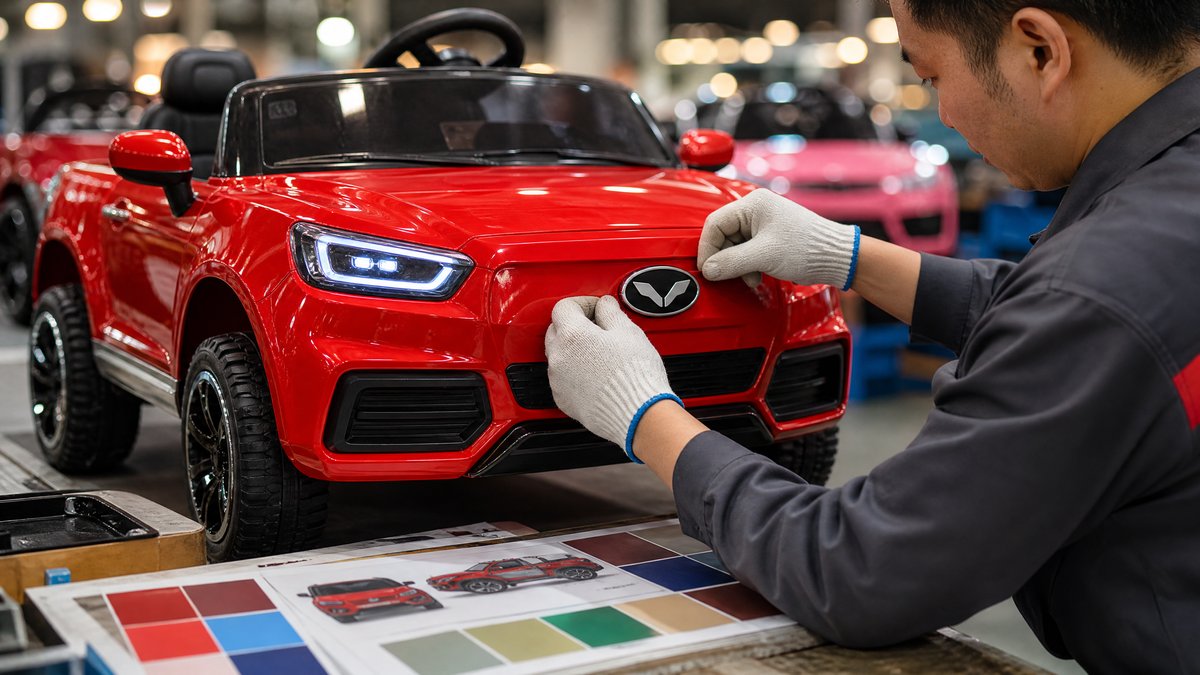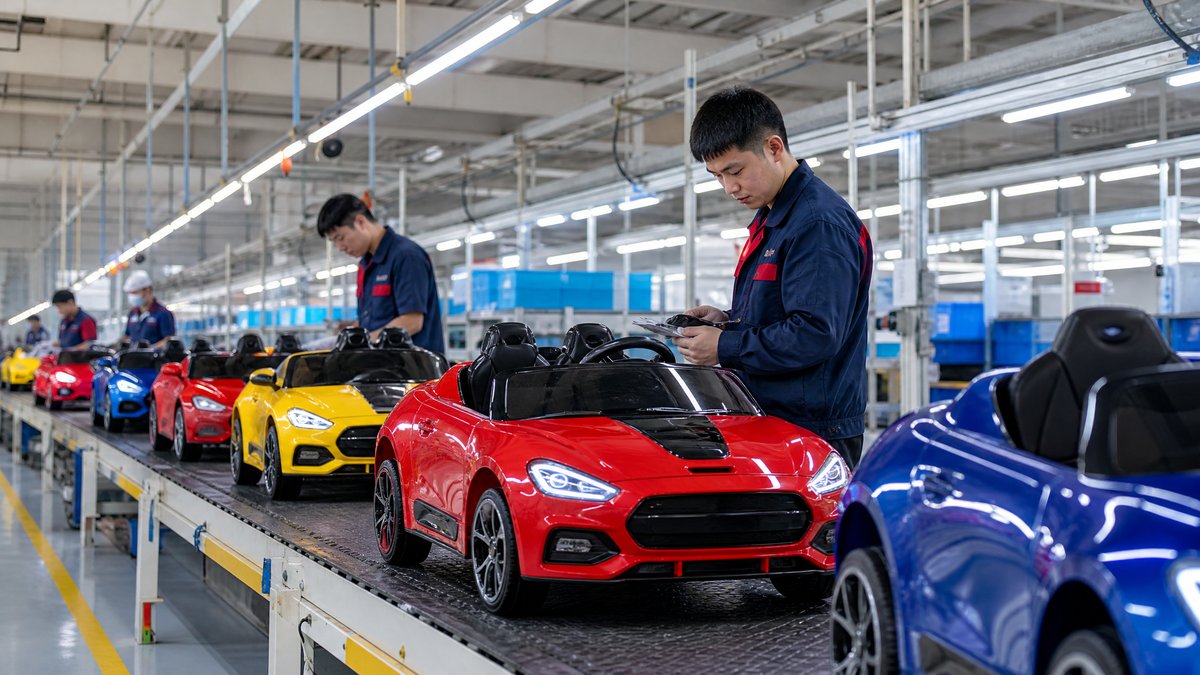
OEM buyers protect brand consistency by controlling every visible and functional detail: one approved brand-standard package, locked artwork files, defined accessory kits, traceable change approvals, and inspections against the approved master. The product, packaging, instructions, accessory pack, labels, and shipment should present the same approved brand experience in every production run.
For kids ride-on car programs, packaging and accessories can create more brand risk than the vehicle body. A carton color shift, outdated remote logo, substitute charger label, or missing fastener pack can make an order feel inconsistent. A disciplined OEM process prevents these issues before goods leave the factory.
Treat Brand Consistency as a Controlled System
A brand standard must become a production-control system. Purchasing, product, quality, packaging, and logistics teams need the same current documents. Different artwork PDFs, parts lists, or approval emails invite inconsistency.
For an OEM kids ride-on car, the controlled system should cover four connected areas:
1. Visual identity: logos, brand colors, typography, imagery, finish references, and placement rules.
2. Product presentation: vehicle decals, badges, steering-wheel marks, dashboard graphics, seat trims, and labels.
3. Packaging and documents: retail cartons, inner boxes, inserts, manuals, warning information, assembly materials, and shipping marks.
4. Accessory configuration: chargers, remotes, batteries where applicable, tools, hardware, adapters, flags, covers, and other included items.
The practical principle is simple: no production-facing item should be governed by an informal description such as “use the usual logo” or “same accessory set as last time.” Each item needs a reference, revision, and acceptance rule.
Create a Brand Control File Before Production
The foundation is a concise brand control file: the approved reference set that tells the supplier what to reproduce and how to identify the current version.
At minimum, include the following in the file:
- Approved vector logo files and permitted color versions.
- Defined color references, including print color targets and product decoration guidance where relevant.
- Artwork placement drawings for cartons, labels, decals, and accessories.
- Approved packaging dielines and carton-panel layouts.
- A master bill of materials for branded and unbranded components.
- Product, accessory, and packaging photographs or approved physical “golden samples.”
- Required copy, language versions, barcodes, SKU references, and date or batch-coding instructions.
- A revision log that names the owner, date, change reason, and affected items.
Give every document a number and revision code, and use it on the purchase order, artwork approval, sample sign-off, and inspection plan. This prevents a newer carton file from reaching the factory while an accessory supplier uses an older label file.
Build Strong Artwork Control Into the Purchase Process
Artwork control is often where brand consistency succeeds or fails. An email preview may conceal errors in scale, color conversion, text, barcode, or dieline.
Use a Single Source of Truth
Nominate one buyer-side person or team to release artwork. Suppliers should receive final files only through that controlled channel, not through scattered chat messages or forwarded attachments. Establish a clear rule that only files marked “released for production” may be used for mass production.
Maintain a release register with the file name, version, file type, affected SKU, release date, and approval status. Ask the supplier to acknowledge receipt and confirm that obsolete versions have been withdrawn from relevant workstations and subcontractor folders. This is especially important when carton printing, label making, manual printing, and accessory assembly are performed by different parties.
Approve Proofs at the Right Level
A PDF artwork approval is necessary but not always sufficient. The buyer should decide which approvals are needed for the risk level of the item:
- Digital proof: confirms text, layout, images, and required identifiers before printing.
- Color or contract proof: supports review of color appearance when this is important to the brand presentation.
- Physical mock-up or pre-production sample: confirms size, folding, substrate, finish, readability, and interaction with the product.
- Golden sample: becomes the retained, signed reference for later production checks.
When approving, review the whole customer-facing piece, including panel orientation, barcode, language, images, safety copy, and the pictured variant. The contents should match the vehicle and accessory configuration shown.
Do not treat a print proof as evidence that all destination-market requirements have been met. Buyers should verify current labeling, product, packaging, and destination-market requirements with the responsible authorities, qualified advisers, or other appropriate sources for the markets they serve.
Define Artwork Tolerances and Escalation Rules
Define critical errors—such as a wrong logo, missing text, incorrect SKU or barcode, unauthorized image, wrong language, or misplaced graphic—separately from agreed, acceptable print variation.
If a supplier sees a file conflict, material issue, or proposed substitution, require written buyer approval before proceeding. A verbal discussion may explain a change; written approval is the release record.
Specify Accessories as Part of the Branded Product
Accessories are not an afterthought. They are a key part of unboxing, assembly, usability, and perceived quality. A carefully branded ride-on car can still disappoint when the accessory pack appears generic, incomplete, or inconsistent with the carton description.
Start With an Accessory Matrix
Create an accessory matrix for each SKU and market configuration. This table should identify every item supplied in the box, including quantities, material or model references, branding status, packaging method, inspection point, and approved alternative status. Examples may include:
- Charger and its label or instruction information.
- Remote control, where included, plus pairing or operating instructions.
- Battery-related components where applicable.
- Assembly hardware, tools, caps, and protective covers.
- Seat belts, mirrors, windshields, flags, decals, or replacement trim pieces when included.
- Printed manuals, quick-start cards, warranty cards, and promotional inserts.
Avoid loose wording such as “one charger suitable for the product.” Instead, identify the approved configuration and its required label language, plug or adapter arrangement if relevant, packaging, and compatibility reference. Any electrical or battery-related component should be handled according to the product design and manufacturer instructions. Buyers should not request unapproved electrical substitutions or modifications.
Control What the Customer Sees First
Many accessory errors are visible immediately after opening the carton. The accessory pack should have a defined location, packing method, and count. If hardware is packed in bags, specify bag identification and seal expectations. If an instruction manual is placed at the top of the pack, show this in the packing diagram. If accessories are meant to be protected from contact with painted surfaces, document the protective material and placement.
Manage Substitutions Carefully
For any proposed accessory substitution, require the reason, affected SKU, photographs or samples, compatibility information, documentation changes, and a clear statement of the difference.
The buyer should obtain manufacturer approval for changes and document the decision before use. Consider the impact on brand appearance, fit, function, packaging, customer instructions, service parts, and destination-market obligations. Do not assume that a component with a similar appearance is interchangeable.
Add Production Checks at the Points Where Errors Occur
Final inspection alone is too late to control every packaging or accessory problem. A more dependable approach places checks at the moments when an error can be stopped with the least disruption.
Pre-Production Check: Confirm the Master Set
Before mass production, confirm the purchase order, SKU, bill of materials, released artwork, packaging, accessory matrix, packing map, and approved sample. The supplier should identify the documents for each line or subcontractor.
Also confirm traceability: cartons, labels, product batches, and accessory packs should link to practical batch or lot information for complaint investigation.
In-Process Check: Verify First-Off Output
Ask the supplier to inspect and retain first-off examples of printed cartons, labels, manuals, decals, and assembled accessory packs. Compare these against the approved master before full output proceeds. For a branded program, an early check may include product decoration as well as packaging.
The check should examine the most error-prone details: logo version, color appearance, text, language, barcode, product image, correct accessory count, label placement, and carton configuration. Record results, exceptions, and approvals. If something differs from the master, clarify whether it is a production issue, an approved change, or a document-control issue before continuing.
Pre-Shipment Check: Audit the Finished Customer Experience
A pre-shipment check should take a finished, packed unit through the same visual sequence a customer would experience. Inspect the vehicle, installed graphics, carton, inner protection, manual, accessory pack, and shipping labels as one system. This helps reveal mismatches that separate component checks may miss.
Useful questions include:
- Does the carton identify the same variant that is inside?
- Are the product images, logo, SKU, barcode, and language correct for the order?
- Does the accessory pack match the approved matrix and packing map?
- Are instructions and labels present, readable, and consistent with the supplied configuration?
- Are there visible packaging defects that undermine the intended brand presentation?
- Is batch or order traceability available for the finished unit?
Document the result with photos, counts, observations, and the document revision reviewed. If an issue is found, record the containment action and disposition rather than relying on an informal promise to fix it.
Make Change Control a Commercial Requirement
Brand consistency becomes fragile when commercial teams negotiate a change without connecting it to artwork, accessories, and production records. Put change control into the purchase terms or quality agreement where appropriate. Define what counts as a change, who may approve it, and what evidence is required.
Changes that commonly need review include artwork edits, packaging materials, carton dimensions, component color, accessory source, accessory pack contents, label copy, instruction revisions, product decoration, and pack-out arrangement. The process should require a written change request, impact assessment, buyer approval, updated master documents, and confirmation of effective production date or batch.
Keep old and new versions separate. If a transition is approved, define whether existing inventory may be used, which orders receive the revised version, and how mixed stock will be avoided. This is particularly important for seasonal retail programs and multiple distributor orders that use similar products with different brand identities.
Coordinate Procurement, Quality, and Marketing Without Slowing Orders
The best process is clear enough to be used under real purchasing deadlines. Give every function a focused role:
| Team | Primary responsibility |
|---|---|
| Marketing or brand owner | Owns visual standards and approves brand-facing changes. |
| Product or engineering | Confirms product configuration and whether a proposed change affects fit, function, or instructions. |
| Procurement | Places only the approved specification on the order and controls commercial communication. |
| Quality team | Sets inspection points, compares output with the master, and records nonconformities. |
| Supplier project lead | Distributes released documents, controls subcontractor use, and reports issues early. |
A short readiness checklist can prevent avoidable delays. Before approving production, ask whether the SKU is frozen, artwork is released, accessory contents are confirmed, print proofs are approved where required, packing instructions are available, and inspection criteria are understood. The answer should be documented rather than assumed.
Protect Safety and Compliance Communication in the Brand System
Brand presentation must not obscure safe use or responsible product information. Packaging, manuals, and labels should retain clear, legible instructions and safety information appropriate to the product and market. Use model-neutral safety language: children should use ride-on products with adult supervision and in accordance with the manufacturer’s instructions. Do not encourage modifications, use of unapproved components, or operation outside the product’s intended conditions.
For orders involving batteries or battery-powered products, buyers should verify current destination-market requirements and applicable battery-transport requirements with responsible authorities, carriers, and qualified compliance resources. Requirements and carrier rules can change, and the buyer should confirm them for the actual battery configuration, shipment route, and transport mode. Artwork or packaging updates should never be treated as a substitute for that verification.
FAQ
How early should OEM buyers approve packaging artwork?
Approve the released production artwork before print purchasing or mass production begins. For higher-risk retail packaging, also review a physical proof, mock-up, or first-off sample when appropriate. Early approval is only effective if the approved version is then locked and distributed through a controlled release process.
What is the best way to avoid missing ride-on car accessories?
Use a SKU-specific accessory matrix and a packing map. Specify every included item, quantity, pack method, and inspection point. Confirm the matrix at pre-production, verify the first assembled pack during production, and audit completed cartons before shipment.
Can a supplier change a charger, remote, or other accessory if the original is unavailable?
Not without a controlled review and written buyer approval. The buyer should obtain manufacturer approval for changes, assess compatibility and documentation impacts, and confirm that labels, instructions, packaging, and destination-market obligations remain appropriate. Similar appearance alone is not enough to approve a substitute.
What should be kept as the brand reference for future orders?
Retain released artwork, revision history, approved proofs, product and packaging photographs, accessory matrices, packing maps, inspection reports, and a signed or otherwise clearly identified golden sample where practical. These records make repeat orders faster and provide an objective reference if a discrepancy arises.
Is a final random check enough to protect the brand?
A final check is valuable, but it should not be the only control. Problems are easier to prevent when checks occur before production, at first-off output, during accessory packing, and at pre-shipment. Layered checks reduce the chance that a wrong file or missing component reaches finished goods.
Conclusion: Make Consistency Measurable
For OEM buyers, brand consistency across kids ride-on car packaging and accessories comes from controlled decisions, not visual hope. Establish one approved brand master, release artwork through a documented process, define every accessory at SKU level, and verify the output at pre-production, in-process, and pre-shipment stages. Clear ownership and written change control help turn a branded program into a repeatable procurement process.
If you are planning a branded kids ride-on car program and need to align packaging, accessories, and production checks, contact the KidsRideCar team.
For a discussion about your OEM specification and artwork-control process, email info@kidsridecar.com.
Official references
Explore these external resources for current regulatory and trade guidance. Confirm requirements with the relevant authority before placing an order.
Ready to Start?
Factory-Direct · CE & ASTM Certified · MOQ from 50 Units
Our export team works with buyers in 60+ countries. Get a quote within 24 hours.
KR
Written by KidsRideCar
China's leading kids electric ride-on car manufacturer. 500,000+ units shipped annually to 60+ countries. CE, ASTM & EN71 certified.