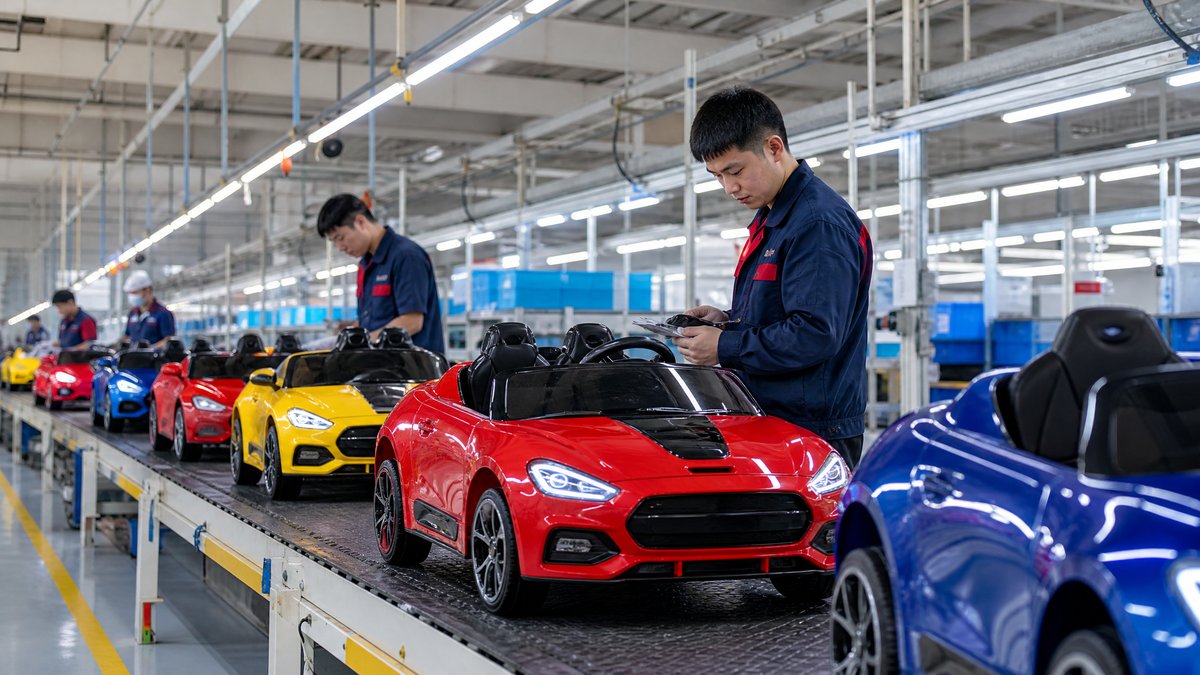
Importers should confirm that a drop-test plan reflects the actual carton, packed ride-on car, and distribution route they will buy. It should define the package configuration, sample selection, conditioning, drop sequence, inspections, acceptance criteria, and records. It should also say what a pass does *not* prove. For kids ride-on cars, a carton result is packaging evidence—not a substitute for product safety evaluation, destination-market compliance, or battery-transport review.
This matters before purchase-order release. A carton may pass through export handling, container loading, a distribution center, retail storage, and sometimes parcel delivery. A clear, revision-controlled plan helps wholesalers, retailers, distributors, and OEM buyers compare supplier proposals and investigate transit damage without treating a simple “pass” as a blanket guarantee.
Start with the decision the test is meant to support
State the purpose in one sentence. For example: “Confirm that the specified retail carton and internal supports protect the defined ride-on car configuration against agreed manual-handling drops before shipment by the stated channel.” This is more useful than a generic instruction to “test packaging quality.”
The plan should identify whether it supports design screening, a new-carton release, verification after a packaging change, or a customer-specific requirement. Screening can expose an obvious weakness, but it should not be presented as proof that every shipment will arrive undamaged.
Map the expected journey before selecting a method: origin, export packing, freight modes, pallet or container use, destination warehouse, retail delivery, and potential parcel handling. ISTA describes its 1-Series as screening rather than simulation tests; its 3-Series procedures simulate broad transport hazards and sequences and include procedures for parcel, LTL, and unitized truckload environments. [1]
The buyer does not always need a named ISTA procedure. The plan does need a defensible match between the likely journey and test sequence. If a buyer or retailer specifies a standard, record the exact edition and procedure. For an internal protocol, list every controlled parameter instead of calling it “ISTA-like.”
Define the unit under test
The unit must be a complete, loaded shipping carton. List the model or variant, carton and internal-pack revisions, gross mass, dimensions, closure method, and any material specification that is available. Identify the state of assembly and how accessories, wheels, instructions, chargers, remote controls, and battery-related items are secured.
This prevents a common mismatch: a test with a lighter pre-production unit, stronger carton, or old insert arrangement when the purchase order uses a different configuration. For a multi-SKU order, document why one configuration represents the group. Product mass, center of gravity, internal voids, protrusions, accessory count, and wheel size can change the load path. Test separately if the rationale is uncertain.
Review test scope before reviewing a pass/fail statement
The plan should state exactly what happens to each sample. ASTM D5276 covers free-fall testing of loaded boxes, cylindrical containers, bags, and sacks. It can evaluate shock resistance of a container or the protection provided by the container and inner packing, compare package designs, and reveal progressive failure. [2] It is useful evidence, but it is not a complete distribution simulation.
Review these scope controls in writing:
- Method and edition: Name the governing method, customer protocol, or work instruction and its revision date. A standard name alone is not a complete plan.
- Drop parameters: Specify height or energy basis, number of drops, orientations, impact sequence, release method, impact surface, and whether a sample is reused. Agree these before preparation; do not let the supplier choose them afterward.
- Handling state: Confirm whether the test unit is a single retail carton, a master carton, a palletized unit, or a carton after de-palletization. It must match the point where drop risk occurs.
- Conditioning: Record pre-test temperature, humidity, and duration, plus any required hot, cold, or humid exposure. A dry-room result may not answer a humid-route question.
- Other hazards: Decide whether vibration, compression, incline or horizontal impact, clamp handling, or pallet stability also require testing. A drop-only result cannot establish performance against untested hazards.
Do not make carton damage an automatic failure, or an unmarked carton an automatic pass. Criteria should distinguish scuffing from loss of closure, exposed contents, collapse that affects stacking, internal-restraint damage, and product damage. The objective is protection and supply-chain suitability under stated conditions.
Require a post-drop product inspection
Inspect packaging and product after the defined sequence. First record damage to corners, panels, seams, tape, labels, and any signs of exposed contents. Then open the carton and compare supports, bags, ties, separators, films, accessory compartments, and battery or charger position with the approved packing specification.
Use a manufacturer-approved, model-appropriate product checklist. It may cover visible cracks, loose parts, pinched leads, detached fasteners, displaced protective materials, and missing or illegible instructions and labels. If functional checks are included, use only the manufacturer’s approved method and normal product instructions. Do not improvise repairs, bypass protective devices, or modify electrical or battery systems to make a sample pass. Adult supervision and the manufacturer’s safety instructions remain essential when a ride-on car is assembled or used.
Product requirements remain separate from packaging testing. CPSC guidance says that U.S. manufacturers and importers of children’s products subject to an enforced regulation, standard, or ban must certify compliance as applicable; it also identifies instruction and marking provisions for certain battery-operated and ride-on toys. [3] Verify current requirements for each destination market with responsible authorities, qualified advisors, or approved testing partners.
Choose samples that can answer the buyer’s question
A drop test is only as representative as its samples. The plan should say where they come from, when they are selected, and who controls selection. “Factory-provided samples” is not sufficient.
Prefer units pulled after normal production packing, with the production carton, inserts, closures, and full production content. Record lot or manufacturing date, packing line, carton and insert revisions, product or batch identifiers when available, gross mass, and selection method. If pre-production samples are necessary, label them clearly and list each difference from the intended shipment.
Sample quantity should follow the agreed procedure, buyer risk, and test purpose. One carton can reveal an obvious design weakness, but one success says little about package variation. More samples may be needed when the procedure requires fresh units for impacts, configurations vary, or evidence is needed across lots. Agree in advance whether every carton receives the full sequence or samples are allocated to particular conditions.
Choose a genuine worst case rather than automatically choosing the heaviest unit. The conservative configuration may have the most components, greatest clearance, a different battery-related pack, or a center of gravity near a panel. Ask the supplier to document why it represents the product family. Independent sampling is especially useful for first orders, new lines, major packaging revisions, recurring claims, or retailer programs with defined evidence requirements.
Set acceptance criteria before the carton is dropped
Write pass/fail criteria before the test. “No damage allowed” is usually too vague to resolve a dispute. Separate packaging integrity, product condition, any properly specified functional check, and documentation.
Packaging criteria may address loss of closure, exposed contents, a tear that compromises handling, collapse that prevents normal stacking, or failure of an internal support. Product criteria can require no damage that prevents safe assembly or normal operation under manufacturer-approved checks, no displaced component that creates a concern, and no missing required item or instruction. Write criteria for the model and market; do not copy them blindly from another product.
Also define the result path for a marginal finding. It might require a documented engineering review, redesign and retest, or the buyer’s written deviation approval. This avoids an informal verbal judgment becoming an untraceable release decision.
Require records that another reviewer can audit
Request an attributable report, not only photographs labeled “drop test.” It should include the plan identifier and revision, client and supplier, date and location, operator or witness, sample identification, package specification, product configuration, and test sequence.
Record actual parameters: conditioning, measured gross mass, drop settings, orientations, impacts, surface description, equipment identity, and departures from the plan. Include clear pre- and post-test photographs, opened-carton photographs, and close-ups of defects. Video can supplement the report, but does not replace the written facts.
The report should list observations whether or not they cause failure, then state pass, fail, or inconclusive against each criterion. Link corrective-action records, revised drawings, and retest reports without overwriting the original outcome. Connect the result to the purchase order, approved sample, packaging artwork revision, and shipment-release record. This traceability helps expose an unapproved change to tape, inserts, carton dimensions, battery positioning, or product content.
> A strong test record preserves the link between the package tested, the method used, and the goods shipped.
Understand the limits of a passing drop test
A pass means the tested samples met stated criteria under documented conditions. It does not guarantee damage-free delivery, prove every production carton is identical, predict every route, certify a toy, or satisfy every carrier and market obligation. ASTM describes free-fall testing as a way to evaluate sudden-shock performance or compare package designs; buyers should not extend that result to hazards not tested. [2]
Sample variation, moisture, load mass, surface, orientation, material condition, and handling sequence can affect results. A test before a carton revision may no longer apply. A single-carton result is also not a process-control program. Use it with incoming-material specifications, packing checks, carton measurements, closure checks, and escalation rules for transit claims.
Battery-powered ride-on cars need a separate transport review. PHMSA states that lithium batteries offered for transportation must meet applicable hazardous-material requirements and that battery designs offered for transport must have passed UN Manual of Tests and Criteria, Section 38.3 tests; test-summary information should be available on request. [4] A carton test neither replaces battery transport documentation nor establishes carrier acceptance. Verify current destination-market and battery-transport requirements with responsible authorities and the selected carrier or freight forwarder, particularly when a battery is packed with or installed in equipment.
Turn results into an approval and change-control process
Use the plan in a buyer-controlled loop. Approve the packaging specification and protocol before production. Confirm samples and any witness arrangements during validation. Then review the full report against the original criteria before approving the configuration, requiring corrective action, or asking for a retest.
When a carton fails, ask for a root-cause explanation that separates the failed package element from the symptom. A crushed corner may stem from insufficient support, weak closure, void space, changed carton material, or an unrepresented hazard. Require a documented revision, new representative sample, and retest under the agreed plan. Keep revisions linked so the approved packaging is unambiguous.
For help aligning a packaging-validation request with a purchase order and route, email KidsRideCar’s team. Include the target market, channel, model configuration, shipment format, and any retailer protocol.
FAQ
Is a carton drop test required for every kids ride-on car order?
Not necessarily. The method and frequency depend on buyer risk, customer program, route, product configuration, and whether the approved package changed. It is an evidence tool for a defined decision, not a universal checkbox.
Can one tested carton cover several ride-on car models?
Only when buyer and supplier document why it represents the others. Compare mass, center of gravity, dimensions, supports, accessory count, battery-related packing, and vulnerable areas. Test separately when those factors could change protection.
What should cause a retest?
Retest after a change that could affect performance, including a revised carton, insert, closure, product arrangement, product mass, or shipment configuration. A new channel or recurring damage claim can also justify retesting.
Does a passed carton test prove destination-market compliance?
No. Packaging validation and product compliance are different evidence streams. Verify current product, labeling, documentation, and other obligations with responsible authorities or qualified specialists, and keep those records linked to product and carton revisions.
What battery records should an importer request?
First confirm the battery chemistry and shipping configuration. Then verify with the carrier and responsible authorities which documents, marks, labels, packing controls, and test-summary evidence are currently needed. A prior shipment or drop-test report does not automatically cover a new route or carrier.
Conclusion
A useful carton drop-test plan defines the product and pack, represents the distribution scope, uses justified samples, sets written criteria, and preserves complete records. It also states the result’s boundary: a pass supports a packaging decision for tested conditions; it does not guarantee delivery, replace toy compliance work, or settle battery transport obligations.
Before releasing a kids ride-on car order, review the protocol, representative-sample evidence, and full report—not only the final “pass” label. To discuss a practical checklist for an OEM, wholesale, retail, or distribution program, contact KidsRideCar at info@kidsridecar.com.
References
[1]: https://ista.org/test_procedures.php "ISTA Test Procedures"
[2]: https://www.astm.org/d5276-19.html "ASTM D5276 Standard Test Method for Drop Test of Loaded Containers by Free Fall"
[3]: https://www.cpsc.gov/Business--Manufacturing/Business-Education/Toy-Safety "CPSC Toy Safety Business Guidance"
[4]: https://www.phmsa.dot.gov/lithiumbatteries "PHMSA Transporting Lithium Batteries"
Official references
Explore these external resources for current regulatory and trade guidance. Confirm requirements with the relevant authority before placing an order.
Ready to Start?
Factory-Direct · CE & ASTM Certified · MOQ from 50 Units
Our export team works with buyers in 60+ countries. Get a quote within 24 hours.
KR
Written by KidsRideCar
China's leading kids electric ride-on car manufacturer. 500,000+ units shipped annually to 60+ countries. CE, ASTM & EN71 certified.