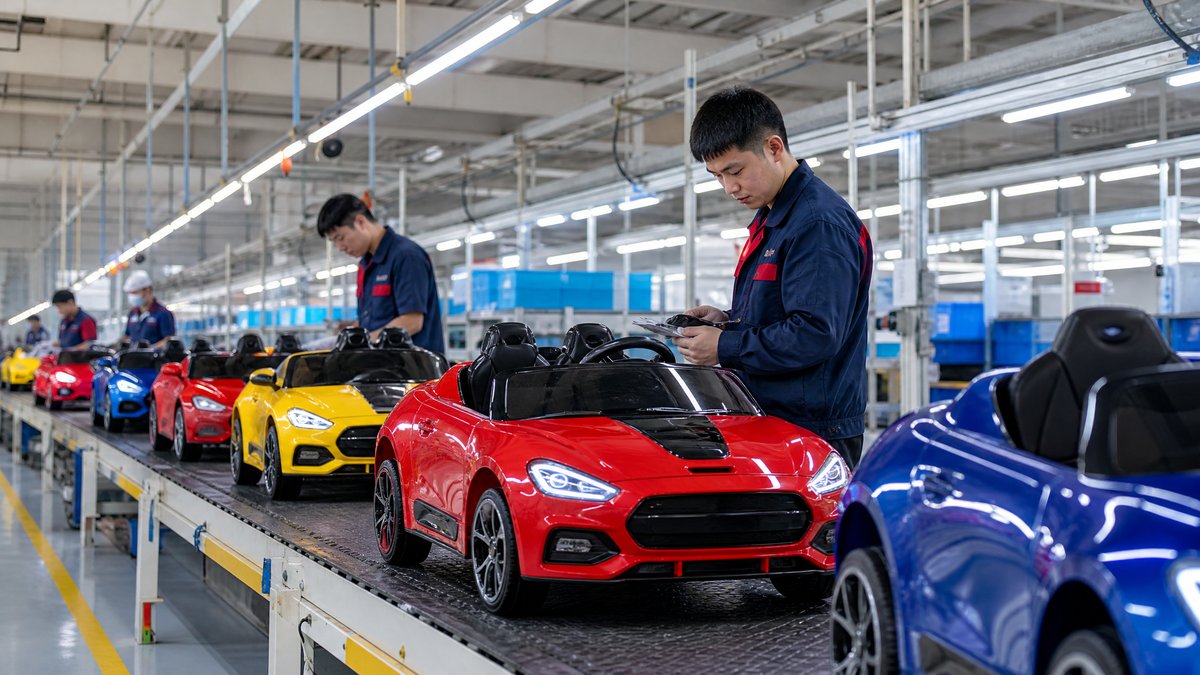
Importers should ask a ride-on car factory for a time-phased capacity plan, not just a quoted monthly output or a promised shipment date. Before placing a seasonal order, confirm which production slot is being reserved, how many units can be completed by each week, where the likely bottlenecks are, what materials are already secured, and how schedule changes will be managed. A realistic lead-time discussion also separates production completion from inspection, booking, loading, and transport. This turns a vague capacity claim into a procurement decision that can be checked and managed.
Seasonal demand makes this discipline especially important. A children’s ride-on car program may need to arrive before a retail promotion, holiday selling window, or weather-dependent period. Missing that window can reduce the value of otherwise good inventory. At the same time, pressing a factory for an unrealistic date can encourage incomplete planning, rushed handoffs, or a production sequence that does not match the importer’s actual priorities.
Start With a Demand and Delivery Brief the Factory Can Plan Against
A useful capacity conversation begins with an importer’s own requirements. A supplier cannot reserve an appropriate slot if the buyer only gives a broad annual forecast or says that the order is “urgent.” Provide the expected quantity by model, colour, battery configuration, packaging type, destination, desired dispatch window, and any required inspection or labeling milestones.
For a seasonal ride-on car order, distinguish between three dates:
1. Required delivery date: when goods need to be available at the intended destination or fulfillment point.
2. Required dispatch date: the latest practical date for cargo to leave the factory or port after allowing for the chosen transport plan.
3. Factory-ready date: when finished, approved goods must be available for collection or loading.
These are not interchangeable. A factory may complete assembly on time while the order still misses the commercial window because inspection, carton marking approval, consolidation, carrier booking, or export paperwork was not built into the schedule. Ask the supplier to plan backwards from the required factory-ready date, while your logistics team separately validates the remaining transport path.
Ask for Capacity by Process, Not One Headline Number
“Monthly capacity” is a starting point, but it is not a schedule. A factory’s maximum theoretical output may rely on an unusually favorable product mix, full material availability, uninterrupted staffing, or a different production line from the one relevant to your order. Ask what the number means and whether it applies to the proposed models and time period.
Request a simple, order-specific capacity view that shows:
- the planned start and finish weeks for each model;
- the quantity planned per week, not only the total quantity;
- the assigned assembly line or production area, where the supplier can share it;
- planned shift pattern and working-day assumptions;
- remaining uncommitted capacity during the requested window;
- the existing confirmed workload that overlaps your slot; and
- which assumptions must hold for the plan to remain valid.
Useful capacity questions to ask
Use direct questions that require operational answers:
- Which production weeks can you reserve for this exact model mix and quantity?
- Is the quoted output normal planned capacity, surge capacity, or a theoretical maximum?
- What is the expected weekly build rate after allowance for changeovers and quality checks?
- Which parts of the process are shared with other ride-on car models?
- What work is already committed during the same period, and what effect does it have on our proposed slot?
- What would cause the order to move to a later week?
- Can you provide a revised production plan after material orders are placed and again before mass production begins?
Reserve Production Slots Early and Define What “Reserved” Means
A production slot has value only if both parties define how it is held. Ask whether a preliminary forecast, purchase order, deposit, approved sample, artwork approval, or material commitment is needed before the factory allocates time. Get the answer in writing as part of the commercial planning record.
Clarify the following points before treating a slot as secure:
Slot trigger and expiry
What action turns a tentative opening into a firm slot? Until when will the factory hold that opening if final quantities, artwork, or payment milestones are pending? If you need an internal approval cycle, tell the supplier early rather than assuming capacity can be kept indefinitely.
Scope of the allocation
Confirm whether the slot covers assembly time alone or also includes component preparation, printing, packaging, and final inspection. An allocation that only covers final assembly may still be vulnerable if upstream materials or cartons have not been planned.
Change rules
Ask what happens if quantities increase, models are added, colours change, or delivery priorities shift. Small changes can have a disproportionate effect when they create a new material requirement, require a packaging change, or interrupt a run with a model changeover. Define when changes can be accepted without revising the schedule and when a new plan is required.
Escalation path
Identify the factory contact responsible for production planning and the commercial contact responsible for order amendments. A named escalation path is especially helpful during seasonal peaks, when updates can otherwise move slowly between sales, purchasing, production, and logistics teams.
Find the Real Bottlenecks Before They Become Delays
For ride-on cars, the assembly line is not always the limiting step. The bottleneck may sit upstream in a component, process, inspection point, carton supply, or loading sequence. Ask the factory to identify the critical path for the proposed order and explain its mitigation plan.
Common areas to examine include the availability of plastic body parts, electronic control components, motors, wheels, seats, remote-control components where applicable, batteries and chargers, printed cartons, labels, and instructions. The relevant constraint will vary by model and supplier. Avoid assuming that an item is simple just because it is physically small; a low-cost electronic part or a model-specific printed carton can hold up an entire order.
Ask four questions for each critical item:
1. Is this item already in stock, ordered, allocated, or still awaiting approval?
2. What is the supplier’s expected replenishment time, and what is the contingency if it changes?
3. Can the item be substituted only with prior written buyer and manufacturer approval, and would that require further review?
4. At what point will the factory notify us that the item threatens the production plan?
A buyer should also ask about internal constraints: mould availability, paint or decoration steps, test capacity, battery charging or handling workflow, rework capacity, carton packing stations, and final inspection. The purpose is not to prescribe the factory’s operation. It is to ensure the supplier’s plan recognizes the resources that actually control output.
For any proposed product, packaging, electrical, or component change, obtain manufacturer approval and assess whether it affects the intended market’s requirements. Do not assume a substitute is equivalent because it looks similar. Changes should be controlled through the supplier’s process and the buyer’s applicable review procedures.
Test the Lead Time, Rather Than Accepting a Single Number
A useful lead-time quotation has stages. Ask the supplier to show how it is calculated from order confirmation through factory readiness. That discussion should include material preparation, production scheduling, assembly, in-process and final checks, packing, inspection access, rework allowance, and loading readiness.
Ask for both a planned date and the assumptions behind it. For example, the plan may depend on confirmed artwork by a certain date, final specifications being locked, materials being available, and inspection booking being requested with sufficient notice. These conditions are not excuses; they make the schedule actionable.
Do not treat a production lead time as a door-to-door transport promise. Transport time can be affected by carrier capacity, port operations, routing, customs processes, destination handling, and other variables outside the assembly schedule. Work with qualified freight and customs partners to build an end-to-end plan appropriate for the destination.
Questions that make a lead-time answer more realistic
- From which event is lead time measured: purchase order, deposit, sample approval, artwork approval, or material confirmation?
- Which calendar days are included, and which planned closures or peak periods affect the schedule?
- When can we book inspection, and how much time is reserved for rework if findings need correction?
- What is the latest date for final packaging details without moving factory readiness?
- When will finished goods be released for loading after approval?
- What updates will we receive if the critical path changes?
Answers to these questions help procurement teams distinguish a preliminary estimate from a managed schedule.
Build Milestones and Reporting Into the Purchase Process
Once the order is placed, capacity planning should not disappear into a supplier email thread. Agree on concise checkpoints. For a seasonal order, a practical reporting rhythm may cover material readiness, production start, first completed units, mid-production status, pre-shipment readiness, inspection outcome, and loading readiness. The exact cadence should match the order’s risk and timeline, rather than creating reports for their own sake.
Each update should state the quantity planned versus completed, status of critical materials, current forecast factory-ready date, quality or rework issues that affect timing, and any decisions needed from the buyer. Request that risks are raised when they are first known, not only when the final date becomes impossible to meet.
For products intended for children, schedule time for appropriate quality checks and destination-market review; do not try to recover a late schedule by bypassing them. Use model-neutral safety language in listings, instructions, and buyer communications, emphasize adult supervision, and make only manufacturer-approved changes. Buyers should verify current destination-market requirements and battery-transport requirements with responsible authorities, qualified advisors, or carriers before shipping.
Compare Suppliers on Planning Quality, Not Only Quoted Speed
When evaluating multiple factories, compare the quality of the plan they provide. The fastest stated lead time is not necessarily the least risky option. A supplier that identifies material dependencies, reserves a defined slot, provides weekly output assumptions, and explains contingency measures may be a stronger seasonal partner than one offering an aggressive but unsupported date.
Use a common question set so the comparison is fair. Score, for example, slot certainty, model-specific capacity, material readiness, bottleneck visibility, milestone reporting, inspection allowance, and change-control process. Keep cost negotiations distinct from capacity validation: a price concession does not create production time.
It can also be useful to separate the initial order from a possible replenishment scenario. Ask how much additional capacity might be available if sell-through is stronger than forecast, what lead-time assumptions would apply, and whether any shared components could constrain a repeat order. Treat the reply as planning input rather than a commitment until the follow-up order and slot are confirmed.
FAQ: Factory Capacity for Seasonal Ride-On Car Orders
Should an importer ask for a factory’s total annual capacity?
Yes, but use it only as background. Annual capacity does not prove availability during your required weeks or for your specific model mix. The more useful request is a time-phased plan for the order, including the reserved slot, weekly output, overlapping workload, critical materials, and known constraints.
How far ahead should we book a seasonal production slot?
There is no universal booking horizon. It depends on product complexity, forecast confidence, component availability, factory workload, destination logistics, and the selling window. Start the discussion as early as your commercial planning permits, then ask the supplier what decisions are needed to convert an indicative opening into a confirmed allocation.
Can a supplier guarantee that a seasonal order will be ready on a certain date?
Avoid relying on an unconditional guarantee. Better practice is to document a planned factory-ready date, its assumptions, milestones, reporting triggers, and the process for managing deviations. This gives the buyer a basis for early intervention while acknowledging that materials, approvals, inspections, and transport can affect outcomes.
What is the best way to handle a late model or artwork change?
Tell the factory immediately and request a written impact assessment. Confirm effects on materials, line sequence, packaging, inspection, factory-ready date, and cost before approving the change. Do not assume a change is minor, and use only manufacturer-approved changes after any required destination-market review.
Do batteries require separate planning for a ride-on car order?
Often they require careful coordination because battery configuration, documentation, packing, and carrier acceptance may influence the shipment plan. Confirm the factory’s readiness information and verify current battery-transport requirements with the selected carrier and responsible authorities for the applicable route and destination. Do not treat previous shipment experience as a substitute for current verification.
Conclusion: Turn Capacity Into a Verifiable Seasonal Plan
Before committing a seasonal ride-on car order, importers should ask for more than a broad capacity figure and a fast lead-time promise. Secure clarity on the production slot, weekly build plan, material status, bottlenecks, assumptions, milestones, and escalation process. Separate factory completion from the remaining inspection and logistics timeline, and protect time for responsible product and shipment review.
A transparent plan makes it easier to identify what must be decided now, what can change later, and where contingency is needed. It also helps the buyer compare suppliers based on execution discipline rather than optimistic headline claims. For help structuring a capacity-planning discussion for your next program, email KidsRideCar’s team. To discuss your model mix and target dispatch window, contact us by email.
Official references
Explore these external resources for current regulatory and trade guidance. Confirm requirements with the relevant authority before placing an order.
Ready to Start?
Factory-Direct · CE & ASTM Certified · MOQ from 50 Units
Our export team works with buyers in 60+ countries. Get a quote within 24 hours.
KR
Written by KidsRideCar
China's leading kids electric ride-on car manufacturer. 500,000+ units shipped annually to 60+ countries. CE, ASTM & EN71 certified.