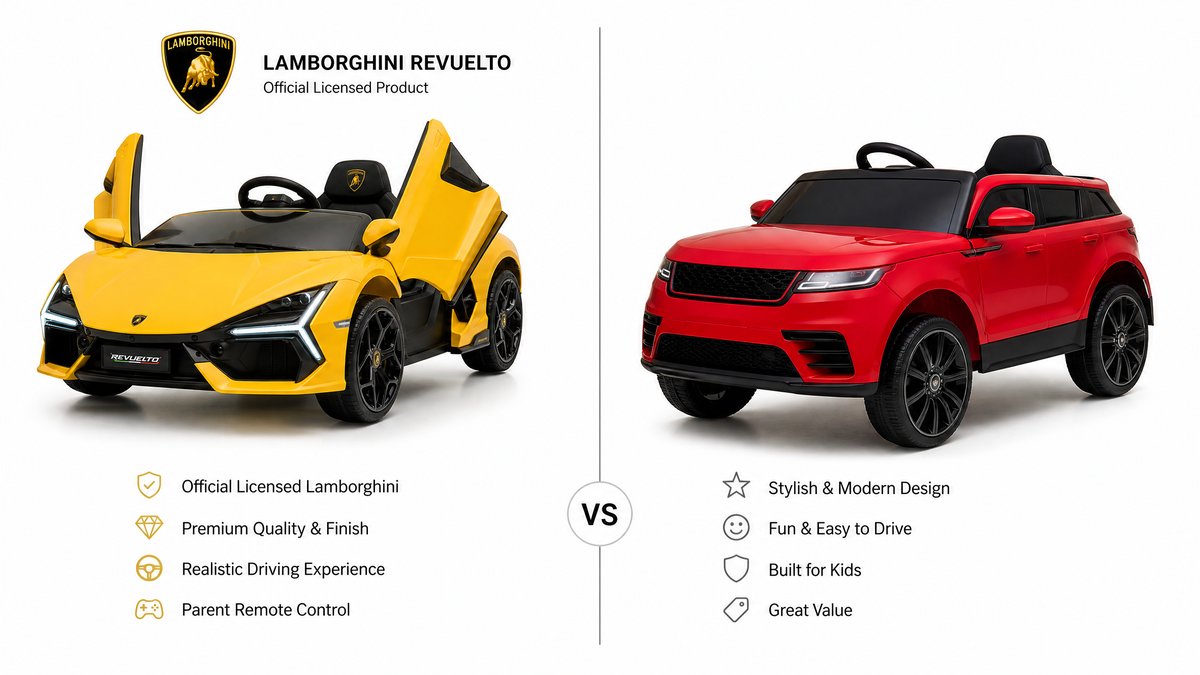
One of the most consequential product strategy decisions for kids electric ride-on car wholesale buyers is whether to stock licensed models — products that carry the official branding of automotive manufacturers like Lamborghini, BMW, Mercedes-Benz, Audi, and Ferrari — or generic models that offer similar features without the brand association. Both categories have genuine advantages and disadvantages, and the right choice depends heavily on your target market, sales channel, and business model.
This guide provides a systematic comparison of licensed and generic kids electric ride-on cars from a wholesale buyer's perspective, covering pricing, margins, licensing costs, sell-through rates, and the market conditions under which each category performs best.
Understanding Licensed Models
Licensed kids electric ride-on cars are products that have been officially authorized by the brand owner (e.g., Lamborghini SpA, BMW AG) to use the brand's trademarks, design elements, and styling cues. The manufacturer pays a licensing fee to the brand owner — typically 5–12% of the wholesale price — in exchange for the right to produce and sell products bearing the brand's name and visual identity.
The licensing agreement typically specifies minimum quality standards, approved color schemes, required brand markings, and geographic territories where the licensed product can be sold. Buyers who purchase licensed products from authorized manufacturers are buying products that have been approved by the brand owner and carry the right to be sold in the specified territories. Buyers who purchase unlicensed products that mimic licensed designs are buying counterfeit goods, which carry significant legal and reputational risks.
Licensed vs Generic: Head-to-Head Comparison
| Factor | Licensed Models | Generic Models |
|---|---|---|
| FOB price premium | +25–60% over comparable generic | Baseline |
| Retail price premium | +30–80% over comparable generic | Baseline |
| Gross margin | Similar or slightly lower (45–52%) | Slightly higher (50–58%) |
| Sell-through rate (premium markets) | Higher — brand recognition drives conversion | Lower — requires more marketing |
| Sell-through rate (value markets) | Lower — price sensitivity limits appeal | Higher — better value proposition |
| Counterfeit risk | Low (if sourced from authorized manufacturer) | None |
| Marketing ease | High — brand does the work | Lower — must build own brand story |
| OEM/private label option | No — brand is fixed | Yes — can add own branding |
| Inventory risk | Higher — brand trends can shift | Lower — timeless appeal |
Market Fit: When to Choose Licensed vs Generic
Licensed models perform best in markets where brand recognition is high and consumers are willing to pay a premium for it. The United States, United Kingdom, Germany, and the Gulf states are markets where Lamborghini, Ferrari, and Mercedes-Benz carry strong aspirational appeal even in children's products. In these markets, a licensed Lamborghini Aventador ride-on car will typically outsell a comparable generic sports car at the same price point, because the brand association drives purchase decisions.
Generic models perform best in markets where price sensitivity is high and brand recognition for premium automotive brands is lower. Southeast Asia, Latin America, and Eastern Europe are markets where the price premium of licensed models is harder to justify to end consumers. In these markets, a well-designed generic SUV or sports car at a lower price point will typically outsell a licensed model.
| Market | Recommended Strategy | Rationale |
|---|---|---|
| United States | Mix: 40% licensed, 60% generic | Strong brand appeal but large value segment |
| United Kingdom | Mix: 50% licensed, 50% generic | Premium market with strong brand culture |
| Germany / EU | Mix: 45% licensed, 55% generic | Brand appeal strong but price-conscious consumers |
| Gulf States | Mix: 60% licensed, 40% generic | Luxury brand culture, high disposable income |
| Southeast Asia | Mix: 20% licensed, 80% generic | Price sensitivity, lower brand recognition |
| Latin America | Mix: 15% licensed, 85% generic | High price sensitivity, value market dominates |
KidsRideCar offers both officially licensed models and premium generic designs. Request our full catalog with wholesale pricing.
Request Full Catalog →How to Source Licensed Models Safely
The licensed kids ride-on car market has a significant counterfeiting problem. Products that use Lamborghini, Ferrari, or BMW styling without authorization are widely available from Chinese manufacturers and are frequently sold to unsuspecting buyers who believe they are purchasing legitimate licensed products. The consequences of importing counterfeit licensed products can be severe: customs seizure, legal action from the brand owner, and reputational damage with retail customers.
To source licensed models safely, always request the manufacturer's licensing agreement or authorization certificate from the brand owner. A legitimate licensed manufacturer will have a current, valid licensing agreement that specifies the licensed products, territories, and term. If a supplier cannot produce this documentation, assume the product is unlicensed regardless of what markings it carries.
The Private Label Alternative
For buyers who want the marketing advantages of a distinctive brand without the constraints and costs of licensed models, private label (OEM/ODM) is an increasingly attractive option. Private label allows you to apply your own brand name and visual identity to a generic base product, creating a proprietary product line that cannot be directly price-compared with competitors.
Successful private label strategies in the kids electric ride-on car category typically involve: selecting a distinctive product design (not a direct copy of a licensed model), investing in quality packaging that communicates the brand story, and building brand recognition through consistent marketing. The investment required is higher than simply stocking generic products, but the long-term margin and competitive position advantages are significant.
Frequently Asked Questions
Are licensed models worth the premium for a first-time importer?
For most first-time importers, generic models are the better starting point. They offer lower unit costs, more flexibility for OEM branding, and lower inventory risk. Once you have established your market, understand your customers' preferences, and have the volume to justify the higher investment, adding licensed models to your range makes sense. Starting with licensed models as a first-time importer exposes you to higher per-unit costs and greater inventory risk before you have validated your market.
Which automotive brands are most popular in kids ride-on cars?
Lamborghini (Aventador, Urus) and Mercedes-Benz (G-Class, AMG GT) consistently rank as the most popular licensed brands in the kids electric ride-on car category globally. BMW (X5, M3) and Audi (Q7, R8) are strong in European markets. Ferrari and Bugatti appeal to the premium segment. Land Rover and Jeep perform well in markets with strong SUV culture. The popularity of specific models shifts with the automotive market — the rise of electric vehicles has made Tesla-licensed models increasingly popular in North America.
Can I sell licensed models on Amazon?
Yes, but Amazon has strict brand registry and intellectual property policies. Selling counterfeit licensed products on Amazon will result in listing removal and account suspension. Legitimate licensed products from authorized manufacturers can be sold on Amazon without issues. When listing licensed products, include the licensing authorization in your product documentation and be prepared to provide it if Amazon requests verification.
The licensed vs generic decision is not binary — the most successful wholesale buyers typically carry a mix of both, calibrated to their specific market and customer base. The key is to make this decision deliberately, based on an understanding of your market's price sensitivity, brand culture, and competitive landscape, rather than defaulting to one category without analysis. Both licensed and generic models can be profitable; the question is which mix is optimal for your business.
Official references
Explore these external resources for current regulatory and trade guidance. Confirm requirements with the relevant authority before placing an order.
Ready to Start?
Factory-Direct · CE & ASTM Certified · MOQ from 50 Units
Our export team works with buyers in 60+ countries. Get a quote within 24 hours.
China's leading kids electric ride-on car manufacturer. 500,000+ units shipped annually to 60+ countries. CE, ASTM & EN71 certified.