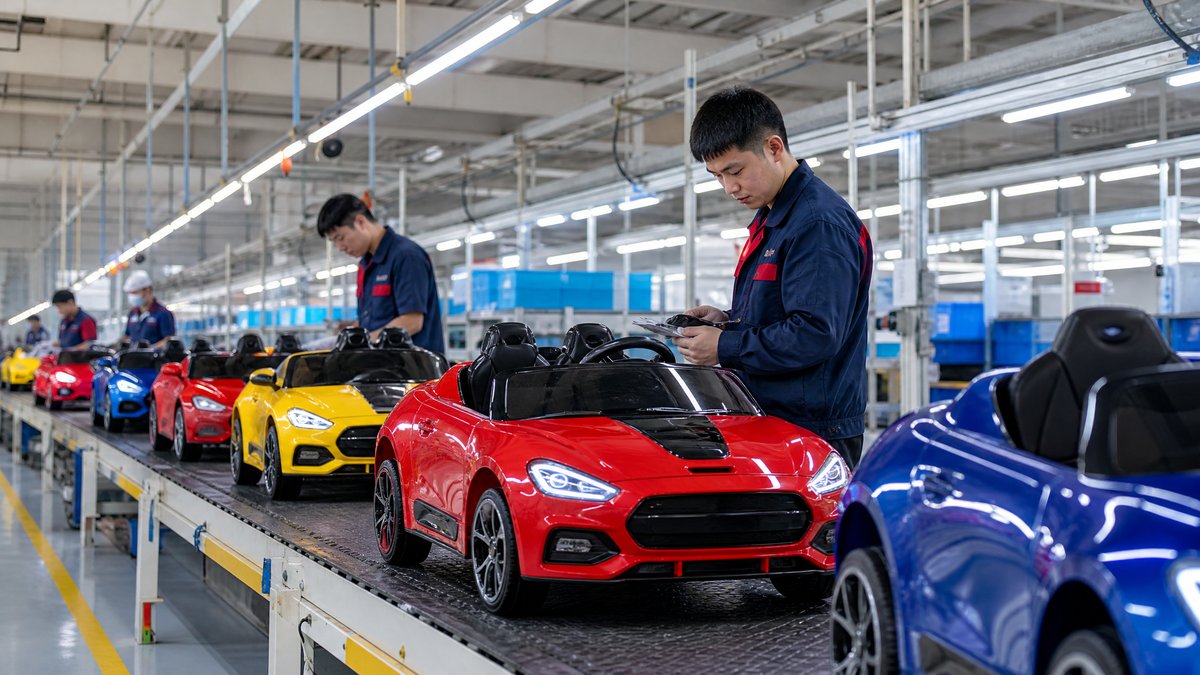
Comparing kids ride-on car supplier quotations is not a matter of putting unit prices side by side. A lower number can reflect a different vehicle configuration, a different packaging assumption, excluded spare parts, or commercial terms that move cost and risk elsewhere. For importers, wholesalers, distributors, retailers, and OEM buyers, the reliable approach is to request the same written brief from each supplier, convert every reply into a common comparison sheet, and clarify every blank, qualifier, and exclusion before selecting a partner.
Concise answer: Compare quotations only after you have normalized the product specification, order basis, Incoterm, packaging, included documents, payment terms, service scope, and change-control conditions. Select the offer that gives the clearest, verifiable scope and a workable total commercial position—not simply the lowest stated unit price.
This guide focuses on quotation normalization: making sure each supplier prices the same request and accepts the same responsibilities before a purchase order is issued.
Why ride-on car quotations are rarely directly comparable
A quotation is a supplier’s interpretation of a request. One may concern a single-seat body, another a two-seat version, and another may list a remote-control option separately. These are not interchangeable offers.
The same issue applies to commercial scope: price can be tied to a delivery term, carton type, branding arrangement, payment schedule, or quantity different from the buyer’s plan. Comparing headline prices before alignment creates a false “best quote.”
For a helpful baseline of vehicle categories, begin with the supplier’s [kids ride-on car product range](/products/kids-ride-on-cars/). Then identify the exact SKU or product family under review. Do not assume that similar product photos mean the same configuration.
Start with one quotation request pack
Make quotes comparable before suppliers respond. Send every shortlisted supplier the same version-controlled request pack and ask for every field to be completed.
What to include in the buyer’s request
Use a clear request that covers the following areas:
- Product identity: model reference, reference images, seat count, and required options.
- Configuration: colors, wheels, seating, control features, and included charger or remote, where relevant.
- Order basis: quantity by SKU, order mix, and packaging format.
- Branding: logo, carton artwork, manual languages, labels, inserts, barcodes, and buyer-supplied materials.
- Commercial request: Incoterm and named place, currency, validity, payment proposal, and separate project charges.
- Quality, safety, and service information: product-specific documents offered, parts support, assembly materials, and escalation contact. Determine local-market requirements with appropriate qualified resources.
Send every revision to all contenders and mark the change. This prevents an apparent gap caused by unequal instructions.
Build an apples-to-apples quotation comparison sheet
Once quotations arrive, do not score them from the supplier’s original PDF alone. Transfer the details into a buyer-controlled sheet. One row per item or commercial condition makes omissions visible and preserves an audit trail.
| Comparison field | What the buyer should record | Why it matters |
|---|---|---|
| Supplier and quotation reference | Legal trading entity named on the quote, date, version, currency, validity | Prevents later confusion about which offer was approved |
| Product reference | SKU, product name, revision, photos or specifications attached | Confirms that all parties refer to the same product |
| Configuration | Every requested feature, option, color, and included accessory | Exposes substitutions and unpriced extras |
| Quantity and MOQ basis | Quantity per SKU, mixed-order conditions, and any stated MOQ | Ensures the unit price applies to the intended order |
| Unit price and currency | Price by SKU, not just an order total | Supports transparent comparison and later PO checking |
| Delivery basis | Incoterm plus named place or port, clearly written | Clarifies where responsibility changes under the agreed term |
| Carton and packing scope | Retail carton, export carton, inserts, marks, and pallet assumption if stated | Affects handling, presentation, and downstream planning |
| Branding and artwork | What is included, excluded, or conditional | Avoids assuming private-label work is in the base price |
| Documents and support | Manuals, parts lists, photos, reports or declarations offered | Defines what the supplier actually promises to provide |
| Payment and changes | Deposit/balance structure, bank charges, change rules, quote validity | Identifies cash-flow and approval implications |
Add a status column: included, excluded, optional, not stated, or needs clarification. Never treat “not stated” as included; close material gaps before scoring offers.
Normalize the commercial basis before reviewing price
Group quotes with the same currency and delivery basis. Different Incoterms or named locations are non-comparable until aligned; request a revision rather than guessing at an unstated cost.
Also make quantities consistent. A large-quantity, full-container, or mixed-model assumption cannot automatically be compared with a trial order. Request prices for the actual SKU and quantity plan.
Separate one-time charges from recurring unit charges. Tooling, artwork, packaging development, samples, and labels need their own rows.
Compare the product scope line by line
With feature-rich ride-on cars, a product name is not a specification. Use a configuration matrix and obtain written confirmation for each line. If an item is “standard,” ask which version is standard for the quoted SKU.
Questions that reveal configuration differences
Ask each supplier to state:
1. What exact model/SKU, product revision, and color are priced?
2. Which user-control and parental-control functions are included in the quoted version?
3. Which accessories are supplied in the carton, and which are optional?
4. Is the charger specified, included, and matched to the quoted configuration?
5. What does the packaging contain: manual, hardware pack, protective materials, labels, or inserts?
6. Are product photos, assembly guidance, and parts diagrams available for the same version?
7. Which changes to color, logo, packaging, or feature set would alter the quotation or approval process?
This is a request for commercial definition, not a request to alter protection systems. Document safety-related features and instructions as offered. End users should follow supplied instructions, use appropriate adult supervision, and keep the product away from hazards.
For pre-shipment planning, use a [ride-on car quality inspection checklist](/blog/ride-on-car-quality-inspection-checklist/). A quotation is not proof of product safety, legal compliance, or performance. Verify product-specific obligations for the destination and sales channel before shipment.
Identify exclusions, conditions, and ambiguous wording
The most important information in a quotation may sit in a footnote—or may be absent altogether. A price marked “subject to final confirmation,” “standard packing,” or “as discussed” needs follow-up. These phrases do not automatically mean the supplier is acting improperly; they show where the buyer needs a written definition.
Create an exceptions register alongside the comparison sheet. For each supplier, list the exact wording, the owner responsible for clarification, the answer received, and the revision date. Ask short, closed questions such as:
- “Please confirm whether the quoted unit price includes the remote-control unit for this SKU.”
- “Please state the carton artwork, inserts, and labels included in the quoted packing scope.”
- “Please confirm the named place attached to the stated delivery term.”
- “Please itemize all one-time fees and identify whether they are refundable, recurring, or conditional.”
- “Please identify any buyer-supplied materials required before production or packing can begin.”
Do not resolve important ambiguity through a verbal call alone. Send a written summary after the call and request acknowledgement, then attach the confirmed revision to the sourcing file.
Assess commercial risk without turning the exercise into price bargaining
A quote comparison should surface operational risk as well as cost. Use red, amber, and green flags for clarity—not as a substitute for due diligence.
Lower-risk signals include a quotation that uses your item references, spells out inclusions and exclusions, names the delivery basis precisely, separates optional items, and is consistent with its attachments. Needs-review signals include a product photo without SKU, an unexplained difference from your brief, a generic claim that paperwork will be available, or terms that differ between the quotation and email. High-priority clarification signals include an unclear seller identity, missing product configuration, no quotation validity, a price that applies only to an undefined quantity, or a request to proceed before key scope is documented.
Keep the conversation objective. Rather than telling a supplier that another seller is cheaper, state the item that needs alignment: “We are comparing equivalent scope. Please revise the quotation to show the requested carton, SKU, and quantity.” This approach produces cleaner information and protects the buyer’s negotiating position.
Use procurement examples that test the scope, not imagined results
Consider two common situations.
Example: identical-looking offers with different packaging scope
A retailer requests a branded ride-on car program. Supplier A quotes a product price and attaches a generic carton image. Supplier B lists product price, carton artwork handling, inserts, and barcode-label placement on separate lines. The buyer should not assume A includes the same work. Instead, the buyer sends the same packing checklist to both suppliers and marks every answer included, optional, excluded, or unconfirmed. Only then can the buyer compare the commercial offers fairly.
Example: a distributor’s mixed-SKU replenishment order
A distributor needs several models in one order. One supplier gives price per model at separate minimum quantities; another gives a blended order proposal; a third quotes a price “for full container.” The buyer should ask every supplier to price the distributor’s actual SKU quantities and explicitly state mixed-order conditions. A blended total may be useful for budgeting, but it should not replace model-level pricing when the buyer needs to manage assortment and replenishment decisions.
Turn the preferred quotation into a controlled approval record
Choosing a supplier is not the final comparison step. Before issuing a purchase order, prepare a quotation approval record containing:
- the accepted quotation version and date;
- the approved SKU/configuration matrix and reference images;
- quantity by SKU, currency, and price lines;
- named Incoterm and place;
- confirmed packaging, branding, and buyer-supplied artwork;
- stated documents, instructions, parts information, and support scope;
- approved exceptions and any open conditions; and
- the contacts authorized to approve changes.
The purchase order should reflect this record rather than relying on a broad product name. If a sample or artwork approval is part of the project, record the approval date, reference version, and exactly what was approved. A later change should be handled as a documented change—not folded into an email thread where commercial consequences can be missed.
If you are comparing an OEM proposal, request an early conversation through the [KidsRideCar inquiry page](/inquiry). Share the completed request pack and ask for a quotation that distinguishes core product scope, optional customization, packaging, and support items.
Frequently Asked Questions
Should buyers choose the lowest ride-on car supplier quotation?
Not automatically. The lowest quote may be the right choice only after the buyer confirms that it covers the same SKU, configuration, quantity, packaging, delivery basis, and commercial conditions as the alternatives. A clearly scoped quote can be more useful than a lower but incomplete number because it reduces uncertainty before a purchase order is issued.
What should buyers do when a supplier leaves an item off the quotation?
Mark it “not stated” in the comparison sheet and ask a written, specific follow-up question. Do not assume an omitted accessory, document, label, or service is included. Request a revised quotation or a written addendum that identifies whether the item is included, optional, unavailable, or buyer-supplied.
Can a supplier quote be used as evidence that a product meets destination-market requirements?
No. A quotation defines a commercial offer; it does not by itself establish compliance, product safety, or legal eligibility in a particular market. Verify applicable requirements and product-specific supporting information with appropriate qualified resources for the destination and sales channel.
How long should a quotation comparison take?
There is no universal timeframe. The right pace is the one that lets the buyer close material differences before committing. For a repeat SKU with a well-defined brief, the review may be straightforward. For a new OEM program, branded packaging, or multiple variants, allow enough time for written revisions and internal approvals rather than relying on an initial headline price.
Conclusion: buy the defined scope, not the attractive number
The strongest supplier quotation is one that survives normalization: it identifies the exact ride-on car configuration, applies to the real order plan, states the commercial basis clearly, exposes optional and excluded items, and provides a reliable foundation for approval. A structured comparison sheet, exceptions register, and controlled quotation approval record transform supplier replies into a defensible procurement decision.
Ready to compare a defined kids ride-on car requirement? Send your SKU list, quantities, destination, branding needs, and desired delivery basis to info@kidsridecar.com or use the [inquiry form](/inquiry) to request a clear, itemized discussion.
Official references
Explore these external resources for current regulatory and trade guidance. Confirm requirements with the relevant authority before placing an order.
Ready to Start?
Factory-Direct · CE & ASTM Certified · MOQ from 50 Units
Our export team works with buyers in 60+ countries. Get a quote within 24 hours.
KR
Written by KidsRideCar
China's leading kids electric ride-on car manufacturer. 500,000+ units shipped annually to 60+ countries. CE, ASTM & EN71 certified.