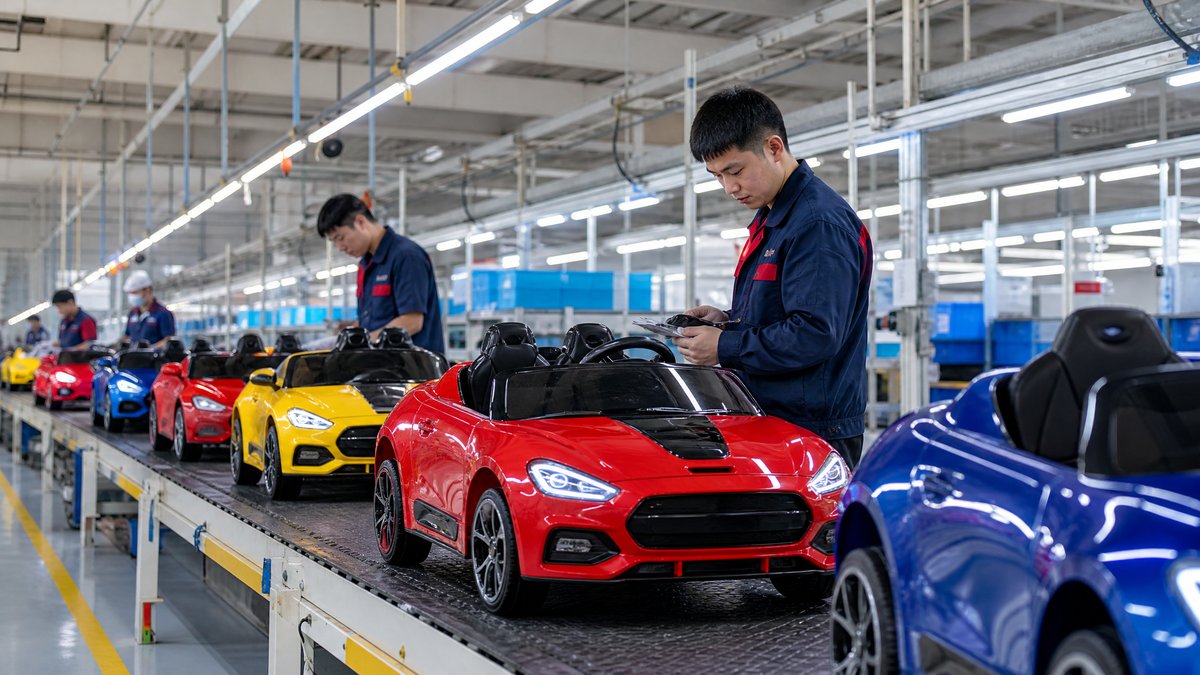
Buyers should plan a kids ride-on car color assortment by selecting a small core palette for dependable, broad appeal, then adding limited channel- or market-specific colors only where there is a clear merchandising reason. Build the assortment by model, sales channel, age-positioning, packaging or listing needs, and reorder risk—not by choosing the colors that look best in a factory catalog. Confirm the available color options and finish on an approved sample before placing production.
For importers, wholesalers, distributors, retailers, and OEM buyers, color is not merely a styling choice. Each additional color can become a separate SKU to forecast, photograph, stock, label, support, and eventually clear. A disciplined color plan helps protect working capital while giving retail partners enough choice to present an attractive range.
This guide focuses on how to build and manage an assortment. For broader inspiration around market aesthetics, see [Kids Electric Ride-On Car Color and Design Trends: What Sells Best in Different Markets](/blog/kids-electric-ride-on-car-color-and-design-trends). For a starting point on product options, browse the [KidsRideCar products](/products/).
Start With the Assortment Decision, Not a Color Preference
A color assortment answers a commercial question: which combinations of model and color should be available in a specific channel, market, and selling period? The correct answer will rarely be “every color the factory can make.”
Before requesting a quote, make four decisions:
1. Define the hero models. Identify the models that will carry most of the category presentation or account for your strongest expected demand. Those models deserve the broadest but still controlled palette.
2. Set the role of each color. A color can be a core replenishment SKU, a differentiating option for a selected account, an online listing variation, or a short-run promotional choice. It should have one clear role.
3. Match the plan to the channel. A marketplace listing may benefit from a closely managed variation family. A small toy store may need a clean shelf selection that is easy to explain. A distributor serving many dealers may need a shallow, dependable range that can be replenished consistently.
4. Set a review point. Decide in advance when you will review sell-through, retailer feedback, cancellation reasons, image performance, or return commentary. Do not wait until slow colors have accumulated.
A robust plan distinguishes catalogue colors from custom colors. Catalogue colors may be options already offered for a model, subject to confirmation. A custom tone, special finish, color-matched trim, or artwork-dependent body treatment may need separate feasibility, sample, order-quantity, and lead-time discussions. Do not assume that a shade visible in a digital render, another model, or a previous order can be applied to your chosen model without approval.
Build a Core, Differentiator, and Controlled-Test Palette
The easiest way to prevent color proliferation is to give each color a tier. The number of colors in each tier depends on your order plan and supplier discussion, but the hierarchy remains useful across order sizes.
| Palette tier | Purpose | Typical decision rule | Operational approach |
|---|---|---|---|
| Core colors | Form the dependable base of the assortment | Chosen for broad appeal, clear product presentation, and repeat-order potential | Keep available across hero models where practical; prioritize complete listing and carton information |
| Differentiator colors | Help a channel, retailer group, or brand line look distinct | Added only when the buyer can explain why the color fits that audience or presentation | Restrict to selected models or accounts; track separately from core replenishment |
| Controlled-test colors | Explore a new theme, finish, or local preference | Approved with a defined learning objective and exit decision | Limit exposure; review evidence before repeating or expanding |
This framework stops a common mistake: treating every approved sample color as a standard stocked color. A factory can be able to produce a color without that color being the right commercial choice for your assortment.
Core colors should simplify choice
A core palette should make the vehicle easy to recognize across photography, product pages, store displays, and gift occasions. Select colors that are versatile for your market, not colors claimed to be universally best. Check the actual sales environment: a shade that works against a white studio background may lose definition on a crowded shop floor.
Differentiators need an account-level reason
Reserve differentiation for an identifiable use case, such as a retailer display theme, a distributor brand plan, or an online range where one additional variation improves choice. Record the rationale in the SKU plan. Do not add a color solely because it looked attractive at a trade show; confirm that the partner can support it with images, naming, display space, and a replenishment path.
Plan Color by Model Architecture and SKU Complexity
Color planning follows the role of the underlying model. Decide what each model must do in the range, then use a model-color matrix before issuing a purchase order.
| Model role | Color-planning question | Sensible control |
|---|---|---|
| Entry or volume model | Which limited color selection keeps the choice easy and supports repeat orders? | Use a tight core palette rather than many low-depth variants |
| Feature or premium model | Which color supports the intended presentation without confusing the base range? | Add a differentiator only if its listing, packaging, and display assets are ready |
| Retailer-exclusive or private-label model | What color story supports the account or brand identity? | Confirm exclusivity scope, artwork, trim, carton marks, and reorder conditions in writing |
| Trial or seasonal model | What are we trying to learn, and what is the exit plan? | Keep it controlled and label it internally as a test SKU |
Every added color can multiply photos, product IDs, carton labels, online variation data, inventory locations, and after-sales records. Combinations of body, seat, wheels, trim, and graphics expand this work quickly.
Maintain a single source of truth: a SKU master with the model, internal SKU, color and finish, trim, artwork version, carton mark, image status, channel, and final approver. Avoid informal names such as “blue car” when shades or finishes differ.
Use Channel Evidence Without Inventing Demand Certainty
Color preferences are market- and channel-specific, and historical sales are useful only when they are comparable. A distributor’s dealer orders, a retailer’s point-of-sale records, marketplace search-term reports, product-page conversion patterns, pre-order responses, and customer-service questions can all inform the plan. None alone guarantees future demand.
Review available evidence with context:
- Compare like with like. Model, price position, image quality, promotion, stock availability, and placement can all shape a color’s results.
- Separate availability from preference. An out-of-stock or deeply discounted variant is not a clean measure of normal demand.
- Use both sales-floor and digital evidence. Collect dealer observations and confirm that images and variation labels accurately show the approved color.
- Look for concentration. Strong reorders in a few colors may justify a narrow core without automatically deleting a purposeful differentiator.
A practical procurement example: a wholesaler is adding a new vehicle style to an existing range. Rather than introducing every proposed color, the buyer assigns established colors to the initial core selection and chooses one additional color for a named retail program. The buyer records which orders and feedback will be reviewed after the launch period. If the added option does not earn a clear commercial role, it is not automatically included in the next replenishment discussion. This is a planning method, not a prediction of results.
Align Factory Communication, Samples, and Purchase Documents
Color errors are expensive because they can affect every unit in a run. Manage the issue before production, not after containers are received.
Request a color confirmation pack
Ask the supplier what is available for the specific model and what parts each color choice affects. Confirm whether the proposal relates to the main body, seat, wheels, trim, decals, dashboard elements, or packaging images. Where the supplier offers a standard palette, ask which combinations are standard for the selected configuration and which require additional review.
If you have a brand color reference, provide it clearly and ask how it will be evaluated. A digital screen reference may reproduce differently in molded plastic, paint, decals, photos, and cartons. Agree on the approved reference and review method rather than relying on an email description.
Approve a representative sample
Use an approved pre-production sample or supplier-agreed reference to document the configuration, color and finish, contrasting components, decals, relevant packaging visuals, and dated approval. Capture any revision explicitly. Review it in normal, well-lit conditions against the agreed reference, including visibly related components, decals, and accurate carton or online identification. This does not replace the buyer’s own product, market, and compliance review.
Make color traceable in the PO
Your purchase order, specification sheet, or artwork pack should identify the variant for production, inspection, receiving, and after-sales teams. Include artwork and packaging revision control; a generic color name may not be enough. For a concern, document photos, SKU/carton identification, quantities, and a clear description, then use the agreed supplier process. Do not modify electrical systems, batteries, or safety-related parts internally; follow product instructions and use qualified service arrangements where appropriate.
Merchandise Color as a Range, Not a Random Row of Boxes
A good assortment must be understandable at the point of sale. Whether you sell through distributors, independent stores, marketplaces, or your own website, organize colors so the buyer sees a coherent choice.
For physical retail, sequence core colors to establish the range and use a differentiator as a focal point where justified. Give store teams accurate names and images. For e-commerce, every variation needs an accurate image, plain-language label, and matching stock data; never use a different color’s image to fill a listing gap.
Keep information model-neutral and safety-conscious: use the manufacturer’s intended age and use information, supervision guidance, instructions, and warnings as applicable. Do not imply that color changes safety, capability, or regulatory status unless formally documented for that configuration. Private-label buyers should coordinate color with cartons, dealer sheets, listings, showroom material, and spare-part identification. See the [private-label branding guide](/blog/private-label-branding-for-kids-electric-ride-on-cars) and use the [inquiry page](/inquiry) for model-specific options.
A Pre-Order Checklist for Color Assortment Decisions
Before approving the order, confirm that the team can answer the following questions:
- What role does each model play: volume, feature, exclusive, or trial?
- Which colors are core, differentiator, and controlled-test options?
- Which model-color combinations will be assigned to each channel or retailer group?
- Are the options confirmed for this exact model and configuration, rather than assumed from a catalog image?
- Has each variant received a clear internal SKU, product name, carton mark, and image requirement?
- What sample, color reference, artwork version, or specification sheet is the approval reference?
- Who signs off on the sample, listing content, packaging, and order document?
- What evidence will be reviewed before a color is replenished, expanded, revised, or discontinued?
- Can the warehouse, sales team, and customer-service team distinguish the variants without guessing?
- Are operating instructions, warnings, and after-sales records aligned to the actual model configuration?
This checklist turns color from a late-stage aesthetic discussion into a controlled buying decision.
Frequently Asked Questions
How many colors should a wholesale buyer launch for one ride-on car model?
There is no universal number. Start with the smallest selection that supports your planned channels and credible presentation. Add a color only when it has a defined role, a supplier-confirmed option, complete images, and a responsible owner.
Should every retailer receive the same ride-on car colors?
Not necessarily. A distributor program may need a stable shared core, while a selected retailer may justify a differentiator or private-label color. Keep terms, artwork, packaging, geographic scope, and reorder expectations in writing; do not promise exclusivity informally.
Can we choose a custom color from a digital color chart?
A digital chart is a starting reference, not final production approval. Confirm feasibility for the specific materials and configuration, then document the approved supplier-agreed reference, finish, trim, decals, and packaging version before making sales promises.
How can a buyer tell whether to replenish a color?
Review comparable sell-through and reorder patterns alongside availability, promotions, retailer observations, listing quality, and customer questions. Look for repeatable evidence. If it is unclear, keep the variant controlled rather than expanding it across every model or channel.
Does a new color require a new safety review?
Do not assume an appearance-only change has no implications. Confirm the configuration, market requirements, documentation, labeling, and supplier information for the model. Keep safety guidance and claims tied to actual product documents, with professional advice where required.
Conclusion: Treat Color as a Managed Buying Decision
The strongest kids ride-on car color assortments are focused, traceable, and easy to replenish. Start with a dependable core palette, introduce differentiators only for a documented commercial reason, and manage new ideas as controlled tests. Tie every color to an exact model configuration, approved reference, SKU record, channel plan, and review decision.
If you are building a wholesale range, refreshing a retailer program, or exploring OEM color options, contact KidsRideCar at info@kidsridecar.com or send your model, market, and planned channel mix through our [inquiry form](/inquiry). We can help you discuss model-specific color availability and organize the questions needed for a clearer sourcing brief.
Official references
Explore these external resources for current regulatory and trade guidance. Confirm requirements with the relevant authority before placing an order.
Ready to Start?
Factory-Direct · CE & ASTM Certified · MOQ from 50 Units
Our export team works with buyers in 60+ countries. Get a quote within 24 hours.
KR
Written by KidsRideCar
China's leading kids electric ride-on car manufacturer. 500,000+ units shipped annually to 60+ countries. CE, ASTM & EN71 certified.