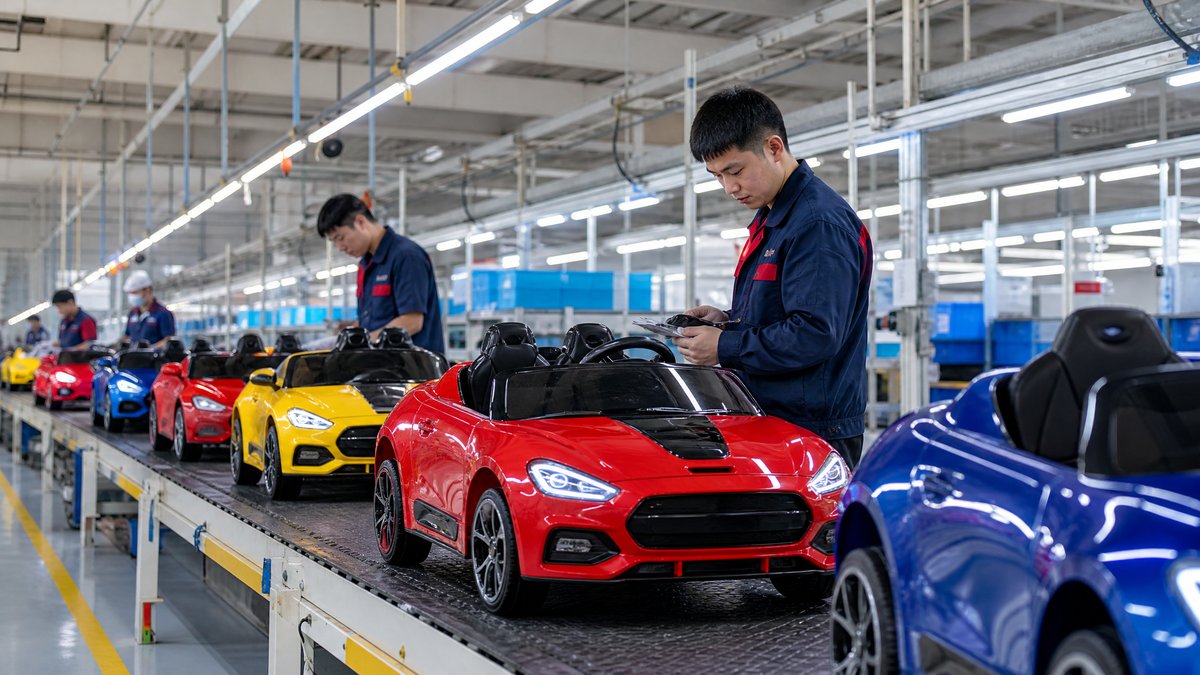
Retailers can compare kids ride-on car bundles fairly by turning every offer into the same line-by-line specification sheet before comparing price. Separate the base vehicle from included accessories, charging equipment, packaging, documentation, freight assumptions, and post-sale support. Then publish the same distinctions in the customer-facing listing. A lower bundle price is not necessarily a better buy if the bundle omits a battery, remote, charger, decorative accessory, spare part, or service item that another offer includes.
This approach protects margin, makes assortment decisions more defensible, and prevents a customer from receiving a product that differs from the impression created online. For importers, wholesalers, distributors, retailers, and OEM buyers, the goal is not to make bundles appear identical. The goal is to make their real differences visible, comparable, and easy to explain.
Start with a defined base vehicle
The phrase “ride-on car bundle” can hide two different kinds of variation. First, two suppliers may offer different versions of a vehicle under a similar description. Second, the same vehicle may be sold with different included parts or services. Treat those as separate questions.
Create a base-vehicle record before discussing the bundle. It should use the supplier’s model identifier and revision or configuration reference where available. Record the intended age guidance supplied for that model, seating configuration, drive arrangement, power-system description, control features, dimensions, stated maximum load guidance, color or trim, and the components fitted to the vehicle. Do not use a generic marketing name alone as the comparison key.
A useful rule is simple: compare like with like first; compare bundles second. If two offers do not share the same base-vehicle record, label them as different product configurations rather than presenting their prices as a direct bundle comparison.
Build a bundle bill of materials
Next, list every delivered item and give it a quantity. The bill of materials should distinguish parts installed on the vehicle from loose components inside the carton. Avoid phrases such as “full set,” “standard accessories,” or “complete package” unless the listing immediately defines them.
For each bundle, document whether it includes:
- the assembled or partially assembled vehicle body and the assembly hardware;
- battery or batteries, charger, charging lead, and any adapter supplied;
- remote control, batteries for the remote if included, and pairing or operating instructions;
- seats, wheels, steering components, mirrors, windscreen pieces, decals, canopy parts, or other trim that may be separate in transit;
- user manual, safety labels, warranty or service card, and country-specific literature if requested;
- optional items such as a cover, spare battery, replacement wheel, display card, or promotional insert; and
- parts and services that are explicitly excluded.
Use a three-status legend: included, optional at an identified charge, and not included. “Compatible with” is a fourth status, not a substitute for “included.” This language is particularly useful for chargers, remotes, covers, spare batteries, and accessories that vary by model or destination.
Make pricing transparent without reducing the decision to one number
A bundle quotation is easiest to assess when it has two layers: a base price and clearly identified additions or deductions. This lets a buyer see whether the price difference comes from product content, packaging, commercial terms, or a service assumption.
Ask suppliers to state the quotation basis in writing. It should identify the model/configuration, currency, quantity basis, included items, excluded items, packaging basis, and delivery or freight terms being discussed. If a price is conditional on a mixed order, retail program, private-label requirement, or a particular destination, show that condition next to the price rather than in an unconnected note.
Do not compare a goods-only figure with a landed-cost estimate, or a single-unit sample price with a production-order price. Those figures answer different questions. A retailer deciding a shelf price needs to understand the cost build-up relevant to its own route to market. A distributor reviewing a supplier needs to understand whether a stated extra is per vehicle, per carton, per order, or a one-time setup item.
Instead of using an opaque “bundle discount,” ask for an itemized commercial schedule. It can show the base vehicle, included accessories, paid options, branding or artwork work if applicable, export packaging changes, documents, and transportation-related charges as separate lines where those charges are known. The schedule does not need to reveal a supplier’s confidential cost structure. It does need to reveal what the buyer receives for the quoted amount.
Use an apples-to-apples comparison worksheet
A practical worksheet has one row per bundle and fixed columns for every decision factor. Start with supplier, model identifier, base configuration, and the component statuses. Then add price basis, order quantity basis, packaging details, documentation, branding options, sampling status, exclusions, and open questions.
Translate the bundle into an honest product listing
A transparent supplier comparison only becomes valuable when the shopper sees the same clarity. A retailer’s listing should put the essential purchase decision near the top: which exact vehicle version is being sold, what is in the carton, what assembly or setup is expected, and which pictured accessories are not included.
Use a dedicated What’s included block rather than leaving buyers to infer content from photographs. A short bulleted list works well when it is model-specific. Pair it with an Optional or sold separately block if the retailer offers compatible extras. If the cart allows add-ons, make the default selection unambiguous and update the order summary when the shopper changes it.
Images deserve the same discipline. Use captions for images that show optional accessories, non-included decorative settings, or more than one product configuration. Do not reuse a photograph of a bundle with a remote, cover, or extra battery to sell a base vehicle without a disclosure that is easy to notice. A text-only disclaimer at the bottom of a page cannot reliably correct a misleading main image.
Specifications should be written as facts that the retailer can substantiate from the supplier documentation and sample review. Avoid casual superlatives, claims that one configuration is “safer” than another, or claims that the product is suitable for every child in a broad age range. Keep all safety information model-neutral, direct buyers to the supplied manual, and state that adult supervision is required during use.
For U.S.-bound children’s products, the CPSC’s business guidance notes that battery-operated toys have requirements that depend on the battery and cover matters including battery access during play, labeling, overheating, and supplied chargers. Its guidance also describes labeling and instructional literature requirements for certain ride-on and battery-operated toys. [1] A retailer should not turn that guidance into a generic compliance badge. Instead, request the product-specific documentation appropriate to the destination market and confirm what applies to the exact configuration being imported or sold.
Treat packaging as part of the bundle promise
Packaging is often the missing column in a bundle comparison, even though it affects receiving, storage, marketplace fulfillment, damage claims, and the shopper’s first impression. Request a packaging specification for each configuration, not only a product photograph.
The specification should identify the number of retail cartons per sellable unit, whether accessories are packed loose or installed, carton dimensions and gross weight as supplied by the manufacturer, protective materials, outer-carton markings, assembly-hardware bagging, and the language or version of manuals and labels. If a bundle adds a loose item, ask whether it travels in the vehicle carton, an accessory carton, or a separate shipment. That answer can affect both warehouse handling and the customer’s expectation of receiving one parcel or more than one.
Inspect a pre-production or representative sample when feasible, including the carton and all loose contents. Compare the inspection result to the quotation, packing list, manual, and proposed listing. If the product will be sold under a private label, confirm where the brand, importer or distributor details, traceability information, and required warnings are expected to appear. Do not assume a carton design used in another market is correct for yours.
Plan battery transport early
Battery configuration and transport method can change the packaging conversation. The U.S. PHMSA describes lithium-battery shipment guidance as scenario-based because requirements depend on cell or battery type, configuration, and size. [2] The FAA also cautions that a carrier can be more restrictive than the regulation and says shippers should check the full regulations and carrier requirements. [3]
Accordingly, buyers should request accurate battery and shipping information from the responsible supplier and verify current destination-market and battery-transport requirements with responsible authorities or carriers before booking, importing, fulfilling, or changing packaging. Do not assume one product’s shipment treatment applies to another, and do not alter battery packaging, electrical connections, chargers, or the vehicle itself without manufacturer approval and an appropriate review of the affected requirements.
Align customer expectations before launch
The most effective way to prevent bundle-related returns is to define expectations at every handoff. Purchasing needs a signed-off configuration. The warehouse needs a receiving checklist. Customer service needs a simple answer to “what should be in the box?” The product team needs images and copy that match the actual shipment. The customer needs a clear explanation before checkout.
Set a review trigger for any change in supplier, model revision, accessory mix, carton, battery arrangement, manual, or photography. The question is not whether the product name changed. The question is whether a reasonable buyer, warehouse operator, or customer-service agent would need different information.
Questions to ask suppliers before comparing offers
Before selecting a bundle, send the same structured request to each supplier. Ask for the current model reference, a configuration sheet, a per-item packing list, carton information, and a quotation that states inclusions and exclusions. Ask which components are installed, which are loose, which are optional, and which version is represented in each image.
Finally, ask how configuration changes are controlled. A reliable answer identifies the revision reference, approval process, updated packing list, and image or documentation updates. That process matters more than a vague assurance that the product will be “the same.”
If you would like a model-by-model bundle comparison template or help defining a transparent assortment, contact KidsRideCar. Include your target market, channels, and desired configuration so the discussion can focus on the information you need.
FAQ: Comparing kids ride-on car bundles
What should retailers compare before comparing the price of two ride-on car bundles?
Compare the base vehicle configuration first, then the complete included-parts list, documentation, packaging, commercial terms, and exclusions. A lower quote may refer to a different vehicle version or a smaller contents list. Use a shared worksheet so every supplier answers the same questions.
How should a product listing show optional accessories?
Place optional items in a clearly labeled “Optional” or “Sold separately” area and caption any image that shows them. Do not describe an accessory as included when it is merely compatible. The order summary should confirm the selected configuration before payment.
Can a retailer use one bundle image for several product versions?
Only when the image and its caption accurately identify the version being sold and make non-included visible items clear. If the configurations differ materially, use separate images or a configuration selector that changes both the imagery and contents list. The aim is to prevent a reasonable shopper from inferring an item is included when it is not.
Why do carton details matter to a retail buyer?
Carton details affect receiving, storage, handling, parcel fulfillment, damage review, and returns. They also clarify whether loose components or manuals are likely to arrive with the vehicle. Compare the packing list with the customer-facing contents list and inspect a sample when feasible.
What battery information should a buyer request?
Ask for the battery configuration and the transport information needed for the planned shipment route, then verify current requirements with the relevant authorities and carriers. Requirements may vary by configuration and method of transport. Keep the product as supplied unless a manufacturer-approved change and the necessary review support a different arrangement.
Conclusion
Fair comparison does not mean removing differences between kids ride-on car bundles. It means showing those differences in a consistent structure: one base-vehicle record, one itemized contents list, a transparent quotation basis, package-level details, and listings that say exactly what a customer receives. This gives buyers a sounder basis for sourcing decisions and gives shoppers a better reason to trust the retailer.
Before committing inventory, reconcile the quote, configuration sheet, packing list, sample, manual, and product page. Treat any mismatch as an open question, not a minor detail. For a practical review of your proposed bundle structure, email KidsRideCar with your assortment brief.
References
[1]: https://www.cpsc.gov/Business--Manufacturing/Business-Education/Toy-Safety "Toy Safety Business Guidance"
[2]: https://www.phmsa.dot.gov/training/hazmat/lithium-battery-guide-shippers "Lithium Battery Guide for Shippers"
[3]: https://www.faa.gov/hazmat/safecargo/resources/lithium-battery-guide "Interactive Guide to Shipping Lithium Batteries"
Official references
Explore these external resources for current regulatory and trade guidance. Confirm requirements with the relevant authority before placing an order.
Ready to Start?
Factory-Direct · CE & ASTM Certified · MOQ from 50 Units
Our export team works with buyers in 60+ countries. Get a quote within 24 hours.
KR
Written by KidsRideCar
China's leading kids electric ride-on car manufacturer. 500,000+ units shipped annually to 60+ countries. CE, ASTM & EN71 certified.