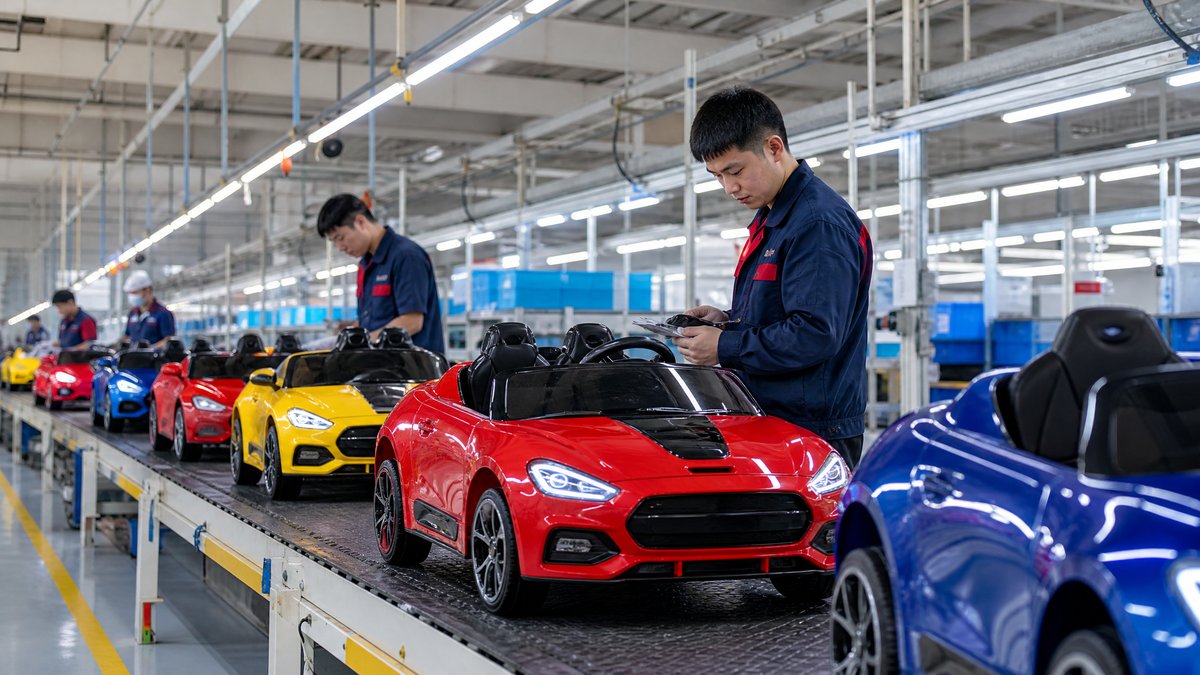
Buyers should review each kids ride-on car SKU at variant level, score demand, margin, inventory exposure, complexity, and market fit, then retain, simplify, replenish cautiously, reposition, or exit it. The goal is an assortment customers understand and the supply chain can replenish without avoidable stock or service risk.
Kids ride-on cars are vulnerable to accidental SKU growth. One base vehicle can become body colors, battery configurations, remote-control versions, accessory packs, carton artworks, and regional instruction sets. Together, these choices divide forecast volume, complicate purchasing, create mismatched parts, and make aged inventory harder to liquidate.
For importers, wholesalers, distributors, retailers, and OEM buyers, rationalization is a recurring commercial process, not a clearance project. It links sell-through and demand to supplier capability, commitments, stock age, documentation, packaging, and approved configuration.
Define What a SKU Represents Before Reviewing It
Define the unit of analysis. A vehicle platform is not necessarily one SKU, and a color is not automatically a strategic product. A consistent hierarchy keeps performance visible.
Start by grouping the range into three levels:
- Platform: the underlying vehicle architecture, such as a single-seat SUV-style ride-on or a two-seat utility-style ride-on.
- Sellable SKU: the specific product and retail configuration that is ordered, stored, and invoiced.
- Variant attribute: a difference such as color, sticker set, wheel treatment, battery type, seat material, remote-control configuration, packaging language, or bundled accessory.
This distinction prevents the wrong decision. A slow blue version may sit on a healthy platform, so retire the color rather than the platform. Conversely, many low-volume variants can consume disproportionate warehouse, parts, and quality-control resources; reduce variants rather than trying to rescue every SKU.
Create one working file that joins sales, procurement, inventory, and product data. Give each SKU a stable code and record its platform, launch date, channel, market, attributes, approved configuration, order history, available and inbound stock, and service-parts relationship. Informal names fail when the model changes or a part must be matched.
Separate true choice from duplicate choice
A useful choice changes the purchasing decision. A duplicate adds a cosmetic difference customers do not seek out. Ask sales teams and retail partners what customers request, then test that view against transactions, site searches, returns, and lost-sale notes.
A color can drive demand in one country but duplicate another choice elsewhere. A retailer may need a narrower range than a specialist distributor, while an OEM buyer may retain private-label artwork or a bundle. Preserve evidence-based differentiation rather than impose a global range.
Build a Performance Scorecard That Looks Beyond Revenue
Unit sales are a start, not a plan. High sales can reflect discounting, a one-off customer, or heavy service needs. Low sales may follow a late arrival, stockout, weak listing, or incomplete selling season. Compare every SKU with a relevant peer group by price tier, channel, market, or format.
Measure demand quality
Use a period that captures a normal selling cycle where practical. Review units, revenue, sell-through, reorders, and active customers against availability. Good sell-through with stockouts is different from slow sales despite continuous availability.
Identify concentration. A SKU may deserve retention if one account drives its sales, but record that dependency and confirm forward demand before treating past volume as repeatable. For online channels, separate traffic from conversion: low conversion on well-exposed stock suggests a value or assortment issue; low traffic may call for better merchandising first.
Measure contribution, not only gross sales
For each SKU, calculate comparable contribution: net sales after normal discounts and credits, less landed cost, relevant freight and duty treatment, known channel fees, handling, and expected returns or warranty cost. Consistency matters more than false precision.
Evaluate margin with demand. A high-margin but slow SKU can trap capital. A fast, low-contribution seller belongs in the range only when it supports a price ladder, wins accounts, or leads to profitable follow-on sales. Record the reason.
Include operational and service signals
Ride-on car performance includes what happens after sale. Track returns, warranty cases, missing parts, carton damage, assembly questions, and component requests. Keep potential safety reports separate from service data and follow the internal escalation process promptly.
A moderate-volume SKU with few issues and shared components may beat a similar-volume item needing unique service stock. Record common versus exclusive parts. Fewer, better-understood components can improve service, but never improvise repairs or change products without manufacturer approval.
Quantify Inventory Risk Before Placing the Next Order
Inventory risk is the gap between likely sell-through and committed stock. For ride-on cars, it includes finished goods, deposit-backed production, transit stock, retail packaging, batteries, chargers, parts, and accessories. Warehouse stock alone understates exposure.
Build a SKU view of on-hand quantity, allocations, open orders, production, transit, and usable service parts. Add age and weeks of supply. Flag no-sales items, declining sell-through, weak demand evidence, and stock that cannot transfer because of packaging, language, or configuration differences.
Do not merge stock because vehicle bodies look alike. Confirm approved configuration, labels, instructions, artwork, components, power system, and destination-market requirements before a transfer or bundle. In the United States, for example, CPSC guidance notes that applicable requirements depend on the specific toy; it also identifies requirements related to battery-operated toys and certain ride-on toys, as well as certification obligations for manufacturers and importers of covered children’s products.[1] The European Commission likewise provides toy-safety guidance aimed at manufacturers, importers, and distributors, while noting that its guidance documents are not themselves legally binding.[2]
This is planning guidance, not legal advice. Before moving or replenishing a configuration, verify current destination-market requirements with responsible authorities, qualified advisers where appropriate, and the manufacturer. Link product documentation and approved changes to the SKU record.
Treat batteries and transport as separate exposure
A battery-equipped ride-on car has distinct handling, documentation, and carrier considerations. Shipping rules and carrier practices can change. IATA’s lithium battery guidance assigns manufacturers, shippers, and other supply-chain parties distinct safety responsibilities, including applicable packaging, marking, labelling, and documentation duties for shippers.[3]
Make battery information required in the SKU file: manufacturer-supplied chemistry and rating, installed or separate status, approved transport documents, and logistics contact. Before shipment, transfer, return, or consolidation, verify current destination-market and battery-transport requirements with responsible authorities or carriers. Never use rationalization to relabel, repack, alter charging arrangements, or modify the battery system without manufacturer approval and appropriate verification.
Decide Which Variants to Keep, Combine, or Exit
Decide at both platform and variant level. Assign every active and dormant SKU an action, owner, timing, evidence, commercial rationale, operational impact, and trigger. This gives the review purchasing effect.
Retain core sellers and protect their replenishment path
Protect core SKUs with reliable sell-through, acceptable contribution, repeatable demand, manageable service load, and channel fit. Confirm approved specifications, supplier communication, parts logic, and a conservative reorder rule. Use current demand, commitments, seasonality, and open inventory to set the next order.
Simplify fragmented variants
Consolidate variants that share a platform but split modest demand without clear customer benefit, such as near-equal colors, trim changes needing unique cartons, or bundles causing picking errors. Select the survivor by contribution, customer preference, documentation readiness, production consistency, component commonality, and stock.
For transition, stop new commitments, tell sales teams and customers the replacement SKU, and use approved descriptions. Sell remaining inventory without implying the outgoing model equals another configuration. Obtain required approvals before changing customer-owned OEM artwork or specifications.
Reposition selectively rather than discounting by habit
Some slow SKUs are misplaced in the price ladder, poorly presented, or allocated to the wrong customer type. Before retaining one, test a different account, bundle, placement, or approved content with a review date and measurable pass condition. If evidence does not improve, exit.
Do not make discounts automatic. They can clear stock but obscure demand, unsettle pricing, and train customers to wait. Use them as one controlled action after considering brand position, contractual constraints, and stock condition.
Exit responsibly
Exit decisions should protect cash and records. Freeze replenishment; confirm production, deposits, inbound stock, parts commitments, and customer obligations; then sell through, transfer only after verification, return by agreement, or dispose through a controlled route. Record the final disposition.
Do not casually discontinue support for products in market. Review commitments, parts, customer communications, and escalation routes. Product communications should reinforce adult supervision and the manufacturer’s instructions. Any change affecting safety, components, labels, instructions, or performance needs manufacturer approval and appropriate destination-market verification.
Turn the Analysis Into a Repeatable Buying Cadence
Keep the plan brief enough for a purchase meeting. Review stock, inbound exposure, exceptions, and service signals monthly; review assortment architecture and supplier decisions quarterly or seasonally. For each SKU ask: What sells? What is committed? What can go wrong? What happens next?
Use a decision log with SKU, action, rationale, evidence date, owner, supplier impact, communication need, stock exposure, and review date. Link it to approved samples, configurations, artwork, instructions, and parts mappings, especially when teams change or a model returns after a pause.
Ask suppliers which configurations share components, what order constraints apply, which parts might become exclusive, and how phase-out affects orders. Obtain written confirmation of approved changes. Never assume a new photo, color, charger, remote, or package equals past stock.
A buyer that wants a neutral second view of its scorecard or configuration matrix can email KidsRideCar’s team. Share the target market, channel, current SKU list, and the decisions that need evidence—not confidential customer data that is unnecessary for the review.
FAQ: Kids Ride-On Car SKU Rationalization
How many kids ride-on car SKUs should a buyer keep?
There is no reliable universal number. Keep the range that covers the intended customer segments and price points while maintaining adequate demand, contribution, replenishment control, and service support. Start with the evidence: if several SKUs deliver the same customer role but each has weak volume and unique complexity, consolidate them. If distinct channels or OEM programs have documented needs, retain purposeful variation.
Should a slow-selling color be discontinued immediately?
Not necessarily. First check its launch date, availability, selling season, channel exposure, margin, and whether it supports a committed account. Compare it to other colors on the same platform. If the evidence shows sustained underperformance and no strategic role, stop future commitments and use a controlled transition. Do not change labels, packaging, or product configuration merely to merge stock without manufacturer approval and suitable verification.
What is the biggest inventory risk in a ride-on car assortment?
The largest risk is often hidden commitment: a combination of aged warehouse stock, inbound containers, production already authorized, market-specific packaging, unique batteries or chargers, and parts held for low-volume variants. Review all of these together. A product that appears low-stock in the warehouse may be overcommitted once open orders and transit stock are included.
Can one model serve several destination markets?
Possibly, but buyers should not assume it. A common body platform may still need different approved instructions, warnings, labels, plugs, packaging, documentation, or other configuration controls. Confirm the exact sellable configuration and verify current destination-market requirements with responsible authorities, carriers where transport is involved, and the manufacturer before allocating stock across markets.
Which data should wholesalers ask OEM suppliers to provide?
Ask for the approved SKU specification, configuration and component list, packing details, battery information relevant to transport, available documentation, service-parts mapping, change-control process, and the status of any open production or material commitments. The request is not a substitute for the buyer’s own checks. It makes rationalization decisions more traceable and reduces surprises when a variant is reordered or retired.
For help structuring a SKU review around your market and channel, contact KidsRideCar. A focused discussion can start with the platform list, variant map, inventory position, and the next purchasing window.
Conclusion
SKU rationalization for kids ride-on cars is a deliberate choice about where to concentrate demand, capital, and operational attention. Begin with an accurate SKU hierarchy. Review demand, contribution, service burden, component commonality, and inventory commitment together. Then act decisively: protect core sellers, simplify weak duplication, test only clear repositioning ideas, and exit configurations with a documented transition.
The strongest plan does more than reduce a SKU count. It gives buyers a repeatable way to connect assortment choices with supplier controls, stock exposure, market fit, and responsible product management. Revisit it before the next purchase commitment, and keep configuration, safety, and transport verification current as markets and carrier requirements change.
References
[1]: https://www.cpsc.gov/Business--Manufacturing/Business-Education/Toy-Safety "CPSC Toy Safety Business Guidance"
[2]: https://single-market-economy.ec.europa.eu/sectors/toys/toy-safety/guidance_en "European Commission Guidance on Toy Safety"
[3]: https://www.iata.org/contentassets/05e6d8742b0047259bf3a700bc9d42b9/lithium-battery-guidance-document.pdf "IATA Guidance Document for Lithium Batteries and Sodium Ion Batteries"
Official references
Explore these external resources for current regulatory and trade guidance. Confirm requirements with the relevant authority before placing an order.
Ready to Start?
Factory-Direct · CE & ASTM Certified · MOQ from 50 Units
Our export team works with buyers in 60+ countries. Get a quote within 24 hours.
KR
Written by KidsRideCar
China's leading kids electric ride-on car manufacturer. 500,000+ units shipped annually to 60+ countries. CE, ASTM & EN71 certified.