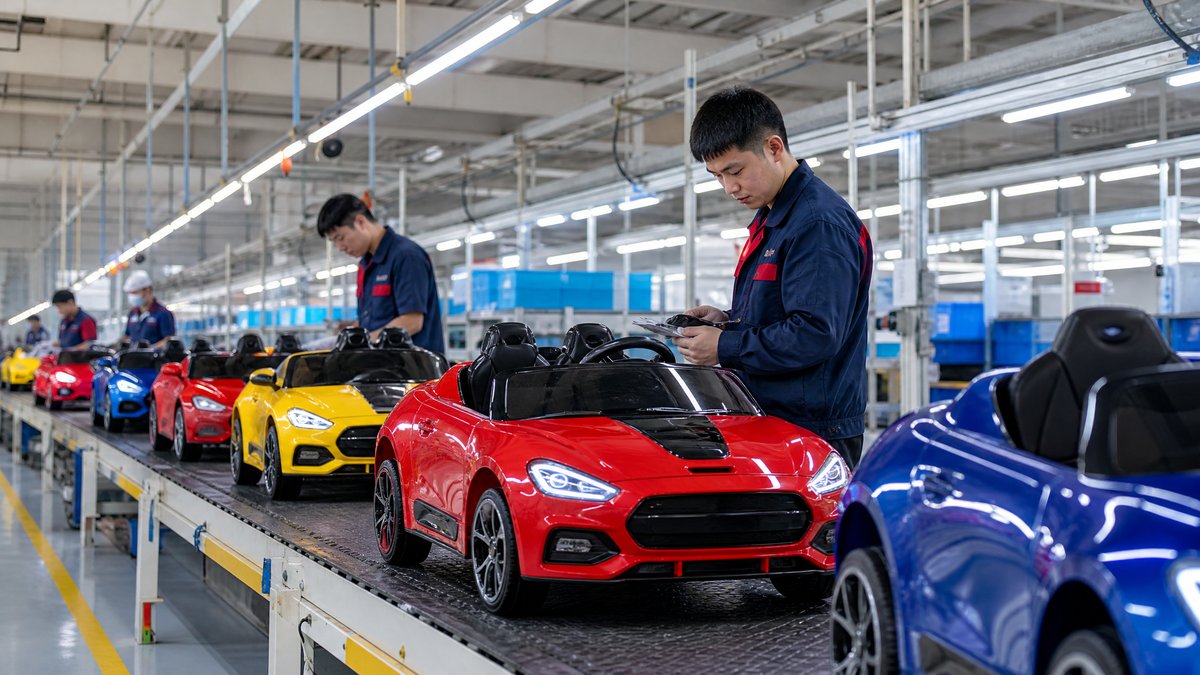
A kids electric ride-on car supplier sustainability questionnaire should request specific, reviewable evidence on sourcing, materials, packaging, energy, labor practices, battery transport documents, and marketing claims. It should not be an invitation for a supplier to call itself “green,” “ethical,” or “carbon neutral” without support. For an importer, wholesaler, distributor, retailer, or OEM buyer, the goal is to compare suppliers consistently, identify material gaps, and decide what needs clarification before a purchase order or a customer-facing claim is approved.
The scope should go beyond the visible body shell. A battery-powered ride-on car can involve plastic and metal parts, paint or coatings, electronics, batteries and chargers, cartons and protective inserts, assembly operations, subcontractors, and outbound shipping. Responsible business due diligence is risk-based: it addresses actual and potential impacts in operations, supply chains, and business relationships rather than implying that a supplier is perfect. [1]
Use a short screening form for an initial inquiry and a deeper evidence request for a private-label program, repeat range, or substantial tender. The questionnaire should state what documents are wanted, who must answer, and the deadline. Keep the completed form, follow-up questions, and any corrective-action commitments with the supplier record.
Build a questionnaire buyers can review
A practical form has two parts. First, ask the supplier to identify the legal entity, production site, product family, relevant subcontractors, and named respondent. Second, ask for evidence against each answer. A yes/no reply can flag an issue, but rarely supports a sourcing decision on its own.
Organize the form into six modules:
1. Responsible sourcing and supplier visibility.
2. Materials, chemicals, components, and product design.
3. Packaging and shipment efficiency.
4. Energy, waste, water, and emissions management.
5. Labor management, worker voice, and corrective action.
6. Claims control, product documentation, and battery transport readiness.
Give each question an evidence field: policy, component list, bill of materials, test report, energy record, audit report, or dated corrective-action plan. Ask for its date, coverage period, issuer, factory, and applicable model. This prevents a generic document from being treated as proof for the offered car.
Use an internal status such as verified, partially evidenced, unverified, or not applicable; the latter needs an explanation. Give more weight to safety-critical components, customer-facing claims, upstream risks, and demanding markets. This is a procurement tool, not a certification or legal conclusion.
Ask responsible sourcing questions that reveal the supply chain
Begin with the important inputs. Ask the supplier to list the factories or direct suppliers for the battery pack, charger, motor, electronic control parts, molded plastic shell or resin, metal frame parts, paint or coatings, tires, and packaging. Ask whether any function is subcontracted and whether the buyer will receive advance notice of a material production-location change.
The questionnaire should also ask:
- Is there a written responsible-sourcing policy or supplier code of conduct? Provide the current version and accountable manager.
- How are new component suppliers screened for quality, labor, environmental, and traceability risks?
- Which inputs can be linked to a batch, lot, production order, or purchase record for the proposed model?
- How are unauthorized, counterfeit, or substituted electrical components prevented from entering production?
- What is the escalation process if a component supplier is connected with a serious labor, environmental, or integrity concern?
- Can the supplier identify the battery chemistry, pack model, direct battery-pack supplier, and relevant cell information while protecting legitimate confidential information?
Do not require an unrealistic guarantee of perfect upstream visibility. OECD guidance encourages companies to prioritize significant impacts and work with business partners over time. [1] For a battery pack, start with identification, a responsible contact, test-summary availability, and change-control records; request further detail when risk justifies it.
Component-change control deserves a separate question. A credible response explains how the affected model is identified, documents are checked, the buyer is notified where agreed, and approval occurs before the part is used. A sustainability review must never bypass product controls. Batteries, chargers, wiring, protective devices, and other safety-related components should only be changed with manufacturer approval and any required reassessment.
Get material facts before discussing environmental benefits
Ask for a model-specific material matrix or bill of materials. It need not reveal every commercial detail, but it should identify main material families and approximate weights or percentages where the supplier can substantiate them. Relevant categories include plastics, metal, rubber or elastomers, textiles, electronic boards, battery pack, charger, fasteners, paint, coatings, and adhesives.
Recycled content and recyclability
For every recycled-content statement, ask which part contains it, whether it is post-consumer or pre-consumer material, the calculation basis, and the evidence available. Ask whether the percentage applies to one component, the total product, or only packaging. Do not turn “recyclable in theory” into “widely recyclable.” Collection and processing infrastructure differ by destination market.
Ask whether mixed materials, additives, labels, coatings, or electronics affect end-of-life handling. This can guide simpler design and accurate consumer information, not a promise of recycling outcomes the seller does not operate.
Chemical controls and durability boundaries
Request the process used to control restricted substances in plastics, coatings, metals, electronics, and packaging. Ask which evidence applies to the offered model and production period, how upstream suppliers receive specifications, and how nonconforming material is quarantined. A declaration is useful but not universal proof; understand the supporting tests, supplier documents, or incoming-material controls.
Name the destination market and the documents your business needs to review rather than asking a factory to declare blanket compliance worldwide. Requirements can change and may differ by model and market. For example, CPSC business guidance identifies battery access, labeling, overheating, and supplied chargers as relevant considerations for battery-operated toys, along with instructions and producer markings. [5] Buyers should verify current requirements for their product and destination market with responsible authorities or qualified advisers.
Longer useful life can reduce replacement demand, but do not encourage improvised repairs. Ask whether approved spare-parts lists, service instructions, and model-specific support are available to commercial customers. Do not make a durability claim unless it is defined and supported for the actual product and expected use. Consumer messaging should remain model-neutral: follow manufacturer instructions, provide adult supervision, inspect before use, and stop use if damage or abnormal operation appears. Do not modify the electrical system, battery, charger, or protective features without manufacturer approval.
Make packaging questions specific and protective
Packaging is a practical improvement area, but it must protect a relatively heavy, battery-powered product in handling and transport. EPA notes that lightweight or more efficient packaging can reduce discarded waste and that recovery of packaging materials also matters. [3] This does not justify a thinner carton unless protection has been considered.
Request each SKU’s carton dimensions, gross weight, board or material description, inserts, bags, tape, labels, pallet method, and units per container. Then ask:
- Which packaging components are fiber-based, plastic, molded pulp, foam, or mixed material?
- What recycled-content evidence exists for cartons or paper inserts, and what is its calculation basis?
- Can protection be reduced, replaced, or right-sized without compromising product protection?
- Are warning labels, carton instructions, and recycling symbols reviewed for the intended language and market?
- What is the container-loading plan, and how are damaged cartons or moisture exposure addressed?
A credible improvement compares a stated baseline with a revised pack: component removed, quantity or weight changed, applicable model and revision, and confirmation that protection remained acceptable. Avoid “plastic-free” if bags, tape, labels, coatings, or other plastic elements remain.
Request operating evidence for energy, waste, and freight
Separate factory data from product claims. Ask where the cars are assembled, the operations performed, the reporting period, and actual site energy data or a credible summary.
Ask what energy sources the site uses and whether recent electricity or fuel records can be shared. For a renewable-energy claim, identify the basis, site, and period. Also ask about efficiency work, waste handling, and whether freight consolidation or container utilization is tracked.
Numbers help only when their boundary is clear. Energy totals do not prove a product-level footprint. For an emissions figure or reduction claim, ask for boundary, method, period, exclusions, and independent-review status. Otherwise, treat it as supplier-reported information, not a verified claim.
Match labor policies with implementation evidence
Labor questions should cover the supplier’s facility and relevant subcontractors. Seek evidence of prevention, worker reporting channels, and responses to issues. The ILO describes due diligence involving risk assessment, prevention, remediation, complaint mechanisms, monitoring, and reporting. [2]
Ask for a current policy covering forced and child labor, discrimination, harassment, working time, wages, and worker representation where permitted. Ask how age is verified, labor agents and temporary workers are controlled, and workers receive terms and grievance-channel information in an understood language.
Also ask whether workers can raise concerns confidentially, whether retaliation is prohibited, and how cases are recorded and closed. Request a description of working-time and wage-payment controls without seeking unnecessary personal data. If a social audit or assessment is available, review its date, facility, workforce scope, findings, corrective actions, and closure evidence. An audit is a point-in-time input, not a guarantee. Review any known serious allegations, enforcement actions, or unresolved corrective actions relevant to the proposed supply and the supplier’s response.
A supplier that identifies a gap and offers a dated corrective-action plan can be more informative than one that simply states “no issues.” Treat certifications and audit logos cautiously. Request the certificate or report and check its scope, issuer, facility address, date, and validity yourself. Never market an unverified certification as fact.
Cover batteries, transport, and careful claims
Electric ride-on cars need both sustainability review and logistics readiness. Ask for the battery chemistry, pack model, nominal voltage, watt-hour rating where applicable, cell or pack manufacturer, charger model, compatible product models, and applicable UN 38.3 test summary. IATA explains that manufacturers and subsequent distributors must make an applicable test summary available for lithium or sodium-ion cells, batteries, and equipment with installed batteries, subject to limited exceptions. [4]
Ask who prepares shipping documentation, marks, labels, packaging instructions, and carrier communications. Battery transport requirements can differ by mode, configuration, route, state of charge, and current carrier policy. Buyers should verify current destination-market and battery-transport requirements with responsible authorities or carriers before shipment. Do not assume a document accepted for one route, battery, or transport mode will apply to another.
Finish with a claim-control section. Require the supplier to list every proposed environmental, material, labor, energy, or packaging claim for the product, package, or factory. For each claim, ask for the exact wording, scope, model, period, calculation method, supporting documents, and approval owner. Prefer a narrow, supportable statement over a broad label. “Carton contains supplier-declared recycled fiber content” can be reviewed; “eco-friendly packaging” often cannot. Do not use absolute terms such as “non-toxic,” “zero waste,” “sustainable,” or “carbon neutral” without a properly assessed basis and market review.
For a tailored OEM or private-label evidence request, contact KidsRideCar.
Turn answers into supplier management
A completed questionnaire starts the review. Compare it with the quotation, specification, packaging drawing, sample, safety documents, shipment plan, and supply agreement. Record what is product-specific, factory-wide, or still unsupported.
Use the form before final supplier nomination and refresh it after material changes in factory, battery, charger, design, subcontractor, packaging, or destination market. Give suppliers model identifiers, target countries, language needs, and claim restrictions. A defined SKU and battery request produces better evidence than a vague request for a “sustainable ride-on car.”
For support reviewing a private-label questionnaire and evidence package, email info@kidsridecar.com.
FAQ
What is the minimum evidence to request from a ride-on car supplier?
Request the factory and product identity, main-component list, packaging specification, responsible-sourcing and labor policies, relevant battery test summary, material or restricted-substance documents needed for the target market, and a list of proposed claims with supporting evidence. The required depth rises with order value, private-label exposure, product complexity, and destination-market risk.
Can a questionnaire prove a kids electric ride-on car is sustainable?
No. It is a due-diligence and comparison tool. It can expose controls, documentation gaps, and follow-up work, but it does not certify a product, factory, or supply chain. Never convert answers into broad consumer claims without separate substantiation and review.
Should buyers ask about recycled plastic in every model?
Yes, but request an exact response: the affected part, resin type, recycled-content type, percentage or mass basis, model, and supporting record. If a material change affects appearance, performance, or a safety-related characteristic, it should follow manufacturer-approved specifications and change control. A claim for one part does not apply automatically to the entire car.
How should battery transport appear in the questionnaire?
Ask for battery and charger identification, applicable test-summary information, product configuration, packing method, responsible shipper, and route or transport-mode assumptions. Confirm the latest requirements with the intended carrier and responsible authorities before dispatch. Do not alter battery packs, chargers, wiring, or transport packaging without manufacturer approval and any required reassessment.
Are social audit reports enough to close labor questions?
Usually not. An audit may be helpful, but it has a date and a limited scope. Check that it covers the correct facility and workforce, identify open findings, request corrective-action evidence, and ask about grievance channels and labor-agent controls. Respect privacy and do not request unnecessary worker personal data.
Conclusion
A strong kids electric ride-on car supplier sustainability questionnaire is specific, evidence-led, and designed for follow-up. It maps key components and subcontractors, requests material and packaging facts, separates operating data from marketing language, checks labor-management evidence, and tests battery documentation and transport readiness. Most importantly, it helps buyers communicate only what they can support for the right model, facility, period, and market.
References
[1]: https://www.oecd.org/en/topics/sub-issues/due-diligence-guidance-for-responsible-business-conduct.html "OECD Due Diligence for Responsible Business Conduct"
[2]: https://www.ilo.org/sites/default/files/2025-08/FL%20Brief%2005%20-%20Due%20diligence.pdf "ILO Brief: Promising Practices in Addressing Forced Labour"
[3]: https://www.epa.gov/smm/sustainable-packaging "US EPA Sustainable Packaging"
[4]: https://www.iata.org/contentassets/05e6d8742b0047259bf3a700bc9d42b9/lithium-battery-guidance-document.pdf "IATA Guidance Document for Lithium Batteries and Sodium Ion Batteries"
[5]: https://www.cpsc.gov/Business--Manufacturing/Business-Education/Toy-Safety "CPSC Toy Safety Business Guidance"
Official references
Explore these external resources for current regulatory and trade guidance. Confirm requirements with the relevant authority before placing an order.
Ready to Start?
Factory-Direct · CE & ASTM Certified · MOQ from 50 Units
Our export team works with buyers in 60+ countries. Get a quote within 24 hours.
KR
Written by KidsRideCar
China's leading kids electric ride-on car manufacturer. 500,000+ units shipped annually to 60+ countries. CE, ASTM & EN71 certified.