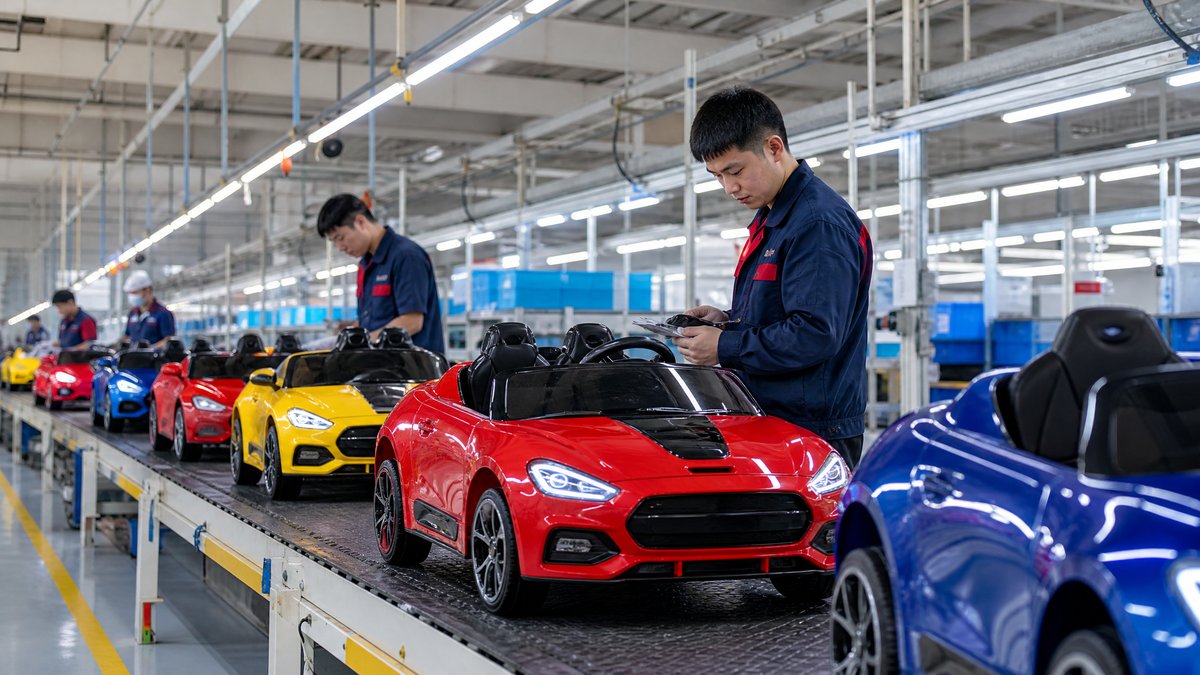
Importers should publish a ride-on car claim only when it is tied to the exact sellable model, configuration, destination market, and approved evidence. Create a model claim sheet, check it against current documents and images, use controlled safety wording, validate translations, and obtain named approval before a listing goes live. A catalogue, conversation, or similar-looking sample is not enough proof.
This protects the buyer’s brand and gives wholesalers, distributors, retailers, and OEM buyers dependable content for product pages, marketplaces, quotation packs, and customer-service scripts. It also prevents claims from one version silently moving to another with different equipment, battery details, seat capacity, or market documentation.
If your team needs a repeatable review pack for an upcoming range, contact KidsRideCar to discuss the model information and listing materials needed before publication.
Start with a claim rule: no evidence, no listing claim
A claim is any statement, image, icon, comparison, or implied promise about what the ride-on car is, includes, does, or how it should be used. “Two seats,” “parental remote,” “included charger,” “suitable for a stated age,” and “certified” are claims. So is a photo showing an accessory not supplied with the selected SKU.
Use one rule: each published claim needs a source, owner, scope, and approval status. The source may be a current manual, approved specification sheet, inspection record, packaging artwork, test document, or SKU-linked supplier confirmation. Scope must identify the model, revision, trim, battery option, and market. Generic brochures are discovery material, not a master source; they may show options, older revisions, or export artwork.
Build a model claim sheet before writing marketing copy
Create one controlled sheet per sellable model or SKU, and revise it whenever configuration changes. Include:
- Model identity: internal SKU, supplier model code, revision or order reference, colour/trim, and destination market.
- Claim text: the exact shopper-facing wording proposed for the listing.
- Claim category: specification, included item, function, safety/use guidance, documentation, logistics, or commercial statement.
- Evidence reference: file, page, image identifier, document date, and reviewer.
- Scope and conditions: for example, “only with remote-control variant,” “charger supplied in this SKU,” or “wording copied from approved manual.”
- Status: draft, verified, rejected, changed, or approved for publication.
- Review date and approver: enough detail to trace later updates.
A spreadsheet, product-information system, or controlled folder can work. The key is that the writer cannot pick an unidentified specification or confuse an option with standard equipment.
Verify facts at the model and configuration level
A listing should describe the product that will arrive, not the closest sample or model family. Before copywriting, obtain the current specification sheet, manual, packaging/label artwork, product and carton photos, and market-specific documents.
For each factual field, ask two questions: what exactly does the evidence say, and does it apply to this SKU? If either answer is unclear, omit the claim or pause publication until it is resolved.
Separate product specifications from performance promises
Approved documents can support dimensions, model code, documented battery details, charger inclusion, supplied accessories, seat count, and control functions. Check each against the order configuration.
Do not turn a component specification into an outcome promise. A battery rating does not prove fixed run time; a motor description does not prove every-terrain suitability; a remote does not replace adult supervision; and a large-looking seat does not prove two-rider use. Say “includes a parental remote control” or list drive settings only where the selected SKU and manual support it.
Treat options, bundles, and substitutions as separate products
“Includes” often causes mistakes: images may show a remote, cover, spare battery, upgraded wheels, or charger that the order does not contain. Use “included with this SKU,” “optional where offered,” or “confirm the selected configuration.” When a component changes, recheck its photos, packaging, instructions, and transport information.
Use safety wording that informs without overclaiming
Safety content should be useful, visible, and model-neutral unless model-specific documentation authorizes more detail. Avoid “completely safe,” “risk-free,” “child-proof,” “road safe,” or “safety certified.” Do not display a compliance mark or claim certification without current documentation for the exact configuration and market.
For U.S.-bound children’s products, the CPSC explains that applicable products require testing and certification, and that a Children’s Product Certificate must identify the product and the applicable rules. Its toy guidance also notes that battery-operated and certain ride-on toys can have labeling and instructional-literature requirements.[1] [2] That is a reason to verify the specific product and market documents, not a basis for a generic compliance claim across a catalogue.
Use approved manuals, labels, and market documents for age guidance, intended use, warnings, charging, and control wording. Never infer age guidance from a photo, product size, or competitor page. Keep approved language consistent across listings, packaging, feeds, and support scripts.
Tell adults to supervise children, follow supplied instructions, and use the product as specified by the manufacturer. Do not say a feature removes supervision needs or publish repair, rewiring, battery-opening, or modification instructions. Manufacturer approval is required before communicating changes to the car, battery, charger, controls, or restraints.
Keep battery and transport claims separate from consumer instructions
Verify battery chemistry, documented rating, inclusion/removability, approved charger, and model instructions. Do not promise charge time, run time, “fast charging,” or a transport outcome without model-specific proof.
Lithium battery air transport can depend on configuration and Watt-hour rating, and IATA provides guidance on identification, packing, marking, labelling, and documentation.[3] Before shipping, verify current destination-market and battery-transport requirements with responsible authorities, the selected carrier, freight forwarder, and product documents. A listing is not a substitute for that verification.
Review images as evidence, not decoration
Images make claims too. Customers may assume that a visible second seat, remote, charger, accessory, or badge is supplied. Link image review to the model claim sheet.
Give each approved image an ID tied to model, variant, colour, and date. Compare it with the bill of materials, specification sheet, and packaging. Check the steering wheel, wheels, seat, lights, controls, remote, charger, decals, and accessories, plus any depicted use that conflicts with the manual.
Use a note such as “accessory shown separately” or “configuration varies by SKU” where needed, but replace materially wrong images. Do not digitally add accessories, remove warnings, alter apparent size, or suggest an unverified brand affiliation or certification.
Check image files and listings across every channel
Assets also appear in wholesale catalogues, marketplace templates, feeds, quotes, and sales presentations. Maintain one approved asset folder, retire superseded files, and record which asset IDs are cleared for each SKU. This controls “image drift” after product changes.
Translate meaning, warnings, and units—not just words
Literal translation can distort “seat,” “occupant,” “remote,” “included,” “recommended age,” “maximum load,” or “assembly.” A small safety-text change can soften a limitation or turn an instruction into a guarantee.
Translate only from the approved claim sheet. Give translators the model, market, image set, units, and source for safety text. Preserve distinctions such as single rider versus total occupants and supplied versus optional items. Convert units carefully and retain the original controlled value.
A second reviewer with product and target-language knowledge should compare the translation with the approved source, manual, packaging, and images. Natural wording alone is not approval; equivalent meaning is the goal.
Put a clear approval workflow between draft and publication
A short, defined workflow is more reliable than an informal email chain. It also prevents sales urgency from turning a supplier promise into an unverified public claim. The following sequence works for importers managing their own label, distributor network, or retailer content feeds.
1. Intake and version lock
The category or sourcing owner identifies the exact SKU, target market, planned channels, product revision, and launch date. They collect current source documents and lock the configuration. If the order is not yet fixed, the listing remains a non-public draft rather than a product promise.
2. Evidence mapping
The product-data owner enters each proposed claim into the model claim sheet and attaches the evidence. Claims without an evidence reference are marked “do not publish.” Marketing language may be drafted only after the factual base is mapped.
3. Cross-functional review
Sourcing confirms that the configuration matches the order. Product or quality staff review model facts, manuals, images, and warning text. The market owner checks local language, mandatory information, and channel rules. Logistics reviews any shipping statement. Compliance specialists or qualified advisers should review matters that need regulatory interpretation; commercial copywriters should not make that decision alone.
4. Content and asset approval
The approver reviews the final page as a customer will see it: title, bullets, description, specification fields, safety language, manuals, translations, icons, images, captions, metadata, and feed attributes. They confirm that every listed claim has a matching record in the claim sheet. Approval should be written, dated, and linked to the exact copy and assets.
5. Publish, archive, and monitor
Publish only the approved version. Archive the source pack, approval, final webpage export, and asset IDs. Then check live retailer and marketplace listings for truncation, automatic translations, incorrect variation mapping, or reused images. When the manufacturer changes a component, instruction, package, or model code, reopen the claim sheet and review affected listings before further orders or content releases.
For help structuring an evidence-led product information pack for your next ride-on car range, email info@kidsridecar.com.
FAQ
What is the minimum proof for a ride-on car feature claim?
Use current evidence that identifies the exact sellable model and configuration, such as the approved specification sheet, manual, packaging artwork, or controlled product photo. The record should show which statement the evidence supports, who checked it, and which market it covers. A claim copied from a competitor or a generic catalogue is not sufficient.
Can we say a ride-on car is suitable for two children because it has two seats?
No. Publish a passenger or seating claim only when the manufacturer’s approved documentation for that model states the permitted occupancy and any related limits. A visual impression is not proof. Keep adults responsible for supervision and follow the manufacturer’s supplied instructions.
May a retailer use “certified” in a product title?
Only if the exact wording, documentation, product configuration, and destination-market use have been reviewed and approved by the responsible team. A test report, mark, or certificate associated with a different model, revision, market, or optional component should not be extended to the listing. If the evidence is unclear, use factual, non-certification language or omit the claim.
How often should listings be reapproved?
Review before initial publication and whenever the model, battery, charger, supplied accessory, packaging, manual, destination market, translation, imagery, or relevant requirements change. A scheduled periodic review can also help identify stale claims, but a configuration change should trigger review immediately.
Who owns final approval: the supplier or the importer?
The supplier is an important source of model information, but the importer or brand should assign a named internal owner for the claims it publishes. That owner should obtain the necessary product, market, logistics, and language sign-offs rather than relying on a single informal confirmation.
Conclusion
The best ride-on car listing is not the one with the most feature claims. It is the one whose claims can be traced to the exact product a customer will receive. Build a model-specific evidence file, distinguish specifications from promises, use careful safety language, review visuals and translations as claims, and require recorded approval before release. This approach makes product pages clearer for buyers and easier to maintain when configurations or markets change.
References
[1]: https://www.cpsc.gov/Business--Manufacturing/Business-Education/Toy-Safety "CPSC Toy Safety Business Guidance"
[2]: https://www.cpsc.gov/Business--Manufacturing/Testing-Certification/Childrens-Product-Certificate "CPSC Children's Product Certificate"
[3]: https://www.iata.org/en/programs/cargo/dangerous-goods/lithium-batteries/ "IATA Batteries Guidance"
Official references
Explore these external resources for current regulatory and trade guidance. Confirm requirements with the relevant authority before placing an order.
Ready to Start?
Factory-Direct · CE & ASTM Certified · MOQ from 50 Units
Our export team works with buyers in 60+ countries. Get a quote within 24 hours.
KR
Written by KidsRideCar
China's leading kids electric ride-on car manufacturer. 500,000+ units shipped annually to 60+ countries. CE, ASTM & EN71 certified.