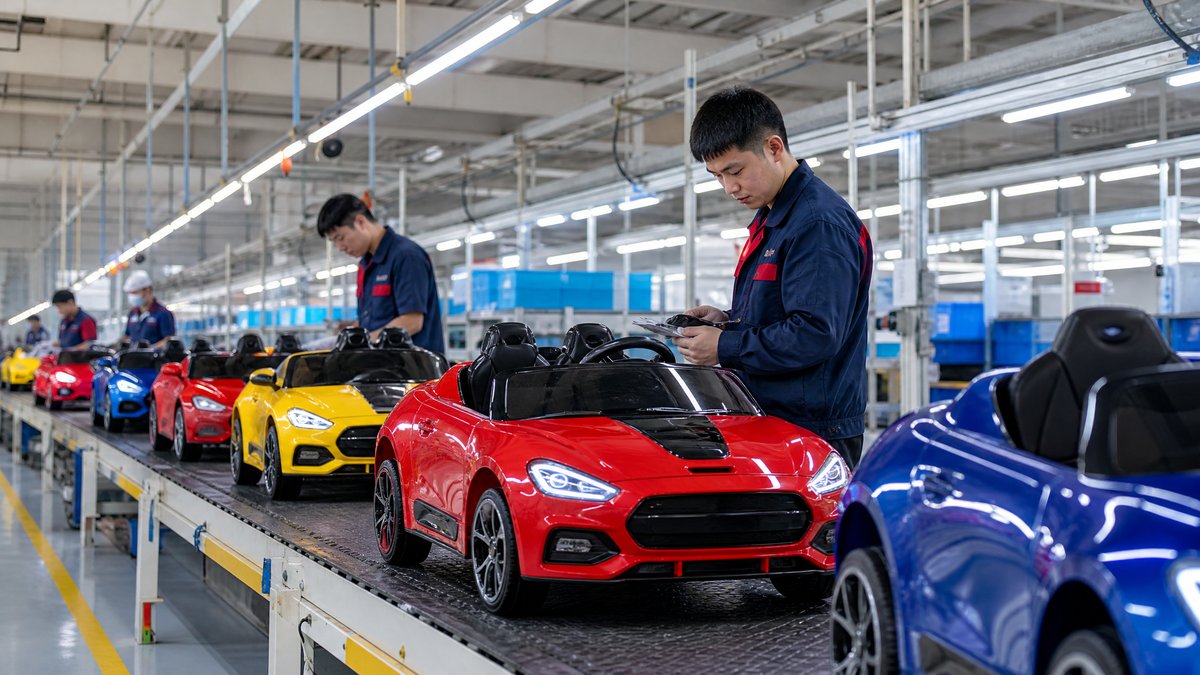
A retail employee can sell a kids ride-on car confidently when the product information is organized, consistent, and easy to use on the shop floor. For a distributor, a training kit is more than a feature presentation. It is a controlled set of product, safety, demonstration, compliance, and after-sales materials that helps every retailer give buyers accurate guidance.
The kit is model-neutral in its structure but specific in its approved facts for each SKU. It should help staff compare models without exaggerating performance, explain supervision requirements, recognize a suitable customer use case, and route technical questions to the right support contact. This framework helps B2B buyers define a useful kit before launch.
1. Start with a SKU reference sheet
Every model should have a one- or two-page reference sheet that staff can consult quickly. Include the model name and SKU, product photographs, recommended age guidance as supplied for that model, seat configuration, dimensions, net and carton weights, maximum load information, battery type and stated electrical specifications, charger information, drive configuration, and included accessories.
Separate verified specifications from selling language. For example, a sheet may state that a model has parental remote control, selectable speed modes, working lights, or a Bluetooth-compatible audio function if those features are actually included. It should not turn a general feature into a promise about speed, terrain, runtime, or safety unless the distributor has approved a model-specific claim and supporting information.
A comparison table is useful when a retailer stocks several products. Compare meaningful attributes such as voltage, seating, size, control method, wheel design, charging interface, and packaging configuration. Link to the relevant product page, such as [/products/kr-s900](/products/kr-s900), [/products/kr-l700](/products/kr-l700), or [/products/kr-t600](/products/kr-t600), only where that model information is current and approved. Add a revision date and owner so old specifications are removed after changes.
2. Add a customer-needs and model-selection guide
Staff need a simple discovery process, not a script that pushes one model to every shopper. The guide should prompt them to ask who will use the vehicle, the child's approximate age and size, whether one or two seats are needed, where it will be used, how much storage space is available, and whether an adult wants remote control. Staff should explain that age guidance, dimensions, maximum load, and supervision requirements must be checked for the individual model and destination market.
Map common answers to product categories rather than unsupported promises. A compact single-seat unit may suit a family with limited storage; a two-seat model may be relevant to siblings if the model's seating and load guidance allow it. A customer planning use on smooth indoor flooring has different practical needs from one considering a private outdoor area. Staff should avoid saying that a vehicle is suitable for public roads, steep slopes, wet conditions, or any surface unless the approved instructions specifically support that use.
Include a short “when not to recommend” section. Examples include a buyer who cannot provide the required adult supervision, a location that lacks safe space, or a child whose size does not fit the model's documented limits. This protects the shopper and reduces avoidable returns. A decision tree or laminated counter card can make this process usable during a busy sales period.
3. Provide a safe demonstration playbook
A demonstration guide should explain how to prepare the display unit, control the area, and end the demonstration. Before use, staff should check that the vehicle is stable, visually intact, charged according to the supplied instructions, and free from loose packaging or damaged parts. The display area should be clear of customers, shelves, steps, traffic routes, and obstacles. An adult—not a child—should control the first demonstration and remain responsible for supervision.
The playbook should cover the approved sequence for showing the power switch, forward and reverse controls, steering, speed modes, parental remote, lights, horn, and audio features where applicable. Demonstrate gradual control and stopping without encouraging races or high-speed behavior. If a unit has a seat belt or restraint, show how it is used without implying that it replaces adult supervision. Do not demonstrate operation on a wet floor, ramp, public walkway, or improvised surface.
Include a pre-demo and post-demo checklist with a clear stop-use rule. If staff notice unusual noise, damaged wiring or casing, a loose wheel, a charger issue, or controls that do not respond normally, they should isolate the display unit and escalate it. Never instruct staff to bypass safety devices, open battery packs, rewire, solder, or perform internal repairs.
4. Include compliance, warnings, and claim-control materials
Retail staff should know how to find the approved manual, warning label copy, age grading, importer or responsible-party information, and market-specific documentation. The kit can include a compliance summary, but it should not present a generic certificate as universal approval. Market compliance must be confirmed for the destination market and model, including applicable toy, electrical, battery, labeling, language, and transport requirements.
Give staff a “say this, not that” claim guide. Approved wording might explain that a parental remote allows an adult to control certain functions from a distance, subject to the model instructions. Unapproved wording might promise that the remote makes the product completely safe, or that a car is suitable for every child or surface. Similar controls should apply to claims about runtime, speed, load, waterproofing, hill climbing, durability, and battery life.
The kit should also contain an escalation card. It should state who handles a compliance question, product incident, suspected defect, missing warning, or customer request for documentation. Staff should record the model, batch or serial information when available, purchase channel, description of the issue, and photographs according to the distributor's process. A short incident form supports traceability without asking retail staff to diagnose a fault.
5. Build a practical selling and merchandising module
Product education works best when it connects features to customer questions. Give staff approved benefit statements, objection-handling examples, and a comparison matrix for the store's assortment. Explain the difference between a feature and a benefit: a two-seat layout may offer shared play for appropriate users, while a remote control may help an adult manage the initial experience. Staff should never turn those examples into guarantees of comfort, safety, or developmental outcomes.
Add display guidance covering shelf placement, model identification, price cards, included accessories, QR codes, and the location of the manual. If a vehicle is live on display, clearly identify whether it is a demonstration unit and explain that the final packaged product may require assembly. Use product photography and videos that match the approved model, color, accessories, and controls. A link to the distributor's [/blog](/blog) can support broader product education, but retailers should not substitute an unverified blog claim for the model manual.
Train staff to set expectations before checkout: carton size and weight, assembly responsibility, charging location, storage, adult supervision, intended use, returns, warranty process, and available spare parts. This conversation is especially important for online-to-store handoffs and gift purchases, where the person buying may not be the person supervising use.
6. Finish with after-sales tools and a knowledge check
A complete kit includes a quick-start handout, assembly overview, charging and storage reminders, approved troubleshooting triage, warranty terms, spare-parts request form, and contact route. Troubleshooting should remain observational: check the power switch position, connector seating only where the manual permits user access, charger indicator behavior, and visible damage. If the issue persists, staff should stop use and escalate rather than improvise a repair.
Include a return-and-claims flow that distinguishes a customer question, missing component, transit damage, suspected defect, and safety incident. Define the evidence to collect, the response owner, and the target internal handoff—not an unsupported promise to the customer. The distributor can direct retailers to [/inquiry](/inquiry) for a formal product or sourcing question when that is the approved channel.
End the training with a short knowledge check and a sign-off record. Questions can test model selection, safe demonstration, claim limits, documentation location, and escalation steps. Keep attendance and version records, then refresh the kit when a model, accessory, manual, label, packaging configuration, or market requirement changes. Review FAQs and claims data to identify sections needing clearer language.
FAQ: Retail staff training kits for kids ride-on cars
What is the minimum content for a retail staff training kit?
At minimum, include a current SKU sheet, model-selection guide, approved safety and compliance information, demonstration checklist, selling claims, manual access, after-sales process, escalation contacts, and a short knowledge check. Add local-language materials where the destination market requires them.
Should every retailer receive the same kit?
The core content should be controlled and consistent, but delivery can vary by store format and role. A showroom may need a detailed demonstration module, while an e-commerce team needs listing specifications, images, FAQs, and customer-service escalation steps. Keep model-specific and market-specific content clearly separated.
How should staff explain battery and charging information?
They should repeat only the instructions supplied for the exact model and charger. Staff can explain where charging takes place, which indicator information the manual provides, and how the product should be stored. They should not advise customers to substitute chargers, modify wiring, open battery packs, or continue using visibly damaged equipment.
What compliance documents should a retailer show customers?
Provide the documents and extracts approved for customer use in the destination market, such as manuals, warnings, labels, and relevant declarations or test documentation where applicable. The distributor should confirm market compliance for the specific model; staff should not claim that one document covers every country or SKU.
How often should a training kit be reviewed?
Review it before each model launch, after a product or packaging change, and whenever a manual, warning, market requirement, or service process changes. A periodic review also captures recurring questions and outdated claims.
Conclusion
A retail staff training kit should turn verified product data into consistent decisions at the point of sale. When it combines model selection, safe demonstrations, claim control, compliance awareness, merchandising, and after-sales escalation, it supports better customer education without overpromising. Distributors should version every document, train staff on the exact models they sell, and confirm market compliance for each destination and model before launch.
For help preparing product information, dealer materials, or an OEM training package for your market, contact KidsRideCar at info@kidsridecar.com.
Official references
Explore these external resources for current regulatory and trade guidance. Confirm requirements with the relevant authority before placing an order.
Ready to Start?
Factory-Direct · CE & ASTM Certified · MOQ from 50 Units
Our export team works with buyers in 60+ countries. Get a quote within 24 hours.
KR
Written by KidsRideCar
China's leading kids electric ride-on car manufacturer. 500,000+ units shipped annually to 60+ countries. CE, ASTM & EN71 certified.