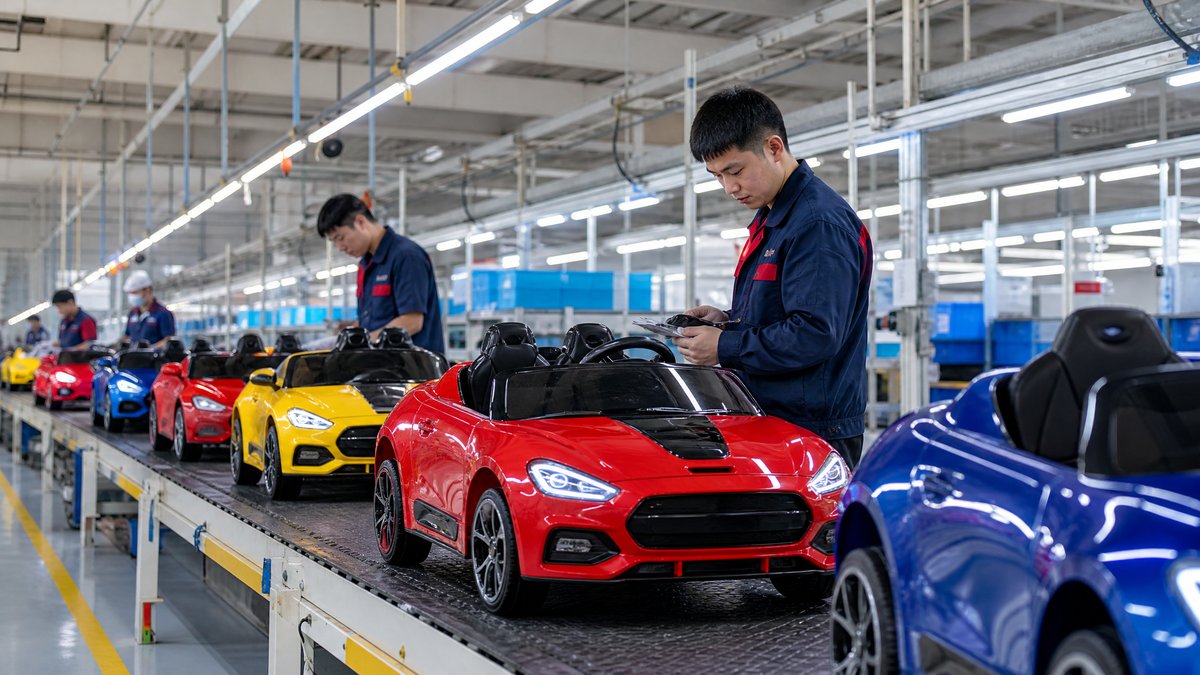
Seasonal demand forecasting helps wholesalers decide what to buy, when to place orders, and how much inventory to hold for each sales channel. For kids electric ride-on cars, a useful forecast must account for gifting seasons, local weather, school holidays, retail promotions, ocean transit, production schedules, and the different sales rates of single-seat, two-seat, and feature-led models. It should be a working planning tool rather than a one-time guess.
The most reliable approach combines your own sales history with retailer signals, supplier lead-time information, market-specific calendars, and clearly stated assumptions. This guide explains a practical process for importers, distributors, retailers, and OEM buyers. It is model-neutral: the same framework can be applied to a core assortment or to models under review such as the [KR-S900](/products/kr-s900), [KR-L700](/products/kr-l700), and [KR-T600), provided the product data is verified for the relevant configuration.
1. Define the forecasting scope before using numbers
Start by deciding what the forecast is meant to support. A country-level annual purchasing plan will use different inputs from a weekly replenishment forecast for an online retailer. Define the forecast period, sales channels, destination markets, currency, and unit of measure. Use calendar weeks or months consistently, and separate units sold from revenue so price changes do not distort volume trends.
Build the forecast at SKU or model-family level where practical. A model family can be useful when colors, packaging variants, or minor accessories sell interchangeably. However, do not aggregate products that have different age guidance, seat configurations, battery systems, cartons, or compliance files. A model that appears similar may have a different retail audience and replenishment pattern.
Record the following baseline information for each item:
- Opening inventory, in-transit units, and confirmed purchase orders.
- Historical sales by week or month, channel, country, and SKU.
- Stockout dates and estimated lost sales, rather than treating zero sales as zero demand.
- Returns, cancellations, promotional orders, and unusually large one-off deals.
- Supplier production lead time, inspection time, booking time, and typical transport duration.
- Minimum order quantities, carton quantities, warehouse capacity, and cash-flow limits.
Create a simple assumptions sheet. Note which figures are measured, estimated, or supplied by a partner. This makes the forecast easier to challenge and update when market conditions change.
2. Build a clean demand history and seasonal index
A forecast is only as useful as its underlying data. Reconcile sales orders with inventory movements before calculating growth. If a retailer could not order because you were out of stock, that week should not be interpreted as weak consumer demand. Mark stockouts separately and estimate the missed demand using retailer backorders, website views, waitlists, or the sales rate immediately before the stockout.
Next, map demand events in each destination market. Common influences include the holiday-gifting period, summer outdoor play, school breaks, local public holidays, promotional weeks, and weather. The timing varies by country, so do not copy a calendar from one market to another. A wholesaler serving both hemispheres may need separate seasonal curves.
One practical method is to calculate a seasonal index:
1. Add the comparable demand for each month or week across several normal periods.
2. Calculate the average period demand.
3. Divide each period's demand by that average.
4. Normalize the indices so their average equals 1.0.
For example, an index of 1.25 suggests a period historically sells about 25% above the average, while 0.75 indicates a slower period. Use multiple years when available, but label structural changes such as a new channel, a discontinued model, or an unusual promotion. If history is limited, combine supplier sell-in data, retailer preorders, category benchmarks, and a cautious pilot order. Do not present an estimate as a guarantee.
3. Layer market signals onto the historical baseline
Historical patterns describe what happened; current market signals help explain what may happen next. Ask retailers and distributors for forward-looking information instead of relying only on last year's purchase orders. Useful signals include planned promotions, store openings, marketplace campaigns, preorder counts, email-list growth, search interest, and changes in shelf or warehouse space.
Segment the signals by confidence. A signed retailer order is more reliable than an informal sales estimate, and a confirmed promotion is more useful than a general intention to advertise. Keep committed demand, likely demand, and upside demand in separate columns. This prevents an optimistic scenario from silently becoming the purchase plan.
Also review assortment changes. Demand can shift when a retailer adds a two-seat option, changes its target age range, introduces licensed styling, or moves from brick-and-mortar demonstrations to online-only selling. Compare like with like and avoid transferring the growth rate of one model to every model in the catalog.
Use base, upside, and downside scenarios to keep uncertainty visible. Make the base case the initial commitment, and define what evidence would justify buying toward the upside case.
4. Convert the forecast into a reorder and order calendar
Demand forecasting becomes procurement guidance when it is connected to inventory targets. For each period, calculate projected ending inventory:
Projected ending inventory = opening inventory + scheduled receipts − forecast sales
Then add a safety-stock target. Safety stock should reflect demand variability, supplier reliability, transport uncertainty, and the commercial cost of a stockout. It should not be an arbitrary percentage applied to every SKU. A core model with predictable sales may need a different buffer from a new OEM variant with limited history.
A basic reorder trigger is:
Reorder point = expected demand during replenishment lead time + safety stock
Use the full replenishment cycle, not only factory production days. Include sample or artwork approval when applicable, production, quality inspection, export documentation, vessel or air booking, transit, customs clearance, receiving, and any required domestic delivery. Confirm the assumptions with the supplier and logistics partners rather than promising a fixed arrival date.
Work backward from the market event. If stock must be available before a holiday promotion, set an inventory-ready date, then a warehouse receiving date, shipping date, production completion date, purchase-order date, and final design or sample-approval date. Add a review gate before each commitment. If the lead time is uncertain, model a range and consider staged or split shipments where commercially and logistically appropriate.
5. Balance service levels, cash, and assortment risk
The lowest unit cost is not automatically the best seasonal decision. Excess stock ties up cash, consumes warehouse space, and may require markdowns if a color or design loses relevance. Too little stock can cause missed retailer promotions and lost shelf space. Evaluate each scenario with a simple financial and operational view: expected sales, gross margin, freight and storage costs, markdown exposure, working capital, and the cost of a stockout.
Use differentiated policies. Classify models as core, seasonal, test, or phase-out. Core models can receive a more stable replenishment target; test models may use smaller commitments and review points; phase-out models should be purchased only against credible demand. Allocate inventory by channel based on confirmed commitments first, then reserve a controlled amount for higher-margin or faster-response channels.
Before placing a seasonal order, confirm product data, packaging, charger information, manuals, labels, and destination-market requirements for the exact model. Market compliance must be confirmed for the destination market and model; a forecast does not replace product-specific compliance review.
6. Review the forecast continuously and document changes
Set a review rhythm that matches the sales cycle. A monthly strategic review can cover the next two seasons, while a weekly operational review can monitor receipts, orders, stockouts, cancellations, and retailer sell-through during peak periods. Track forecast accuracy with a consistent measure, but also record bias: repeated over-forecasting and under-forecasting create different purchasing problems.
Use a version-controlled worksheet or planning system. Keep the original forecast, current forecast, assumptions, approved changes, and reason codes. Typical reason codes include promotion added, promotion canceled, stockout correction, supplier delay, price change, model replacement, or retailer order confirmed. This history helps improve the next seasonal index and supports supplier discussions.
Create exception alerts for stock below reorder point, late receipts, unusually large orders, or aging inventory. Coordinate changes with the supplier early, especially for tooling, packaging, or OEM artwork. Buyers can reference the [KidsRideCar blog](/blog) and [inquiry page](/inquiry) for current product data and ordering assumptions.
FAQ: Seasonal forecasting for wholesale ride-on cars
How much historical data does a wholesaler need?
Three or more comparable seasonal periods are helpful, but they are not mandatory. With less history, separate actual sales from assumptions and use retailer commitments, pilot orders, supplier insight, and conservative scenarios. Recalculate the forecast as new sell-through data arrives.
Should a wholesaler forecast by model or by product category?
Forecast by model or model family when products have materially different customers, configurations, prices, cartons, or compliance files. Category totals can be a useful top-level check, but they should not replace SKU-level purchasing decisions.
How should stockouts be handled in the demand history?
Flag the stockout and estimate unconstrained demand using backorders, retailer requests, website waitlists, or the pre-stockout sales rate. Recording zero sales without the stockout context will understate future demand.
When should a seasonal purchase order be placed?
Work backward from the date inventory must be available in the destination warehouse. Include production, approval, inspection, booking, transit, customs, receiving, and a realistic buffer. The correct date depends on the market, supplier, route, and model, so confirm it for each order.
How can buyers avoid overbuying a new model?
Start with a clearly bounded test or base-case commitment, define reorder triggers, and secure current product and compliance information before scaling. Use staged commitments or allocations when the supplier and logistics plan allow them, rather than assuming the first forecast will be exact.
Conclusion
A seasonal forecast for kids electric ride-on cars should connect demand evidence to a dated purchasing plan. Clean the sales history, separate stockouts from weak demand, map each market's calendar, collect retailer signals, build scenarios, calculate lead-time inventory and safety stock, and review exceptions regularly. With documented assumptions and model-level controls, wholesalers can protect service levels without automatically overcommitting cash or warehouse space.
For current model information, wholesale planning support, or an OEM discussion, contact KidsRideCar at info@kidsridecar.com.
Official references
Explore these external resources for current regulatory and trade guidance. Confirm requirements with the relevant authority before placing an order.
Ready to Start?
Factory-Direct · CE & ASTM Certified · MOQ from 50 Units
Our export team works with buyers in 60+ countries. Get a quote within 24 hours.
KR
Written by KidsRideCar
China's leading kids electric ride-on car manufacturer. 500,000+ units shipped annually to 60+ countries. CE, ASTM & EN71 certified.