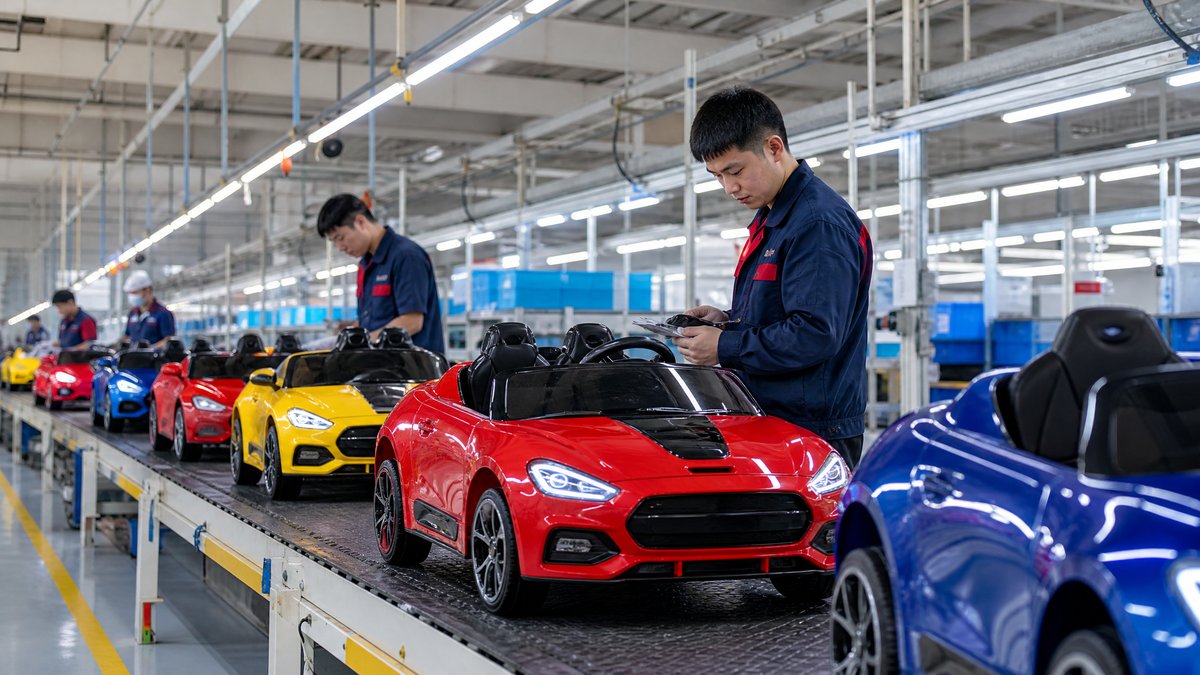
Packaging damage is more than a freight inconvenience for a wholesaler. A crushed carton can lead to scratched body panels, broken trim, missing accessories, bent hardware, or a unit that cannot be sold as new. It can also create rework at the warehouse, customer complaints, replacement costs, and disputes about whether the problem occurred during production, loading, transit, or delivery.
The most effective approach is preventive: define the packaging requirement before production, validate it with a representative packed sample, control how cartons are loaded, and record the shipment condition at every handoff. This guide explains a practical process for importers, distributors, retailers, and OEM buyers sourcing model-neutral kids electric ride-on cars for export markets. It focuses on packaging and logistics controls, not on unsupported promises that any particular carton will survive every route or handling method.
1. Start with a Packaging Risk Assessment
Before requesting a quotation, map the parts of the product and shipment most exposed to damage. A ride-on car typically combines a molded body, wheels, axles or drive components, seats, mirrors or decorative pieces, chargers, remote controls, wiring harnesses, and assembly hardware. These items do not all need the same protection.
Ask the supplier to identify:
- Contact points where the body can rub against a carton wall or another component.
- Protruding wheels, bumpers, mirrors, doors, dashboards, or trim that could receive impact.
- Loose accessories that may move inside the carton and scratch the finish.
- Heavy components that could shift downward if a carton is tilted or stacked.
- Battery and charger placement, including protection against compression and moisture.
- Assembly parts that could be lost if small bags open during transit.
2. Specify Internal Protection, Not Just a Stronger Box
A heavier outer carton is not automatically a better packaging system. Damage often happens because the product moves inside the carton, a hard accessory presses against the body, or a wheel transfers impact directly to a carton edge. The internal design should restrain movement while keeping pressure away from cosmetic and functional parts.
Useful controls may include molded pulp, foam, corrugated partitions, edge guards, sleeves, protective film, and separate accessory compartments. The right combination depends on the model, materials, weight distribution, and route. Require the supplier to show how the body is centered, how wheels are supported, and how fragile or projecting components are isolated.
For every SKU, confirm that:
- The car cannot slide freely from side to side inside the carton.
- Body surfaces are separated from abrasive cardboard edges and hardware.
- Wheels and axles are supported without creating concentrated pressure points.
- Doors, mirrors, lights, and decorative parts are protected from direct contact.
- The charger, remote, manual, and assembly hardware have a defined location.
- Small parts are sealed and labelled so they do not disappear into void space.
- Plastic bags, films, and cushioning do not obscure required warnings or instructions.
If the product is shipped partially assembled, define which parts are detached and how each is secured. For an OEM project, include the approved packing diagram or photographs in the packaging brief, along with revision control. A packaging change that appears minor can alter carton fit, cubic volume, stacking behavior, or the risk of cosmetic damage.
Buyers can use product pages such as [/products/kr-s900](/products/kr-s900), [/products/kr-l700](/products/kr-l700), or [/products/kr-t600](/products/kr-t600) as model references when discussing a product family, but packaging must still be confirmed for the actual SKU, battery configuration, accessories, and destination.
3. Validate the Packed Sample Before Mass Production
A pre-production packaging review is one of the lowest-cost opportunities to prevent a large claim. Ask for a sample packed exactly as it will be shipped, including the inner supports, accessory bags, labels, carton markings, pallet wrap, and any corner protection. Inspect the product after unpacking, not only the empty materials.
Record objective observations: carton dimensions, gross weight, visible gaps, compression points, movement inside the carton, scuffed surfaces, loose components, and the order of unpacking. Photograph every side of the carton and the internal arrangement before removing the product. If the shipment will be containerized, review the planned orientation and loading pattern at the same time.
After evaluation, compare the sample against the approved production standard. Changes to carton board, cushioning, tape, straps, pallet footprint, or product placement should require written approval. Keep the approved photographs and packing specification with the purchase order and inspection file.
4. Control Carton Markings, Pallets, and Container Loading
Even well-designed packaging can be damaged by incorrect loading. Provide clear carton markings for orientation, stacking limits where applicable, moisture sensitivity, model identification, quantity, and handling instructions. Markings should be legible and consistent with the destination market’s language and documentation needs. They should not imply a legal certification or handling performance that has not been verified.
Before loading, the logistics team should check that cartons are dry, intact, correctly labelled, and free from visible compression. During loading, photograph the empty container, first layer, bracing or void filling, and final door area. Record container or truck identification and seal information according to the shipping documentation process. Avoid placing cartons directly against wet or contaminated surfaces, and consider moisture-control measures appropriate to the route without making unverified claims about protection.
The loading plan must match the carton’s approved orientation. Turning a carton on its side to gain space can put wheels, doors, or battery compartments under loads they were not designed to carry. If a mixed container is necessary, document which SKUs can be stacked together and which require top-layer or edge positions.
5. Build Inspection and Receiving Controls Around Evidence
Packaging prevention continues after the container leaves the factory. At destination, instruct the warehouse to record:
1. Seal and vehicle condition before unloading.
2. Carton count and visible damage during unloading.
3. Photos of crushed corners, punctures, water marks, torn tape, or shifted pallets.
4. The affected carton numbers, model, and batch or shipment reference.
5. The condition of the product and accessories after opening.
6. Any carrier notation, delivery exception, or shortage report.
Separate visibly damaged cartons when possible and open them promptly under a documented process. Do not discard packaging before the claim or supplier review is complete. A photo guide can distinguish transport impact, packaging failure, missing parts, and possible assembly or product defects without assigning blame prematurely.
Use a simple trend log by SKU, route, carton position, carrier, and damage type. Repeated damage at one corner may indicate loading or pallet issues; repeated scratches inside intact cartons may point to internal fit or missing separators. This evidence allows the buyer and supplier to test a targeted improvement instead of changing packaging blindly.
6. Put Packaging Requirements in the Commercial Agreement
Packaging decisions should not remain informal messages. Attach a packaging specification to the purchase order, quality agreement, or OEM approval file. Include the approved carton artwork or markings, materials and dimensions, internal protection, accessory placement, pallet and loading instructions, inspection checkpoints, and the procedure for approving changes.
Clarify who supplies replacement packaging for approved rework, who documents freight damage, and how claims are escalated. Avoid vague terms such as “damage-free delivery” unless the parties define the inspection point, evidence, exclusions, and process. Freight insurance may support a claim, but coverage terms and claim procedures must be reviewed with the insurer or logistics provider; insurance does not replace preventive packaging controls.
For battery-powered products, request the relevant shipping and product documentation for the actual model and battery type. Packaging design, labelling, and transport documentation must align with applicable carrier and destination requirements. Market compliance must be confirmed for the destination market and model, including product, battery, labelling, and packaging-related requirements where applicable.
When the packaging standard is approved, link it to the supplier communication process and the buyer’s product file. The [KidsRideCar blog](/blog) can support internal buyer education, while an [inquiry](/inquiry) is the appropriate next step when a distributor needs model-specific packing information or an OEM packaging discussion.
FAQ: Packaging Damage in Kids Electric Ride-On Car Shipments
What is the first packaging detail a wholesaler should confirm?
Confirm the complete packed configuration for the exact SKU: carton dimensions and weight, internal supports, accessory placement, product orientation, pallet plan, and shipping mode. A carton specification without an internal packing diagram is incomplete.
Should wholesalers always request thicker cartons?
No. Board strength matters, but movement, pressure points, carton fit, pallet stability, and loading conditions can be equally important. Ask the supplier to address the complete system and validate a representative packed sample.
How can a buyer prove that damage occurred during transport?
Keep time-stamped photos of the container or vehicle, seal, cartons, pallets, unloading, and opened units. Record carton numbers and carrier exceptions, and preserve the packaging. These records support a fact-based review, although responsibility depends on the contract, shipping terms, and applicable claim process.
Can packaging be changed after the first production order?
It can, but changes should be reviewed and approved before implementation. A new insert, carton size, accessory location, or pallet footprint may affect product protection, cubic volume, loading quantity, labels, and compliance documentation.
What should a distributor do with a damaged carton on arrival?
Photograph it before opening, note the damage on the delivery record where possible, isolate it for inspection, and document the product and accessory condition. Keep all packaging until the carrier, insurer, or supplier confirms that it is no longer needed.
Conclusion
Reducing packaging damage starts with a model-specific risk assessment and continues through internal cushioning design, packed-sample validation, disciplined loading, evidence-based inspection, and warehouse receiving controls. Wholesalers that document the approved standard and measure recurring damage by SKU and route can work with suppliers on targeted improvements while protecting inventory and customer experience. Confirm every packaging, transport, battery, and market-compliance requirement for the destination market and actual model before shipment.
For model-specific export packaging guidance, carton specifications, or an OEM discussion, contact KidsRideCar at info@kidsridecar.com.
Official references
Explore these external resources for current regulatory and trade guidance. Confirm requirements with the relevant authority before placing an order.
Ready to Start?
Factory-Direct · CE & ASTM Certified · MOQ from 50 Units
Our export team works with buyers in 60+ countries. Get a quote within 24 hours.
KR
Written by KidsRideCar
China's leading kids electric ride-on car manufacturer. 500,000+ units shipped annually to 60+ countries. CE, ASTM & EN71 certified.