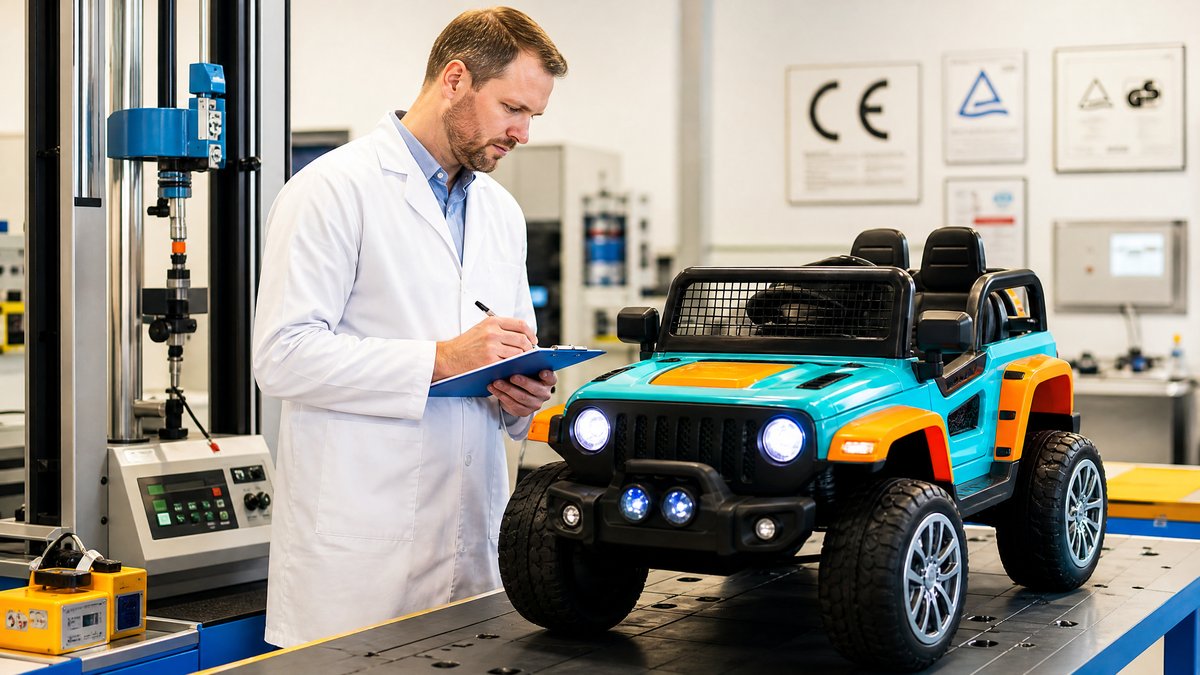
Introduction
Selling kids electric ride-on cars in the United States requires compliance with a specific set of federal safety standards — most importantly ASTM F963 (Standard Consumer Safety Specification for Toy Safety) and the Consumer Product Safety Improvement Act (CPSIA). For importers sourcing from China, understanding these requirements before placing an order is essential: non-compliant products can be detained at the border, recalled from the market, or result in significant civil penalties.
This guide explains the US compliance framework, what testing is required, how the Children's Product Certificate works, and how to verify that a Chinese factory's compliance documentation is genuine.
The US Regulatory Framework
Kids electric ride-on cars sold in the US are regulated primarily under two frameworks:
ASTM F963 is the voluntary standard for toy safety, but it has been incorporated by reference into CPSIA, making it effectively mandatory for toys sold in the US. The current version is ASTM F963-23. It covers mechanical and physical properties, flammability, electrical safety, and chemical requirements.
CPSIA (Consumer Product Safety Improvement Act, 2008) is federal law that establishes mandatory third-party testing and certification requirements for children's products. Key provisions include:
- Lead content limits: 100 ppm in substrate materials
- Phthalate limits: 0.1% in accessible plasticized materials
- Mandatory third-party testing by a CPSC-accepted laboratory
- Children's Product Certificate (CPC) required for each product
CPSC (Consumer Product Safety Commission) is the federal agency that enforces these requirements. The CPSC maintains a public database of product recalls and can issue import alerts that block non-compliant products at US ports of entry.
What ASTM F963 Covers for Electric Ride-On Cars
The most relevant sections of ASTM F963 for kids electric ride-on cars are:
| Section | Topic | Key Requirements |
|---|---|---|
| Section 4.5 | Electrical safety | Battery voltage limits, charger safety, wiring insulation |
| Section 4.6 | Flammability | Fabric and foam flammability limits |
| Section 4.7 | Mechanical hazards | Sharp edges, protrusions, pinch points |
| Section 4.25 | Ride-on toys | Stability, load capacity, speed limits |
| Section 4.3 | Chemical requirements | Lead, phthalates, heavy metals in coatings |
For electric ride-on cars specifically, Section 4.25 (Ride-On Toys) is particularly important. It covers stability testing (the vehicle must not tip over under specified conditions), load capacity (the vehicle must support the rated weight without failure), and speed limits (maximum speed under load conditions).
The Children's Product Certificate (CPC)
The CPC is a written certificate that must accompany every children's product sold in the US. It certifies that the product complies with all applicable CPSC rules and standards. The CPC must include:
- Product description and model number
- Citation of each CPSC rule and standard the product complies with
- Name and contact information of the manufacturer or importer
- Date and place of manufacture
- Date and place of testing
- Name, address, and contact information of the CPSC-accepted laboratory that conducted the testing
- The test results that support the certificate (or a reference to where they can be obtained)
The importer is responsible for issuing the CPC for products they import. If you are importing kids electric ride-on cars from China, you must issue the CPC — you cannot simply use the factory's CPC.
Third-Party Testing Requirements
CPSIA requires that children's products be tested by a CPSC-accepted third-party laboratory. The CPSC maintains a list of accepted laboratories on its website. Major laboratories with China operations include:
- SGS (multiple China locations)
- Intertek (multiple China locations)
- Bureau Veritas (multiple China locations)
- TÜV Rheinland (multiple China locations)
- UL (multiple China locations)
Test reports must be based on samples from production, not pre-production prototypes. If you change the product design or materials, new testing is required.
How to Verify a Factory's US Compliance Documentation
When a Chinese factory tells you their products are "ASTM F963 certified" or "CPSC compliant," verify the following:
Request the actual test report, not just a certificate. The test report should show the laboratory name and CPSC acceptance number, the specific ASTM F963 version tested against, the product model and description, test dates, and pass/fail results for each test item.
Verify the laboratory's CPSC acceptance. Check the CPSC's online database of accepted laboratories to confirm the lab is currently accepted for the specific tests referenced in the report.
Check the test report date. ASTM F963 is updated periodically. A test report from 2020 may reference an older version of the standard. For current US market entry, reports should reference ASTM F963-23 or the most current version.
Confirm the product scope. The test report is issued for a specific model. If you are ordering a variant (different battery, different motor, different materials), the existing test report may not cover your product.
Request the CPC. If the factory has issued a CPC, review it against the requirements listed above. If they have not issued a CPC, you will need to issue one yourself based on the test reports.
State-Level Requirements: California Proposition 65
California's Proposition 65 requires businesses to provide warnings before knowingly exposing individuals to chemicals listed as known to cause cancer or reproductive harm. For kids electric ride-on cars, relevant chemicals include lead, cadmium, and certain phthalates.
If you are selling in California, ensure your products comply with Prop 65 limits and that appropriate warnings are included if required. Many importers add a Prop 65 warning label as a precaution, even if they believe their products are below the threshold levels.
FAQ
Do I need to test every model separately?
Yes, in general. Each model that differs in materials, components, or design requires its own test report. However, if models share the same components and materials (e.g., the same battery, motor, and plastic formulation), a family testing approach may be possible — consult with your testing laboratory.
What are the penalties for non-compliance?
CPSC can impose civil penalties of up to $15 million for knowing violations. Products can be detained at the border, recalled from the market, and publicized in the CPSC's recall database. The reputational damage from a public recall can be severe.
How often do I need to re-test?
There is no fixed re-testing interval under CPSIA. However, if the product design or materials change, if the applicable standards are updated, or if there are safety incidents, re-testing is required.
Conclusion
US compliance for kids electric ride-on cars is non-negotiable. The CPSC actively enforces CPSIA requirements, and non-compliant products face significant consequences. Importers who invest in proper testing and documentation before their first shipment avoid the far greater costs of recalls, penalties, and reputational damage.
If you need help evaluating a factory's US compliance documentation or understanding your obligations as an importer, our team is available to assist.
*Questions about US compliance for your order? Contact us for guidance.*
Official references
Explore these external resources for current regulatory and trade guidance. Confirm requirements with the relevant authority before placing an order.
Ready to Start?
Factory-Direct · CE & ASTM Certified · MOQ from 50 Units
Our export team works with buyers in 60+ countries. Get a quote within 24 hours.
KR
Written by KidsRideCar
China's leading kids electric ride-on car manufacturer. 500,000+ units shipped annually to 60+ countries. CE, ASTM & EN71 certified.

