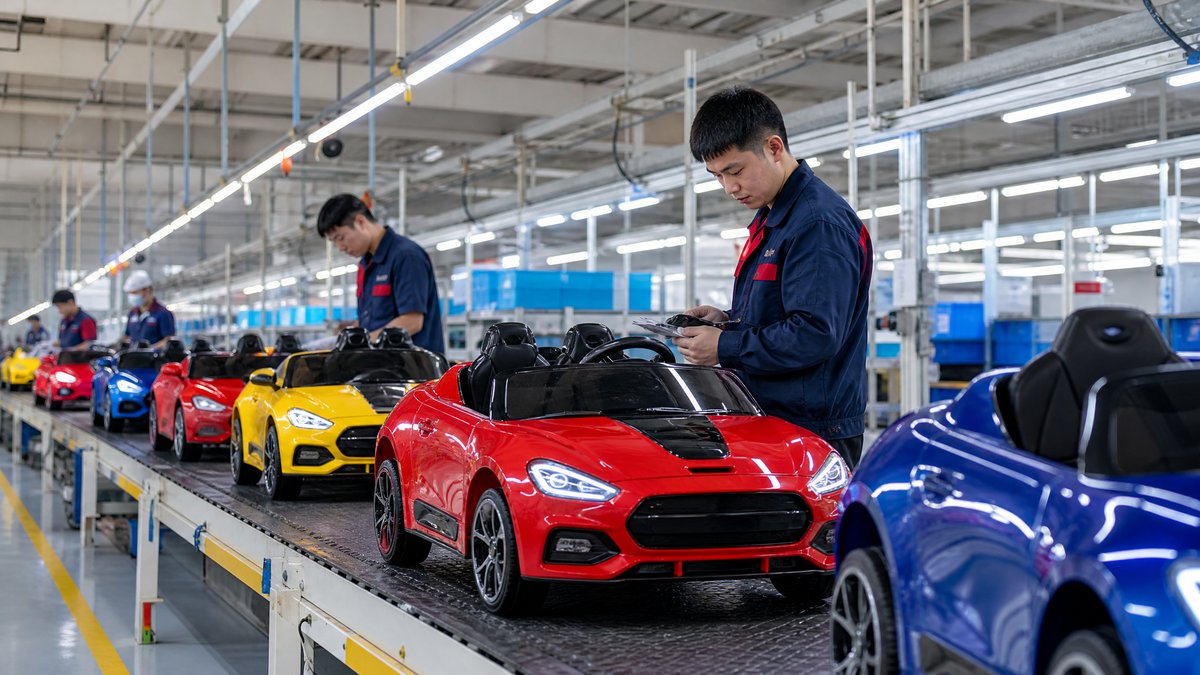
A kids ride-on car’s landed cost is the total cost of getting a sellable unit from the agreed supplier point to the importer’s nominated destination. It is more useful than the factory quotation because it combines the product, packaging, export logistics, international transport, insurance where applicable, import charges, and destination handling.
The practical formula is:
Landed cost per unit = (product and origin costs + international logistics + insurance + import taxes and duties + destination charges) ÷ sellable units received
The exact components depend on the quotation’s Incoterm, shipment structure, destination market, customs classification, currency, and configuration. Treat this as a planning framework—not a substitute for a customs broker, freight forwarder, tax adviser, or the requirements of the destination market.
For a buyer ordering a small test shipment, a wholesaler building a container plan, a distributor comparing suppliers, a rental operator planning fleet replacement, or an OEM buyer adding custom packaging, landed cost shows whether a quoted unit price can support the intended channel margin.
What should be included in kids ride-on car landed cost?
Start with a cost sheet that separates costs by shipment, by SKU, and by unit. Do not place every number in one “shipping” line. A transparent sheet makes it easier to compare a factory quote with a forwarder’s offer and to explain a variance to finance or sales teams.
1. Product and preparation costs
Record the agreed unit price for each model, battery configuration, accessory package, color, branding option, and spare-parts pack. Then add costs that are charged before export, such as:
- Sampling, tooling, artwork, logo setup, or packaging design fees, if applicable.
- Custom cartons, inserts, labels, manuals, or barcode work.
- Spare parts, replacement chargers, remote controls, or service kits included in the order.
- Pre-shipment inspection or other agreed third-party services.
- Bank charges, payment fees, or foreign-exchange costs when they are material to the buying decision.
For an OEM order, decide whether one-time development costs belong entirely to the first shipment or should be amortized across a planned quantity. Show both views: cash landed cost for this order and normalized landed cost after amortization. This prevents a one-off setup fee from being mistaken for the recurring cost of every unit.
2. Origin charges and export handling
Depending on the Incoterm, the supplier may quote only the goods, or may include delivery to a port, export documentation, or loading-related services. Confirm what is included in writing. Origin charges can include inland pickup, export documentation, terminal handling, consolidation, palletization, and origin forwarding fees.
Packaging matters especially for ride-on cars. The carton may be large relative to its weight, so the forwarder may calculate ocean LCL or air freight by volume or chargeable weight. Ask for the packed dimensions, gross weight, carton count, and cubic-meter total for each SKU. Use the final packing list for the calculation rather than a preliminary estimate.
3. International freight and insurance
Add the freight mode and the quote’s charge basis separately. For sea freight, distinguish FCL from LCL and record whether the quote includes the full container, a shared-container allocation, or only the main leg. For air or express shipments, use the carrier’s chargeable-weight rule.
Insurance may be separately purchased, included in a service package, or left to the importer. If it is used, record the premium and the insured value. Also note the policy exclusions and claims process; an insurance line in a spreadsheet does not guarantee that every type of loss is covered.
Freight is often quoted for a shipment rather than a unit. Allocate it consistently:
Freight per unit = allocable shipment freight ÷ units in the shipment
If SKUs use materially different carton volumes, a volume-based allocation is usually more informative than dividing the bill equally. For example, a two-seater model and a compact single-seater should not automatically receive the same share of an LCL charge. Ask the forwarder which measurement the invoice uses, then apply that same basis to the internal cost sheet.
4. Customs value, duty, and taxes
Import duty and taxes are destination-specific. They may depend on tariff classification, customs value, origin, trade preferences, product configuration, and the importer’s tax status. Confirm the likely HS classification with a qualified customs professional before placing an order; do not infer a rate from a supplier’s old shipment or a generic online table.
A planning sheet can show:
- Customs value used for the entry.
- Estimated duty rate and duty amount.
- Import VAT, GST, sales tax, or similar tax where applicable.
- Customs broker, entry, port, inspection, and disbursement charges.
- Any recoverable tax shown separately from non-recoverable cost.
Whether tax is included in landed cost depends on the business model and accounting treatment. A recoverable import VAT amount may affect cash flow without being a permanent product cost. A non-recoverable tax generally belongs in the cost base. Ask the importer’s accountant to confirm the treatment for the destination entity.
Do not assume an Incoterm makes the supplier responsible for every import obligation. The commercial term allocates responsibilities between parties, but local authorities determine import procedures and taxes. Requirements also vary by destination market and configuration, particularly where batteries, wireless functions, toy rules, labeling, or packaging obligations are involved.
5. Destination and post-arrival charges
Add costs between arrival and the point where inventory is ready for sale or deployment. Depending on the route and service, these can include destination terminal handling, port storage, demurrage or detention, customs brokerage, delivery appointment fees, drayage, warehouse receiving, unloading, pallet handling, and short-term storage.
For marketplace or retail programs, you may need a second calculation that adds fulfillment, prep, labeling, and last-mile delivery. Those are not always part of “landed cost” in a strict accounting definition, but they are essential to a channel contribution margin. Keep the layers visible:
1. Landed at destination: ready to be received by the importer.
2. Warehouse-ready: after receiving, inspection, and local movement.
3. Channel-ready: after marketplace, retail, or fulfillment preparation.
4. Customer-ready: after final delivery and any installation or service provision.
This layered approach avoids comparing a factory-to-port number with a competitor’s customer-delivered number.
A simple importer landed-cost worksheet
Create one row per SKU and one column per cost category. At minimum, include:
| Cost category | What to record |
|---|---|
| Goods | Unit price, quantity, model, battery and accessory configuration |
| Origin | Inland movement, export documents, consolidation and handling |
| Freight | Mode, route, quote validity, volume or chargeable-weight basis |
| Insurance | Premium, insured value and coverage assumptions |
| Import | Customs value, estimated duty, taxes and broker charges |
| Destination | Terminal, delivery, receiving and storage assumptions |
| Adjustments | Discounts, credits, setup fees, samples and FX costs |
| Output | Total shipment cost, sellable units and cost per unit |
Use the following sequence:
1. Freeze the commercial scope: model, quantity, packaging, accessories, Incoterm, currency, and destination.
2. Obtain packed dimensions and weights from the supplier or final packing list.
3. Request a written freight quote with inclusions, exclusions, validity, and charge basis.
4. Confirm the likely customs classification and destination taxes with qualified local professionals.
5. Separate one-time fees from recurring per-unit costs.
6. Allocate shipment costs by a documented basis, such as units, cartons, weight, or volume.
7. Divide by sellable units, not simply ordered units. Deduct samples, damaged cartons, quarantine stock, or units reserved for quality checks when relevant.
8. Run low, expected, and high cases before approving the purchase order.
For a worked procurement example without invented figures, imagine an importer comparing Model A and Model B in the same order. Model A has more cartons but smaller cubic volume; Model B has fewer cartons but larger cartons and a different battery configuration. The importer enters each model’s actual packed volume, allocates shared freight by cubic meter if that is the forwarder’s basis, assigns model-specific origin costs, and calculates duty using the classification confirmed for each configuration. The result is a defensible comparison even when the supplier’s unit prices look similar.
How Incoterms change the calculation
The same product can show different headline prices under different Incoterms because different logistics stages are included. For each quotation, ask: At what named place does the seller’s price end, and which costs remain mine?
A factory-gate or origin collection price may leave inland movement, export handling, freight, insurance, customs clearance, and destination delivery to the buyer. A port-delivered term may include more origin movement but still exclude destination charges and import taxes. A delivered term may include transport to a named destination, while import clearance, duties, or taxes may remain the importer’s responsibility depending on the agreed term and local rules.
Never compare Incoterm labels without comparing the named place, inclusions, exclusions, and quote validity. Ask suppliers and forwarders to restate the offer as a cost breakdown. The cheapest unit price is not necessarily the lowest landed cost.
Sensitivity checks importers should run
Landed cost is an estimate until the shipment is cleared and received. Use a scenario table to test the assumptions most likely to move the result:
- Freight rate and surcharge changes.
- Currency movement between quotation and payment.
- A different packed volume after final packaging approval.
- Customs value or duty treatment confirmed at entry.
- Port storage caused by a documentation or appointment issue.
- Damaged, missing, or non-sellable units.
- A different order quantity that changes the freight allocation.
For wholesalers, compare landed cost against the target ex-warehouse price and channel margin. For retailers, add promotion, fulfillment, returns, and local delivery separately. For rental operators, compare delivered acquisition cost per usable unit and include planned spares, maintenance, and replacement policy as operating assumptions—not as hidden import costs. For OEM buyers, show setup fees and recurring costs in separate rows so a larger forecast can be evaluated fairly.
Common landed-cost mistakes
Using the supplier’s unit price as the final cost. The quotation may exclude freight, duties, brokerage, taxes, or destination delivery.
Dividing freight equally across unlike products. Volume, weight, carton count, or chargeable weight may be the correct allocation basis.
Ignoring packaging changes. A retail-ready carton or added protective material can change the shipment volume.
Counting ordered units instead of sellable units. Samples, inspection units, damage allowances, and quarantine stock can affect the practical unit cost.
Mixing recoverable tax with permanent cost. Keep cash-flow impact and accounting cost visible as separate fields.
Using an outdated tariff assumption. Classification and rates should be confirmed for the destination, date, origin, and actual configuration.
Hiding one-time OEM fees. Setup and tooling costs should be clearly identified and amortized only under a stated forecast.
FAQ: Kids ride-on car landed cost for importers
What is the difference between landed cost and wholesale price?
Wholesale price normally describes the seller’s charge for the goods under a stated commercial term. Landed cost adds the buyer’s applicable logistics, import, destination, and allocation costs until the inventory reaches the defined destination stage. Always ask what the quoted wholesale price includes.
Should import duty be included in landed cost?
Include estimated or confirmed duty when calculating the importer’s total acquisition cost. Show the duty rate, customs-value basis, and source of the assumption. Because rates and classification vary by destination and configuration, have a customs professional confirm the entry treatment.
How do I allocate shared freight across different ride-on car models?
Use the basis that matches the freight invoice—often volume, chargeable weight, cartons, or a shipment-specific allocation. Document the method and keep model-level packed dimensions so another person can reproduce the calculation.
Is import VAT part of the landed cost?
It depends on local accounting and tax treatment. A recoverable amount may be a cash-flow requirement rather than a permanent inventory cost; non-recoverable tax usually belongs in the cost base. Confirm the treatment with the importer’s accountant.
What information should I request before accepting a quotation?
Request the Incoterm and named place, SKU and configuration, packed dimensions, gross weights, carton count, included accessories, export scope, quote validity, payment terms, and any one-time fees. For logistics planning, request the route, charge basis, exclusions, and destination charges from the forwarder.
Conclusion
To calculate kids ride-on car landed cost, start with the complete commercial scope, add every cost from the agreed supplier point through the defined destination stage, allocate shared charges using a consistent physical or shipment basis, and divide by sellable units. Then test freight, currency, duty, volume, and loss assumptions before setting a wholesale or retail price.
A clear cost sheet also makes supplier comparison more reliable. If you are reviewing configurations, packaging, OEM fees, or shipment options, browse the [kids ride-on car product range](/products/), review the [logistics and sourcing articles](/blog/), or [send your requirements to KidsRideCar](/inquiry). You can also email info@kidsridecar.com for a quotation scope that lists the assumptions your landed-cost model needs.
Official references
Explore these external resources for current regulatory and trade guidance. Confirm requirements with the relevant authority before placing an order.
Ready to Start?
Factory-Direct · CE & ASTM Certified · MOQ from 50 Units
Our export team works with buyers in 60+ countries. Get a quote within 24 hours.
KR
Written by KidsRideCar
China's leading kids electric ride-on car manufacturer. 500,000+ units shipped annually to 60+ countries. CE, ASTM & EN71 certified.