Introduction to Commercial Ride-On Battery Management
For B2B toy distributors, global retail partners, commercial fleet operators, and conscientious parents alike, understanding the precise mechanics of battery charging in children's electric ride-on vehicles is paramount. As consumer expectations for product reliability, durability, and safety continue to rise across international markets, retailers frequently field technical inquiries regarding charging cycles, battery longevity, and operational readiness. A recurring point of confusion among end-users—and occasionally retail frontline staff—is accurately determining the exact moment a ride-on car battery reaches full charge. Unlike modern consumer electronics or automotive systems that feature sophisticated software operating systems, digital dashboards, and precise percentage-based battery indicators, children's ride-on cars are engineered with simplicity, mechanical ruggedness, and child safety in mind. Consequently, they typically rely on straightforward electromechanical adapters or basic LED-based charging feedback loops. Misinterpreting these charging indicators or failing to adhere to proper power management protocols can lead to undercharging, which diminishes total battery capacity through cumulative plate sulfation, or overcharging, which generates excessive internal heat, accelerates component wear, and compromises electrical safety. This comprehensive technical guide examines the markers of a fully charged ride-on car battery, the operational distinctions between various battery chemistries, the critical importance of initial unboxing conditioning, thermal management principles, and rigorous safety protocols. All operational parameters, charging durations, and maintenance procedures discussed herein must be strictly interpreted and executed in accordance with each specific vehicle's rated nameplate, user manual, and manufacturer's written technical documentation.
Manufacturer Nameplate Specifications and Documentation Governance
The foundation of reliable battery management and charging verification begins with the manufacturer's official documentation and rated nameplate specifications. Every electric ride-on vehicle distributed through commercial wholesale channels is engineered with specific electrical thresholds, motor controller parameters, internal fuse ratings, and battery capacities tailored to its chassis design and motor configuration. Consequently, relying on generic rules of thumb or generalized charging assumptions across disparate vehicle models can introduce operational risks, reduce overall product lifespan, or cause premature electrical failure. When establishing operational guidelines for commercial clients or retail customers, stakeholders must emphasize the primary role of the documentation supplied directly inside the vehicle packaging. The manufacturer's nameplate—typically affixed permanently beneath the vehicle seat, adjacent to the battery compartment, or stamped onto the structural chassis—provides crucial electrical ratings. Because different models incorporate varying circuit architectures, attempting to apply uniform charging durations or voltage thresholds across all inventory is technically unsound. Retailers should instruct end-users to consult their specific user manual for authorized charging intervals, operating limits, and storage recommendations. Furthermore, commercial distributors must ensure that all replacement parts, chargers, and batteries supplied match the exact specifications stipulated by the original equipment manufacturer (OEM). Ignoring manufacturer-specified technical limits invalidates compliance frameworks and introduces preventable safety hazards.
Decoding Charger Indicator Lights and System Status
Understanding how to correctly interpret the LED indicators or operational status lights on the official OEM charger is the most direct method available to end-users for determining charge completion. Most ride-on car chargers supplied by reputable manufacturers feature an external adapter housing equipped with a dual-color LED indicator light designed to reflect the active state of energy transfer. Analyzing these visual signals correctly prevents both premature disconnection and prolonged over-energization.
Interpreting Charger LED States and Operational Phases
* Active Charging Phase (Constant Red or Amber): A steady red or amber illumination indicates that the charger is actively delivering electrical current to the battery cells, overcoming internal chemical resistance, and successfully replenishing stored energy. During this phase, energy conversion generates moderate warmth, which is entirely normal as long as it remains within manufacturer-specified operating thresholds.
* Completion or Float Stage (Constant Green or Transition to Off): A steady green light typically signifies that the bulk charging cycle is complete and the battery has reached its optimal charge retention capacity. In many advanced OEM chargers, this transition also initiates a low-amperage float or trickle maintenance stage designed to counteract natural self-discharge without causing overcharging stress.
* Diagnostic Flashing or Blinking Indicators: On various standard charger models, alternating flashing red and green lights or a persistent blink indicate a connection anomaly, reverse polarity, terminal corrosion, or a battery voltage that has dropped below the safe recovery threshold. End-users must immediately inspect external cable plugs and terminal connections if blinking occurs.
It is vital to recognize that charger indicator behaviors can vary significantly across different manufacturers and charger designs. Some chargers transition from red to green when the battery reaches approximately ninety percent capacity, continuing with a low-amperage top-off charge for a designated period. Therefore, disconnecting the charger the exact millisecond an indicator shifts to green may occasionally result in a slightly suboptimal charge, whereas leaving the unit connected indefinitely beyond the completion indicator can risk thermal degradation if the charger lacks an intelligent automatic shut-off circuit. Retailers should guide customers to follow the exact instructions outlined in the manufacturer's user manual regarding post-indicator connection times.
Understanding Battery Chemistries in Children's Ride-On Vehicles
Ride-on car power systems are not homogenous; commercial buyers and retail staff must understand the fundamental chemical differences between energy storage technologies, as charging behavior, indicator interpretation, and lifespan vary extensively across chemistries.
Sealed Lead-Acid (SLA) and Absorbent Glass Mat (AGM) Systems
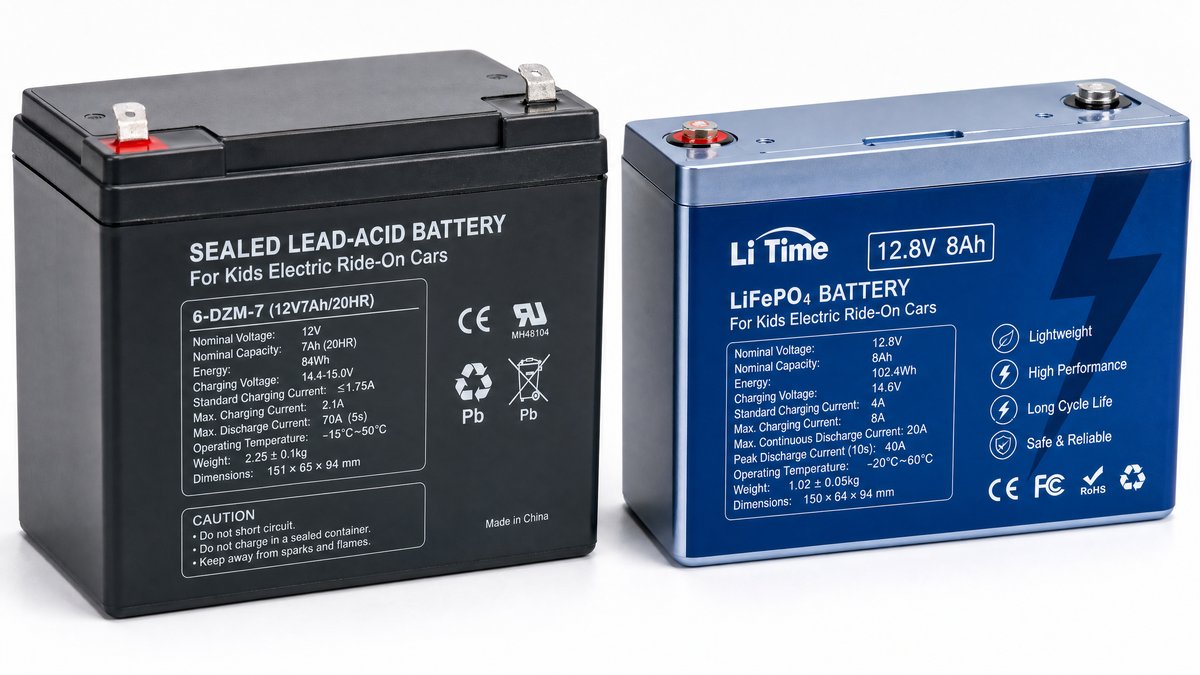
The vast majority of standard, mid-tier, and utility-focused electric ride-on vehicles utilize Sealed Lead-Acid (SLA) or Absorbent Glass Mat (AGM) batteries. These established chemistries are favored across the toy industry for their robust safety profile, economical production cost, and ability to deliver the high startup torque demanded by electric drive motors under load. SLA and AGM batteries require a constant-current, constant-voltage charging profile delivered by compatible OEM adapters. As these cells approach full charge, their internal resistance increases naturally, causing the incoming charging current to taper off automatically.
Advanced Lithium-Ion and LiFePO4 Battery Systems
Increasingly, premium performance ride-on vehicles adopt Lithium-ion (Li-ion) or Lithium Iron Phosphate (LiFePO4) battery packs. These advanced chemistries offer higher energy density, reduced vehicle weight, and extended operational run times. Lithium systems incorporate sophisticated, internal Battery Management Systems (BMS) that actively monitor individual cell voltage, temperature, and current flow to protect against overcharging, over-discharging, and thermal anomalies. When a lithium battery reaches full capacity, the internal BMS cuts off incoming current entirely, prompting the external charger indicator to signal completion.
The following comprehensive comparison table outlines the key operational characteristics, voltage markers, indicator behaviors, and maintenance guidelines across the primary battery chemistries utilized in children's electric ride-on vehicles:
| Battery Chemistry Classification | General Voltage Category | Full Charge Rest Voltage State | Primary Charger Indicator Behavior | Standard Charging Duration Framework | Operational Maintenance & Safety Guidelines |
|---|---|---|---|---|---|
| Sealed Lead-Acid (SLA) | OEM Nameplate Dependent | Defined by Manufacturer Manual | Constant Red during bulk charging; Solid Green upon float transition | As specified in OEM manual; never exceed manufacturer time limits | Must not be stored in discharged state; highly sensitive to plate sulfation. |
| Absorbent Glass Mat (AGM) | OEM Nameplate Dependent | Defined by Manufacturer Manual | Red-to-Green transition; auto-tapering current output | As specified in OEM manual; routine monitoring required | Spill-proof construction; mountable in any orientation; moderate lifespan. |
| Lithium-Ion / LiFePO4 | OEM Nameplate Dependent | Defined by Manufacturer Manual | Solid Green triggered via internal BMS cut-off mechanism | Rapid charging cycle as stipulated by OEM documentation | Requires dedicated OEM BMS-matched charger; strict prohibition of non-OEM adapters. |
The Critical Importance of Initial Conditioning and Unboxing Protocols
For wholesale distributors, retail storefronts, and end-consumers alike, the initial charge administered immediately upon unboxing a brand-new ride-on vehicle establishes the baseline for long-term battery health and performance reliability.
Why the Initial Charge Determines Lifespan
During the manufacturing process, overseas transit, and extended warehouse storage, batteries naturally undergo self-discharge. An unconditioned or partially depleted battery installed in a newly unboxed ride-on car will suffer from reduced initial capacity and diminished plate conditioning if the vehicle is operated immediately without undergoing a complete initial charge cycle. Retailers should establish clear point-of-sale communication instructing customers to connect the vehicle to the supplied OEM charger for a continuous, uninterrupted initial charge—strictly adhering to the hours specified in the user manual—prior to the child's first operating session. Interrupting this initial charge cycle can create a false memory effect in certain battery subclasses or fail to fully saturate internal chemical plates, permanently capping the maximum achievable capacity. Furthermore, commercial distribution warehouses holding inventory for extended periods must implement a routine top-off charging schedule every thirty to sixty days. Batteries left sitting on warehouse shelves in a depleted state experience irreversible plate sulfation, rendering them unserviceable before they ever reach the retail sales floor.
Thermal Management, Warning Signs, and Critical Safety Protocols
Electrical energy storage and power conversion inherently generate thermal energy. In the context of children's electric ride-on cars—where vehicles may encounter heavy physical loads, inclined surfaces, or prolonged operating sessions—rigorous thermal management is an essential safety parameter.
Identifying Physical Warning Signs of Battery and Charger Stress
Retailers, commercial operators, and parents must be educated to recognize the physical warning signs indicating battery degradation, overcharging stress, or impending electrical failure:
1. Excessive Thermal Output: While mild warmth during active charging is normal energy dissipation, if the battery casing, charger adapter brick, or vehicle charging port feels excessively hot, scalding, or blistering to the touch, charging must be halted immediately.
2. Structural Deformation and Bulging: Any visible physical swelling, warping, bulging, or cracking of the plastic battery housing indicates severe internal gas pressure accumulation, electrolyte boiling, or catastrophic overcharging.
3. Unusual Chemical Odors: A pungent, sulfurous, acidic, or rotten-egg odor emitting from the battery compartment during or after charging points to severe electrolyte boiling or damaged lead-acid cell plates.
4. Sudden Run-Time Degradation: If a previously dependable vehicle loses motive power within minutes of operation despite a glowing green full-charge indicator, the internal cells have suffered irreversible capacity loss and require immediate replacement.
Mandatory Protocol for Critical Hazards
For any scenario involving water ingress, chemical odors, excessive heat, visible smoke, damaged electrical wiring, frayed charger plugs, cracked casings, abnormal braking performance, or modified battery setups, the operational protocol is absolute: immediately stop using the vehicle, disconnect it from all power sources, keep children safely away, and refer the unit to qualified repair personnel or manufacturer customer support. Under no circumstances should end-users attempt to tamper with, modify, open battery packs, short-circuit fuses, or bypass built-in protective electrical devices.
Frequently Asked Questions (FAQs)
How do I know if my ride-on car battery is fully charged when the charger does not feature an LED indicator light?
Certain budget or legacy models feature basic wall adapters without multi-color LED visual feedback. In such circumstances, determine charge completion strictly by adhering to the maximum charging duration specified in the manufacturer's user manual. Never leave the charger connected indefinitely beyond the recommended window, and consult qualified personnel if charging times appear inconsistent.
Is it safe to leave the ride-on car plugged into the charger overnight?
Leaving a standard ride-on car plugged in overnight is generally acceptable only if the official manufacturer documentation explicitly permits it and the supplied charger features an automatic float-charge cut-off circuit. However, leaving units connected continuously for twenty-four to forty-eight hours is strictly discouraged, as prolonged trickle currents can degrade battery plates and create thermal stress. Always follow the specific vehicle user manual.
What should I do if the charger indicator remains red and never shifts to green?
If the charger indicator light remains in active charging mode long after exceeding the maximum recommended charging time specified in the manual, the battery may be deeply discharged, sulfated, or experiencing an internal short circuit. Disconnect the charger immediately. Inspect all external terminal connections for looseness or corrosion. If the issue persists, do not force further charging; contact the manufacturer or authorized service technicians for proper battery replacement.
Can I upgrade my ride-on car battery to a higher voltage or lithium pack for longer run times?
No. Modifying factory electrical systems, upgrading voltages beyond the vehicle's rated nameplate specifications, or substituting incompatible battery chemistries bypasses built-in safety controls, overloads motor controllers, and voids product compliance certifications. Always utilize replacement batteries and chargers that precisely match original OEM specifications.
Conclusion
Determining when a children's ride-on car battery is fully charged requires a balanced, technically prudent understanding of manufacturer instructions, charger indicator behaviors, battery chemistry nuances, and vigilant safety practices. For B2B partners, global distributors, and retail operators, providing clear, accurate guidance to commercial clients and end-users safeguards product reputation and protects young users. By strictly adhering to nameplate specifications, respecting manufacturer-designated charging time limits, and recognizing thermal warning signs, businesses can ensure safe, long-lasting enjoyment of electric ride-on vehicles.
Transparent Wholesale Inquiries
KidsRideCar is committed to supplying premium, safety-compliant electric ride-on vehicles and replacement components to global retail partners, distributors, and commercial operators. For detailed wholesale catalogs, container pricing, compliance documentation, or bulk purchasing inquiries, please contact our commercial sales division directly at Request a wholesale quote.
Official References
* CPSC Toy Safety Guidance - US Consumer Product Safety Commission - Official regulatory guidance outlining federal safety requirements for battery-operated toys, battery accessibility, labeling, overcharging precautions, mechanical stability, overloads, and manufacturer assembly instructions. Note: This reference provides general federal safety education and does not replace specific manufacturer instructions, product manuals, or individual compliance testing.
Official references
Explore these external resources for current regulatory and trade guidance. Confirm requirements with the relevant authority before placing an order.
Ready to Start?
Factory-Direct · CE & ASTM Certified · MOQ from 50 Units
Our export team works with buyers in 60+ countries. Get a quote within 24 hours.
KR
Written by KidsRideCar
China's leading kids electric ride-on car manufacturer. 500,000+ units shipped annually to 60+ countries. CE, ASTM & EN71 certified.