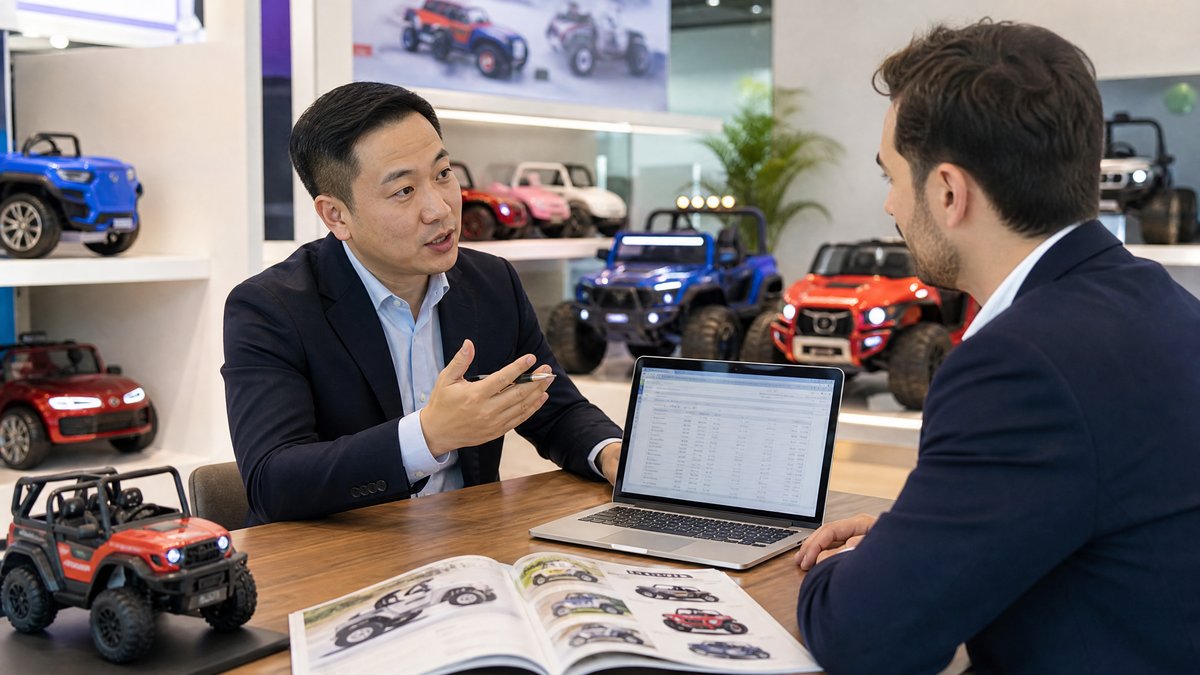
Shopping malls can plan kids ride-on car operations by treating them as a managed family entertainment service rather than simply placing a few vehicles in an open corridor. The operating plan should connect the business objective, approved riding zone, fleet specification, rental or payment workflow, staffing, safety controls, cleaning, charging, maintenance, and performance review.
For an importer, wholesaler, distributor, retailer, rental operator, or OEM buyer, the most important decision is to define the operating environment before selecting a model. A vehicle that looks attractive in a catalog may not be the right fit for a mall with narrow circulation routes, shared pedestrian space, strict property-management rules, or frequent handovers between young riders. Start with the site and service rules, then source a fleet that can be documented, inspected, and supported consistently.
1. Define the mall’s operating model first
A mall may use ride-on cars as a paid rental service, a timed attraction, a seasonal promotion, a tenant-operated activity, or a mobile event fleet. Each model needs a defined check-in process, charging access, storage, maintenance routine, and agreement on who supplies staff, handles incidents, and owns the vehicles and consumables.
Write a one-page operating brief before requesting quotations. Include the intended rider age range as determined by the operator, indoor or outdoor use, floor surfaces, approximate service hours, expected peak periods, number of riding zones, branding needs, storage location, and the local team’s capability for routine checks. This brief gives factories and distributors a consistent basis for recommending a configuration.
2. Survey the site and design a controlled riding zone
A safe mall operation begins with a defined route, not with a vehicle count. Walk the proposed area with property management, security, cleaning, facilities, and the service operator. Mark entrances, exits, columns, escalators, lifts, food-service queues, fire equipment, shopfronts, emergency paths, low-visibility corners, and surfaces that may become slippery during cleaning.
The route should be easy for staff to observe from more than one position. Avoid placing a riding activity where children can enter a vehicle and immediately reach a busy pedestrian stream. Use visible boundaries, a waiting area, a return point, and a separate place for vehicles that need inspection or charging. If the mall cannot dedicate a complete circuit, establish a short, clearly supervised operating zone instead of allowing uncontrolled travel through common areas.
The final layout is a property-specific decision. Keep required access routes and building-management rules in mind, and obtain approval from the responsible mall team. Requirements can vary by destination market, building, event type, and configuration; this article is an operational planning guide, not a substitute for local review.
Useful planning questions include:
- Can staff see the complete route and loading area?
- Where will riders wait without blocking shoppers?
- How will a vehicle return if a child stops in the route?
- Where will the operator store chargers, supplies, records, and spare parts?
- Can service pause immediately for cleaning, crowding, a facility issue, or an incident?
3. Select the commercial fleet around the use case
A commercial fleet should be selected for controlled, repeated operation and straightforward support. Do not choose only by body style or novelty features. Compare the requirements in your operating brief with the supplier’s written product information and sample-unit inspection.
Review the following points with the manufacturer or distributor:
Physical fit and rider interface
Confirm the vehicle’s overall dimensions, turning behavior, seating arrangement, access points, controls, and visibility from the operator’s position. Check that the model suits the approved route and the intended rider profile. If two riders may share a vehicle, verify the seating and supervision plan rather than assuming that a two-seat design is automatically appropriate.
Control and supervision features
Ask how the vehicle is started, stopped, supervised, and secured between sessions. If a parental or operator remote is included, define who may use it, how it is checked before service, and what happens if it is unavailable. Keep controls simple enough for staff to explain consistently. The operator should be able to pause service when conditions change.
Battery and charging workflow
Confirm the battery type, charger specification, charging instructions, storage conditions, and any transport or destination-market requirements that apply to the configuration. Plan a designated charging area with suitable access, ventilation, housekeeping, and staff responsibility. Use only the charger and procedures approved for the supplied configuration. Never ask operating staff to open batteries, rewire a vehicle, solder connections, or perform internal repairs.
Cleaning and high-touch surfaces
Identify surfaces that need cleaning between sessions or at scheduled intervals, including steering controls, handles, seats, and any touchable accessories. Ask the supplier which cleaning methods are compatible with the materials. A written cleaning checklist is more useful than a general promise that a model is easy to clean.
Parts, service, and documentation
Before ordering, ask for a parts list, user and charging instructions, assembly information where relevant, troubleshooting boundaries, warranty terms, and a process for reporting faults. Separate operator-level checks from work that must be handled by an authorized technician or qualified service provider. A distributor should be able to provide the same documentation to each mall location.
For a broader sourcing process, see the [kids electric ride-on car manufacturer evaluation guide](/blog/how-to-evaluate-kids-electric-car-manufacturer-china) and the [commercial safety features checklist](/blog/kids-electric-ride-on-car-safety-features-checklist).
4. Build the rental and customer-flow procedure
A clear customer flow reduces confusion and keeps staff focused on supervision:
1. The parent or guardian approaches the service desk or booking point.
2. Staff explain the applicable use rules, route, session process, and rider limitations.
3. Staff select an available, inspected vehicle and complete the handover.
4. The rider enters only in the approved loading area, with the accompanying adult present as required by the operator’s policy.
5. Staff confirm that the route is clear and begin the session.
6. At the end, the vehicle returns to the marked unloading point.
7. Staff check for visible damage, unusual behavior, missing accessories, and cleanliness before releasing it again.
Payment may use a counter transaction, membership benefit, event voucher, digital booking, or tenant promotion. Document who issues refunds or credits when a session is interrupted, and record the start and end time, vehicle ID, staff member, and notable observations. Paper or digital records are both workable if used consistently.
Do not collect more customer information than the service requires. If the mall uses cameras, membership accounts, waivers, or digital payments, the mall and its service partners should review their own privacy and record-retention obligations.
5. Staff the operation for observation, not just transactions
Staffing should reflect the route, active vehicles, queue length, and distance between the desk and riding area. A cashier who cannot see the route cannot replace an operator assigned to supervise it.
Create a short training program covering:
- How to explain the riding rules in plain language.
- How to fit or check any included restraint according to the product instructions.
- How to conduct the pre-use and post-use inspection.
- How to stop service and secure a vehicle if a problem appears.
- How to handle a crowded route, a lost child, a fall, a collision, or a parent complaint under the mall’s incident procedure.
- Which issues staff may document and isolate, and which require escalation.
- How to clean, charge, store, and hand over vehicles without improvising repairs.
Use opening and closing checklists. Managers should review incident, downtime, inspection, and customer-feedback records. A documented handover prevents the service from depending on one experienced operator.
6. Put safety and compliance into the operating documents
Safety should be visible in the layout, instructions, staff behavior, and maintenance records. Model-neutral controls may include a clearly marked route, controlled speed appropriate to the setting, adult supervision, a no-racing rule, separation from stairs and vehicle access points, a clean and unobstructed floor, and an immediate service-stop procedure.
Use the manufacturer’s instructions for the specific model and configuration. Inspect visible condition before each operating period and after any unusual event. Pay attention to steering response, wheels, body panels, seats, restraints if fitted, controls, remote functions if supplied, battery enclosure condition, charger and cable condition, and signs of leakage, heat, impact, or unusual noise. Remove a vehicle from service when its condition is uncertain; do not return it to customers based on a guess.
Compliance requirements vary by destination market and configuration. The relevant product category, intended use, electrical system, battery, labeling, language, importer role, mall policy, and local authority requirements can all affect the review. Ask suppliers for the technical file, declarations, test documentation, labels, manuals, and other records that apply to the actual configuration being supplied, then have the importer or local compliance adviser confirm what is required for the destination. Do not treat a generic logo, an old report, or a document for a different model as proof of compliance.
7. Plan maintenance, charging, and downtime
A mall needs a simple asset-control system. Give each vehicle an internal identifier and record its model, configuration, purchase documentation, date placed into service, inspection history, faults, repairs, battery or charger changes, and current status. Keep unavailable vehicles physically separated from those ready for use.
Set inspection frequencies based on use and the supplier’s instructions. A daily opening check can cover visible damage, controls, wheels, seat, restraint where applicable, charge status, and route readiness. A periodic review can examine fasteners, wear points, charging equipment, labels, and other items specified by the manufacturer. Only authorized personnel should perform repairs or component replacement.
Keep a small, planned buffer of usable vehicles when the business model depends on continuous availability. The correct buffer depends on the site, fleet size, service promise, and support arrangement; it should be calculated from the mall’s own records rather than copied from an arbitrary industry percentage. Review downtime by cause so the operator can address recurring issues through better training, a different configuration, or a supplier discussion.
8. Forecast demand without overbuying
Start with observation rather than assumptions. Track enquiries, sessions, queue length, school holidays, weekend patterns, mall events, promotions, and route closures. Compare demand by time block and location, not only by monthly total.
Use a small pilot or phased launch when the mall is testing the concept. A pilot can reveal whether customers prefer short sessions, whether the waiting area is large enough, how much staff time is required, and which vehicle features create confusion or delays. The purpose is to gather operating evidence before expanding the fleet or committing to a customized OEM configuration.
For importers and distributors, procurement examples can be framed as decisions rather than invented forecasts:
- A mall with a fixed indoor route may request a compact sample unit and route-fit review before a repeat order.
- A distributor serving several malls may standardize one base configuration while offering optional branding panels and documentation packs.
- An event operator may prioritize transport protection, quick visual inspection, and a clear charging handover over decorative customization.
- An OEM buyer may request a controlled pilot configuration, then revise colors, signage, accessories, or packaging after staff feedback.
For related commercial sourcing context, review the [kids ride-on cars for rental businesses guide](/blog/kids-electric-ride-on-cars-rental-businesses-roi-analysis-fleet-management), while keeping in mind that a shopping mall has its own property, pedestrian, and concession constraints.
9. Use a supplier brief that supports repeatable operations
When requesting quotations, send the same specification to each supplier. Include the approved environment, route constraints, intended rider profile, number of vehicles under consideration, branding requirements, battery and charger information requested, documentation needs, packaging, spare-parts expectations, inspection process, training materials, and after-sales contact.
Ask suppliers to identify assumptions and exclusions. Request a sample or detailed review before placing a larger order. Confirm that the exact model, color, battery, charger, accessories, labels, manual language, and packaging listed in the quotation match the configuration evaluated by your team. Keep approved samples and written specifications as the reference for future replenishment.
A distributor or OEM buyer should agree on change control. If a component, battery, charger, controller, body panel, or accessory changes, require disclosure and updated documentation where applicable. This protects consistency across locations and staff training.
Frequently Asked Questions
Are kids ride-on cars suitable for every shopping mall?
No. Suitability depends on the approved space, pedestrian flow, floor conditions, supervision plan, building-management rules, and local requirements. A mall should complete a site review and receive internal approval before launching the service.
Should a mall buy or rent its ride-on car fleet?
The choice depends on the operating term, capital budget, service responsibility, storage, replacement policy, and the provider’s support terms. Compare the full operating scope—not only the vehicle price—including staff, charging, cleaning, maintenance, insurance or risk review where applicable, storage, and downtime handling.
How many vehicles should a shopping mall order first?
There is no universal starting number. Begin with the route capacity, staffing plan, expected demand observations, and service objective. A pilot with a manageable fleet can produce better evidence than purchasing a large quantity before the customer flow and maintenance workload are understood.
What should a mall check before each session?
Staff should follow the manufacturer’s instructions and the mall’s checklist. At minimum, the procedure should address visible condition, controls, wheels, seating, restraints where fitted, charge status, charger separation, and route readiness. If a vehicle appears damaged or behaves unusually, remove it from service and escalate the issue.
Can a supplier customize vehicles for a mall brand?
Many OEM programs may offer choices such as colors, graphics, labels, packaging, or selected accessories, but availability, minimum order requirements, documentation, and destination-market review vary. Ask the supplier to confirm every proposed change in writing before approval.
Conclusion: plan the service before buying the fleet
A successful shopping mall kids ride-on car operation is built around a controlled route, a clear customer journey, trained staff, documented inspections, responsible charging, and supplier support. The right fleet is the one that fits the approved environment and can be operated consistently—not simply the one with the most features.
For a practical next step, prepare your site brief and supplier checklist, then compare suitable configurations against your mall’s actual workflow. [Contact KidsRideCar about a commercial or OEM requirement](/inquiry) or email info@kidsridecar.com with your route conditions, target market, fleet concept, and documentation needs.
Official references
Explore these external resources for current regulatory and trade guidance. Confirm requirements with the relevant authority before placing an order.
Ready to Start?
Factory-Direct · CE & ASTM Certified · MOQ from 50 Units
Our export team works with buyers in 60+ countries. Get a quote within 24 hours.
KR
Written by KidsRideCar
China's leading kids electric ride-on car manufacturer. 500,000+ units shipped annually to 60+ countries. CE, ASTM & EN71 certified.