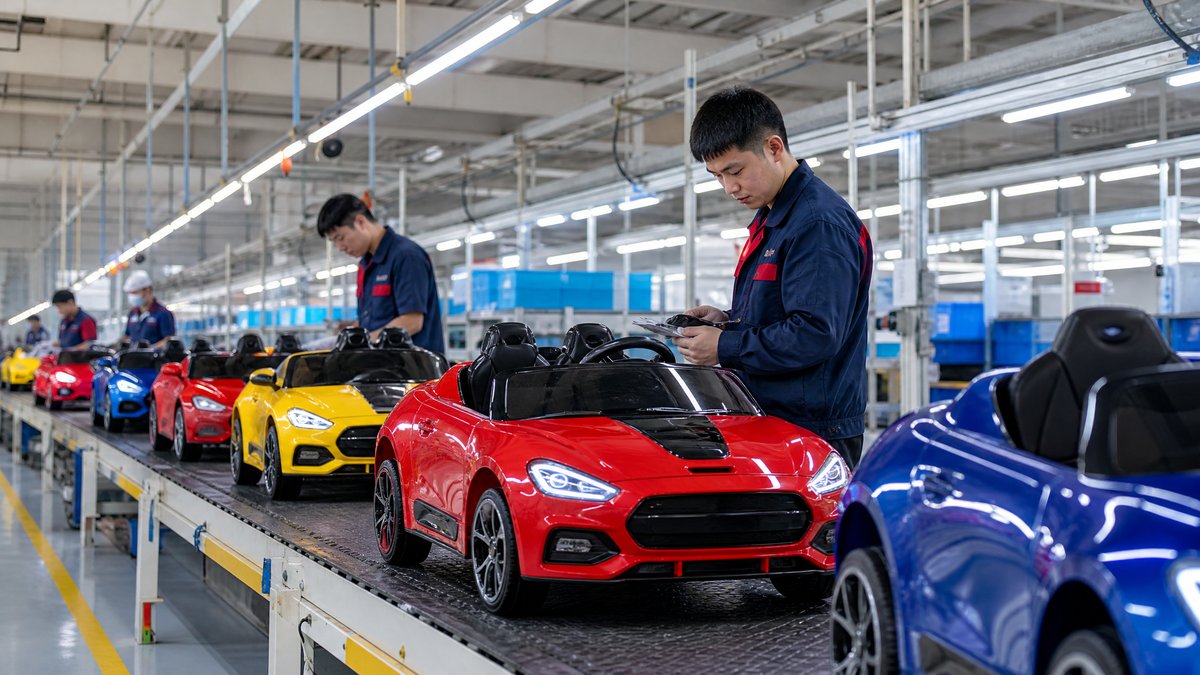
A wholesale buyer should turn every ride-on car sample review into a dated, model-specific approval record—not a casual “looks good” message. Record what arrived, how it compares with the agreed specification, how the controls and charging process work, what labels and packaging contain, what evidence is attached, and which points remain open. That record becomes the reference for production, pre-shipment inspection, receiving checks, and change control.
For importers, distributors, retailers, and marketplace sellers, the goal is simple: approve the exact sellable configuration you intend to order, or document every deviation before production begins. A sample is useful only when its identity, observations, evidence, and decision are traceable.
> Important: Sample approval is a commercial and quality-control step; it is not, by itself, proof of regulatory compliance or transport eligibility. Specifications, battery transport rules, and market requirements must be verified for the selected model and destination market.
Start with a sample approval record, not a verbal approval
Create one controlled file for each model and configuration. Give it a revision number and include the following at the top:
- Buyer company, supplier/factory, contact names, review date, and location.
- Model code, sample serial or batch identifier if available, sample color, trim, seating configuration, and proposed market.
- Purchase-order or quotation reference, agreed specification sheet revision, and drawing/artwork revision.
- Intended sales channel: wholesale, retail store, e-commerce, marketplace, rental, or another approved channel.
- Reviewers, decision status (approved, approved with conditions, rework/resubmit, or rejected), and sign-off date.
- A photo/video folder link and the identity of the physical sample reviewed.
Ask the supplier to confirm in writing whether the sample represents the proposed production configuration. If it does not, identify every difference. A polished display sample with a different battery, controller, charger, label set, wheel material, packaging, or accessory kit is not an adequate production benchmark.
Wholesale buyer sample approval checklist
Use the table below as the working checklist. Do not simply mark “pass.” State what was checked, what was observed, the evidence captured, and the decision. Where a tolerance or target is required, use the buyer-approved specification rather than an assumed industry value.
| Approval area | What the buyer should record | Useful evidence | Decision trigger |
|---|---|---|---|
| Sample identity | Model, color, configuration, sample ID, factory, specification revision, date received | Overall photos; supplier declaration of configuration | Do not approve if the sample cannot be matched to the quoted configuration |
| Appearance and build | Color/finish, panel alignment, gaps, sharp or rough edges, decals, lights, seat, wheels, doors/hood where fitted, visible defects | Dated close-up photos and a defect log | Agree rework standard or note accepted cosmetic variation before approval |
| Dimensions and fit | Overall product dimensions, carton dimensions, seat/internal space where relevant, component count, assembled/unassembled state | Measurement photos with scale; packing list | Hold if the recorded configuration does not match the agreed specification or channel constraints |
| Controls and functions | Pedal, direction selection, start/power switch, remote control where supplied, music/lights, display, steering, stop behavior, pairing steps | Short functional videos; controller/remote version photo | Resolve unclear, inconsistent, or undocumented operation before production |
| Battery and charging | Battery type, declared rating and markings, connector/polarity, battery compartment, charger model/label, charging instructions, supplied accessories | Photos of battery and charger labels; manual pages; supplier documents | No approval until the exact battery/charger combination and shipping documentation path are confirmed |
| Safety-related features | Seat restraint where fitted, parental remote features where fitted, wheel/drive protection, accessible fasteners, pinch/entrapment observations, warnings and instructions | Photos, functional video, issue log | Escalate any concern to the supplier and the relevant compliance process; do not treat a visual check as a compliance test |
| Labels and documents | Product label, age/weight/use warnings, importer/brand information where applicable, charger/battery labels, carton marks, manual language/version | Flat, readable label and manual scans | Correct omissions, inconsistencies, untranslated content, or unapproved claims before artwork release |
| Packaging | Carton artwork, inner protection, hardware/accessory bags, manual placement, spare-parts list, barcode/carton marks, assembly-tool inclusion | Unboxing video; photos of each packed layer; carton dimensions | Hold if the pack-out differs from the approved retail or shipping specification |
| Change control | Open issues, approved deviations, owner, deadline, affected documents, resubmission requirement, approved final revision | Signed change log and revised artwork/specification | No production change should be accepted solely by chat or oral confirmation |
Record the appearance and configuration in enough detail to inspect later
Build a visual “golden sample” record
Photograph the sample from the front, rear, both sides, top, underside, cockpit, battery compartment, charger, remote control, labels, accessories, and carton. Use consistent lighting and include close-ups of any concern. If a video is practical, show power-on, each control, lights/sound functions, and remote-control operation where supplied.
Your photo set should answer questions a production inspector may ask later:
- Which color, decal layout, seat style, wheel design, and trim were approved?
- Is branding present, absent, or still pending approval?
- Which accessories are included in the carton?
- What does the battery bay look like when assembled?
- Where are labels placed, and what revision of artwork was used?
Separate cosmetic approval from functional approval. For example, a buyer may accept a minor surface variation for the approved sample while requiring a specific defect threshold for production. Put that decision in writing; do not rely on memory.
Measure dimensions and carton data against the agreed specification
Record the measurement method, unit, and the person who measured it. Photograph the tape or rule in place for key dimensions. At minimum, note the product’s overall length, width, height, and the outer-carton dimensions as relevant to your quotation, warehouse, fulfillment channel, and freight plan.
Also record assembled versus packed state, gross/net weights where supplied or measured, number of cartons per unit, and any component that changes the pack-out. Do not convert a single sample measurement into a production tolerance unless the buyer and supplier have agreed that tolerance in the specification.
Test controls as an end user and as a service team would
A controls review is not a certified safety test. It is a structured operational check that helps a wholesale buyer find unclear instructions, incorrect parts, and configuration mismatches before a bulk order.
Create a repeatable functional script
Use the same script for every sample and record the result next to each step:
1. Check the assembly instructions, supplied tools, hardware bags, and part identification.
2. Confirm power-on/off operation and the location/feel of switches and buttons.
3. Operate forward/reverse or direction controls only as instructed for the model.
4. Check pedal response, steering movement, lights, sounds, music/media functions, and display features where fitted.
5. If a parental remote is included, record its model/version, pairing method, control mapping, range observations only if you measured them under documented conditions, and any priority/override behavior described by the supplier.
6. Record how the product stops when the user releases the pedal or uses the relevant control, without claiming a stopping distance or performance level you have not formally tested.
7. Repeat the check after any assembly adjustment or battery reconnection required by the instructions.
For each issue, capture: step performed, observed result, expected result from the approved specification/manual, photo or video reference, severity, owner, and due date. This format turns vague feedback such as “remote feels wrong” into an actionable correction.
Verify the exact battery and charging configuration
Battery/charger mismatches can cause avoidable returns, service issues, and logistics delays. Record the battery chemistry/type stated on the unit, the declared voltage/capacity or other markings, the connector style, connector orientation/polarity marking, compartment access, charger model, input/output markings, and every charging instruction provided with the sample.
Do not assume that the battery in a sample will be the one used in production. Ask for written confirmation of the proposed production battery and charger bill of materials, including any approved alternative part process. Ask the supplier or logistics provider which documents, packing method, marks, and carrier requirements apply to the actual battery configuration and shipment mode.
Transport requirements can differ by battery type, how the battery is packed or installed, route, mode, carrier, and destination. The [UN Model Regulations][unece] include provisions affecting battery-powered vehicles, while carriers and national authorities may impose applicable requirements of their own. Treat a supplier document as input to your verification process, not a substitute for it.
Battery and charger evidence to collect
- Clear photographs of all battery and charger markings.
- Battery/charger model numbers and revision/date codes where present.
- The manual’s charging, storage, inspection, and replacement instructions.
- A supplier confirmation tying the battery and charger identifiers to the production configuration.
- Requested transport/compliance documentation appropriate to the battery, route, and destination, reviewed with the responsible freight and compliance parties.
- A spare-parts and after-sales plan: what replacement battery/charger is intended, and how it will be identified.
The [FAA][faa] notes that lithium batteries require safety testing and may present hazards if damaged, overheated, overcharged, exposed to water, or improperly packed. That is useful context for a buyer checklist, but passenger guidance is not a complete cargo-shipping compliance plan. Verify cargo rules with the applicable carrier, forwarder, and destination-market authorities.
Record safety features, labels, and documents without overclaiming
Inspect safety-related design points and escalate concerns
Document the presence and operation of features offered on the selected model—such as a seat restraint, parental remote, protective covers, or speed/settings controls—without describing them as compliant or safe merely because they are present. Note accessible gaps, rough edges, loose hardware, wiring access, battery-compartment closure, moving parts, and anything that could conflict with the approved design or instructions.
Then direct identified issues into the appropriate engineering, test, or compliance review. A buyer’s sample observation can identify a problem; it does not replace product testing or a legal assessment.
Requirements vary by product classification and market. In the United States, the [CPSC][cpsc] explains that the classification of a product affects the set of applicable standards and that children’s products have third-party testing and certification requirements in the circumstances it identifies. In the EU, the [European Commission][eu-toys] describes toy safety requirements addressing, among other things, physical/mechanical and electrical risks, and explains the EU conformity framework for toys. These sources are starting points, not a determination that a particular ride-on car qualifies under a particular rule.
Make labels and manuals part of the sample gate
Collect legible copies of every label on the product, battery, charger, remote, accessory bag, and carton. Compare them with the approved artwork and the selected destination-market requirements. Record:
- Brand, model identifier, production/batch traceability fields, and importer/responsible-party information where required.
- Warnings, intended-age/use information, assembly, charging, and supervision instructions.
- Language versions and the manual/artwork revision number.
- Regulatory marks or claims proposed for the destination market; verify their basis separately.
- Barcode, carton marks, country-of-origin marking, handling marks, and any marketplace or retailer-specific labeling.
Avoid approving labels from a low-resolution photo or a generic PDF. The final label and instruction artwork should be controlled files, with a revision number and approval date. If you sell into multiple countries, maintain a market-by-market label and document matrix rather than assuming one label set works everywhere.
Unbox the sample like a customer and a warehouse would
A complete packaging review includes more than checking whether the car fits inside the carton. Record the outer-carton artwork, dimensions, handling marks, inner protection, fastener/accessory bags, manual placement, loose parts, and how the sample is immobilized in transit.
Open and re-pack the carton if feasible. Note whether items are easy to identify, whether protective materials are correctly placed, and whether a retailer, warehouse team, or end customer could confuse left/right parts or lose hardware. For e-commerce and retail programs, add your channel’s requirements for barcodes, inserts, carton labels, palletization, and presentation packaging to the approval record.
Do not infer transit performance from one unboxing. If packaging performance matters for your route or channel, agree the verification method, acceptance criteria, and responsible party separately. The sample approval record should at least preserve the approved pack-out and carton version for later comparison.
Use change control to protect the approved sample
The most valuable section of the file is often the change log. It prevents a supplier correction from creating a new, undocumented difference elsewhere in the product.
Minimum change-control fields
| Field | What to capture |
|---|---|
| Change ID and date | A unique reference and the date the change was requested or proposed |
| Trigger | Sample issue, artwork correction, component availability, market requirement, cost proposal, or other reason |
| Affected item | Model/configuration, component, software/remote version, label, manual, carton, or document |
| Before/after description | Clear description plus photos, drawing, BOM, or artwork revisions |
| Impact review | Buyer review of appearance, functionality, safety/compliance process, packaging, spares, documentation, and lead time as applicable |
| Approval authority | Named buyer and supplier approvers; required internal compliance/quality reviewers |
| Effective point | Pre-production sample, first production lot, carton date code, purchase order, or another traceable boundary |
| Closure evidence | Revised specification/artwork, replacement sample or photos, inspection instruction update, and final acceptance |
Use a written rule: no material substitution or configuration change without documented buyer approval before it is used in production. “Material” should be defined for your program and may include changes to battery, charger, controller, remote, motor/gearbox, plastic resin/color, wheel, restraint, wiring, labels, manual, packaging, and accessories.
A practical approval decision workflow
1. Prepare the baseline. Freeze the buyer specification, required options, destination markets, packaging expectations, and document list before the sample arrives.
2. Identify the sample. Link the received unit to the supplier’s model/configuration declaration and your file revision.
3. Inspect and document. Complete the appearance, dimensions, function, battery/charging, safety-feature, label, document, and packaging checks with photos/video.
4. Log every gap. Assign an owner, evidence requirement, and due date; distinguish a clarification from a required correction.
5. Review market and logistics readiness. Verify selected-model specifications, battery transport path, and destination-market requirements with the appropriate supplier, forwarder, test/compliance resources, and authorities or regulators.
6. Issue a controlled decision. Approve, approve with explicit conditions, request rework/resubmission, or reject. Attach the approved specification, artwork, and change log.
7. Transfer the record to production control. Give the approved sample pack and open-item list to the factory, third-party inspector where used, warehouse/receiving team, and after-sales team as appropriate.
Need a second set of eyes on the sample checklist or want a model-specific document pack? Email KidsRideCar with the model and destination market.
Internal-link suggestions for this page
Use these existing KidsRideCar paths where they match the reader’s next question:
- [Kids electric ride-on car quality inspection guide in China](/blog/kids-electric-ride-on-car-quality-inspection-guide-china) — link from the production-inspection handoff section.
- [Kids electric ride-on car battery safety guide for importers](/blog/kids-electric-ride-on-car-battery-safety-guide-importers) — link from the battery/charger evidence section.
- [Kids electric ride-on car packaging guide for Amazon FBA and retail](/blog/kids-electric-ride-on-car-packaging-guide-amazon-fba-retail) — link from the packaging review section.
- [How to write a purchase order for kids electric ride-on cars from China](/blog/how-to-write-purchase-order-kids-electric-ride-on-cars-china) — link from the change-control or baseline-specification section.
- [KidsRideCar inquiry page](/inquiry) — link for buyers ready to request a sample or production confirmation.
Image plan
| Placement | Suggested dimensions | English caption | Alt text | English AI prompt |
|---|---|---|---|---|
| After the introduction | 1600 × 900 px | “A documented sample review turns a ride-on car into a controlled production reference.” | “Wholesale buyer reviewing a kids ride-on car sample with a clipboard in a quality-control workspace” | “Photorealistic B2B product-quality scene, diverse wholesale buyer in a clean warehouse inspection area reviewing an unbranded kids electric ride-on car with a clipboard, tape measure and inspection checklist, neutral colors, no logos, no readable brand names, wide landscape composition, professional trade publication style” |
| In the dimensions and appearance section | 1400 × 900 px | “Measure the product and carton, then attach the evidence to the approval record.” | “Tape measure documenting dimensions of an unbranded kids ride-on car and shipping carton” | “Photorealistic close-up of a quality inspector measuring an unbranded children’s electric ride-on car beside its plain shipping carton, tape measure visible, hands only, clean warehouse background, no logos, no text, landscape composition” |
| In the battery and charging section | 1400 × 900 px | “Record the exact battery, charger, connector and label configuration—not just the advertised feature.” | “Close-up of a kids ride-on car battery compartment with charger and identification labels being documented” | “Photorealistic product documentation scene showing an unbranded kids electric ride-on car battery compartment open beside a charger, inspector photographing labels with a tablet, safety-conscious tidy workbench, no visible logos or readable proprietary text, landscape composition” |
| In the packaging/change-control section | 1600 × 900 px | “Approved artwork, pack-out photos and a change log keep production aligned with the sample.” | “Quality-control desk with plain ride-on car carton, packaging components, sample photos and change-control checklist” | “Photorealistic B2B quality-control desk, plain unbranded kids ride-on car carton, protective packaging materials, printed sample photos, generic change-control checklist, pens and tablet, organized factory office, no logos, no readable brand names, wide landscape composition” |
FAQ
What is the most important record in a ride-on car sample approval?
The most important record is the controlled model-and-configuration specification, supported by dated photos, functional observations, approved artwork, and a signed decision. It lets you compare later production units against what was actually approved.
Can a buyer approve a sample if the battery or charger will change for production?
Only treat the approval as conditional until the exact production battery/charger configuration, its markings, documents, and any resulting packaging or instruction changes have been reviewed. A battery or charger substitution should go through written change control. Verify battery transport rules for the selected configuration, route, shipment mode, carrier, and destination market.
Does a good sample check prove that the ride-on car meets regulations?
No. A buyer’s review can document appearance, configuration, operation, labels, and packaging, but it does not replace the applicable testing, technical documentation, conformity assessment, certification, or legal review. Confirm the requirements for the selected model and destination market with the relevant authority, regulator, and qualified compliance resources.
Which labels should a wholesaler photograph during approval?
Photograph every product, battery, charger, remote, accessory, carton, and manual label. Record the label text, location, artwork revision, model identity, warnings/instructions, language versions, traceability fields, and any market-specific information required for the proposed sale.
How should a buyer handle an approved sample with minor defects?
List each accepted deviation explicitly, with photos and a production acceptance instruction. If the defect must not appear in production, log a corrective action, owner, deadline, and closure evidence. Never leave a known issue as an informal verbal understanding.
Conclusion: approve evidence, not impressions
A strong kids ride-on car sample approval file captures the exact product configuration, visual condition, dimensions, controls, battery and charger identity, safety-related observations, labels, packaging, documents, and all approved changes. It gives the buyer a practical benchmark for production inspections and helps prevent avoidable disputes, returns, and relabeling work.
Before placing a bulk order, verify the selected model’s specifications, battery transport requirements, and destination-market obligations with the appropriate parties. For help organizing a sample review or requesting model-specific information, contact KidsRideCar at info@kidsridecar.com.
[cpsc]: https://www.cpsc.gov/Business--Manufacturing/Business-Education/childrens-products "U.S. Consumer Product Safety Commission: Children’s Products (verified September 2026)"
[eu-toys]: https://single-market-economy.ec.europa.eu/sectors/toys/toy-safety_en "European Commission: Toy Safety in the EU (verified September 2026)"
[unece]: https://unece.org/transport/dangerous-goods/un-model-regulations-rev-23 "UNECE: UN Model Regulations Rev. 23 (2023) (verified September 2026)"
[faa]: https://www.faa.gov/hazmat/packsafe/lithium-batteries "Federal Aviation Administration: PackSafe – Lithium Batteries (verified September 2026)"
Official references
Explore these external resources for current regulatory and trade guidance. Confirm requirements with the relevant authority before placing an order.
Ready to Start?
Factory-Direct · CE & ASTM Certified · MOQ from 50 Units
Our export team works with buyers in 60+ countries. Get a quote within 24 hours.
KR
Written by KidsRideCar
China's leading kids electric ride-on car manufacturer. 500,000+ units shipped annually to 60+ countries. CE, ASTM & EN71 certified.