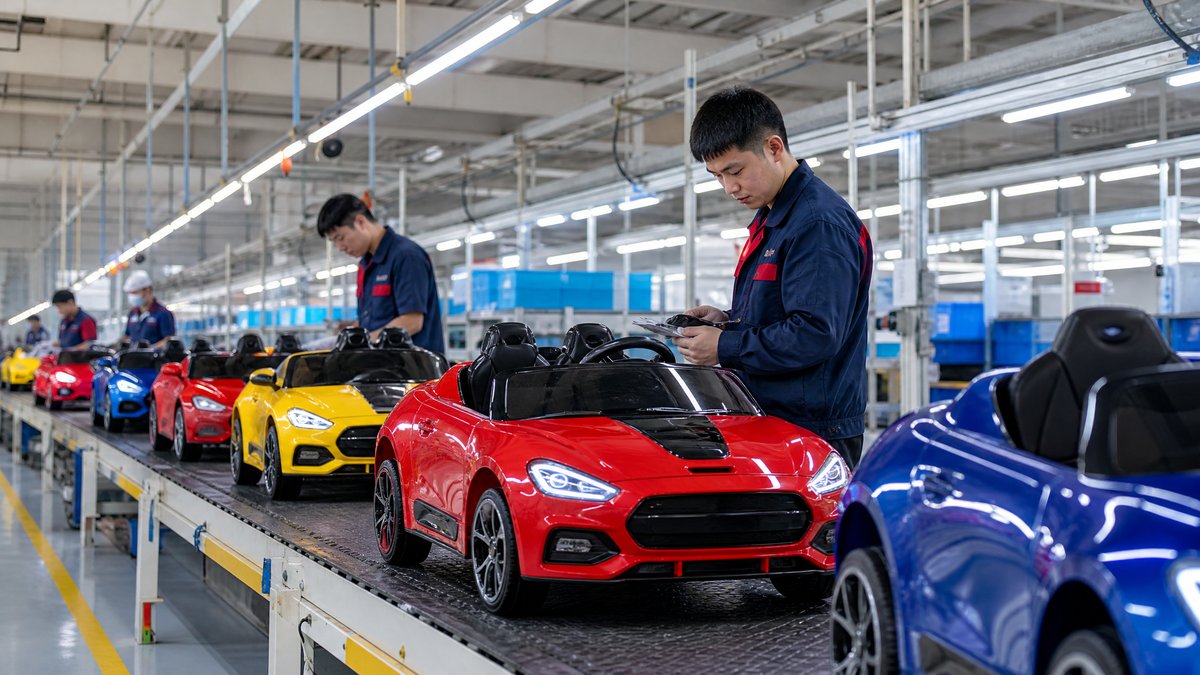
An effective RFQ for kids electric ride-on cars tells suppliers exactly which model configuration, order scope, packaging, documentation, destination market, and commercial terms they are pricing. It should make every quote comparable and leave no uncertainty about what is included. Verify all specifications, battery transport rules, and market requirements for the selected model and destination market before placing an order.
For importers, wholesalers, distributors, and retailers, the goal is not simply to receive a low unit price. It is to receive a quote that can be checked against the same product definition, delivery basis, compliance-document scope, and after-sales expectation.
> Need a usable RFQ template or a model-by-model quotation? Send the target market, planned quantity, and preferred configuration to info@kidsridecar.com.
Start with a clear RFQ brief
A supplier should not have to infer whether the request is for a catalogue item, a colour variation, private-label packaging, or a new development. Begin the RFQ with a short commercial brief that answers these questions:
- Buyer type and sales channel: importer, wholesaler, distributor, retailer, e-commerce seller, marketplace seller, or rental operator.
- Destination market(s): country or region of sale, not just the port of discharge.
- Product use case: retail resale, promotional program, rental fleet, or another defined channel.
- Product basis: a model code, reference photo, catalogue page, or a statement that alternatives are invited.
- Estimated order quantity: total units and quantity by model, colour, or variant where known.
- Target timing: quote deadline, sample timing if needed, and desired shipping or delivery window.
- Commercial request: required Incoterm and named port/place, preferred currency, and whether the price is requested for sample, trial order, or repeat order.
A brief with the selected market and sales channel is particularly important. The product presentation, labels, instructions, packaging, documentation, and sales-channel requirements may differ by market. Do not treat a document set for one market as automatically sufficient for another.
Specify the ride-on car configuration—not just “electric car”
A model name or photo is a useful starting point, but it is not a complete product definition. Ask the supplier to confirm the exact version quoted and list every included component. This avoids comparing a basic configuration from one supplier with an upgraded configuration from another.
Core product information to request
Include the following fields in the RFQ and ask the supplier to state included, optional, unavailable, or to be confirmed for each field:
| RFQ field | What the buyer should state or request | Why it matters in quote comparison |
|---|---|---|
| Model identification | Model code, reference images, body style, seat configuration, and preferred colours | Keeps all suppliers aligned to the same product basis. |
| Age/use positioning | Intended age range or buyer’s preferred retail positioning; request the supplier’s approved product information | Helps align warnings, instructions, and product presentation with the intended market. |
| Power configuration | Battery chemistry/type, voltage/capacity marking, charger input/output details, motor/drive arrangement, and connector type | These elements affect configuration, documentation, replacement parts, and transport planning. Confirm them for the selected model. |
| Driving and control features | Pedal operation, parental remote-control option, speed settings if applicable, forward/reverse operation, and start method | Prevents assumptions about functions that may be optional or model-specific. |
| Physical configuration | Seating, restraint type if supplied, wheels/tyres, suspension if supplied, doors, lights, audio features, and storage | Makes it clear what is in the box and what may add cost or assembly work. |
| Dimensions and load information | Product dimensions, carton dimensions, gross/net weight, and manufacturer-stated load guidance | Needed for retail planning, container calculations, fulfilment, and packaging review. Ask for the supplier’s current specification sheet rather than relying on a prior listing. |
| Included parts | Charger, remote control, assembly hardware, manual, decals, spare parts, batteries, and any accessories | Identifies omissions that can create retail-service issues later. |
| Version control | Product revision, BOM/revision date, and photo of the exact proposed version | Makes the quotation traceable to the approved sample and purchase order. |
Avoid asking a supplier to “quote the best version” without defining what “best” means. Instead, request one base configuration and separately priced options. For example, a buyer can ask for a quote that distinguishes a standard carton from custom retail packaging, or a catalogue colour from a private-label colour program.
Separate standard options from custom work
For every requested change, mark it as one of the following:
1. Catalogue option — already offered for the selected model; ask for available choices and the quoted selection.
2. Private-label adaptation — logo, carton artwork, manual artwork, labels, or decals; ask for artwork requirements, approval steps, and any incremental cost or timing impact.
3. New tooling or development request — a new body, component, function, or mould; ask for a separate feasibility review and quotation rather than assuming it is included in the unit price.
This distinction helps buyers prevent a common RFQ problem: a supplier quotes a standard product while the buyer expects a custom program.
Define packaging and fulfilment requirements early
Carton design and packing method can affect freight planning, online fulfilment, retail shelf presentation, product protection, and returns handling. Put packaging requirements in the RFQ rather than discussing them after a purchase order is issued.
Packaging checklist for the RFQ
Request confirmation of:
- carton dimensions, gross weight, net weight, and units per carton;
- pack-out method and a carton packing list or component layout where available;
- retail carton, brown carton, or other required packaging format;
- buyer artwork, brand marks, barcode location, carton marks, warning text, country-of-origin marking, and language requirements;
- inner protection, moisture protection, palletisation, and container-loading requirements, if applicable;
- whether the product is shipped partly assembled and what assembly materials are included;
- photos of the proposed carton and finished pack-out before mass production, when packaging is custom or channel-specific;
- any e-commerce, marketplace, retailer, or fulfilment-centre receiving rules that apply to the buyer’s channel.
Ask suppliers to separate product unit price, packaging charge, artwork/setup charge, and any special packing or palletisation charge. This makes it easier to decide whether a packaging change is commercially worthwhile.
For further packaging questions, see the internal reading suggestion: [Kids Electric Ride-On Car Packaging Guide: Amazon & Retail](/blog/kids-electric-ride-on-car-packaging-guide-amazon-fba-retail) and [Kids Electric Ride-On Car Packaging Design Guide](/blog/kids-electric-ride-on-car-packaging-design-guide).
State the target market and required documents
The target market should be a mandatory RFQ field. Requirements can depend on product classification, the exact model and feature set, the importer’s role, local language rules, and the destination authority or sales platform. A test report or certificate name alone is not a substitute for checking current requirements.
For example, the U.S. CPSC explains that children’s products are subject to applicable federal safety rules and that classification matters; it also describes testing and certification obligations that may apply to manufacturers and importers.[^cpsc-children][^cpsc-testing] The European Commission states that toys placed on the EU market must meet EU safety requirements and outlines manufacturer, importer, and distributor responsibilities for technical documentation, declarations, marking, traceability, instructions, and warnings.[^eu-toys]
These official pages are useful starting points, not a market-by-market legal determination. The buyer should verify current requirements with the relevant destination-market authority, qualified compliance adviser, and—where applicable—sales platform before confirming the order.
Document-request matrix
Use the following matrix to tell suppliers what you need them to quote, provide, or confirm. Mark each item as required before sample, required before production, required before shipment, or not applicable.
| Document or evidence | RFQ instruction | Buyer check before relying on it |
|---|---|---|
| Current specification sheet | Request the exact model/version, included components, dimensions, weights, power configuration, and revision date | Confirm it matches the quoted model, approved sample, carton, and purchase order. |
| Product photos/video | Request images or video of the exact proposed configuration and packaging | Check that colour, features, remote, charger, labels, and included parts match the quotation. |
| Applicable testing/compliance documents | State the destination market and ask what documents are available for the exact model and configuration | Verify scope, product identity, issue date, applicability, and acceptance with the relevant authority or adviser. Do not assume a document for another model or market applies. |
| Declaration/certificate information | Ask the supplier to identify what declaration or certification information it can provide, if applicable to the selected market | Confirm the responsible party, product identification, scope, and destination-market relevance. |
| Labels, warnings, and instructions | Request artwork or samples showing proposed product, carton, charger, and manual information in required languages | Review against the destination-market and channel requirements; ensure product, packaging, and manual are consistent. |
| Battery and transport information | Ask for battery type, marking, shipment configuration, relevant transport documents, and packaging/handling information | Confirm current transport treatment with the freight forwarder/carrier and the competent transport rules for the selected battery and route. |
| Parts and service documentation | Request assembly instructions, parts list/exploded view where available, and replacement-part ordering process | Confirm the buyer can support its warranty and repair commitments. |
| Quality-control records | Ask what inspection points, sampling basis, records, and pre-shipment evidence can be provided | Agree the inspection scope and acceptance criteria in writing; do not describe unverified factory practices as a guarantee. |
Treat battery transport as a separate verification workstream
Battery-powered products may have transport obligations that vary by battery type, battery configuration, mode of transport, route, packaging, and the current rule set. IATA notes that air transport of lithium batteries depends on configuration and watt-hour rating and provides shipper guidance covering identification, packing, marking, labelling, and documentation.[^iata-batteries]
In the RFQ, ask the supplier to identify the battery type and shipment configuration, but have the buyer’s nominated freight forwarder or carrier confirm the current shipping classification, acceptance conditions, documents, packing, marks, labels, and route restrictions. Battery transport rules must be verified for the selected model and destination market; do not promise a shipping method based only on a previous order or a supplier statement.
For sourcing context, consider the related guide [Kids Electric Ride-On Car Battery Guide: Lead-Acid vs. Lithium](/blog/kids-electric-ride-on-car-battery-guide-lead-acid-vs-lithium) and the [Shipping Kids Electric Ride-On Cars From China: Complete Logistics Guide](/blog/shipping-kids-electric-ride-on-cars-from-china-complete-logistics-guide).
Ask for a quotation that is comparable line by line
A low price cannot be evaluated if the scope is unclear. Require suppliers to complete the same commercial fields, state exclusions, and identify any assumptions. This turns quotations into a decision tool rather than a collection of loosely comparable offers.
Quote-comparison checklist
| Comparison area | Ask every supplier to quote or confirm | Buyer’s comparison question |
|---|---|---|
| Product scope | Exact model/version, included parts, options, colour, and configuration | Is it genuinely the same ride-on car specification? |
| Quantity and MOQ | MOQ by model, colour, packaging type, and custom feature | Does the MOQ work with the planned assortment and cash flow? |
| Pricing basis | Currency; Incoterm; named port/place; unit price; sample price; and separate option/customisation charges | Are all quotes on the same delivery basis and currency? |
| Packaging | Carton specification, artwork scope, barcodes/marks, and added packing charges | Does each quote include the same retail and shipping pack-out? |
| Tooling/artwork | One-time charges, ownership terms if relevant, and scope of setup work | Which costs are one-time, recurring, refundable, or excluded? |
| Production and shipment | Estimated lead-time basis, sample/approval milestones, production assumptions, and shipment readiness definition | Are the milestones measured from the same approved starting point? |
| Quality and inspection | Proposed inspection stage, agreed specification, defect/acceptance approach, and documentation supplied | Is the quality agreement specific enough to inspect against? |
| Documentation | Exact documents offered for the selected model, market, and shipment configuration | Does the evidence match the destination-market plan? |
| Service and spares | Warranty terms offered, parts availability, spare-parts price list, and response process | Can the buyer support retailer or end-customer issues after sale? |
| Payment and validity | Payment terms, quote validity period, and conditions for price changes | What commercial assumptions could change before purchase order? |
A useful internal comparison sheet should include a final column called “not included / needs confirmation.” Fill it in immediately when a supplier gives an unclear answer. An unanswered item should not be treated as included.
Compare landed scope, not unit price alone
Buyers commonly compare unit price first. A more useful method is to compare the full quoted scope: product configuration, packaging, document support, local work after arrival, freight basis, inspection, spare parts, and foreseeable channel requirements. This does not replace a landed-cost calculation, but it reduces the risk of selecting a quote that appears cheaper because key elements were omitted.
For a related calculation framework, see [How to Calculate Total Landed Cost for Kids Electric Ride-On Cars](/blog/how-to-calculate-total-landed-cost-for-kids-electric-ride-on-cars).
Put approval gates into the RFQ
An RFQ becomes stronger when it says what must be approved before the next stage. The exact process should be agreed with the supplier, but buyers often define these checkpoints:
1. Quotation review: confirm model, configuration, quotation scope, exclusions, Incoterm, and target market.
2. Sample or pre-production confirmation: approve the exact configuration, colour, labels, manuals, carton artwork, and included accessories where relevant.
3. Pre-production document check: verify the agreed document list and any destination-market or transport workstream before shipment is committed.
4. Inspection and shipment release: use agreed product, packaging, and packing-list criteria; record any exception in writing.
5. Post-shipment service setup: confirm replacement parts, contact route, and warranty/claim handling process.
These gates do not establish compliance or guarantee product performance. They create a traceable buying process and give the buyer a chance to identify mismatches before they become inventory problems.
Copy-and-send RFQ outline
Use this outline as a starting point. Replace brackets with buyer-specific details and attach reference images or a spreadsheet where useful.
```text
Subject: RFQ — Kids Electric Ride-On Cars — [Destination Market] — [Quantity]
1. Buyer and project
- Buyer type / sales channel: [ ]
- Destination market(s): [ ]
- Target delivery or shipment window: [ ]
- Requested Incoterm, named port/place, and currency: [ ]
2. Product requested
- Model code/reference image: [ ]
- Required configuration and colours: [ ]
- Required included parts/accessories: [ ]
- Requested options to price separately: [ ]
- Custom work (logo/carton/manual/decals/new development): [ ]
3. Quantities
- Quantity by model/colour/configuration: [ ]
- Sample requirement: [ ]
4. Packaging and retail requirements
- Carton type and artwork requirements: [ ]
- Barcode/carton marks/language requirements: [ ]
- Channel or fulfilment requirements: [ ]
- Required carton dimensions and gross/net weight confirmation: [ ]
5. Target-market documents and shipment information
- Destination-market requirements to be confirmed for the selected model: [ ]
- Documents/information requested: [ ]
- Battery type and shipment-configuration details requested: [ ]
- Instruction/warning/label language requirements: [ ]
6. Quote format required
Please state separately:
- Unit price and all included items
- MOQ by model/colour/customisation
- Sample, artwork, tooling, packaging, palletisation, and other charges
- Incoterm/named port or place; currency; quote validity
- Estimated lead-time basis and assumptions
- Available documentation for this exact model/version
- Spare-parts/service terms and exclusions
- All items not included or requiring confirmation
7. Attachments
- Reference photos/specification sheet
- Artwork files, if available
- Packaging/label requirements
```
Before moving from RFQ to purchase order, buyers can use the related internal guide [How to Write a Purchase Order for Kids Electric Ride-On Cars From China](/blog/how-to-write-purchase-order-kids-electric-ride-on-cars-china) and [Kids Electric Ride-On Car Quality Inspection Guide: China](/blog/kids-electric-ride-on-car-quality-inspection-guide-china).
FAQ
1. What is the most important item in a ride-on car RFQ?
The most important item is a precise definition of the exact product configuration being priced, followed by the destination market and commercial delivery basis. Without those, the supplier may quote a different model version, packaging scope, or document set than the buyer expects.
2. Should I ask for compliance documents in the first RFQ?
Yes—state the destination market and ask which documents or evidence are available for the exact model and configuration. Then verify applicability, scope, and current requirements with the relevant authority, qualified adviser, or marketplace. Documents should not be assumed transferable between models, revisions, or markets.
3. How should I request battery shipping information?
Ask the supplier to identify the battery type, marking, shipment configuration, and available transport documentation. Then have your freight forwarder or carrier confirm the current requirements for the selected model, battery, route, and transport mode. Battery transport rules must be verified rather than copied from an earlier shipment.
4. What packaging information should a retailer include?
Specify the required carton type, dimensions/weight information, branding and barcode location, warnings and language, inner protection, and any marketplace, fulfilment-centre, or retailer receiving rules. Ask for all packaging-related charges separately from the product unit price.
5. How can I compare quotes from several suppliers fairly?
Use one RFQ template and one comparison sheet. Compare configuration, included parts, quantity, MOQ, packaging, Incoterm, document scope, customisation charges, lead-time assumptions, service/spares, and exclusions—not unit price alone. Mark unclear answers as “needs confirmation.”
Conclusion: an RFQ is a control document, not just a price request
A buyer-ready RFQ for kids electric ride-on cars defines the model, configuration, quantity, packaging, target market, document requests, transport questions, and quote format before negotiations begin. That clarity helps importers, wholesalers, distributors, and retailers compare suppliers on a like-for-like basis and carry the approved scope into the sample, purchase order, inspection, and shipment stages.
Specifications, battery transport rules, and market requirements must always be verified for the selected model and destination market. If you want help turning your buying brief into a model-specific RFQ, email KidsRideCar with your target market, product reference, expected quantity, and sales-channel requirements.
Image planning
| Placement | Suggested dimensions | English caption | Alt text | English AI prompt |
|---|---|---|---|---|
| Below the introduction / featured image | 1600 × 900 px | “A clear RFQ aligns product details, packaging, documents, and quote scope before a buyer compares suppliers.” | “B2B buyer reviewing an RFQ checklist for kids electric ride-on cars with product samples and cartons” | “Professional B2B sourcing scene in a modern office: procurement manager reviewing a detailed RFQ checklist beside an unbranded kids electric ride-on car sample and plain shipping carton, neutral blue and white palette, realistic commercial photography, clean natural light, no logos, no readable text, wide composition with clear negative space on the left.” |
| In the packaging section | 1400 × 900 px | “Packaging details belong in the RFQ because carton specification affects fulfilment and quote comparison.” | “Plain ride-on car shipping carton and protected components prepared for B2B packaging review” | “Studio still life of an unbranded children’s electric ride-on car partially packed in a plain corrugated retail shipping carton, visible protective inserts and separated components, procurement packaging review mood, realistic product photography, no brand marks, no labels or readable text, horizontal layout.” |
| In the document and target-market section | 1400 × 900 px | “Document review should be tied to the exact model, configuration, and destination market.” | “Buyer comparing model specification sheet, carton labels, and destination-market document checklist” | “Close-up professional procurement desk with an unbranded toy ride-on car specification sheet, generic checklists, packaging label mockups without readable text, and a small unbranded ride-on car model in background, realistic editorial photograph, calm blue-gray palette, no seals, no certification logos, no readable words.” |
| Before the quote-comparison checklist | 1400 × 900 px | “A like-for-like comparison makes supplier quotations easier to evaluate.” | “Procurement team comparing supplier quotation columns for kids electric ride-on cars” | “Overhead view of a diverse procurement team comparing several generic supplier quote sheets in a spreadsheet-style layout next to an unbranded kids electric ride-on car sample, commercial B2B editorial photography, no logos, no readable text, clean organized desk, horizontal composition.” |
References
[^cpsc-children]: [U.S. Consumer Product Safety Commission (CPSC), “Children’s Products”][cpsc-children]
[^cpsc-testing]: [U.S. Consumer Product Safety Commission (CPSC), “Testing & Certification”][cpsc-testing]
[^eu-toys]: [European Commission, “Placing toys on the EU market”][eu-toys]
[^iata-batteries]: [International Air Transport Association (IATA), “Batteries”][iata-batteries]
[cpsc-children]: https://www.cpsc.gov/Business--Manufacturing/Business-Education/childrens-products
[cpsc-testing]: https://www.cpsc.gov/Business--Manufacturing/Testing-Certification
[eu-toys]: https://single-market-economy.ec.europa.eu/sectors/toys/placing-toys-eu-market_en
[iata-batteries]: https://www.iata.org/en/programs/cargo/dgr/lithium-batteries/
Official references
Explore these external resources for current regulatory and trade guidance. Confirm requirements with the relevant authority before placing an order.
Ready to Start?
Factory-Direct · CE & ASTM Certified · MOQ from 50 Units
Our export team works with buyers in 60+ countries. Get a quote within 24 hours.
KR
Written by KidsRideCar
China's leading kids electric ride-on car manufacturer. 500,000+ units shipped annually to 60+ countries. CE, ASTM & EN71 certified.