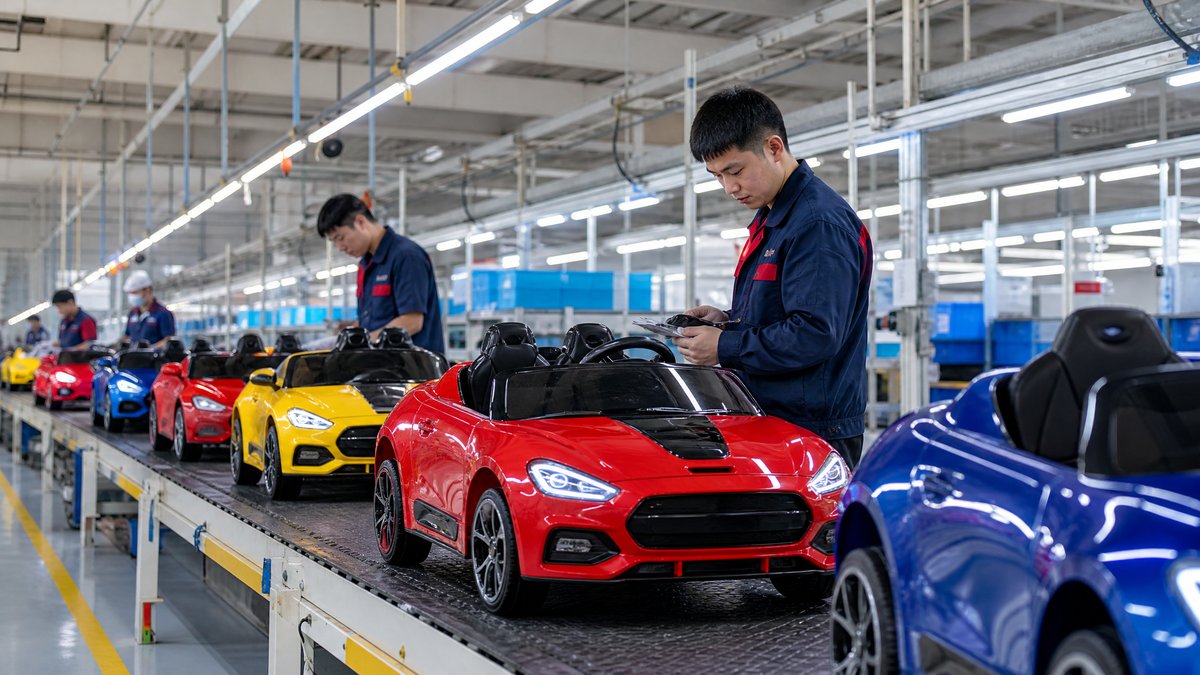
A practical answer: agree the inspection plan with the buyer *before* the inspection date and tie it to the approved sample, purchase order, packing specification, artwork, accessory list, and destination-market requirements. The plan should state what will be sampled, what will be checked, how findings will be classified, what evidence the inspector must collect, and who may release, rework, or hold the shipment. For kids ride-on cars, the plan should cover appearance, assembly and core functions, included accessories, product and carton labels, packaging condition, and document consistency—not simply whether a vehicle turns on.
A pre-shipment inspection can help importers, wholesalers, distributors, and retailers identify visible or functional issues in the inspected lot before dispatch. It is not a substitute for product design validation, laboratory testing, legal compliance review, carrier acceptance, or the buyer’s own due diligence. Confirm the selected model’s specification, battery configuration and transport rules, and the requirements of the destination market before approving shipment.
> Build the plan around the order, not around a generic checklist. A model-neutral inspection plan gives every party the same reference point while leaving the buyer in control of the agreed specification and acceptance decision.
Start with a buyer-approved inspection brief
The most useful pre-shipment inspection (PSI) begins well before cartons are opened. Send the factory, inspection provider, and buyer a single controlled brief. Mark the revision number and issue date so that everyone knows which version applies.
What the brief should identify
Include the following items in the inspection brief:
- Order identity: purchase order number, customer, factory, selected model/SKU, colour or finish, ordered quantity, and planned shipment date.
- Approved reference: signed or otherwise approved production sample, approved photos, bill of materials where relevant, artwork proof, instruction manual, and packaging dieline or carton artwork.
- Model configuration: battery type and configuration, charger or power adapter version, remote-control version if included, wheel/seat configuration, language version, and any retailer-specific bundle.
- Inspection timing: proposed date, factory address, inspection window, and the minimum production and packing status needed before inspection begins.
- Sampling method: who chooses the sampling plan, how cartons and units are selected, which inspection levels apply, and the agreed accept/reject criteria.
- Defect definitions: critical, major, and minor categories tailored to the buyer’s risk policy. Include examples relevant to the specific model.
- Evidence required: overall and close-up photos, video of functional checks where useful, serial/batch or carton identifiers, count records, and a written finding log.
- Disposition rules: who can authorize rework, re-inspection, shipment release, shipment hold, or an exception acceptance.
Avoid treating a supplier’s checklist as the complete acceptance standard. It may be a helpful starting point, but the final checklist should reflect the buyer’s contract, approved sample, retail channel, and market obligations.
Agree the sampling plan instead of assuming one
Sampling does not mean inspecting a convenient handful of finished units. The buyer should agree, in writing, the sampling approach with the factory or third-party inspector before the visit. The plan should explain whether selection is random from the available finished lot, whether multiple carton positions will be represented, and whether different SKUs, colours, or production batches require separate coverage.
There is no universal sample size or pass/fail threshold that suits every ride-on car order. A first order, a new model, a new factory, a retailer launch, a complex remote-control configuration, or a quality-sensitive market may justify a more cautious plan than a repeat order with stable, documented controls. If an industry sampling standard is used, record the edition, inspection level, lot definition, defect classifications, and acceptance/rejection limits agreed by the buyer. Do not silently replace a buyer-approved plan with a generic one.
| Sampling decision | What to agree before inspection | Why it matters to the buyer |
|---|---|---|
| Lot definition | Which POs, SKUs, colours, production dates, and carton ranges are in scope | Prevents a report on one configuration being used to release another |
| Readiness condition | Required percentage of completed production and packed cartons; whether rework units are included | Reduces the risk of inspecting an unrepresentative or unfinished lot |
| Unit selection | Random carton selection across accessible pallet/carton locations and, where relevant, across variants | Helps avoid a hand-picked sample |
| Sample size and plan | The agreed sampling standard or buyer-defined sample size, inspection levels, and accept/reject limits | Makes the decision rule transparent before findings arise |
| Defect classification | Definitions and examples of critical, major, and minor defects for this model | Links observations to a consistent release decision |
| Escalation rule | Who is contacted for a safety concern, material discrepancy, suspected mix-up, or failed function | Prevents an inspector from making unauthorized commercial decisions |
Practical control: ask the inspector to photograph selected outer-carton marks and record the carton numbers or other traceability identifiers used for the sample. This supports the report without implying that the inspection covers every unit in the shipment.
Translate the approved sample into inspection points
The approved sample is valuable only when its key attributes are written into observable checks. For example, “match approved sample” is not enough by itself. The plan should say what colour, logo location, trim, seat, wheel, dashboard, remote, accessory, manual, and carton attributes must match.
Visual and workmanship checks
Visual checks are usually completed on selected units under adequate lighting. The inspector can compare production units with approved references and record deviations, rather than relying on memory or broad descriptions.
Typical visual checks for a kids ride-on car include:
- Body-shell colour, gloss/finish, moulding quality, visible gaps, sharp or rough edges, cracks, scratches, stains, deformation, and unwanted marks.
- Decals, branding, and decorative graphics for position, spelling, adhesion, alignment, and approved artwork.
- Seat, steering wheel, wheels, doors or other moving trim, windshield, dashboard, and external fittings for assembly condition and appearance.
- Fasteners, covers, caps, and accessible parts for missing, loose, or obviously damaged condition.
- Product colour, configuration, and branding against the approved sample and SKU specification.
- Manual, warranty card, insert, or retailer-specific literature for version, language, legibility, and inclusion where ordered.
The inspection brief should define tolerance or acceptance expectations where appearance is subjective. A photo reference that shows approved logo placement, finish, and packaging is often more actionable than a vague instruction to check “good workmanship.”
Functional checks: test the ordered configuration, not assumed features
A functional inspection should follow the selected model’s approved specification and instructions. Do not presume that every ride-on car has the same drive modes, remote functions, lighting, sound, media inputs, suspension, or charging arrangement.
Depending on the configured model, the buyer may ask the inspector to verify that selected units can be assembled or prepared as instructed; start and stop as intended; move according to the documented operating controls; respond to steering or direction controls; and operate ordered functions such as lights, horn, music, remote control, or other specified features. Verify that connectors, switches, and accessible controls are present, fitted, and visibly undamaged. If the buyer requires a particular functional sequence, write it into the plan and ask for a video record of the sequence.
A PSI is not a substitute for an engineering safety assessment or a laboratory compliance test. The inspector should report a failed or abnormal observed function and escalate it under the agreed rule; the buyer should decide whether further technical review, testing, or a hold is needed.
Inspect accessories, labels, and cartons as a matched system
A retail-ready ride-on car shipment is more than the vehicle. Missing accessories, incorrect warnings, mixed artwork, or damaged cartons can create downstream returns, warehouse disruption, or market-entry issues even if sampled units appear to work.
Accessories and in-box contents
Create a model-specific packing list that names each required item and version. Check the presence and apparent condition of items such as the battery, charger or adapter, remote control, hardware pack, instructions, and any model-specific parts ordered by the buyer. Count and version-check accessories according to the agreed sampling plan; do not simply confirm that “an accessory bag” exists.
For battery-powered products, verify the selected model’s battery specification and the intended transport route with the responsible parties. Battery classification, packaging, marking, labelling, documentation, and carrier rules can depend on the actual battery and shipment configuration. IATA notes that battery transport requirements depend on factors including configuration and rating and provides shipper guidance; sea, road, rail, air, and destination rules may differ.[iata-batteries] Do not use a PSI as evidence that a shipment is accepted for transport.
Product, packaging, and shipping labels
The buyer should supply or approve label artwork and specify which markings belong on the product, inner packaging, master carton, pallet, and shipping documents. The plan can then verify legibility, placement, language, SKU/barcode association, country-of-origin marking where required, warning content where applicable, model or batch traceability, and carton marks.
For EU-bound toys, the applicable framework and documentation must be assessed against the product and market; the Toy Safety Directive includes requirements concerning, among other things, CE marking and technical documentation.[eu-toy-safety] For U.S. children’s products subject to CPSC rules, CPSC explains that applicable testing and certification requirements apply and that documentation must be accurate.[cpsc-testing][cpsc-cpc] These official sources are reference points, not a determination that a particular ride-on car meets every requirement. Verify the selected model and destination-market requirements with the relevant authority, qualified compliance professional, and, where needed, test laboratory.
Carton, pallet, and quantity checks
Carton checks should address both retail presentation and the shipment’s ability to move through the buyer’s logistics flow. Plan to check selected cartons for correct artwork, carton dimensions if specified, SKU and quantity markings, barcode readability where applicable, closure condition, damage, moisture exposure, protective packing, and consistency with the approved packing specification.
If palletization is part of the order, include pallet count, accessible pallet labels, visible condition, and any buyer-specified arrangement in the plan. Record the factory’s stated total quantity and, where feasible, reconcile accessible carton counts with the packing list. An inspection report should clearly distinguish a sampled quantity check from a full physical count.
Use a simple, buyer-facing PSI checklist
The following table can be adapted into an inspection order. The “evidence” column keeps the report useful for a buyer who was not on site.
| Inspection area | Buyer-approved check | Suggested evidence in report | Escalate when |
|---|---|---|---|
| Order and traceability | PO, model/SKU, variant, colour, quantity, and available batch/carton identifiers match the inspection scope | Scope summary, carton/lot photos, factory quantity statement | The inspected lot cannot be matched to the order or includes mixed configurations |
| Sampling | Cartons and units are selected using the agreed plan across available variants/locations | Sample list, carton IDs, selection photos, plan reference | Production is not at the agreed readiness stage or sampling cannot follow the approved plan |
| Appearance and assembly | Body, trim, decals, fittings, and finish match the approved reference within agreed criteria | Overall/close-up photos, defect log | Cracks, damage, wrong artwork/configuration, or recurring workmanship findings appear |
| Core functions | Each ordered function is checked using the agreed model-specific sequence | Functional checklist and, where useful, video | A unit does not perform as specified or a function is inconsistent across samples |
| Accessories and manuals | Required in-box items, versions, and languages match the approved packing list | Contents photo, count/version record | Required items are missing, substituted, damaged, or inconsistent |
| Labels and warnings | Product, packaging, and carton markings match approved artwork and market instructions | Label/carton photos, artwork comparison | Markings are missing, incorrect, illegible, or inconsistent with the selected market |
| Packaging and quantity | Cartons, internal protection, carton marks, and accessible counts match the packing specification | Carton condition photos, count record, packing-list comparison | Damaged/incorrect cartons, incorrect packing, or unexplained quantity discrepancy is found |
| Documents | Production and shipping documents are consistent with the selected order and agreed release package | Document index and discrepancy list | Documents are missing, mismatched, outdated, or do not identify the inspected model/lot |
Prepare the documentation review before the inspection date
Document review should be planned, not added after the inspector leaves. Ask the supplier which documents can be supplied in advance and which are final only after shipment booking. The buyer should determine the required document set for the destination market, Incoterms, retailer, and transport mode.
A practical document-control list
Depending on the transaction, the buyer may wish to reconcile:
- Purchase order, pro forma invoice, final commercial invoice, packing list, and model/SKU description.
- Approved specification, approved sample sign-off, artwork approvals, accessory list, and carton specification.
- Instructions, warning copy, labels, and language versions required for the selected market.
- Applicable declarations, test reports, certificates, and technical documentation identified by the buyer’s compliance plan.
- Battery information and any transport documents, marks, labels, or packaging records applicable to the actual battery and route.
- Shipping marks, booking details, bill of lading instructions, and carton/pallet quantities where available.
For U.S.-bound children’s products, CPSC states that the certificate and supporting test reports must be in English and describes the elements of a Children’s Product Certificate (CPC).[cpsc-cpc] That is not a universal document template for all countries or products. For every shipment, verify what documentation is required for the exact model and destination market rather than reusing a prior order’s files.
Define defect categories and release authority before findings occur
Defect categories should be agreed in buyer language—not improvised by the inspector. The plan might define a critical issue as one requiring immediate escalation under the buyer’s policy; a major issue as one that materially affects specification, function, retailability, or compliance readiness; and a minor issue as a limited departure that does not materially affect the agreed product requirements. These are examples of a decision framework, not legal or safety classifications.
For each category, add model-specific examples and a response. A wrong charger version, a missing mandatory buyer-specified warning, a non-functioning ordered control, or a mismatched product model may require escalation even if it appears only in a small sample. Let the buyer—not the inspector—authorize an exception, concession, rework plan, or shipment release.
> Useful reporting rule: record facts first—what was selected, what was observed, the relevant order/sample reference, photo/video evidence, and quantity affected in the sample—then state the agreed action. Avoid conclusions that the complete shipment is compliant or defect-free.
Understand what pre-shipment inspection cannot prove
A well-run PSI is an important risk-control step, but it has defined limits:
- It normally examines a sample, not every unit, carton, or pallet.
- It reflects conditions and documents available at the time of inspection; production, packing, or documents can change afterward.
- It can identify observed discrepancies but cannot by itself prove legal compliance, product safety, durability, laboratory performance, or suitability for every market.
- It cannot replace supplier qualification, approved-sample control, in-process quality control, audit activity, regulatory review, laboratory testing, freight-forwarder confirmation, or cargo insurance.
- It cannot confirm that a carrier, customs authority, marketplace, or retailer will accept the shipment.
Set a final release gate that requires the buyer to review the PSI report, defect/disposition status, final documents, and any re-inspection evidence before authorizing shipment. If the inspection raises a concern, hold the affected decision until the buyer has evaluated the evidence and obtained technical, regulatory, or logistics advice as appropriate.
Image plan
| Placement | Suggested dimensions | English caption | Alt text | English AI prompt |
|---|---|---|---|---|
| Below the introduction | 1600 × 900 px | “A buyer-approved inspection brief keeps the factory, inspector, and importer aligned.” | “Importer reviewing a pre-shipment inspection brief beside boxed kids ride-on cars” | “Photorealistic B2B factory-quality scene, importer and quality inspector reviewing a printed inspection checklist beside unbranded boxed children’s electric ride-on cars, clean production area, neutral blue and white palette, no logos, no visible brand names, landscape 16:9” |
| In the sampling-plan section | 1600 × 900 px | “Random carton selection should follow the buyer’s agreed sampling plan.” | “Quality inspector selecting cartons from different positions in a warehouse” | “Photorealistic warehouse quality-control scene, inspector in neutral clothing selecting sealed export cartons from several pallet positions, carton labels intentionally generic and unreadable, children’s ride-on car outline on cartons only, no logos, landscape 16:9” |
| In the labels-and-cartons section | 1400 × 933 px | “Inspect labels, accessories, and cartons as one retail-ready system.” | “Close view of unbranded ride-on car accessory pack, instruction leaflet and carton label during inspection” | “Professional product inspection flat lay, unbranded children’s electric ride-on car accessory pack, generic instruction leaflet, barcode-style carton label with no readable words, gloved hands checking contents, realistic studio lighting, no logos, 3:2 aspect ratio” |
| Before the conclusion | 1600 × 900 px | “A clear report helps buyers decide whether to release, rework, or re-inspect the lot.” | “Buyer reviewing an inspection report with ride-on car shipment photos on a laptop” | “Photorealistic B2B office scene, wholesale buyer reviewing a quality inspection report with generic product and carton photos on laptop, small unbranded kids ride-on car in background, no visible data, no logos, landscape 16:9” |
Related KidsRideCar reading
- How to Source Kids Electric Ride-On Cars from China — useful for supplier selection, approved samples, and broader sourcing controls.
- Kids Electric Ride-On Car Packaging Guide: Amazon FBA, Retail & Export Requirements — useful when defining carton, retail, and channel-specific checks.
- EU Toy Safety Directive & EN 71: What Every Importer of Kids Electric Ride-On Cars Needs to Know — useful when building an EU-focused compliance-document review.
FAQ
1. When should an importer schedule a pre-shipment inspection for kids ride-on cars?
Schedule it only when the buyer’s agreed readiness condition can be met—for example, when the relevant production is complete and the required portion is packed and available for selection. The exact timing should be written into the purchase order or inspection brief. An early visit may be better treated as a production check rather than a final PSI.
2. Who should choose the sample size and acceptance limits?
The buyer should approve them in advance, ideally with input from the inspection provider, supplier, and any retailer or compliance team that has requirements. The appropriate plan depends on the order, model complexity, order history, risk tolerance, and destination market. Do not assume one sampling approach is appropriate for every order.
3. Does a passed pre-shipment inspection mean the shipment is compliant?
No. It means the inspection provider observed the selected sample and records against the agreed checklist at that point in time. It does not replace product testing, regulatory assessment, required certificates, transport acceptance, or a complete inspection of all units. Confirm market requirements for the selected model and destination.
4. What functions should be checked on a ride-on car?
Check the functions that are actually specified for the selected model and buyer configuration. This may include the agreed operating controls and ordered features such as lights, sound, remote control, or other functions. Write the functional sequence into the inspection brief and record observed results; do not rely on assumed standard features.
5. What should happen if labels or accessories do not match the approved sample?
Document the discrepancy with photos, identify the affected model/carton or sample unit, and escalate it under the pre-agreed disposition rule. The buyer should decide whether rework, replacement, re-inspection, a hold, or a formally documented exception is appropriate. Recheck the final version against the buyer-approved artwork and packing list.
6. Can the factory’s own inspection replace a third-party PSI?
Factory inspection records can be useful, especially when they are tied to the order and traceability information. Whether they are sufficient is a buyer risk decision. Independent inspection can provide another view, but neither approach replaces the buyer’s responsibilities for specification control, documentation, market requirements, or final release decisions.
Conclusion: make the inspection plan a release-control document
A pre-shipment inspection plan is most effective when it converts the buyer’s approved sample and order requirements into a controlled on-site process. Agree the sampling plan, visual and functional checks, accessory list, labels, cartons, document review, evidence format, and escalation authority before inspection. Then use the report as one input to a deliberate release decision—not as a blanket guarantee.
For help aligning a model-specific inspection brief, packing checklist, and document request list with your order, email info@kidsridecar.com. Include the model, destination market, planned transport mode, and any retailer requirements so the discussion can start from the right configuration.
Request a product and packing-specification discussion from KidsRideCar.
[cpsc-testing]: https://www.cpsc.gov/Business--Manufacturing/Testing-Certification "U.S. Consumer Product Safety Commission: Testing & Certification"
[cpsc-cpc]: https://www.cpsc.gov/Business--Manufacturing/Testing-Certification/Childrens-Product-Certificate "U.S. Consumer Product Safety Commission: Children's Product Certificate"
[eu-toy-safety]: https://eur-lex.europa.eu/eli/dir/2009/48/oj "EUR-Lex: Directive 2009/48/EC on the safety of toys"
[iata-batteries]: https://www.iata.org/en/programs/cargo/dgr/lithium-batteries/ "International Air Transport Association: Batteries guidance"
Official references
Explore these external resources for current regulatory and trade guidance. Confirm requirements with the relevant authority before placing an order.
Ready to Start?
Factory-Direct · CE & ASTM Certified · MOQ from 50 Units
Our export team works with buyers in 60+ countries. Get a quote within 24 hours.
KR
Written by KidsRideCar
China's leading kids electric ride-on car manufacturer. 500,000+ units shipped annually to 60+ countries. CE, ASTM & EN71 certified.