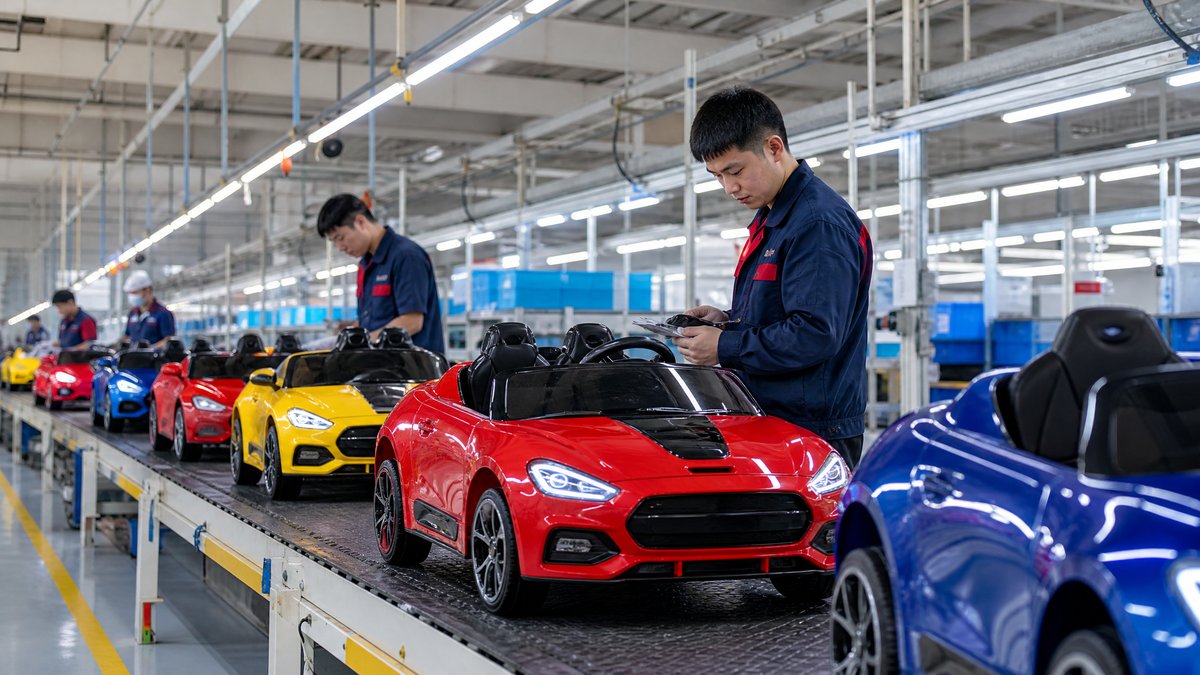
Online retailers should not list a kids electric ride-on car from a sales photo and a model name alone. Before a listing goes live, they need a model-specific, destination-market-ready data pack: dimensions and packed dimensions, product and carton weight, intended age and load guidance, battery and charging instructions, controls, included parts, complete images, warnings, and the supporting documents behind every claim. This protects listing accuracy, helps parents choose appropriately, and gives importers, wholesalers, distributors, and marketplace teams one reliable source of truth.
For a retail-ready product-data pack for a selected KidsRideCar model, email info@kidsridecar.com with the model, sales channel, and destination country.
The first rule: make the selected model the source of truth
A ride-on car category can contain one-seat and two-seat configurations, different battery systems, optional remote controls, and running changes under similar-looking product names. Do not copy a specification from a comparable model, a previous season, or a marketplace competitor.
Build the listing from a signed-off specification sheet and current instruction manual for the exact SKU/variant. Record the model number, colour or trim code, battery configuration, plug type, remote-control version, packaging revision, documentation revision, and the date the information was confirmed. If an option changes a field that a shopper can see or rely on—such as seating, battery, remote control, or included charger—give that option its own SKU-level data.
> Practical standard: a claim belongs in the listing only when it can be traced to the selected model’s approved documentation, packaging artwork, or verified product inspection record.
This is also the right time to confirm what the retailer is actually selling: an assembled vehicle, a partly assembled product, a vehicle with a battery installed, or a separate replacement battery. Specifications, battery transport rules, and market requirements must be verified for the selected model and destination market before publication or shipment.
Core data retailers need before publishing
Dimensions, weight, and delivery data
Physical and logistical facts reduce unsuitable purchases, delivery exceptions, and warehouse confusion. Collect both customer-facing and operations-facing measurements; they answer different questions.
| Data field | What the retailer should publish or retain | Why it matters | Quality check before listing |
|---|---|---|---|
| Assembled dimensions | Length × width × height, with units used consistently in the target market | Helps buyers assess home storage and play-space fit | Confirm whether mirrors, roll bars, or removable parts are included in the measurement |
| Product net weight | Weight of the ride-on car as supplied, clearly labelled as net weight | Useful for handling and customer expectations | Do not substitute gross/carton weight |
| Carton dimensions | Outer length × width × height for the retail carton | Supports fulfilment, carrier setup, FBA-style prep, and receiving | Use the current carton revision, not an estimate |
| Gross weight | Weight of packed retail carton | Needed for freight, warehouse, and delivery operations | Match the factory packing list and carton marking |
| Assembly footprint | Space required during assembly and any storage considerations from the manual | Helps customer-support content | Only state it if the manual or approved assembly guide supports it |
| Parts/package count | Number of cartons and whether the item ships in one or more packages | Prevents “missing parcel” enquiries | Match the order configuration and retailer fulfilment setup |
Use a consistent order for every channel: L × W × H, then name the unit system. Avoid ambiguous entries such as “large size” or “heavy duty.” If the dimensions differ between assembled product and box, label each one prominently.
Age guidance, passenger capacity, and load guidance
Age guidance should be copied from the approved model documentation and packaging, not inferred from the car’s visual size. Present it as an intended-use guide, not as a substitute for adult supervision or a safety assessment of an individual child.
The data pack should distinguish among these fields:
- Recommended or intended age range: the exact wording approved for the model and market.
- Maximum user or total load: clarify whether the figure covers one child, total occupants, or the combined load of occupants and permitted items.
- Passenger/seating capacity: state the intended number of riders; a two-seat appearance alone is not evidence of a two-rider allowance.
- Adult supervision statement: use the model’s approved manual and warning language.
- Usage surface and environment restrictions: only include model-supported instructions, such as use on an appropriate dry, level surface if stated in the manual.
Do not transform a maximum load into a blanket age claim, and do not label a product “suitable for siblings” merely because it has a wide seat. The retail listing, packaging, manual, and customer-service answer should all carry the same approved age, passenger, and load language.
Battery, charging, and transport information
Battery data needs more than a voltage headline. Retailers should obtain the exact battery chemistry, nominal voltage, rated capacity where supplied, whether the battery is removable, charger model and input/output details, charging connector, battery/charger inclusion status, and the approved charging and storage instructions.
For shopper-facing copy, publish only the information supported by the selected model’s documentation. For example, say that a charger is included only when it is included in that SKU; do not promise a “fast charger,” a specific run time, or a recharge time unless the manufacturer has approved that claim for the exact configuration and the intended conditions.
A safe operational data set normally includes:
1. The approved battery and charger identification.
2. Where and how the manual says to charge the product.
3. The instruction to use only the supplied or approved charger and replacement parts where the manual requires it.
4. The approved supervision, ventilation, storage, and “do not use if damaged” language from the manual.
5. A clear escalation path for battery damage, replacement, return, and transport questions.
Battery transport is not a generic checkbox. IATA notes that air carriage of lithium batteries depends on factors including configuration and rechargeable battery Watt-hour rating, and it provides guidance for shippers and others in the supply chain.[1] Verify current transport classification, packaging, marking, documentation, carrier acceptance, and destination-country rules with the applicable carrier, freight forwarder, competent authority, and selected model documentation. Do not use this article as shipping or legal advice.
Controls, functions, and what each one actually does
Parents and customer-service teams need functional clarity, not a dense feature list. Make a short feature matrix for each model.
| Listing field | Detail to verify for the selected model | How to phrase it responsibly |
|---|---|---|
| Drive control | Pedal, start switch, gear selector, steering, forward/reverse operation | Describe the control present; do not imply capability not shown in the manual |
| Parental remote | Whether included, optional, or unavailable; pairing/override behavior; battery requirements if applicable | “Parental remote control included” only for the applicable SKU; refer to manual for operation |
| Speed/drive settings | Number and type of selectable settings, if documented | State approved setting names rather than unverified performance promises |
| Safety-related functions | Any manufacturer-documented start/stop, restraint, or control features | Do not call a feature “safety certified” unless documentation supports the claim for that market |
| Lights, sound, media, ports | Exact fitted features and their operation | List only working, supplied functions for that product revision |
| Assembly | Who assembles it, tools/steps, and what remains to be fitted | Link or attach the approved manual/assembly instructions where the channel allows |
Remote control deserves its own QA check. Confirm whether it is in the retail box, whether it needs separate batteries, whether it is paired before shipment, and whether any function differs by variant. A product photo of a handset is not enough to support an “included parental remote” claim.
Included parts and after-sales essentials
A precise “What’s in the box” block avoids avoidable returns. Create it from the packing list, not from a styled image. It should identify the vehicle body, wheels or removable components, seat or restraint components where applicable, battery status, charger, remote control status, manual, hardware pack, tools, decals, and any accessories. Use included, optional, and not included labels clearly.
For the retail operations record, also collect the spare-parts list, model-specific exploded diagram if available, replacement battery and charger identifiers, warranty process, and customer-service troubleshooting route. These items may live behind the storefront but are especially useful to distributors and marketplace sellers.
Images that answer buying questions
A complete image set should make the product understandable without overstating it. It should show the actual model and current colour/trim, not a composite of several variants. Keep labels, accessories, and optional items visible enough to avoid misinterpretation.
| Suggested asset | Suggested dimensions | Placement | English caption | Alt text | English AI prompt |
|---|---|---|---|---|---|
| Clean hero image | 1600 × 1600 px | Main product image | “Kids electric ride-on car shown in [approved colour], selected model configuration.” | “Front three-quarter view of [model] kids electric ride-on car in [approved colour]” | “Photorealistic e-commerce product image of the exact approved kids electric ride-on car model, front three-quarter view, plain light neutral background, no child, no logos or accessories beyond the approved configuration, accurate proportions and trim, soft shadow, square composition.” |
| Size and carton diagram | 1600 × 1200 px | Dimensions/Delivery section | “Assembled and carton dimensions for the selected model; verify units before publishing.” | “Dimension diagram showing assembled ride-on car and retail carton measurements” | “Clean technical e-commerce infographic of the exact approved kids electric ride-on car and its retail carton, side-view line art, clear length width height arrows, blank editable callout fields, white background, no invented numbers, professional retail catalog style.” |
| Controls close-up | 1600 × 1200 px | Controls and charging section | “Controls and connection points shown for the selected model.” | “Close-up of the approved ride-on car dashboard controls and charging connection” | “Photorealistic close-up of the exact approved kids electric ride-on car dashboard and charging connection, show only confirmed buttons, switches and ports, studio lighting, no unverified labels, neutral background, product-manual clarity.” |
| In-box / parts flat lay | 1600 × 1200 px | What’s-in-the-box section | “Included components for the selected SKU; contents may vary by configuration.” | “Flat lay of the verified ride-on car components, charger, manual and hardware pack” | “Organized top-down flat lay of the exact verified components supplied with an approved kids electric ride-on car SKU: vehicle parts, approved charger, printed manual, hardware pack, and only included accessories, plain background, clear separation, no extra items.” |
Use real approved photography wherever possible. AI-generated images are best treated as planning or layout assets until a product owner verifies that every visible feature, accessory, colour, and label matches the selected SKU. Do not use an AI prompt to create a claim that has not been verified.
Warnings, documentation, and destination-market review
Warnings should be complete, readable, and consistent across the product page, marketplace attributes, carton, manual, and customer-service macros. Never shorten or rewrite an approved warning in a way that changes meaning. Keep warning content separate from promotional claims so the shopper can find it easily.
For US-oriented listings, CPSC business guidance says battery-operated toys have requirements that depend on the specific battery, including provisions related to preventing child access to the battery during play, labelling, overheating, and supplied chargers; it also identifies instruction-literature and producer-marking considerations for certain toys, including battery-operated and certain ride-on toys.[2] That guidance is not a substitute for a model-and-market compliance review.
For EU sales, the European Commission explains that toy safety requirements address general and particular risks, and that toys marketed in the EU must comply with applicable EU legislation; its page also notes the transition from the Toy Safety Directive framework to Regulation (EU) 2025/2509, which begins applying after its stated transition period.[3] Importers and distributors should verify the requirements that apply when and where the product is placed on the market, including the required warnings, technical documentation, language, responsible economic operator information, and any product-specific obligations.
Before launch, have the responsible compliance owner review:
- Exact model and variant against the applicable test reports, declarations, certificates, markings, and approved labels.
- Destination-market age grading, warning text, language, and required product/producer or importer information.
- The relationship between listing copy and the approved manual, carton artwork, and product marking.
- Battery and charger documentation, plus the chosen transport mode and carrier rules.
- Any marketplace-specific attributes, restricted-products workflow, image rules, and document requests.
Do not claim a certification, regulatory status, test result, or market acceptance in the listing unless it is current, applicable to the selected model/configuration and destination market, and backed by the relevant documentation. When in doubt, pause the claim and obtain a written confirmation from the responsible supplier or compliance adviser.
One master record keeps every listing consistent
The biggest listing problem is usually not missing data; it is conflicting data. A product page may say one age range, a marketplace template another, and the manual something else. Prevent this by maintaining a version-controlled product information management (PIM) record or master spreadsheet at SKU level.
Minimum fields to lock before syndication:
- SKU, model, revision date, destination market, and owner of the record.
- Approved product title, short description, dimensions, weights, age/load/passenger language, and included-parts list.
- Battery, charger, controls, assembly, warnings, documents, and image-asset IDs.
- Claim source for every regulated, performance, or compatibility statement.
- Channel-specific fields and a log of where the listing has been updated.
Use the same canonical values in the direct store, distributor feed, B2B catalogue, marketplace templates, warehouse system, and customer-service knowledge base. If a model change affects the carton, supplied charger, remote, battery, seat configuration, or warning text, flag the affected pages and images before new stock is published.
A pre-launch listing checklist
Before activating a listing, confirm that the following answers are all “yes”:
1. Is this information tied to the exact sellable SKU and current revision?
2. Are assembled dimensions, carton dimensions, net weight, and gross weight separately labelled and unit-checked?
3. Do age, passenger, and load statements match the approved product documentation exactly?
4. Does the battery/charger copy state only verified information and direct shoppers to the manual where appropriate?
5. Have remote-control status, controls, parts, optional accessories, and assembly requirements been confirmed against the packing list and manual?
6. Do every image, caption, alt text, and graphic show the same product configuration without unverified accessories or claims?
7. Have warnings, documentation, and market-specific requirements been reviewed by the responsible party for the destination market?
8. Have the same approved data and asset versions been sent to every retail channel?
Suggested internal links for a stronger buyer journey
These existing KidsRideCar resources are relevant when a buyer needs more detail around a retail-ready listing workflow:
- [Kids Electric Ride-On Car Packaging Guide: Amazon FBA, Retail & Export Requirements](/blog/kids-electric-ride-on-car-packaging-guide-amazon-fba-retail) — link from the carton-dimensions and fulfilment discussion.
- [Quality Inspection for Kids Electric Ride-On Cars: A Buyer’s Guide to Pre-Shipment Checks in China](/blog/kids-electric-ride-on-car-quality-inspection-guide-china) — link from the model-verification and pre-launch checklist sections.
- [EU Toy Safety Directive & EN 71: What Every Importer of Kids Electric Ride-On Cars Needs to Know](/blog/eu-toy-safety-directive-en71-kids-electric-ride-on-cars-importers-guide) — link from the destination-market documentation section.
- [ASTM F963 Compliance for Kids Electric Ride-On Cars: What US Importers Need to Know](/blog/kids-electric-ride-on-car-astm-f963-compliance-us-market-guide) — link from the US-focused warning and documentation section.
FAQs
What is the minimum information a kids ride-on car listing needs?
At minimum, use model-specific assembled and carton dimensions, net and gross weight, approved age and load guidance, passenger capacity, included parts, battery/charger status, controls, images, assembly information, warnings, and destination-market documentation status. Retain the source document for each material claim.
Should a retailer list the maximum load or the recommended age range?
List both when each is approved for the selected model, and make clear that they answer different questions. Do not derive one from the other. The approved manual and packaging should control the wording.
Can we use one listing for 12V and 24V versions of the same ride-on car?
Only if the channel allows clear variant-level data and every affected field is correctly mapped. Battery configuration can affect supplied parts, charging details, images, transport handling, and product claims. If those facts cannot be presented unambiguously, use separate SKU-level listings.
Is a photo of the remote enough to say that a parental remote is included?
No. Confirm that the remote belongs to the selected SKU, is in the current retail box, and is not optional. Also verify any separate remote batteries and the approved operating instructions.
What battery information should a retailer share with shoppers?
Share only the battery and charging information approved for that model: the supplied battery/charger status, supported charging instructions, and relevant manual guidance. Verify transport and market requirements separately for the exact battery configuration and destination market.
How often should product data be reviewed?
Review it at least whenever a product revision, supplier change, packaging change, destination-market expansion, or channel requirement changes. A formal pre-launch review is especially important when new inventory has a new battery, remote, charger, or carton revision.
Conclusion: accurate data is a retail asset
A strong kids electric ride-on car listing does not need exaggerated performance language. It needs complete, model-specific facts presented consistently: fit and delivery measurements, age and load guidance, charging and controls, box contents, honest images, accessible warnings, and a documented compliance review for the target market. That combination helps importers, wholesalers, distributors, and retailers publish faster while giving families clearer purchasing information.
Need a structured product-data template, current documents, or a catalogue review for a selected model? Contact the KidsRideCar team at info@kidsridecar.com to discuss your sales channel and destination market.
References
[1]: https://www.iata.org/en/programs/cargo/dangerous-goods/lithium-batteries/ "International Air Transport Association (IATA) — Batteries"
[2]: https://www.cpsc.gov/Business--Manufacturing/Business-Education/Toy-Safety "U.S. Consumer Product Safety Commission — Toy Safety Business Guidance"
[3]: https://single-market-economy.ec.europa.eu/sectors/toys/toy-safety_en "European Commission — Toy Safety in the EU"
Official references
Explore these external resources for current regulatory and trade guidance. Confirm requirements with the relevant authority before placing an order.
Ready to Start?
Factory-Direct · CE & ASTM Certified · MOQ from 50 Units
Our export team works with buyers in 60+ countries. Get a quote within 24 hours.
KR
Written by KidsRideCar
China's leading kids electric ride-on car manufacturer. 500,000+ units shipped annually to 60+ countries. CE, ASTM & EN71 certified.