Introduction
Private label branding — selling products under your own brand name rather than the factory's — is one of the most effective ways to build long-term value in the kids electric ride-on car business. A private label product commands higher margins, builds customer loyalty, and creates a defensible market position that generic reselling cannot.
But private label also requires more planning, longer lead times, and closer collaboration with your factory. This guide covers the complete process, from brand registration through to shelf-ready product.
What Private Label Means in Practice
Private label for kids electric ride-on cars typically involves:
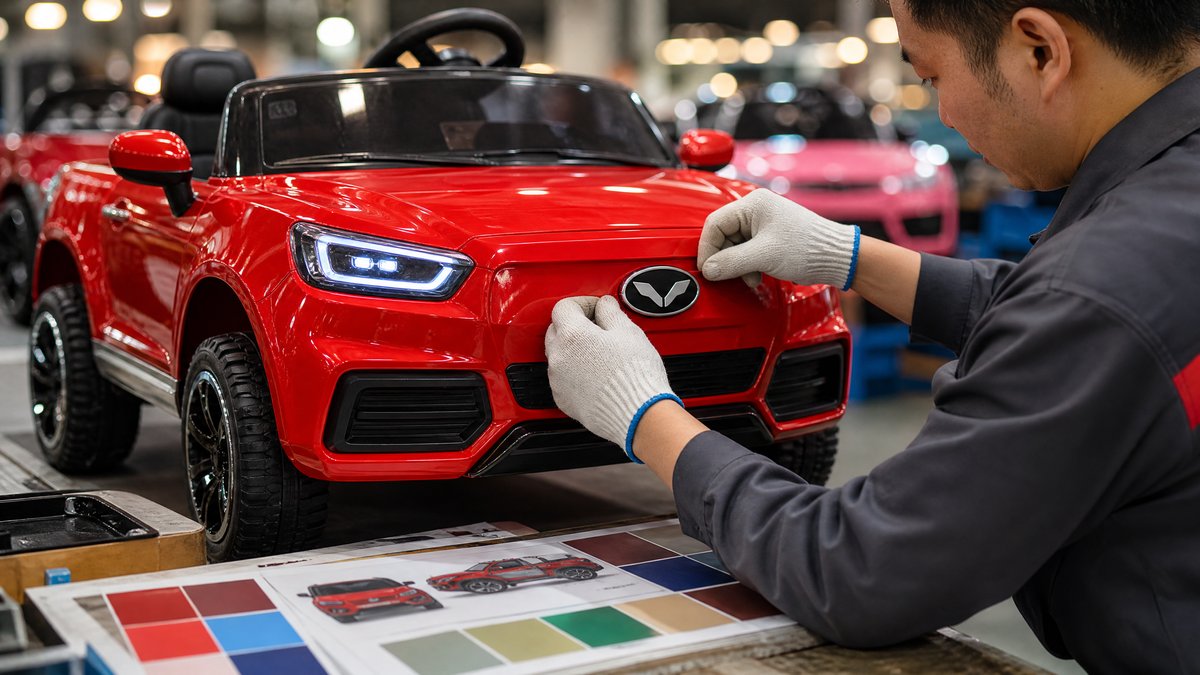
- Your brand name and logo on the vehicle body (embossed, decal, or painted)
- Custom packaging with your brand identity
- Custom color options (if MOQ allows)
- Exclusive model variants (if you are commissioning new tooling)
- Your contact information on compliance labels and documentation
The underlying product is manufactured by the factory using their existing tooling and components. You are not designing a new vehicle from scratch — you are applying your brand identity to an existing platform.
Step 1: Register Your Brand Before Production
Before briefing a factory on private label production, register your brand in your target markets. This is important for two reasons:
Legal protection. A registered trademark gives you the right to prevent others from using your brand name or logo on similar products. Without registration, a competitor (or even your factory) could use your brand name without recourse.
Amazon Brand Registry. If you are selling on Amazon, Brand Registry requires a registered trademark. Without it, you cannot access Brand Registry's anti-counterfeiting tools or A+ content.
Trademark registration timelines vary by country: 8–12 months in the US (USPTO), 4–6 months in the EU (EUIPO), and 12–18 months in China (CNIPA). Start the process early.
Step 2: Develop Your Brand Identity
Before approaching a factory, have your brand identity ready:
- Logo files: Vector format (AI or EPS), in both full-color and single-color versions
- Brand colors: Pantone references for consistent color matching across production runs
- Typography: Font files or font names for any text elements
- Usage guidelines: Clear rules for how the logo can and cannot be used
Factories work with what you give them. Vague briefs produce inconsistent results. A clear brand identity brief reduces back-and-forth and speeds up the approval process.
Step 3: Brief Your Factory
A private label factory brief should include:
Product specifications
- Model(s) to be branded
- Color(s) required (RAL or Pantone references)
- Logo placement: position, size, and application method (decal, embossing, paint)
- Any custom features (different seat color, different wheel style)
Packaging specifications
- Box dimensions and structure (window box, closed box, display box)
- Print specifications (CMYK, finish, coating)
- Artwork files (print-ready PDF with bleed and safe zone)
- Regulatory text requirements (destination market)
- Barcode requirements (UPC, EAN, FNSKU)
Documentation requirements
- CE/ASTM compliance documentation in your brand name
- Declaration of Conformity with your company details
- Instruction manual in required languages
Step 4: Sample Approval Process
The sample approval process for private label typically involves two stages:
Pre-production sample (PPS): A sample produced before mass production begins, incorporating your brand identity. Review for: logo placement and quality, color accuracy, packaging structure and print quality, regulatory label placement. Approve in writing before mass production begins.
Production sample (PS): A sample pulled from the production line during mass production. Confirms that the approved PPS quality is being maintained at scale.
Budget 3–4 weeks for the PPS stage, including shipping time for the sample to reach you and return feedback to the factory.
Timeline Planning
A realistic timeline for a first private label order:
| Stage | Duration |
|---|---|
| Brand registration (parallel) | 4–18 months |
| Factory selection and negotiation | 2–4 weeks |
| Artwork development and factory brief | 1–2 weeks |
| Pre-production sample | 2–3 weeks |
| Sample review and approval | 1–2 weeks |
| Mass production | 3–6 weeks |
| Pre-shipment inspection | 1–2 days |
| Ocean freight (China to US/EU) | 3–5 weeks |
| Total (from brief to arrival) | 12–20 weeks |
Plan your inventory accordingly. Private label products require longer lead times than off-the-shelf orders.
FAQ
What is the minimum order for private label?
Most factories require a higher MOQ for private label than for standard models, because custom packaging requires minimum print runs. Typical private label MOQ: 100–200 units per model. Some factories will accommodate lower quantities at a price premium.
Can I use the same factory for multiple brands?
Yes, but be aware that factories often supply multiple buyers. If brand exclusivity is important to you, negotiate an exclusivity clause for your specific model or color combination — not for the factory's entire product range.
Do I need to redesign the product, or just the branding?
For most private label arrangements, you are applying your brand to an existing product platform. Full product redesign (new tooling, new features) is OEM development, which requires significantly higher investment and longer timelines.
Conclusion
Private label branding transforms a commodity product into a brand asset. The investment in brand registration, identity development, and factory briefing pays dividends in margin, customer loyalty, and long-term business value.
The key is preparation: have your brand identity ready, your factory brief clear, and your timeline realistic before production begins.
*Ready to build your private label brand? Contact us to discuss OEM and branding options.*
Official references
Explore these external resources for current regulatory and trade guidance. Confirm requirements with the relevant authority before placing an order.
Ready to Start?
Factory-Direct · CE & ASTM Certified · MOQ from 50 Units
Our export team works with buyers in 60+ countries. Get a quote within 24 hours.
KR
Written by KidsRideCar
China's leading kids electric ride-on car manufacturer. 500,000+ units shipped annually to 60+ countries. CE, ASTM & EN71 certified.
