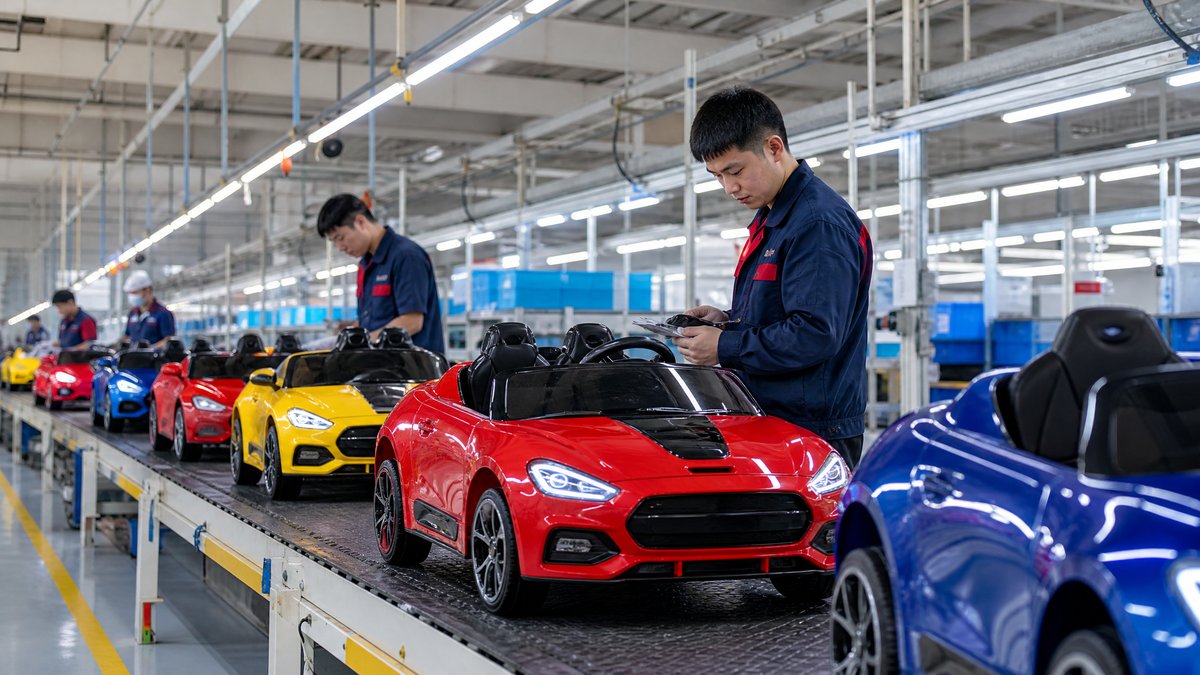
A product safety file gives a retailer, importer, wholesaler, distributor, or OEM buyer one controlled place to show how a kids ride-on car was specified, assessed, tested, labelled, and prepared for sale. It is more useful than a loose folder of certificates: the records should identify the exact model, version, market, responsible parties, and evidence supporting each safety claim.
The file also makes routine work easier. Buying teams can compare suppliers, compliance teams can review a new SKU, customer-service staff can answer questions from approved information, and the business can investigate a complaint or product change without relying on memory. Market compliance must be confirmed for the destination market and model, including any requirements that apply to batteries, chargers, radio equipment, packaging, language, age grading, and toys.
1. Start with a controlled product identity record
Open the file with a product identity sheet that prevents evidence from being attached to the wrong item. Include the model name and SKU, internal item number, product photographs, revision or version number, intended age range, dimensions, approximate net weight, maximum user/load information supplied by the manufacturer, seat configuration, power system description, charger identification, remote-control identification, and packaging version.
Record the legal entities and contacts involved: manufacturer, brand owner, importer of record, distributor, and the person or team responsible for the file. Note the production site and the date the model was approved. If the ride-on car is private label, keep the approved artwork, brand marks, carton code, manual version, and model reference together with the underlying factory model.
A change log is essential. Track changes to the body, wiring harness, motors, battery pack, charger, controller, remote, wheels, plastics, labels, packaging, instructions, and software or radio functions where applicable. Require documented review before a revised sample is released to production.
For examples of how different product configurations may be organized, a retailer can link internally to [KidsRideCar product pages](/products/kr-s900), [/products/kr-l700](/products/kr-l700), or [/products/kr-t600](/products/kr-t600), while keeping the safety evidence specific to each SKU.
2. Add the design, materials, and risk-assessment evidence
The technical core should explain what the product is made to do and what reasonably foreseeable misuse has been considered. Include an approved specification or drawing set, parts list, key material information, electrical block diagram where available, charger and battery specifications, and photographs of safety-relevant construction. Useful records may cover sharp edges and points, small detachable parts, pinch and entrapment areas, stability, access to moving parts, seat and restraint features, wheel and axle security, thermal hazards, electrical hazards, and packaging-related risks.
Maintain a written risk assessment that connects each hazard to a control and an item of evidence. For example, a risk entry might identify unintended movement and point to the control arrangement, instructions, supervision warning, and relevant test record. Another might identify charging misuse and point to the specified charger, battery instructions, warnings, and inspection controls. Do not mark a hazard “passed” without stating the acceptance basis and the document that supports it.
Include material declarations and supplier statements, but treat them as supporting evidence rather than an automatic replacement for required testing. Ask suppliers to identify material or component substitutions before shipment. If a model uses decorative coatings, adhesives, soft components, cables, or plastics that could affect market requirements, retain the corresponding declarations, bills of materials, or laboratory evidence.
3. Keep complete, model-specific test and inspection records
A safety file should contain reports that identify the tested sample and its relationship to the production model. Ask for the laboratory name, report number, issue date, sample description, photographs or sample identifiers, test methods or standards used, results, deviations, and any corrective-action closure. A report for a visually similar model is not automatically evidence for the SKU being sold.
Depending on the destination market and product design, the evidence package may address mechanical and physical safety, flammability or material requirements, electrical safety, battery and charger behavior, markings, instructions, packaging, and radio functions. The applicable scope must be confirmed for the destination market and model; do not assume that a CE mark, a general “certificate,” or one familiar toy standard covers every obligation.
Add incoming inspection criteria, production inspection records, and pre-shipment inspection results. Define what must be checked on a sample: correct model and color, wheels and fasteners, seat or belt components, remote pairing documentation, charger label, battery connector condition, carton markings, warning labels, and manual version. Inspection records should show sampling basis, findings, photographs when defects matter, disposition, and sign-off.
If a report contains a nonconformity, retain the corrective-action record and evidence of re-test or verification. Never edit a laboratory report to make it appear compliant. Instead, link the original finding to the approved correction and identify the lot or production period affected.
4. Document labels, manuals, warnings, and retail claims
Include the final, market-specific artwork for the product label, carton, rating label, warnings, age grading, importer details, traceability code, and disposal or battery notices where required. Keep translations and approval dates. A label file should show where each marking appears on the actual product or packaging, not only as an isolated graphic.
The user manual should be the exact version shipped with the model. File the assembly instructions, operating limits, supervision guidance, charging and storage information, maintenance boundaries, fault and stop guidance, disposal information, spare-parts cautions, and contact details. Instructions should tell users not to modify the electrical system or use an unapproved charger. Retail teams should not publish advice that encourages battery rewiring, bypassing protective devices, soldering packs, or internal repair by an unqualified person.
Create a claims matrix for product listings, packaging, sales sheets, and retailer training. For every claim—such as age range, number of seats, remote-control function, outdoor suitability, battery type, or accessory inclusion—record the source and any qualification. Avoid unsupported runtime, speed, load, waterproofing, or safety claims. If a statement depends on supervision, surface, temperature, configuration, or local rules, make the limitation visible.
A central [KidsRideCar blog](/blog) link can help teams find general buyer education, but product-specific claims should always be checked against the approved file for the SKU.
5. Include battery, charger, packaging, and logistics documentation
Battery records deserve their own subsection because they affect product safety, shipping, service, and returns. Include battery chemistry and rated information supplied for the model, pack or battery identification, charger model and input/output information, approved compatibility, charging instructions, storage guidance, transport information requested by the carrier, and relevant test or declaration documents. Keep records for both the battery and charger actually supplied, not merely an earlier sample.
For lithium batteries or other regulated configurations, confirm the destination and transport requirements with the responsible compliance specialist, carrier, and regulations. Do not infer transport eligibility from a product brochure. Retain packaging specifications, inner protection details, carton markings, pallet or loading instructions, and any drop, compression, or handling evidence required by the sales channel.
Record lot or batch identifiers where available, shipment dates, quantities, destination, and supplier production records. A traceability system should allow the retailer to move from a customer complaint to a sale period, shipment, supplier lot, component revision, and corrective action.
6. Set review, retention, and recall controls
A safety file is a living controlled record. Assign an owner and define when it must be reviewed: before first listing, after a design or component change, after a new destination market is added, after a serious complaint, after a failed inspection, and at a scheduled interval. Use document IDs, revision dates, approval status, and access controls so staff do not use obsolete manuals or artwork.
Set a retention period appropriate to the destination market, product lifecycle, warranty exposure, and company policy, then verify it with qualified local compliance advice. Keep supplier correspondence that resolves ambiguities, not only formal reports. Store the original files in a secure location with a backup and make a readable review copy available to the relevant buyer, compliance, quality, and customer-service teams.
Prepare a contact tree and response procedure for a serious incident, regulator request, suspected nonconformity, or recall. The process should identify who can stop listings and shipments, quarantine stock, contact the supplier, assess affected models or lots, communicate with channel partners, and document the decision.
FAQ: Kids Ride-On Car Product Safety Files
Is a safety file the same as a certificate?
No. A certificate or test report is one piece of evidence. A safety file normally connects the exact product identity, risk assessment, testing, labels, manuals, supplier records, traceability, and change history. The required records vary by destination market and model.
Should retailers keep one file for all ride-on car models?
Use a controlled master system if convenient, but each SKU or materially different configuration needs clearly separated evidence. Different batteries, chargers, motors, seats, radio functions, labels, or age grades may require a separate review and updated documents.
Can a supplier’s generic test report be used for a private-label product?
Only after the retailer verifies that the report covers the same construction and configuration, identifies the relevant manufacturer and sample, and is acceptable for the destination market. Private-label artwork does not by itself make an unrelated report applicable.
How should battery documents be handled?
Keep the battery and charger identification, compatibility information, instructions, transport documents, and applicable test or declaration records with the model file. Confirm destination and carrier requirements; never substitute a different battery or charger without a documented review.
What should happen when a model changes after approval?
Stop and assess the change before mass production or listing. Update the product identity, risk assessment, affected tests, labels, manual, claims matrix, and traceability records as needed. Retain the previous revision and record the approval decision rather than silently replacing it.
Conclusion
A well-managed kids ride-on car product safety file is a buying and retail-control tool. It should let a reviewer identify the exact model, understand the hazards and controls, locate credible test evidence, verify market-specific labels and instructions, confirm battery and charger compatibility, and trace changes or affected stock. Build the file before launch, keep it tied to production, and confirm market compliance for the destination market and model instead of relying on generic certificates or marketing claims.
For model-specific documentation, OEM support, and a structured review of your retail requirements, contact KidsRideCar at info@kidsridecar.com or use the [buyer inquiry page](/inquiry).
Official references
Explore these external resources for current regulatory and trade guidance. Confirm requirements with the relevant authority before placing an order.
Ready to Start?
Factory-Direct · CE & ASTM Certified · MOQ from 50 Units
Our export team works with buyers in 60+ countries. Get a quote within 24 hours.
KR
Written by KidsRideCar
China's leading kids electric ride-on car manufacturer. 500,000+ units shipped annually to 60+ countries. CE, ASTM & EN71 certified.