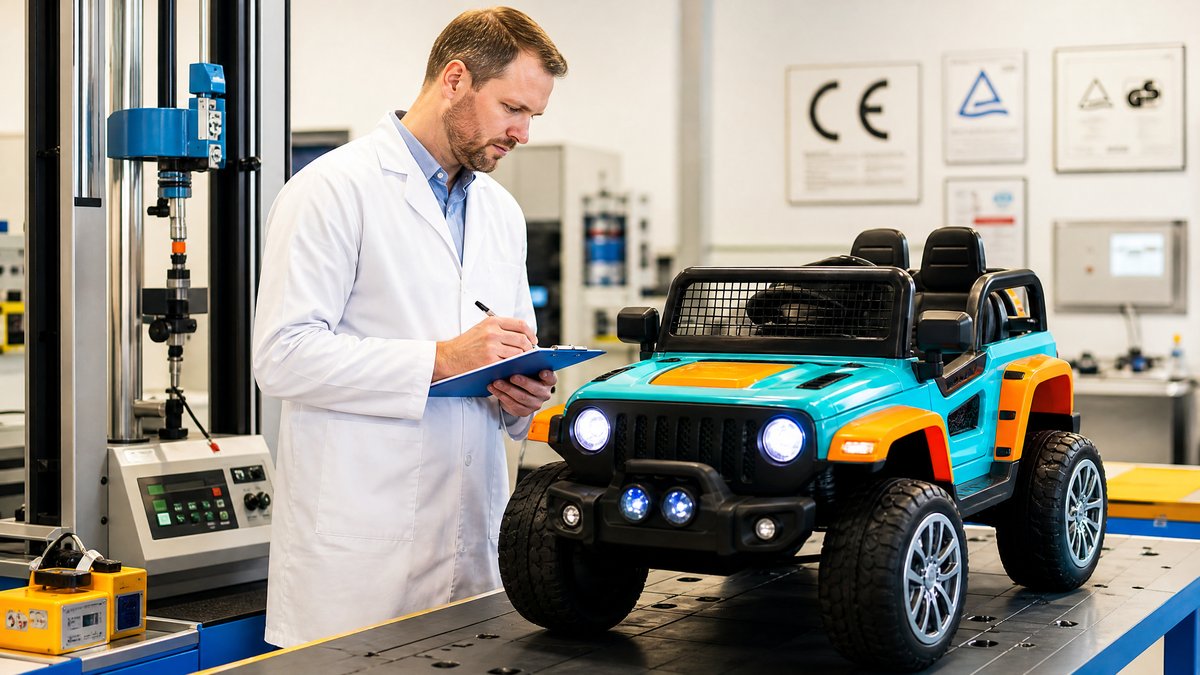
Every kids electric ride-on car sold in the European Union, EEA, or the United Kingdom must carry a CE mark — a declaration that the product meets the essential safety requirements of applicable EU directives. For importers and wholesale buyers, understanding what CE marking actually requires is not optional: customs authorities, market surveillance bodies, and major retail buyers will all ask for documentation. Getting it wrong means product seizures, recalls, and potential personal liability.
This guide explains the CE marking process for kids electric ride-on cars in plain language: which directives apply, what EN71 testing actually tests, how to read a test report, and how to distinguish a genuine certificate from a fraudulent one. It is written for buyers who are placing orders with Chinese manufacturers and need to ensure their products can legally enter European markets.
Why CE Marking Is Non-Negotiable for European Markets
The CE mark is not a quality mark or a seal of approval from a government agency — it is a manufacturer's self-declaration that the product complies with all applicable EU directives. However, for most toy and ride-on vehicle products, this self-declaration must be backed by third-party testing from a Notified Body (an accredited laboratory recognized by the EU). Without valid CE documentation, your products cannot legally be placed on the EU market, and any importer who brings non-compliant products into the EU becomes legally responsible for the compliance failure.
Market surveillance authorities in Germany, France, the Netherlands, and Scandinavia are particularly active in testing toys and ride-on vehicles. Products found non-compliant are subject to mandatory recall, destruction, and fines. In 2024 and 2025, several batches of kids electric ride-on cars were recalled across Europe due to excessive chemical migration (EN71-3 failures) and inadequate battery protection circuits. These recalls cost importers tens of thousands of euros in logistics, disposal, and reputational damage.
Which EU Directives Apply to Kids Electric Ride-On Cars?
Kids electric ride-on cars are subject to multiple EU directives simultaneously. Understanding which directives apply — and ensuring your supplier's CE documentation covers all of them — is the first step in compliance verification.
| EU Directive | Scope for Ride-On Cars | Key Requirements |
|---|---|---|
| Toy Safety Directive 2009/48/EC | Products designed for children under 14 years | EN71 testing, chemical limits, mechanical safety, electrical safety |
| Low Voltage Directive 2014/35/EU | Electrical equipment operating at 12V-24V DC | Electrical insulation, overload protection, battery management |
| EMC Directive 2014/30/EU | Electronic components (remote control, Bluetooth) | Electromagnetic compatibility, radio interference limits |
| RoHS Directive 2011/65/EU | Electrical and electronic equipment | Restriction of hazardous substances (lead, mercury, cadmium, etc.) |
| REACH Regulation (EC) 1907/2006 | Chemical substances in materials | SVHCs below 0.1% threshold, phthalate limits in plastics |
Most Chinese manufacturers produce a single CE Declaration of Conformity (DoC) that references all applicable directives. When reviewing supplier documentation, verify that the DoC explicitly lists each directive — a DoC that only references the Toy Safety Directive is incomplete for a product with a remote control or Bluetooth connectivity.
EN71: What the Standard Actually Tests
EN71 is the European harmonized standard for toy safety. It consists of multiple parts, each addressing a different safety aspect. For kids electric ride-on cars, the most relevant parts are EN71-1, EN71-2, EN71-3, and EN71-9.
EN71-1: Mechanical and Physical Properties
EN71-1 tests the physical safety of the toy — whether it can cause injury through sharp edges, pinch points, entrapment hazards, or structural failure. For ride-on cars, the key tests include: static load testing (the seat and frame must support 1.5x the maximum rated load without permanent deformation), dynamic stability testing (the vehicle must not tip over on a 10 degree incline when loaded), sharp edge and point testing (no accessible sharp edges after normal use and foreseeable abuse), and small parts testing for any components that could detach and pose a choking hazard.
EN71-1 failures in ride-on cars most commonly occur in the seat mounting (insufficient bolt torque specification), footrest design (sharp edges under the plastic trim), and wheel retention (wheels that can be pulled off with excessive force). When reviewing a test report, check that all applicable sub-tests are listed with pass results — a report that omits certain sub-tests may indicate incomplete testing.
EN71-2: Flammability
EN71-2 tests the flammability of materials used in the toy. For ride-on cars, this primarily applies to the seat upholstery, carpet-style floor inserts, and any fabric elements. The test exposes materials to a standardized flame and measures burn rate. Most ABS plastic bodies pass EN71-2 without difficulty; the common failure point is seat cushion foam or fabric covers that use non-flame-retardant materials. Ensure your supplier specifies that seat materials are EN71-2 compliant — this is sometimes overlooked in budget-tier products.
EN71-3: Migration of Certain Elements
EN71-3 tests for the migration of 19 chemical elements from toy materials, including lead, cadmium, antimony, arsenic, barium, chromium, mercury, selenium, and strontium. The test simulates the amount of these elements that could be ingested by a child chewing or sucking on the toy material. For ride-on cars, the tested materials include painted surfaces, plastic components accessible to children, and any soft materials.
EN71-3 failures are the most common compliance issue in Chinese-manufactured toys. The most frequent failure is excessive lead in paint — a problem that has been largely eliminated by reputable manufacturers but still occurs in lower-tier production. When sourcing ride-on cars, request EN71-3 test reports that are less than 12 months old and verify that the tested samples match the current production specification (paint color and supplier should be documented in the report).
EN71-9: Organic Chemical Compounds
EN71-9 addresses organic chemical compounds in toy materials, with particular focus on phthalates in PVC components. Phthalates are plasticizers used to make PVC flexible; several phthalate compounds (DEHP, DBP, BBP, DIBP) are restricted in toys to a maximum of 0.1% by weight. For ride-on cars, the most common PVC components are steering wheel covers, seat surfaces, and cable insulation. Request specific EN71-9 test results for these components, not just a general pass statement.
KidsRideCar provides complete CE documentation packages including test reports, Declaration of Conformity, and technical files for all products. Contact us for documentation review.
Request Compliance Package →How to Read and Verify a CE Test Report
A genuine CE test report from an accredited laboratory contains specific information that allows you to verify its authenticity. When reviewing a supplier's test report, check the following elements.
| Report Element | What to Check | Red Flags |
|---|---|---|
| Laboratory accreditation | CNAS, ILAC-MRA, or EU Notified Body number | No accreditation number; unrecognized laboratory name |
| Sample description | Model number, color, batch code matching your order | Generic description; no model number |
| Test date | Within 12 months; matches production period | Undated; more than 2 years old |
| Standard version | EN71:2014+A1:2018 or later | Outdated standard version (pre-2014) |
| Test results | Pass/Fail for each sub-test with measured values | Only summary pass; no measured values |
| Authorized signature | Signed by laboratory engineer with stamp | Unsigned; digital signature only without stamp |
To verify a test report's authenticity, you can contact the issuing laboratory directly with the report number and request confirmation. Major accredited laboratories (SGS, Bureau Veritas, Intertek, TUV, QIMA) maintain report verification systems. For high-value orders, consider commissioning your own independent test on production samples — the cost of $300-$600 per product is negligible compared to the cost of a compliance failure.
The Most Common CE/EN71 Failure Points in Ride-On Cars
Based on market surveillance data and industry experience, the following failure points are most commonly identified in kids electric ride-on car compliance testing. Understanding these failure modes helps buyers ask the right questions when evaluating suppliers.
- Battery management system (BMS) failures: Inadequate overcharge, over-discharge, and short-circuit protection. A compliant BMS must prevent battery temperature from exceeding 70 degrees Celsius during charging.
- Charger voltage mismatch: Chargers supplied with 12V vehicles that output incorrect voltage (16V+) create a fire risk. Always verify charger output voltage specification.
- Pinch points in folding mechanisms: Convertible models with folding roofs or adjustable seats must be tested for finger entrapment.
- Inadequate seat belt retention: Seat belts must withstand a 50N pull force without detaching. Clip-style buckles on budget models frequently fail this test.
- Remote control frequency compliance: Remote controls must comply with EN 300 220 (EU radio equipment regulations).
- Paint lead content on repainted or touched-up units: Factory touch-up paint sometimes uses a different formulation than the tested production paint.
UKCA Marking: Post-Brexit UK Requirements
Since January 1, 2021, products sold in Great Britain (England, Scotland, Wales) require UKCA marking instead of CE marking. Northern Ireland continues to accept CE marking under the Windsor Framework. The UKCA marking requirements are technically equivalent to CE requirements, but the documentation must reference UK-designated standards rather than EU harmonized standards, and the Declaration of Conformity must be issued by a UK Responsible Person (an entity with a registered address in Great Britain).
For importers selling in both EU and UK markets, you need both CE and UKCA documentation. Most Chinese manufacturers can provide both sets of documentation, but you should explicitly request UKCA documentation as a separate deliverable — it is not automatically included with CE documentation. The UK market surveillance authority (OPSS) has been increasingly active in testing imported toys since 2022.
CE Compliance Documentation Checklist for Importers
When placing an order for kids electric ride-on cars intended for European markets, request the following documentation from your supplier before shipment. Keep copies of all documents for a minimum of 10 years (the EU Toy Safety Directive requirement for technical file retention).
- CE Declaration of Conformity (DoC) — must list all applicable directives and standards, be signed and dated
- EN71-1 test report from accredited laboratory — dated within 12 months
- EN71-2 test report from accredited laboratory
- EN71-3 test report from accredited laboratory — verify tested materials match current production
- EN71-9 test report for PVC components
- LVD compliance documentation (for 12V/24V electrical systems)
- EMC test report (if product includes remote control or Bluetooth)
- RoHS compliance statement and REACH SVHC declaration
- User manual in the language(s) of the destination market
- Warning labels in the language(s) of the destination market
Frequently Asked Questions
Can I use a supplier's existing CE certificate for my OEM-branded product?
No. When you apply your own brand to a product, you become the legal manufacturer for CE purposes and must issue your own Declaration of Conformity. You can use the supplier's test reports as the technical basis for your DoC, but the DoC itself must be issued under your company name and signed by an authorized representative. This is a common compliance gap for first-time OEM buyers.
How often do CE test reports need to be renewed?
There is no fixed renewal period in EU law, but test reports should be renewed whenever the product specification changes (new materials, new components, new paint formulation), when the applicable standard is revised, or when the report is more than 2-3 years old. Market surveillance authorities and major retail buyers typically expect test reports dated within 12-24 months. For products with ongoing production, annual re-testing is considered best practice.
What is the difference between a self-declaration CE and a Notified Body CE?
For most toy products, the Toy Safety Directive requires involvement of a Notified Body for the conformity assessment — pure self-declaration is not sufficient. The manufacturer must have the product tested by an accredited Notified Body laboratory, and the test reports form the technical basis for the CE Declaration of Conformity. A self-declaration CE without Notified Body test reports is non-compliant for toys and ride-on vehicles.
CE and EN71 compliance is not a bureaucratic formality — it is the foundation of a sustainable import business in European markets. Buyers who invest in proper compliance documentation from the start avoid the costly disruptions of market surveillance actions, retail buyer audits, and consumer recalls. The cost of compliance — typically $300-$800 in testing fees per product model — is a small fraction of the cost of a single compliance failure.
Official references
Explore these external resources for current regulatory and trade guidance. Confirm requirements with the relevant authority before placing an order.
Ready to Start?
Factory-Direct · CE & ASTM Certified · MOQ from 50 Units
Our export team works with buyers in 60+ countries. Get a quote within 24 hours.
China's leading kids electric ride-on car manufacturer. 500,000+ units shipped annually to 60+ countries. CE, ASTM & EN71 certified.