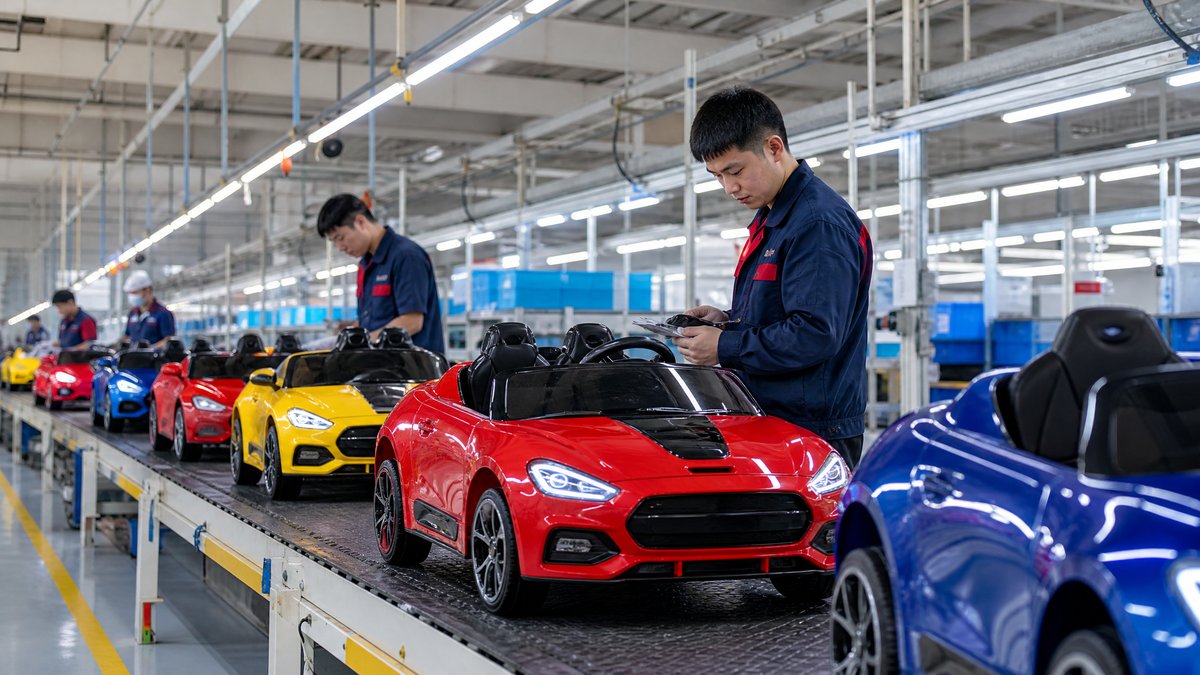
A kids ride-on car can remain in a customer’s home long after its retail listing has been replaced. That gap creates a practical B2B issue: a model may be commercially discontinued while owners still need chargers, wheels, switches, remote controls, batteries, or safe service guidance. For B2B buyers, end-of-life support is part of product selection—not an issue for complaints.
The right discussion is not simply “How long will you sell this model?” Buyers should ask how a supplier manages model changes, identifies compatible components, communicates discontinuation, and supports responsible transition to a successor. A written plan can reduce returns and help a retailer decide when to reorder or retire a SKU. These questions provide a framework. Market compliance must always be confirmed for the destination market and the specific model.
1. Ask for a clear product-lifecycle definition
Start by asking the supplier to define the stages of the model’s lifecycle. Useful terms may include launch, active production, final order opportunity, production stop, service-support period, and fully retired status. Use terms with a shared meaning in the purchase order or supplier agreement.
Ask these questions:
- Is this model in active production, being refreshed, or approaching a planned phase-out?
- What event triggers an end-of-life notice: tooling changes, component availability, low demand, or a successor model?
- How much advance notice will the supplier provide before the last production run or last order date?
- Will the same SKU, color, packaging, and specification remain available during the transition?
- Who is the named contact responsible for lifecycle notices?
Do not treat a verbal statement such as “the model will be available for a long time” as a supply commitment. Request the current status in writing and record the date, model code, revision, and major configuration. If a product is sold under private label, also confirm whether the factory’s internal model number differs from the retail SKU. That cross-reference is essential when asking about old inventory or replacement parts later.
A lifecycle review should include a comparison with current options in the [KidsRideCar product catalog](/products/kr-s900). It helps buyers see whether a successor changes voltage, controller, charger, dimensions, or instructions.
2. Ask which parts will remain available—and for how long
“Spare parts available” is too broad to be useful. Ask for a component-level support list linked to each model revision. The list should separate high-wear items, electrical service items, cosmetic items, and safety-relevant or model-specific parts.
Typical questions include:
- Which components are expected to be stocked after production ends?
- Are tires, wheels, drive motors, gearboxes, switches, pedals, seat belts, body panels, remote controls, chargers, wiring harnesses, and batteries treated differently?
- Are parts original, approved equivalent, or compatible alternatives?
- Are parts shared with another model, and if so, what fitment conditions apply?
- How are superseded part numbers recorded?
- Can the supplier provide a parts diagram, exploded view, or illustrated replacement-parts list?
Compatibility should never be assumed from appearance. A charger or battery with a similar connector may have different electrical characteristics or be unsuitable for the model. Retail teams should not advise customers to modify wiring, bypass protection, solder battery packs, or substitute unverified components. Instead, route technical questions to the supplier or a qualified service professional using the model and revision information.
For an assortment review, compare the parts profile of established models such as [KR-L700](/products/kr-l700) with newer candidates. The purpose is to identify commonality that can simplify training and inventory—not to assume that parts interchange without written confirmation.
3. Ask how parts continuity is planned and documented
Availability is only useful when the supply chain can identify, order, receive, and verify the correct part. Ask whether the supplier maintains a model-to-part-number matrix and whether that matrix is updated when a controller, motor, connector, or cosmetic component changes.
A useful continuity discussion covers:
- Minimum or recommended quantities for service parts after model retirement.
- Whether parts can be ordered separately or only with complete assemblies.
- How the supplier handles low-volume requests for older models.
- Whether the buyer receives a current price list and revision date.
- How packaging labels identify part number, model, revision, and quantity.
- What information must accompany a parts request, such as photos, serial numbers, fault descriptions, or purchase records.
- Whether the buyer can purchase a final service-parts package with the last production order.
Retail buyers should distinguish a supplier’s stock on hand from a replenishment plan. Ask where parts are held, whether inventory is dedicated or shared, and how the supplier communicates allocation when demand exceeds available stock. Avoid requesting unsupported promises about fixed delivery times. A better record states the ordering process, normal review cadence, escalation contact, and what happens when a requested part is unavailable.
A parts continuity worksheet can be attached to the SKU file. Include the model code, revision, component name, part number, approved substitute status, last verification date, and documentation location. This record is more reliable than memory when a model has changed.
4. Ask about warranty, service, and customer-care boundaries
End-of-life support should connect to the retailer’s warranty and after-sales workflow. Ask which issues the supplier investigates, which components are covered under the agreed warranty, and what evidence is required for a claim. Use [after-sales resources](/blog) for training, but follow the supplier’s current written terms.
Clarify:
- How a retailer opens a claim for an obsolete or near-obsolete model.
- Whether the supplier can provide troubleshooting documents, assembly diagrams, or replacement instructions.
- Which repairs must be performed by an authorized or qualified technician.
- How safety-related complaints, repeated failures, or suspected defects are escalated.
- Whether a replacement unit, part, refund, or other remedy is considered when a component is no longer available.
- How complaints and corrective actions are documented across model revisions.
Keep customer-facing language factual. Do not promise that every part will always be available, that every repair is economical, or that an old model can be upgraded to a newer specification. A responsible retailer can explain the current support status, collect the model details, and offer the supplier-approved next step.
Also ask whether manuals, labels, warnings, and charging instructions remain available for the end-of-life model. If a component change affects instructions or market compliance documentation, the buyer needs the updated version before selling replacement inventory. Compliance requirements vary by destination and model; confirm the applicable rules and records with the responsible supplier and local compliance advisers.
5. Ask how the supplier manages a successor model
A successor is not automatically a drop-in replacement. Before presenting it as an alternative, ask for a side-by-side change summary. This should cover model identity, dimensions, seating configuration, voltage and battery system, charger, controller, remote, motor arrangement, wheel or tire specification, packaging, age grading, instructions, and destination-market compliance documentation.
Useful questions include:
- Which parts, if any, are shared with the retired model?
- Will the new model require different customer service training or assembly steps?
- Can existing cartons, manuals, photos, videos, or listings still be used?
- What changes must be disclosed in a replacement recommendation?
- Is a new sample approval required before the successor is added to the assortment?
Use a model such as [KR-T600](/products/kr-t600) as a reference point for a structured comparison, not as proof that it replaces another SKU. After approval, update product data, images, packaging copy, parts lists, and service scripts. Keeping old and new model codes visible in the internal record prevents an order picker or support agent from sending the wrong component.
6. Put end-of-life expectations into buying and inventory decisions
Lifecycle support should influence the commercial plan. Before placing a final order, estimate how many units may remain in the channel, the likely warranty exposure, expected replacement-part demand, and the cost of holding slow-moving components. Avoid buying an excessive quantity of a discontinued model merely because its unit price is attractive.
Ask the supplier to help identify a practical last-order checklist:
1. Confirm the last order date, final production revision, and remaining component availability.
2. Reconcile open purchase orders, samples, spare parts, packaging, and private-label materials.
3. Decide whether to buy a proportionate service-parts package with the final units.
4. Archive compliance, test, instruction, artwork, and product-data records for the exact revision.
5. Set a customer communication plan for the retail listing, warranty desk, and dealer network.
6. Approve a successor only after sample, specification, and destination-market checks.
Inventory controls should use the model code and revision, not only a generic description such as “remote” or “charger.” A small service stock may be sensible for fast-moving, model-specific components, while bulky body panels may require a different policy. Base the decision on sales history, warranty experience, supplier evidence, storage cost, and service promises.
FAQ: Kids Ride-On Car End-of-Life Support
What does end-of-life support mean for a kids ride-on car?
It means the supplier’s process for handling a model after production is reduced or stopped. It can include discontinuation notices, parts identification, manuals, warranty handling, technical escalation, and a documented transition to a successor. It does not necessarily mean every component will remain available indefinitely.
How early should a retailer ask about discontinuation?
Ask before approving a new model and again before each major reorder or seasonal buying decision. Early confirmation gives the buyer time to assess parts, update listings, and avoid making a long-term service promise based on an unverified assumption.
Which replacement parts deserve the most attention?
Prioritize components that commonly wear, prevent operation, or are difficult to substitute safely, such as wheels, drive assemblies, controls, chargers, batteries, switches, and model-specific harnesses. Confirm the exact part number and compatibility rather than selecting by visual similarity.
Can a newer model replace an older model’s parts?
Not automatically. Electrical ratings, connectors, mounting points, firmware or control logic, dimensions, and instructions may differ. Use only supplier-confirmed compatibility information and do not recommend rewiring, bypassing protection, or modifying battery systems.
What should a retailer do when an obsolete part is unavailable?
Record the model and revision, pause unsupported substitution advice, and contact the supplier through the agreed escalation route. Review the applicable warranty or remedy terms and communicate the available option accurately. If safety or compliance is implicated, follow the relevant market reporting and corrective-action process.
Conclusion
Retail buyers can make end-of-life support manageable by treating it as a procurement requirement. Ask when a model may be discontinued, which parts will remain available, how compatibility is documented, how claims are handled, and what changes accompany the successor. Capture those answers by model and revision, then align inventory, product data, service scripts, and customer promises with the evidence. This approach supports spare-parts continuity without overcommitting to unverified availability or unsafe repairs.
For model-specific lifecycle questions, replacement-parts planning, or an OEM sourcing discussion, contact KidsRideCar at info@kidsridecar.com or use the [buyer inquiry page](/inquiry).
Official references
Explore these external resources for current regulatory and trade guidance. Confirm requirements with the relevant authority before placing an order.
Ready to Start?
Factory-Direct · CE & ASTM Certified · MOQ from 50 Units
Our export team works with buyers in 60+ countries. Get a quote within 24 hours.
KR
Written by KidsRideCar
China's leading kids electric ride-on car manufacturer. 500,000+ units shipped annually to 60+ countries. CE, ASTM & EN71 certified.