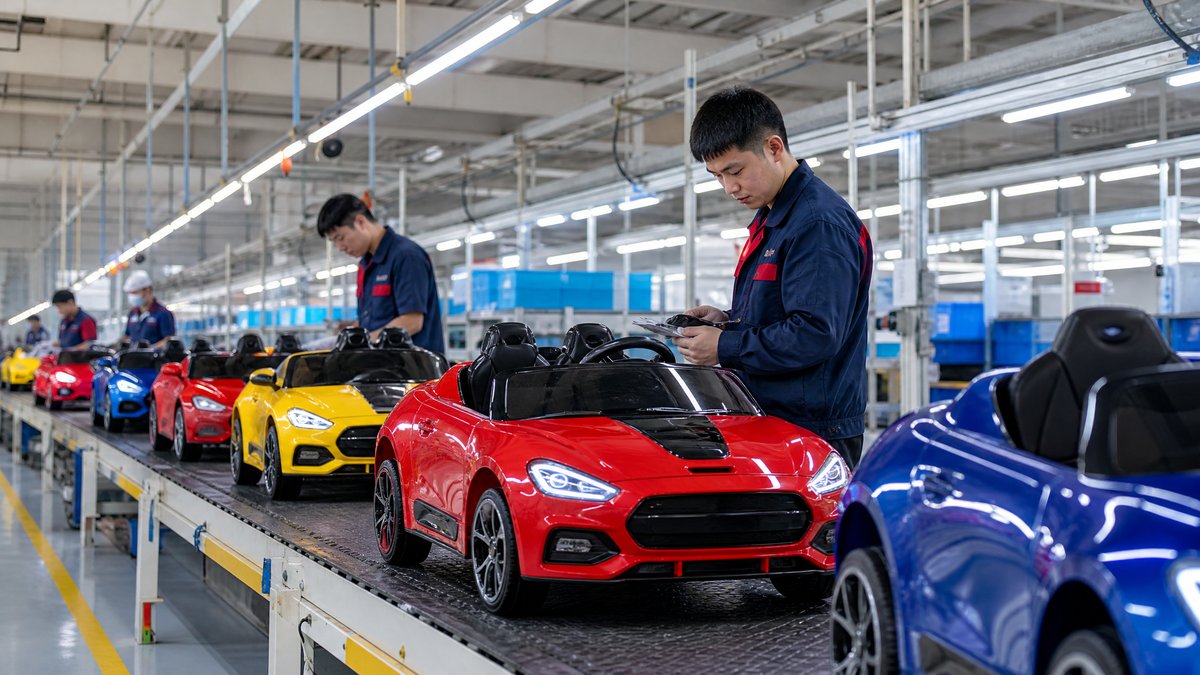
A practical kids ride-on car supplier shortlist should compare more than company names and unit prices. It should show which candidates fit the intended product and market, what evidence has been reviewed, which commercial assumptions remain open, and what risks could stop an order. For many importers, wholesalers, distributors, retailers, and OEM buyers, three to five documented candidates are more useful than a long list of unqualified contacts.
A shortlist is not final supplier approval. It is a controlled step before samples, contracts, production controls, and deeper due diligence. Build it around the program you actually intend to buy, and verify current destination-market requirements before placing an order.
Start With a Clear Buying Brief
Set the same frame of reference for every candidate. Before requesting quotations, prepare a short internal brief identifying the sales channel, target countries, estimated first-order quantity, desired delivery window, and expected price positioning. State whether the project is for wholesale, retail, e-commerce, private label, or OEM development.
Separate requirements from preferences
List non-negotiable conditions separately from preferences. A maximum carton size, a required delivery window, or a specific configuration may be a gate. A wider color selection or an optional feature may be a preference. This distinction makes supplier comparisons clearer when trade-offs arise.
Record the target vehicle type, seating format, stated age grading, load rating, charging arrangement, controls, accessories, packaging needs, and market labels. Ask suppliers to identify the precise configuration quoted.
Manufacturer instructions and warnings should set use boundaries. Communicate stated limits accurately, use adult supervision where instructed, and do not alter battery wiring, bypass protection, or electrical components.
Use the Same Supplier Record for Every Candidate
Attach dated quotations, catalog pages, emails, and sample notes. Keep the source of each entry, and confirm important statements in writing before treating them as purchase assumptions.
| Shortlist field | What to capture | Why it matters |
|---|---|---|
| Supplier identity | Legal name, address, contact, website, and independently checked contact channel | Supports basic due diligence |
| Product fit | Model references, configurations, specifications, and catalog pages | Confirms relevance to the requested range |
| Quote basis | Currency, Incoterm, MOQ, included items, carton basis, and validity | Enables like-for-like comparison |
| Documentation | Available documents, model references, dates, and gaps | Identifies market-readiness work |
| Operating proposal | Sample route, stated lead-time assumptions, change process, and packaging options | Tests delivery feasibility |
| Service support | Parts identification, manuals, labels, claims contact, and process | Indicates post-sale readiness |
| Open risks | Issue, owner, next action, and deadline | Keeps uncertainty visible |
Check Product and Documentation Fit
A shortlisted supplier should discuss the required product at configuration level, not only in broad sales terms. Request a current specification sheet identifying the model code, components, included charger and accessories, carton dimensions, weights, and user-facing materials.
Match evidence to the exact model and market
Ask which labels, manuals, reports, and other documents the supplier can provide for the product under consideration. Record whether they apply to the exact model, battery arrangement, and destination. Documents for a prior version, a different configuration, or another market should not be assumed to transfer automatically.
Importers should verify current destination-market requirements using appropriate local resources or qualified advisers. Requirements may depend on product design, labeling, batteries, packaging, age grading, and the role of the business placing the product on the market. Supplier documentation can support the review, but it does not settle every obligation. Do not publish compliance claims until the product and evidence have been assessed for the intended market.
Review customer-facing materials
Check that proposed manuals, warnings, labels, and assembly materials match the quotation and are usable in the target market. Review their treatment of stated age range, load limits, adult-supervision boundaries, charging information, intended use conditions, and assembly. The purpose is to identify consistency and translation needs early, not to create informal safety instructions.
Compare Commercial and Service Readiness
Price belongs on the shortlist, but a lower headline figure is not automatically the better option. Compare quotations on the same basis. One offer may include a charger, remote control, packaging materials, manuals, or artwork work that another excludes.
Make assumptions visible
For each candidate, capture the model code, configuration, currency, Incoterm, MOQ by model or color, payment proposal, production estimate, carton information, and included items. Flag missing information instead of filling gaps with optimistic assumptions. For a price range, ask whether quantity, color, accessories, or packaging cause the variation.
Use a deliberate process for bank-detail or payment changes. Confirm material amendments through an independently established contact channel, retain a dated approval trail, and escalate unexpected requests internally. This is a sensible sourcing control, not a judgment about a particular supplier.
Evaluate support before selection
Ask how the supplier handles missing parts, warranty inquiries, documentation updates, and quality feedback. Record who receives a claim, what evidence is required, how parts are identified, and how remedies are agreed. A general promise of support is less useful than a documented process.
Discuss spare parts in relation to the selected models and your sales channel. Retailers, distributors, and OEM buyers may need different parts availability and response arrangements. For a focused discussion of target models, documentation, and commercial assumptions, email KidsRideCar’s B2B team.
Use Gates Before Scoring Preferences
Move from a broad discovery list to a shortlist in stages. First apply genuine pass/fail gates, such as willingness to quote the required configuration, an acceptable MOQ range, model-specific information, a plausible delivery route, and a path to review documentation. A candidate that cannot meet an essential condition should not remain solely because its catalog is attractive.
Then compare preferences: range depth, packaging flexibility, customization process, communication quality, and service approach. Keep “unknown” separate from “no.” Assign a named owner and deadline to every material open question.
Keep a decision record
Prepare a one-page comparison for each finalist: intended models, quote basis, confirmed facts, documents reviewed, assumptions, open checks, and recommendation. Keep it with the RFQ, sample records, and correspondence. A shortlist does not replace sample approval, contractual review, factory due diligence, production-stage controls, inspection planning, or market-specific compliance work.
FAQ
How many suppliers should a kids ride-on car shortlist include?
Three to five candidates commonly provide enough comparison without unnecessary administration. The right number depends on product complexity and how many suppliers meet your non-negotiable conditions. Keep extra leads in a separate discovery list if needed.
Can a supplier be shortlisted before documentation is reviewed?
Yes, provisionally, where product and commercial fit are relevant. However, list missing documentation as a condition with an owner and deadline. Verify current destination-market requirements and whether the evidence relates to the exact model before relying on it.
Should buyers choose the lowest quotation?
Not without a like-for-like comparison. Check configuration, MOQ, Incoterm, packaging scope, included accessories, payment assumptions, documentation status, and support process. A lower figure may leave material costs or risks unresolved.
What should be requested before ordering a sample?
Request a current model specification, quote basis, carton data, available manuals and labels, stated production assumptions, and the supplier’s sample-change process. This helps ensure the sample represents the product you may actually buy.
Does a shortlist replace a factory audit or product inspection?
No. It is an early sourcing tool. Depending on risk and market obligations, later steps may include supplier due diligence, sample evaluation, a quality agreement, production monitoring, and inspection planning.
Conclusion
A strong supplier shortlist is a compact decision record rather than a directory. It connects the intended product and market to comparable evidence, transparent terms, support expectations, and open risk. Start with a precise brief, apply non-negotiable gates, and document what still needs verification before suppliers move to samples and due diligence.
If you are preparing a wholesale, retail, or OEM sourcing program, contact KidsRideCar by email with your target markets, models, expected quantities, and timing.
Official references
Explore these external resources for current regulatory and trade guidance. Confirm requirements with the relevant authority before placing an order.
Ready to Start?
Factory-Direct · CE & ASTM Certified · MOQ from 50 Units
Our export team works with buyers in 60+ countries. Get a quote within 24 hours.
KR
Written by KidsRideCar
China's leading kids electric ride-on car manufacturer. 500,000+ units shipped annually to 60+ countries. CE, ASTM & EN71 certified.