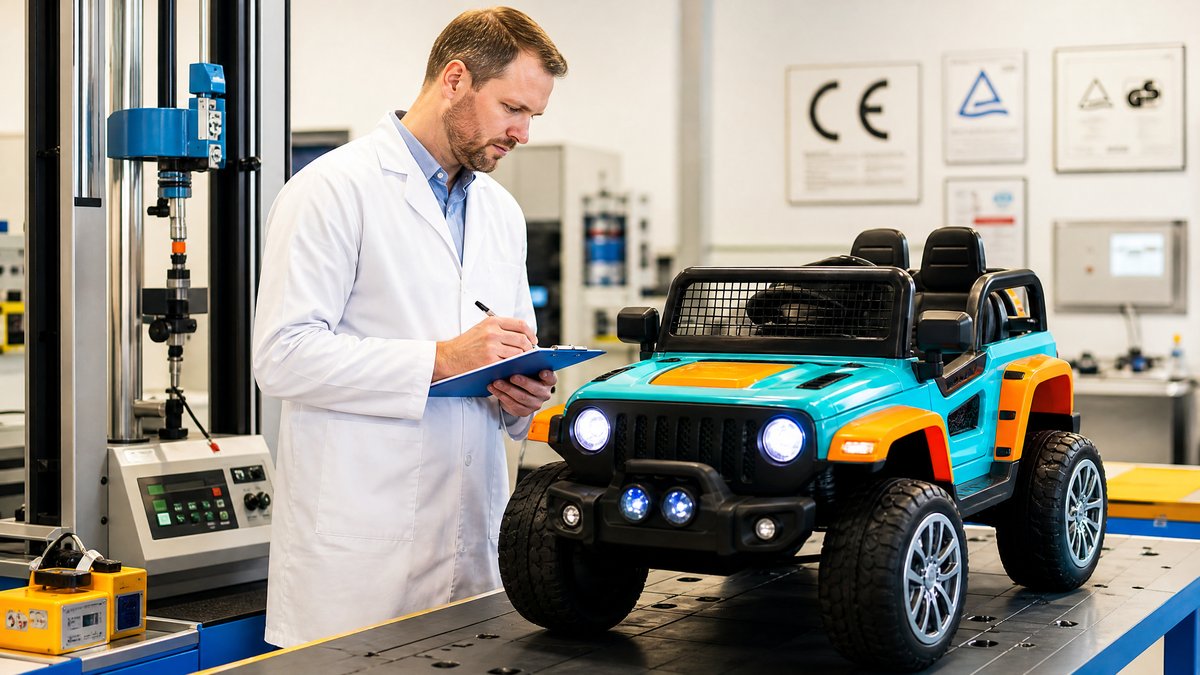
Introduction
Selling kids electric ride-on cars in the European Union requires compliance with the EU Toy Safety Directive 2009/48/EC — one of the most comprehensive product safety frameworks in the world. For importers sourcing from China, understanding what compliance actually requires (versus what factories claim) is essential before placing orders.
This guide explains the Directive's scope, the relevant EN 71 standard series, CE marking obligations, and the practical steps for verifying that your Chinese supplier's compliance documentation is genuine and current.
What Is the EU Toy Safety Directive?
Directive 2009/48/EC (the "Toy Safety Directive" or TSD) sets essential safety requirements for toys sold in the EU. It applies to products "designed or intended, whether or not exclusively, for use in play by children under 14 years of age."
Kids electric ride-on cars — battery-powered vehicles designed for children to sit in and drive — fall squarely within the Directive's scope. The importer (the entity placing the product on the EU market) bears primary legal responsibility for compliance, even if the product was manufactured in China.
The CE mark on a toy is a declaration by the manufacturer or importer that the product meets all applicable EU requirements. It is not a certification issued by a third party — it is a self-declaration, supported by a technical file and, for certain categories, a third-party test report.
Relevant EN 71 Standards for Electric Ride-On Cars
The EN 71 series is the harmonized standard referenced by the Toy Safety Directive. For electric ride-on cars, the most relevant parts are:
| Standard | Title | Relevance |
|---|---|---|
| EN 71-1:2014+A1:2018 | Mechanical and Physical Properties | Structural integrity, sharp edges, protrusions |
| EN 71-2:2011+A1:2014 | Flammability | Fabric, foam, and plastic flammability |
| EN 71-3:2019+A1:2021 | Migration of Certain Elements | Heavy metals in paints and coatings |
| EN 71-9:2005+A1:2007 | Chemical Compounds | Phthalates, formaldehyde in materials |
| EN 62115:2005+A2:2011 | Electric Toys — Safety | Electrical safety, battery, charger |
EN 62115 (now superseded by EN IEC 62115:2020 in most EU member states) is particularly important for electric ride-on cars. It covers:
- Maximum no-load voltage (typically 24V DC for children's vehicles)
- Battery charger safety and overcharge protection
- Motor thermal protection
- Wiring insulation and connector safety
- Warning labels for battery and charger
CE Marking Process: Step by Step
For electric ride-on cars, CE marking under the Toy Safety Directive follows this process:
Step 1: Identify applicable directives and standards. In addition to the Toy Safety Directive, electric ride-on cars may also need to comply with the Low Voltage Directive (2014/35/EU) and the EMC Directive (2014/30/EU) depending on their electrical characteristics.
Step 2: Conduct conformity assessment. For most toys, the manufacturer or importer can self-assess against the harmonized standards. However, if the toy does not fully comply with harmonized standards, a Notified Body (an accredited third-party testing organization) must be involved.
Step 3: Compile the technical file. The technical file must include: product description and drawings, list of standards applied, test reports, risk assessment, Declaration of Conformity, and quality control procedures.
Step 4: Issue the Declaration of Conformity (DoC). The DoC is a formal document signed by the manufacturer or EU-authorized representative, declaring compliance with all applicable directives.
Step 5: Affix the CE mark. The CE mark must be affixed to the product and/or packaging before placing on the EU market. Minimum height: 5mm.
What to Check When a Factory Claims CE Compliance
Many Chinese factories will tell you their products are "CE certified." This claim requires careful verification:
Request the actual test reports, not just the certificate. A CE certificate from a recognized lab (SGS, TÜV, Intertek, Bureau Veritas) should reference specific test standards and show pass/fail results for each test item. A generic "CE certificate" with no test data is not meaningful.
Check the test report date. EN standards are updated periodically. A test report from 2018 may reference superseded standards. For EU market entry in 2026, reports should reference current standard versions.
Verify the product scope. Test reports are issued for specific models. If you are ordering a model that differs from the tested model (different battery voltage, different motor, different materials), the existing test report may not cover your product.
Check the issuing laboratory's accreditation. The lab should be accredited by a recognized national accreditation body (UKAS in the UK, DAkkS in Germany, COFRAC in France, etc.) for the specific test standards referenced.
Request the Declaration of Conformity. The DoC should list the specific directives and standards the product complies with, and be signed by an authorized representative.
UKCA Mark for the UK Market
Since January 1, 2021, products placed on the Great Britain market (England, Scotland, Wales) require the UKCA (UK Conformity Assessed) mark rather than CE. Northern Ireland continues to accept CE marking.
The technical requirements for UKCA are largely identical to CE for toys, but the documentation and marking process is separate. If you are selling in both the EU and UK, you will need both CE and UKCA compliance documentation.
Importer Obligations Under EU Law
As an EU importer, your legal obligations include:
- Ensuring the manufacturer has completed the conformity assessment and compiled the technical file
- Verifying that the CE mark is affixed correctly
- Keeping a copy of the Declaration of Conformity for 10 years
- Ensuring the product bears the manufacturer's name, registered trade name, and contact address
- Ensuring the product bears a type, batch, or serial number for traceability
- Informing the manufacturer and market surveillance authorities if you believe a product presents a risk
FAQ
Does CE marking mean the product has been tested by a third party?
Not necessarily. CE marking can be based on self-assessment against harmonized standards. Third-party testing by a Notified Body is only mandatory for certain high-risk product categories. However, most reputable factories will have third-party test reports as evidence of conformity.
Can I sell a product with a Chinese factory's CE mark in the EU?
If the CE mark was affixed by the Chinese manufacturer and you are importing the product into the EU, you become the importer and bear legal responsibility for compliance. You should verify the manufacturer's compliance documentation before placing the product on the market.
What are the penalties for non-compliance?
EU market surveillance authorities can order product recalls, impose fines, and prohibit further sales. In serious cases, criminal liability may apply. Non-compliant products can be reported to the RAPEX (Rapid Alert System for dangerous non-food products) database, which is publicly accessible.
How often do I need to re-test?
There is no fixed re-testing interval under EU law. However, if the product design changes, if the applicable standards are updated, or if there are safety incidents, re-testing is advisable.
Conclusion
EU compliance for kids electric ride-on cars is achievable, but it requires more than accepting a factory's claim of "CE certified." Importers who invest time in verifying test reports, reviewing technical files, and understanding their legal obligations avoid the costly consequences of non-compliant products reaching the EU market.
If you need help evaluating a Chinese factory's compliance documentation, or want to discuss compliance requirements for a specific EU market, our team is available to assist.
*Questions about EU compliance for your order? Contact us and we will review your requirements.*
Official references
Explore these external resources for current regulatory and trade guidance. Confirm requirements with the relevant authority before placing an order.
Ready to Start?
Factory-Direct · CE & ASTM Certified · MOQ from 50 Units
Our export team works with buyers in 60+ countries. Get a quote within 24 hours.
KR
Written by KidsRideCar
China's leading kids electric ride-on car manufacturer. 500,000+ units shipped annually to 60+ countries. CE, ASTM & EN71 certified.

