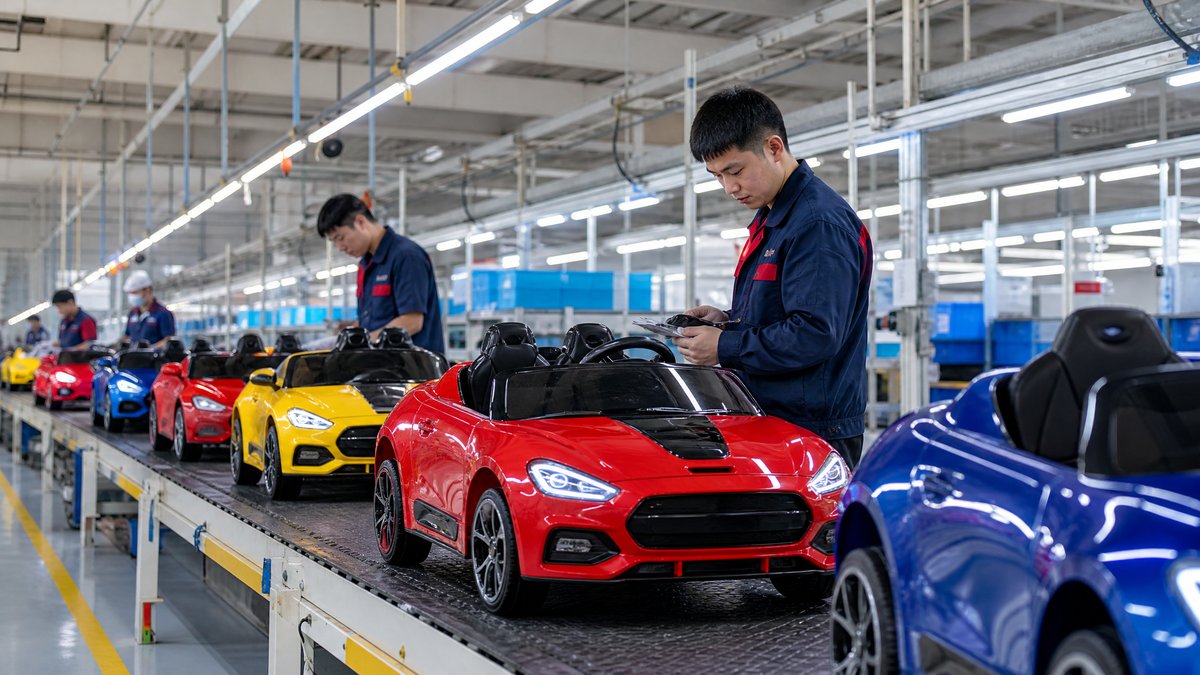
Importers should calculate landed cost by adding every cost required to make a sellable kids electric ride-on car available at its intended warehouse or fulfilment point, then allocating shared costs to each SKU on a consistent basis. Start with the agreed supplier price and Incoterm, then add origin charges, freight, insurance where applicable, duty and import taxes where applicable, customs clearance, destination handling, inland delivery, inspection, and the direct preparation costs needed before sale. Keep recoverable taxes and recurring operating overhead separate from the unit landed-cost calculation unless they are genuinely non-recoverable or directly attributable to the shipment.
For bulky, carton-packed ride-on products, a low ex-factory price can still produce a weak margin after logistics and preparation. This article gives importers, wholesalers, distributors, retailers, and OEM buyers a repeatable costing method.
What does landed cost mean for a kids electric ride-on car importer?
Landed cost is the fully traceable cost of getting one saleable unit to the location where your business takes responsibility for stock. Define that location before you begin. For one importer it may be the port; for another it is the distribution centre; for an e-commerce retailer it may be a third-party fulfilment warehouse after appointment and receiving charges.
That definition prevents a common reporting problem: comparing a supplier quote for one model with a “landed” figure for another that includes local delivery and warehouse fees. Both figures may be valid, but they are not comparable.
A useful import-cost equation is:
> Unit landed cost = (product costs + shipment-level costs + destination costs + direct readiness costs) ÷ saleable units received
Use saleable units received, not merely units ordered, when a shipment has documented damage, shortages, or units held back from sale. Treat the difference transparently in the shipment file; do not hide it inside an unrelated SKU cost.
Landed cost is not the same as retail price or gross margin
Landed cost answers, “What has this unit cost us to make saleable at our chosen handover point?” It does not set the retail price. Retail pricing also has to account for channel fees, marketing, storage, returns, warranty provision, sales commissions, payment processing, and the margin your business requires. Those commercial decisions should be modelled alongside landed cost, but not mixed into it without a clear rule.
For assortment work, pair the landed-cost sheet with your sales plan. The [KidsRideCar product range](/products/kids-electric-ride-on-cars) can help a buyer map models and configurations before requesting like-for-like quotes.
Build the calculation from the commercial term outward
The same supplier number can mean very different things depending on the agreed Incoterm. Do not enter “freight” as a generic placeholder until both the product quote and the logistics quote state what each party is responsible for.
1. Capture the supplier-side product cost
Record the exact commercial inputs per SKU or configuration:
- Unit price and currency
- Quantity, carton quantity, and total cartons
- Product configuration, colour mix, branding, accessories, and spare-parts inclusion
- Tooling, artwork, packaging development, samples, or other one-time charges, if applicable
- Deposit, balance, and any bank or payment charges that your policy treats as purchase cost
- The agreed Incoterm, named place or port, and quote validity date
For an OEM programme, do not spread a one-time cost automatically across the first shipment just because it was paid with it. Decide whether the cost benefits one order, a defined annual volume, or a product’s expected lifecycle. Document that allocation basis and use it consistently. This makes later margin reviews much more credible.
2. Map the responsibility point under the Incoterm
An EXW, FCA, FOB, CIF, or DDP quote may include different costs and transfer points. The quotation itself, purchase contract, freight forwarder, and customs adviser should establish the applicable responsibilities for the specific transaction. Do not assume that a label in an email settles every local charge.
Map factory release, export handling, international carriage, insurance, customs entry, duties and taxes, destination handling, inland delivery, and final receiving. For each, mark who pays and whether the amount is included, estimated, or pending confirmation.
This map is especially valuable when comparing suppliers. A seemingly cheaper FOB offer may not be comparable with an offer that includes different packing, origin services, or export handling. Request the same quote structure from each supplier.
3. Collect shipment-level logistics costs from evidence
Keep each logistics line in the currency and unit used by the provider before converting it to your reporting currency. Typical shipment-level categories include:
- Origin pickup or consolidation, export processing, and origin terminal charges
- Main freight and cargo insurance, where separately charged
- Documentation and customs-broker charges
- Duty, non-recoverable import taxes, and government fees as confirmed for the destination
- Destination terminal, release, appointment, demurrage or detention charges where incurred
- Inland transfer to the warehouse or fulfilment site
- Inspection, palletisation, labelling, repacking, or other direct readiness work
Use actual invoices after the shipment closes. Before then, distinguish an estimate from a booked or invoiced amount. A model that shows confidence status is more useful than a single “final” number built from assumptions.
Allocate shared costs fairly across ride-on car SKUs
A container or consolidated shipment may contain different ride-on car models, cartons, and accessory packs. Shared freight and destination charges need a defensible allocation method. There is no universal basis; choose one that best reflects what drives the charge and apply it consistently.
| Cost type | Often suitable allocation basis | Why it may fit |
|---|---|---|
| Main freight for volume-sensitive shipments | Verified cubic volume or carton volume | Larger cartons generally consume more transport space. |
| Weight-driven handling or air freight | Verified chargeable weight | The logistics provider may bill from weight or dimensional rules. |
| Customs duty | Customs value and the applicable tariff treatment | Duty should follow the product’s entered value and classification approach. |
| Broker entry fee | Entry, line item, or documented transaction rule | A flat fee may relate to an entry rather than a carton. |
| Warehouse receiving | Pallets, cartons, units, or supplier invoice | Use the basis used by the warehouse when available. |
| Product-specific inspection or rework | Actual SKU cost | Do not spread a model-specific cost across unrelated products. |
Do not allocate every cost by unit count: a compact accessory and a large car carton consume different transport resources. Record the allocation rationale in the workbook.
A practical allocation example without assumed figures
Imagine a shipment containing two ride-on car SKUs and a small set of replacement parts. The freight invoice is driven mainly by space, the customs charges relate to the entry, and a receiving charge is billed by pallet.
First, enter the verified carton dimensions, weights, quantities, product values, pallet counts, and all invoice lines. Next, allocate freight based on the agreed volume measure, allocate any value-linked duty based on the declared customs value and classification advice, allocate the broker fee using the entry rule selected in your policy, and assign SKU-specific labelling directly to the affected model. Finally, divide each SKU’s total assigned cost by its saleable received quantity.
The result is a traceable unit cost for each SKU. It is not a made-up average. A reviewer can see both the source document and the method behind every line.
Treat classification, duty, and tax as controlled inputs
Product classification and import charges can materially change landed cost. They are also destination-specific and fact-dependent. Confirm the correct treatment with qualified customs, tax, or trade advisers in the importing market, using accurate product descriptions and documentation. Do not rely on a supplier’s informal classification suggestion as the final decision.
Record the intended market, classification reference, customs-value basis, duty status, tax-recovery treatment, advice source, and review date. Clearly flag every provisional treatment.
For clearance readiness, align the costing sheet with the commercial invoice, packing list, transport documents, product description, and any destination-required documentation. Our guide to [customs-clearance preparation](/blog/how-should-retailers-prepare-ride-on-car-import-clearance-documents) is a useful companion for organising the workflow; it does not replace professional advice for your market.
Build a landed-cost worksheet that procurement can audit
A strong worksheet shows the approved quote version, changed assumptions, reviewer, and actual shipment cost—not merely a total.
Recommended worksheet tabs
1. SKU master: SKU name, version, supplier, carton specification, currency, quote date, product price, and saleable-unit definition.
2. Quote comparison: common Incoterm, volume/weight assumptions, included services, exclusions, quote validity, and supplier notes.
3. Shipment budget: planned quantities, estimated logistics lines, allocation rules, exchange-rate policy, duty/tax assumptions, and scenario label.
4. Actuals and variance: invoice reference, actual payment amount, actual receipt quantity, variance versus budget, owner, and explanation.
5. Margin view: landed cost by SKU, intended channel price, channel-specific deductions, and approval status.
6. Document register: links or references to quote, PO, packing list, freight invoice, customs entry, broker invoice, receiving record, and inspection report.
Lock formulas, use version numbers, and date updates so users can distinguish estimates from post-arrival invoices.
Use scenario planning before committing stock
Compare a base case with an adverse case for exchange-rate policy, freight expiry, lower saleable receipt quantity, or documented destination charges. This shows whether margin can absorb normal uncertainty.
Ask a commercial question for each SKU: If the cost changes, can our channel price, assortment mix, or order quantity absorb it without undermining the range? A high-cube model may still be strategically right, but the answer should be deliberate.
Include quality and readiness costs without compromising safety
Budget direct readiness work, including applicable inspection, labels or inserts, palletisation, and retailer preparation. Record nonconformities, shortages, and transit damage, then apply your documented cost and claim policy.
Check safety and product documentation before shipment; requirements vary by market and configuration. Verify obligations with competent local advisers and retain model-specific records. Never alter protective systems, wiring, batteries, or internal components to save cost; use approved supplier support and qualified service arrangements.
For a broader pre-shipment process, see the [ride-on car quality inspection checklist](/blog/what-is-a-practical-quality-inspection-checklist-before-ride-on-car-shipment).
Common landed-cost mistakes to avoid
- Comparing incompatible quote terms. Normalize supplier and freight quotes to the same responsibility point before choosing a source.
- Using ordered quantity as the denominator forever. Reconcile to saleable units received when closing the shipment cost.
- Hiding one-time OEM charges. Allocate them under a stated policy and review the impact before approving the programme.
- Using an expired freight estimate as a final number. Show its status and replace it with booked or invoiced evidence.
- Double-counting costs already included in the supplier term. Cross-check the responsibility map against each invoice line.
- Treating duty or tax assumptions as universal. Confirm the position for the destination and retain the supporting reference.
- Forgetting destination readiness costs. Receiving, labelling, relabelling, and delivery can affect a bulky product’s true unit economics.
Frequently Asked Questions
Should importers calculate landed cost per container or per SKU?
Calculate the shipment total first, then allocate it to each SKU using cost drivers that match each charge. Management may also want a container-level summary, but SKU-level cost is necessary to assess assortment and channel margin decisions.
Which Incoterm gives the lowest landed cost?
No Incoterm automatically gives the lowest cost. It changes the responsibility point and visibility of charges rather than guaranteeing an economic outcome. Compare complete, normalized cost models and assess the operational capability your business has to manage each responsibility.
Should recoverable import tax be included in unit landed cost?
Follow your accounting and tax policy. If a tax is recoverable, businesses often track it separately from the cost of inventory; if it is non-recoverable, it may form part of the cost. Confirm the treatment with a qualified adviser for the relevant jurisdiction.
How often should a buyer update the model?
Update it at each decision point: supplier quote review, freight booking, pre-shipment quantity confirmation, customs clearance, warehouse receipt, and final invoice reconciliation. This creates an auditable budget-versus-actual record rather than a static spreadsheet.
Can one average cost be used for all colour variants?
It can be reasonable only when the variants truly share the same product cost, carton data, compliance/readiness requirements, and allocation drivers. If branding, packaging, accessory content, or value differs, cost them separately or document why a grouped method is appropriate.
Conclusion: make landed cost an approval discipline
For kids electric ride-on cars, landed cost is a purchasing control, not just a finance calculation. Define the warehouse handover point, normalize all quotes, build from source documents, allocate shared costs using sensible drivers, separate assumptions from actuals, and reconcile to saleable received units. That discipline gives importers clearer margins, more reliable supplier comparisons, and better evidence for pricing decisions.
Need a quote structure, a product-specific cost worksheet, or an OEM discussion? [Send KidsRideCar an inquiry](/inquiry) or email info@kidsridecar.com to discuss your target market, required configuration, and purchasing plan.
Official references
Explore these external resources for current regulatory and trade guidance. Confirm requirements with the relevant authority before placing an order.
Ready to Start?
Factory-Direct · CE & ASTM Certified · MOQ from 50 Units
Our export team works with buyers in 60+ countries. Get a quote within 24 hours.
KR
Written by KidsRideCar
China's leading kids electric ride-on car manufacturer. 500,000+ units shipped annually to 60+ countries. CE, ASTM & EN71 certified.