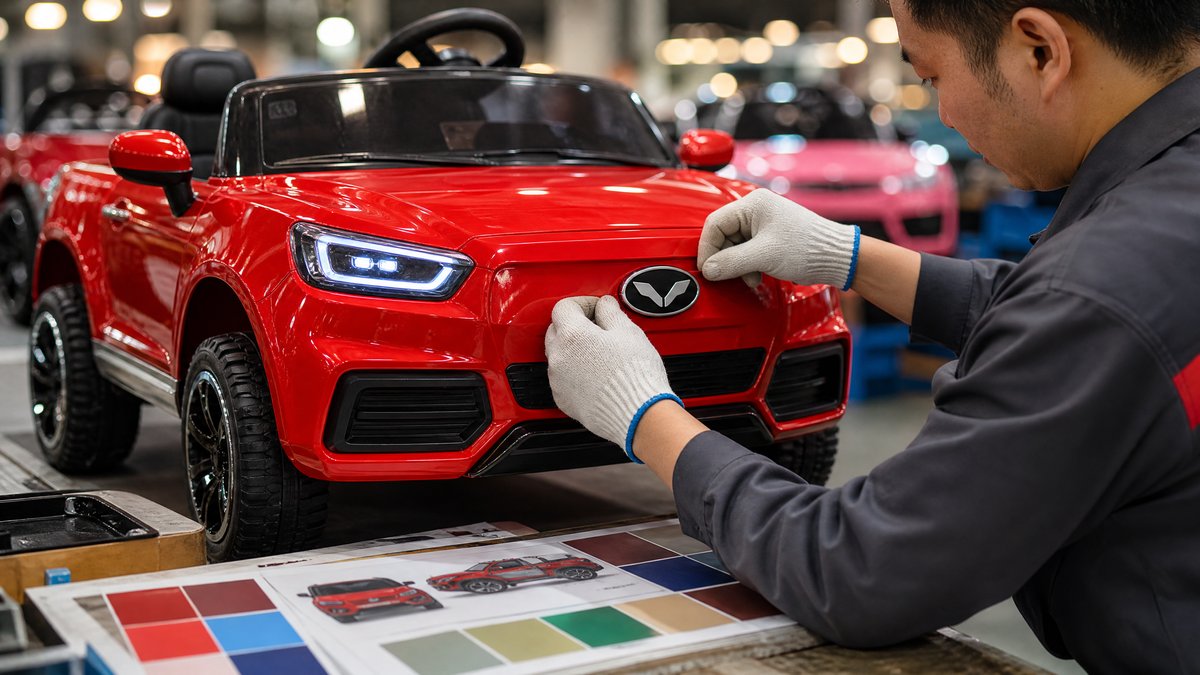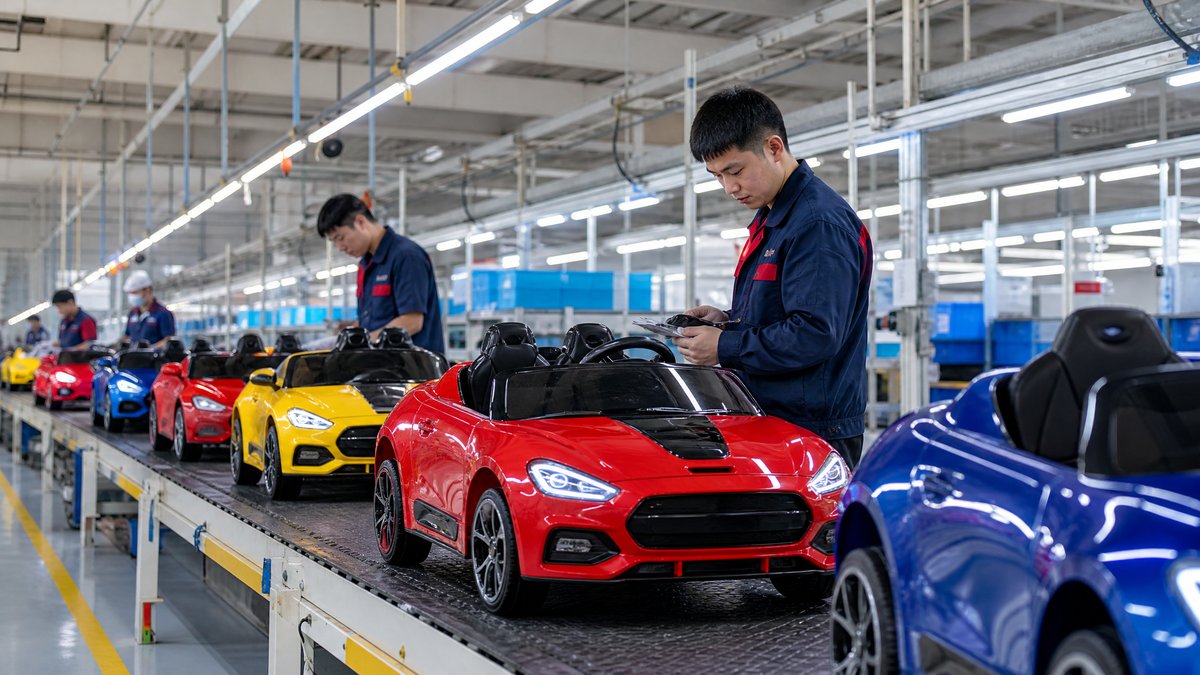
A usable OEM brief turns a distributor’s or retailer’s product idea into a controlled manufacturing project. For a custom kids electric ride-on car, it should define what can change, what must stay unchanged, who approves each stage, and what evidence is required before shipment. Start with a selected base model, a destination market, your brand assets, a component-level customization list, packaging and manual requirements, and a written approval/change process.
> Important: Specifications, battery transportation rules, and market-entry requirements must be verified for the selected model and destination market. A product’s appearance, battery configuration, wireless functions, labeling, and intended age grade can affect the requirements that apply. This article is a commercial planning guide, not legal, testing, or transport advice.
For importers, wholesalers, distributors, and retailers, the goal is not merely to request a logo. It is to create a brief that lets the factory quote accurately, makes samples comparable with the approved specification, and prevents an unapproved change from reaching a container.
Planning an OEM program? Send your selected model, market, target order quantity, and draft brand assets to info@kidsridecar.com for a practical brief review.
Image Planning
| Suggested dimensions | Placement | English caption | Alt text | English AI prompt |
|---|---|---|---|---|
| 1600 × 900 px | Below the introduction | A controlled OEM brief aligns the factory, buyer, and approved configuration. | B2B buyer reviewing a custom kids electric ride-on car OEM brief with color swatches and packaging artwork | Photorealistic B2B product-development meeting in a modern toy vehicle showroom, two professionals reviewing an OEM specification sheet beside a generic unbranded kids electric ride-on car, color swatches, carton dieline, clean natural lighting, no logos, no readable brand names, 16:9 |
| 1200 × 900 px | In “Separate OEM Customization From New Tooling or New-Model Development” | Identify whether the request is a branding change, component configuration, or tooling project. | Exploded view of a generic kids electric ride-on car showing customizable parts and tooling boundary | Clean technical 3D exploded-view illustration of a generic unbranded kids electric ride-on car, callout zones for body shell, seat, wheels, battery compartment, carton and logo decal, professional B2B presentation style, white background, no text, 4:3 |
| 1200 × 800 px | In “Treat Packaging and Manuals as Part of the Product” | Packaging, labels, and instructions need approval alongside the vehicle. | Custom ride-on car carton, user manual, quick-start card, and accessory pack arranged for quality review | Photorealistic flat lay for a B2B toy manufacturer: plain unbranded ride-on car carton, user manual, quick-start card, barcode label placeholder, accessory bag and color chip, tidy quality-control desk, no visible logos or readable claims, 3:2 |
| 1600 × 900 px | Before “Build Approval Gates Into the Project Timeline” | Approval gates keep the OEM project aligned from brief through shipment release. | Project approval workflow for a custom kids electric ride-on car from brief to shipment | Minimal professional infographic showing a seven-step OEM approval workflow for a generic kids electric ride-on car: brief, feasibility, artwork proof, sample, documentation review, production confirmation, shipment release; navy, white, and muted orange palette; crisp vector style; no brand logos, 16:9 |
Start With an OEM Brief That Is Specific Enough to Quote
An OEM brief should be a controlled document, not a collection of chat messages, screenshots, and verbal promises. Give it a document number, version, issue date, buyer company name, selected model code, and destination country or countries. Attach files rather than embedding low-resolution artwork in a message.
At minimum, state:
- Business objective: private-label launch, channel-exclusive colorway, promotional program, replacement order, or market adaptation.
- Commercial context: forecast quantity, preferred order split, target launch window, intended channel, and sample quantity. These inputs support feasibility discussions; they do not substitute for a factory quotation or production confirmation.
- Base product: exact model identifier, photos from the current catalog/sample, and a list of baseline features that must be retained.
- Destination and intended user: destination market(s), sales channel, intended age grade, and labeling language(s).
- Customization scope: a line-by-line request for branding, color, components, packaging, instructions, and documentation.
- Governance: named buyer approver, approval deadlines, version-control rule, and a change-request process.
Define the Brief’s “Source of Truth”
Ask the supplier to return a factory confirmation sheet or specification matrix that mirrors the brief. Resolve differences before sample production. The approved matrix, artwork pack, approved sample record, and inspection criteria should be referenced by version in the purchase order or quality agreement where applicable.
A clear source of truth avoids a common problem: one team approves a color rendering, another approves carton art, and the factory works from an older file.
Separate OEM Customization From New Tooling or New-Model Development
The most important early question is: Are you changing a finished platform, a replaceable part, or the product’s physical structure? The answer affects lead time, cost, validation scope, ownership discussions, and approval gates.
| Requested change | Typical project type | What the buyer should define | Boundary to confirm before approval |
|---|---|---|---|
| Logo on carton, manual, label, seat embroidery, or approved decoration area | Brand/graphic OEM | Vector artwork, placement, dimensions, colors, artwork versions | Print method, final artwork proof, applicable label content, and whether the decoration affects warnings or traceability |
| Existing production color or standard trim option | Standard configuration | Exact factory color reference or approved physical sample | Availability for the selected model and production batch; color consistency tolerance/process |
| New color on an existing plastic part | Color customization | Physical color standard, finish, affected parts, UV/appearance expectations if relevant | Material/color-masterbatch feasibility, sample approval, and whether any market documentation or test evidence must be reviewed |
| Different wheels, seat, lights, remote, audio module, battery pack, charger, or harness | Component configuration | Approved part specification, compatibility requirements, color/finish, supplier approval needs | Fit, electrical compatibility, software/remote pairing, packaging fit, documentation updates, and any compliance review triggered by the change |
| Modified body shell, structural part, new dashboard, or altered mounting geometry | Tooling/new-model development | 2D/3D data, functional requirements, ownership and maintenance terms, validation plan | Tooling responsibility, design freeze, revision rights, tooling acceptance, pilot build, and re-validation scope |
The table is a planning tool, not a rule that every change has the same effect. A minor-looking component swap can affect assembly, power supply, user instructions, package markings, transport classification, or applicable market requirements. Ask the manufacturer to identify affected documents and validation steps for each requested deviation.
Tooling Boundaries to Put in Writing
When a project involves new or modified tooling, add a dedicated tooling appendix. It should identify:
1. What is being tooled: part name, drawing/3D model revision, material, surface finish, texture, cavity count if applicable, and the product/model(s) it serves.
2. Who funds and owns what: separate the commercial arrangement for tooling from access, storage, maintenance, modification, replacement, and end-of-project treatment. Do not assume that paying a tooling charge alone answers every ownership or use question.
3. Design and freeze points: who approves DFM feedback, pilot samples, first-off-tool parts, texture/color plates, and the final design freeze.
4. Acceptance criteria: dimensional/fit requirements, appearance standard, cycle/assembly expectations if agreed, and which sample evidence is required before mass production.
5. Change authority: no tool modification, cavity adjustment, material substitution, or design revision without a documented buyer approval where the agreement requires it.
For licensed or third-party artwork, confirm that the buyer has the necessary rights before requesting production. The OEM brief should include only artwork and claims that the buyer is authorized to use.
Specify Branding and Color as Production Requirements
“Make it look premium” is a direction, not a production requirement. Convert brand intent into files and acceptance criteria.
Brand Assets and Decoration Details
Provide a single artwork pack with:
- Master logo in editable vector format, approved color variants, clear-space/minimum-size guidance, and font information or outlined text.
- Placement drawings or annotated product images for each logo, badge, print, emboss, decal, seat mark, carton panel, manual cover, and label.
- Required language, trademark symbols where authorized, model name, SKU, and any approved marketing claims.
- A list of prohibited marks, colors, competitor-like styling, and unapproved claims.
- An approval route for final print proofs, pre-production samples, and any serial/traceability label format.
State the decoration method if it matters to the brand outcome: for example, decal, pad print, screen print, in-mold treatment, embossed mark, or metal badge. The factory should confirm compatibility with the selected part material and surface.
Use Physical Color References, Not Screenshots Alone
Screens and renders vary. For body plastics, wheels, seats, trim, and printed packaging, provide a physical standard whenever practical—such as an approved swatch, sample, or recognized color reference—and note the desired finish (gloss, matte, metallic, pearlescent, or texture). Ask for a color chip or production-representative sample before final sign-off.
Record each affected component separately. “Blue car” may involve multiple materials and finishes, so one visual target may not reproduce identically on every part. The approval record should identify the approved sample, photo conditions, color reference, part names, and any acceptable variation agreed with the factory.
Lock Down Components, Interfaces, and Service Parts
Component requests are where OEM projects can become operationally difficult. A buyer should name the part—not only the feature—and say whether a substitution is permitted.
Build a Component Configuration Table
For every non-standard item, include:
- Part/function: battery, charger, motor, gearbox, remote control, receiver, wiring harness, switch, lights, sound module, seat, wheels, tires, fasteners, or other selected parts.
- Requested configuration: manufacturer-approved specification, color/finish, connector or mounting interface, and language/region settings where relevant.
- Approved alternatives: “none without written approval” or a pre-approved list with criteria.
- Impact owner: factory engineering, buyer product team, test/compliance contact, packaging owner, or after-sales owner.
- Evidence/approval needed: sample check, fit check, functional review, document update, or external review as appropriate.
- Spare-parts plan: SKU/part code, forecast, packaging, compatible-model list, and post-sale availability expectations.
Avoid requesting a battery or charger merely by a headline voltage. The complete electrical configuration, matching interfaces, charging system, applicable markings, documentation, and transport status must be confirmed for the selected model and destination market. If the product includes a lithium battery, involve the freight forwarder/carrier and relevant transport authority early; applicable transport requirements depend on the actual battery and shipment arrangement.[PHMSA lithium-battery guidance][phmsa]
Do Not Treat Remote or Electronic Features as Cosmetic
A remote-control pairing change, different sound module, LED configuration, or wiring revision can affect functionality, instructions, warnings, and potentially the market review. Describe the intended behavior in plain language and have the supplier confirm its feasibility on the selected model. If a feature changes after sample approval, route it through formal change management rather than treating it as an assembly adjustment.
Treat Packaging and Manuals as Part of the Product
For retailers and distributors, a car can arrive physically correct but still be commercially unusable because carton marks, language, or assembly instructions are wrong. Put packaging and manuals inside the OEM brief—not at the end of production.
Packaging Requirements
Specify both consumer-facing and logistics-facing details:
- Carton artwork files, panel layout, brand hierarchy, SKU, model name, color identification, barcode data supplied by the buyer, and country-specific labeling needed for the agreed market.
- Required language(s), warnings, age information, importer or responsible-party information where applicable, batch/lot or traceability format, and any recycling/disposal or battery-related markings that have been validated for the intended market.
- Inner packing, protective materials, accessory bag identification, spare part inclusion, photo/shipping-mark requirements, and carton orientation/handling marks where applicable.
- Carton dimensions, gross/net weights, palletization/loading preferences, and barcode placement to be confirmed by the factory for the final approved configuration.
Do not assume that a generic carton can be reused after an OEM change. A new component, battery configuration, language set, or market label may require a revised packaging proof and a revised packing check.
Manual, Quick-Start, and After-Sales Content
Give the factory a content brief before translation/layout. It should define:
- Required languages and the buyer’s approved translation/technical review process.
- Product name/model/SKU, parts list, assembly sequence, charging instructions, operating steps, warnings, troubleshooting, cleaning/storage, warranty contact, and spare-parts pathway.
- Which party supplies market-specific legal text or required contact details.
- Required formats: printed manual, quick-start card, assembly insert, QR destination, digital PDF, or retailer portal file.
- Proofing gates: technical review, brand review, language review, and final print proof approval.
The factory can provide product input, but the buyer should ensure that market-facing claims, local contact details, and destination-specific wording are reviewed by the appropriate qualified person. Instructions must match the approved production configuration; any difference between the manual and the final product should stop the documentation release.
Request Compliance Evidence by Model and Configuration
“Certified” is not a sufficient brief requirement. Request a documentation matrix tied to the selected model, configuration, factory identity, revision, and destination market. The evidence needed may vary by market and by product features.
For example, the European Commission states that toys placed on the EU market must meet applicable safety requirements and carry CE marking, while the applicable toy framework covers areas including mechanical, flammability, chemical, electrical, hygiene, and radioactivity risks.[European Commission toy-safety guidance][eu-toy] In the United States, CPSC guidance explains that children’s products subject to the applicable rules require third-party testing and a Children’s Product Certificate (CPC).[CPSC children’s-products guidance][cpsc-children]
Those official pages are not a substitute for determining the requirements for a specific ride-on car. Before purchase-order release, have the responsible compliance party confirm the product classification, applicable standards/rules, test scope, labeling, documentation, and importer/distributor responsibilities for the selected model and destination.
Compliance-Evidence Request Checklist
Ask for the following as applicable and relevant to the destination market:
| Evidence or record | What to verify | Buyer action before release |
|---|---|---|
| Product identification | Model, variant, color/configuration, revision, factory/manufacturer identification | Ensure the report/document actually corresponds to the ordered configuration or obtain a documented applicability assessment |
| Test reports or assessments | Issuer, report date, product description, tested samples/components, scope, conclusions, and exclusions | Have the responsible compliance reviewer confirm relevance; do not rely on a logo or certificate image alone |
| Declarations/certificates | Issuing party, validity/scope, exact product identity, applicable destination-market framework | Verify required format and responsible economic operator details for the intended market |
| Technical file/supporting records | Drawings, BOM, risk-related documentation, labels, manuals, production controls, change history, as applicable | Agree what is provided, what remains on file, access timing, and retention responsibilities |
| Materials/component evidence | Paints, plastics, coatings, batteries, chargers, electronics, and other selected components as relevant | Confirm whether the evidence covers the selected supplier/part revision and whether changes trigger review |
| Transport documentation | Battery chemistry/type, configuration in/with equipment, packing/marks/documents and carrier requirements as applicable | Confirm requirements with the freight forwarder/carrier and the relevant transport authority before booking |
Use qualified testing, compliance, customs, and transport advisers where needed. General claims about testing or destination-market compliance should not be printed on product, packaging, or marketing materials until the claim and its supporting evidence have been verified.
Build Approval Gates Into the Project Timeline
Approval gates protect both buyer and manufacturer. They prevent an expensive problem—such as incorrect carton language or a part substitution—from being noticed only at final inspection.
A practical OEM project can use the following gates:
1. Brief acceptance: factory confirms the selected model, requested scope, open questions, commercial assumptions, and whether the request is OEM configuration or tooling/new-model work.
2. Technical and artwork feasibility: factory confirms component interfaces, decoration method, color/finish approach, packaging fit, and documentation inputs. Resolve feasibility issues before a sample is made.
3. Pre-production digital proof: buyer signs off on controlled artwork files, placement renderings, carton/manual layouts, component specification matrix, and document versions.
4. Sample approval: buyer checks the representative sample against the approved matrix: appearance, branding, color, fit, functions, accessories, packaging prototype, and instructions as applicable. Document pass/fail comments and the sample’s revision.
5. Compliance/documentation review: the responsible party confirms the evidence package and any required labels/manual language for the selected model and destination. This gate may require updates after a configuration change.
6. Pre-production confirmation: buyer approves the final BOM/specification, approved sample reference, artwork proofs, packaging documents, inspection plan, and change freeze.
7. Production and pre-shipment release: verify that the batch follows the approved configuration and that final packaging/manual/label versions are correct. Handle deviations through the agreed change process before shipment authorization.
Set response deadlines and an escalation contact for each gate. Silence should not automatically count as approval unless that rule is expressly agreed in the contract and is appropriate for the project’s risk level.
Use Formal Change Management After the Brief Is Approved
Custom projects often change. The risk is not change itself; it is an undocumented change that bypasses cost, quality, documentation, or compliance review.
Require a Change Request for Any Deviation
A simple change request form should include:
- Change-request number, date, initiator, and affected order/model/configuration.
- Current approved version and proposed new version.
- Reason for the change and exact affected items: part number, artwork, color, software/remote behavior, packaging, manual, label, or tooling.
- Impact assessment: price, MOQ, sample timing, production schedule, inventory, fit/function, packaging, documentation, test/compliance evidence, and transport planning.
- Required approvals, approver names, decision date, effective lot/date, and disposition of work in progress or old materials.
- Updated controlled files and confirmation that obsolete files are withdrawn.
No substitution should be assumed equivalent simply because it looks similar or is available faster. If a supplier proposes an alternative component, ask for a documented comparison against the approved part and determine whether it requires a new sample, document update, or market/compliance review.
Create a Change-Freeze Point
The purchase order should reference a final “production release” revision. After this point, changes should be limited to documented exceptions approved by the designated buyer contact and factory contact. This is particularly important when orders use custom cartons, translated manuals, specialized components, or buyer-funded tooling.
A Buyer-Ready OEM Brief Checklist
Before asking for a final quotation or sample release, confirm that the brief answers these questions:
- [ ] What is the exact base model and approved baseline configuration?
- [ ] Which destination market(s), sales channels, age grade, and languages apply?
- [ ] Which changes are branding/graphic, component-level, or tooling/new-model development?
- [ ] Are logo rights, artwork versions, placement drawings, colors, and finish references complete?
- [ ] Does each requested component identify compatibility, approved alternatives, and spare-parts needs?
- [ ] Are battery/charger specifications and transport requirements being verified for the selected configuration and shipment route?
- [ ] Are carton marks, barcode data, language, labels, manuals, and quick-start content controlled by version?
- [ ] Has the responsible party identified the applicable market requirements and the evidence needed for the selected model/configuration?
- [ ] Are sample, packaging, document, and production approval gates assigned to named people?
- [ ] Is there a written process for substitutions, cost changes, tooling changes, and post-approval revisions?
Internal-Link Suggestions
Use these links only where they add context to the reader’s next step:
- Link “review the available base models before defining your configuration” to the KidsRideCar product range.
- Link “explore more wholesale and sourcing guidance” to the KidsRideCar Blog.
- Link “learn more about the manufacturer” to About KidsRideCar.
FAQ: OEM Briefs for Custom Kids Electric Ride-On Cars
1. What is the difference between OEM customization and ODM for a kids ride-on car?
OEM customization commonly starts with an existing production model and adapts approved elements such as branding, colors, selected components, packaging, and manuals. ODM or new-model development may involve a broader design solution or new tooling. The factory should confirm the actual scope rather than relying on the label alone.
2. Can we request a custom color without new tooling?
Often, a color change may be possible on an existing part, but feasibility depends on the part material, finish, factory process, minimum quantities, and the selected model. Provide a physical color reference and request a production-representative color approval sample. A color change can still require review of related packaging, documentation, or market evidence.
3. What should we approve before mass production?
At minimum, approve the controlled specification/BOM, product sample, branding and color references, carton proof, manual/quick-start proof, labels, inspection criteria, and the documentation status relevant to the selected model and destination market. Any open item should have a named owner and a documented release condition.
4. Can a supplier substitute a battery, charger, or electronic part if the specification is similar?
Do not assume so. A substitution can affect fit, function, matching interfaces, instructions, transport handling, and market documentation. State whether substitutions are prohibited or require written buyer approval, and route every proposed change through the agreed change-control process.
5. Which compliance documents should an importer ask for?
The answer depends on the selected model, configuration, and destination market. Ask for a model/configuration-specific evidence matrix and have the responsible compliance party verify the applicable requirements, test scope, declarations, labels, and recordkeeping. For EU sales, consult the European Commission’s toy-safety information; for U.S. children’s products, consult CPSC guidance and the applicable rules.[European Commission toy-safety guidance][eu-toy] [CPSC children’s-products guidance][cpsc-children]
6. How early should packaging and manuals be included in the OEM brief?
At the beginning. Packaging and instructions can depend on the exact configuration, battery/charger arrangement, accessories, warning content, languages, traceability, and destination market. Early control makes it easier to approve correct proofs before production.
Conclusion: A Better Brief Creates a More Controllable OEM Project
A custom kids electric ride-on car project is easier to manage when the brief reads like an operating specification: it identifies the base model, sets clear tooling boundaries, controls brand and color assets, specifies components, includes packaging and manuals, requests relevant evidence, and requires approval gates and documented changes.
The strongest starting point is a short, complete package: a model selection, destination-market list, brand/artwork pack, configuration table, packaging/manual outline, and approval contacts. Then let the factory confirm feasibility and identify which changes need samples, tooling discussion, documentation updates, or further review.
Ready to turn your concept into a controlled OEM brief? Email info@kidsridecar.com with your target model, market, customization list, and brand files to start the discussion.
[cpsc-children]: https://www.cpsc.gov/Business--Manufacturing/Business-Education/childrens-products "U.S. Consumer Product Safety Commission: Children’s Products" — Verified for its explanation of children’s-product testing and certification concepts. Applicability must be confirmed for the specific product and U.S. market scenario.
[eu-toy]: https://single-market-economy.ec.europa.eu/sectors/toys/toy-safety_en "European Commission: Toy Safety in the EU" — Verified for the EU toy-safety framework, CE-marking context, and official guidance links. Confirm the applicable framework and transition arrangements for the product and market before placing goods on the market.
[phmsa]: https://www.phmsa.dot.gov/lithiumbatteries "U.S. DOT PHMSA: Transporting Lithium Batteries" — Verified for the general point that lithium batteries are regulated in U.S. transport. Battery transport obligations depend on the actual battery, transport mode, route, and carrier/destination rules.
Official references
Explore these external resources for current regulatory and trade guidance. Confirm requirements with the relevant authority before placing an order.
Ready to Start?
Factory-Direct · CE & ASTM Certified · MOQ from 50 Units
Our export team works with buyers in 60+ countries. Get a quote within 24 hours.
KR
Written by KidsRideCar
China's leading kids electric ride-on car manufacturer. 500,000+ units shipped annually to 60+ countries. CE, ASTM & EN71 certified.