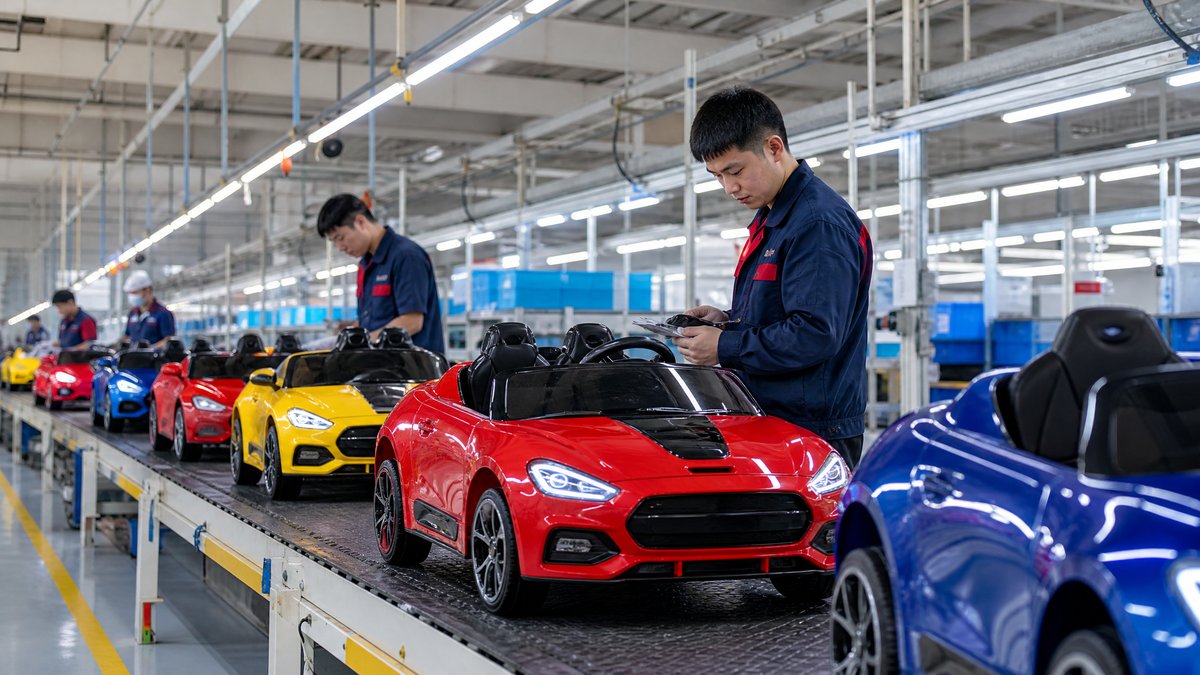
A kids electric ride-on car launch readiness review should be a documented go/no-go decision covering the approved product, destination-market documents, packaging, inventory, customer support, and sales content. It should happen before a purchase-order release, shipment booking, marketplace activation, or retailer launch—whichever comes first. For B2B buyers, it prevents mismatched parts, unclear instructions, inaccurate listings, and unsupported releases.
This cross-functional control asks whether the exact sellable configuration can be received, assembled, used, charged, stored, and supported as approved. It is ready only when each material gate has evidence, ownership, and a clear decision.
Define the scope and decision rule
Start with a one-page launch brief. Identify the model and SKU, color, battery and charger configuration, remote-control configuration if supplied, included accessories, target age guidance, sales territories, channels, launch date, and accountable launch owner. Attach approved bill of materials, artwork, manual, and content versions.
Use three statuses. Pass means evidence matches the sellable configuration. Conditional pass is a low-risk issue with a written owner and due date that does not affect safety, market access, shipping, or truthful selling. Hold blocks the affected SKU, market, or channel until a material gap is corrected and rechecked.
Do not let a launch date silently turn a hold into a pass. A change to a battery pack, charger, controller, wheel, accessory, packaging insert, or remote control can alter documents, shipping treatment, product photos, and support instructions. Treat any material change as a review trigger.
Maintain one evidence record
The launch owner should keep a controlled folder or product-information record with versioned files. A short gate log should identify the requirement, evidence location, owner, reviewer, status, and date. This is more reliable than assembling approvals from email or chat messages after the fact.
Add a market-by-market applicability list because rules vary by classification, age, battery configuration, and destination. U.S. CPSC guidance addresses labeling, instructions, markings, tracking labels, and certification for children’s toys, including considerations for battery-operated toys and certain ride-on toys. [1] It is not a universal route; the importer of record and compliance function should verify requirements for the product and market.
Gate 1: Confirm the approved product is the product to be sold
Review production-representative units with the components and retail pack planned for sale, not only CAD images or an early sample. Compare its visible identity with the approved specification: model name, SKU, color, private-label artwork where relevant, trim, seat count, wheel style, and included accessories.
Confirm the manufacturer-provided battery details, charger model and markings, connector, motor/controller, remote version, and carton contents. Capture batch or traceability data where used. Check missing parts, labels, fasteners, damaged wires, rough areas, and pinch points.
Use the manufacturer’s approved instructions and intended operating conditions for a repeatable acceptance check. Confirm that the unit can be assembled as documented and that controls and supplied features operate as represented. Do not improvise electrical repairs or modify wiring, battery protection, chargers, or performance-related parts during the review. Escalate discrepancies to the manufacturer and use only manufacturer-approved changes.
The aim is to confirm that the sellable item agrees with approved specifications, warnings, and claims. Use model-neutral language: adult supervision is required; users should follow manufacturer age, weight, surface, and charging guidance; and damaged products should not be used. Do not imply that a feature removes risk.
Use change control before release
Request a written deviation list covering component, remote, carton, label, accessory, battery, and charger changes. Assess effects on documents, packaging, transport, inventory, content, and support.
Small changes can create major launch errors. A different connector can make a charger image inaccurate. A changed carton dimension can invalidate a pallet plan. A revised remote can make an assembly video misleading. Record the decision and update affected assets before release rather than assuming the change will go unnoticed.
Gate 2: Reconcile the document pack by destination
The document gate is a reconciliation exercise, not a folder of unrelated PDFs. For every item, show the SKU, configuration, market, version, issue date, responsible party, and evidence source. The reviewer should be able to trace each document to the final product without guessing.
The pack may include specifications, configuration records, applicable test reports, declarations or certificates, labels, manual, assembly instructions, warranty terms, trade documents, and battery-transport information. Requirements vary. Do not use “certified” unless the responsible party has confirmed the claim, scope, and current validity.
Review the manual as a customer-facing control. It should identify the product and appropriate supplier or responsible party, match the components in the box, give a clear assembly sequence, present manufacturer-provided charging and storage directions, and state applicable warnings. A manual for a similar model is not enough if it shows a different dashboard, seat, charger, battery, or remote control.
For U.S. children’s products subject to CPSC-enforced requirements, a Children’s Product Certificate may be required; CPSC also distinguishes tracking labels from producer markings. [1] Verify the correct route for the configuration with the responsible compliance function, authority, or qualified adviser before shipment and sale.
Stop for a battery-transport review
Treat battery transport as an independent gate. Confirm battery type, whether it is packed with or contained in equipment, manufacturer information, package presentation, outer-pack instructions, and transport modes. Give the carrier or forwarder details early enough for assessment.
PHMSA’s guide uses scenarios based on battery type, configuration, and size, so a generic label or declaration may not fit every shipment. [2] Verify current destination-market and battery-transport requirements with responsible authorities, carriers, and logistics providers before booking. Never alter batteries, chargers, labels, or protective packaging to force a preferred shipping method.
Gate 3: Validate packaging, packout, and receiving
Review finished retail and master cartons, not only artwork. Confirm SKU, barcode where used, markings, color, quantity, handling information, warnings, origin, and importer details where applicable against the product and market plan.
Open the carton using the intended customer flow. Check that components are protected, hardware is accounted for, the manual and charger are present, and inserts are readable. Confirm that the buyer can identify the correct instructions and support contact without searching for basic information. The carton should not create avoidable confusion during removal or assembly.
Review the logistics unit as well. Compare completed-carton measurements with warehouse master data, retailer routing guides, pallet pattern, load plan, and any parcel-channel limits. Photograph the approved packout. An oversized carton, mismatched barcode, or unstable pallet can interrupt a retailer receiving process even when the product itself is acceptable.
Use a risk-based validation plan with handling, stack, route, or formal testing as appropriate. ISTA calls 1-Series methods screening tools and 3-Series methods general transport-hazard simulations, so choose a method that fits distribution. [3] Do not claim “ISTA certified” without verifying the test and claim.
Gate 4: Lock inventory, allocation, and traceability
Reconcile production, passed-inspection, hold, service-parts, sample, and channel-allocation quantities by SKU and color. Finance, supply, and sales should use one approved number set.
Maintain an inventory map showing what is ready at the factory, in transit, received, quality-held, reserved for retailers, available to sell, and retained for service. Keep samples separate from saleable stock, and do not count units twice because they are both produced and allocated.
Define how a complaint, return, or safety inquiry connects to SKU, purchase order, batch or date code if used, channel, and customer order. Test it with a simulated inquiry. If the team cannot identify affected inventory and its communication owner, improve the process before launch.
Confirm which manufacturer-approved replacement parts the support model intends to offer and how they are identified. Do not promise parts availability, repair outcomes, or turnaround periods that are not arranged. Battery, electrical, and structural concerns should have a clear escalation route to the manufacturer, not an improvised reseller repair.
Gate 5: Prepare support for the first customer contact
Train support on model-specific assembly, normal-use questions, approved charging guidance, damaged-product handling, warranty intake, returns, and escalation. It should distinguish a missing-part request from a product-safety concern and record cases consistently.
Prepare a controlled knowledge base with carton contents, assembly, manufacturer-approved troubleshooting, warranty fields, and customer messages. Tell customers to stop using damaged products and contact seller or manufacturer support. Do not instruct battery opening, bypassing protections, rewiring, or performance modification.
List the support lead, commercial owner, warehouse contact, and manufacturer technical contact. Define who reviews recurring complaints, what evidence to collect, and when listings or inventory should be paused. A recurring issue with one batch, accessory, or assembly step only becomes actionable if it reaches an authorized owner.
To align the support plan with the launch configuration, procurement and channel teams can contact KidsRideCar. Bring the intended model, destination, sales channel, and documentation questions so the discussion can focus on the product you plan to sell.
Gate 6: Approve sales content after technical review
Sales content should describe an approved product, not create a specification. Review titles, copy, images, video, comparison charts, feeds, marketplace attributes, packaging, FAQs, and advertising against the approved specification and manual.
Check model name, color, included items, charger, seat, wheels, and remote. Age and weight information must match approval. Support dimensions, battery, speed, run-time, and feature claims with the product record. Omit unconfirmed facts, vague superlatives, and blanket safety claims.
State that adult supervision is required and customers should follow manufacturer instructions. Use the approved manual for intended use, age, weight, charging, and surface guidance. Make warnings readable in the listing, not only in a mobile-hidden image.
Localize rather than merely translate. Confirm language, units, warnings, responsible-party details, and channel fields as needed. Before publishing, use a listing preview or test order to check SKU, images, stock, shipping weight, carton data, and support links.
Make the launch decision and monitor the first weeks
At the launch meeting, the owner presents the gate log, evidence, unresolved issues, and recommendation. Product, quality, compliance, logistics, support, and sales confirm their gates. Record launch, conditional launch, or hold by SKU, market, and channel.
Specify every conditional-launch limitation in writing. A model might be ready for one wholesale market but not for a marketplace with incomplete channel fields. Never conditionally launch around an unresolved product-safety, regulatory, transport, or critical-documentation gap.
After release, monitor orders, carrier exceptions, returns, support reasons, reviews, and content questions. If a concern repeats, pause the relevant claim, channel, SKU, or batch while the responsible team investigates. Use the readiness record after sales begin.
FAQ
Who should own a ride-on car launch readiness review?
Assign one launch owner with authority to assemble evidence and escalate holds. That person does not replace quality, compliance, logistics, support, or sales responsibilities. Each function should approve its own gate while the owner keeps the record and makes unresolved risks visible.
When should the review start?
Start as soon as the configuration and market plan are defined, well before production completion or channel setup. Repeat the review after a material battery, charger, accessory, packaging, destination-market, or product-claim change. Early review gives teams time to correct documents and content without rushing a shipment.
What should cause an immediate launch hold?
Hold the affected SKU, market, or channel if the final configuration cannot be identified; a material discrepancy is unresolved; labels or documents are missing or mismatched; battery transport has not been reviewed for the actual shipment; packaging cannot identify or protect the product as planned; support escalation is absent; or sales claims lack evidence.
Can a generic battery shipping declaration be reused for every model?
No. Battery type, size, configuration, packaging, transport mode, destination, and carrier rules can affect handling. Confirm that the documents and package presentation fit the actual shipment, and verify current requirements with the carrier, logistics provider, and responsible authorities before dispatch. [2]
How does an OEM buyer apply the review to a private-label program?
Approve private-label artwork and copy, map SKUs to the factory configuration, confirm responsible-party details, and ensure manuals, support contacts, and sales assets carry the correct brand. Private-label status does not remove product, document, packaging, transport, or safety validation.
Conclusion
A disciplined review makes a kids electric ride-on car launch a controlled decision. Review the exact configuration, market documents, retail and transport packout, inventory, support, and evidence-backed sales claims. Assign ownership and keep material gaps on hold until resolved.
For a wholesale, retail, distribution, or OEM launch discussion, email KidsRideCar with the model configuration and market you are planning. A focused pre-launch conversation helps align product, operations, and commercial teams around the information customers need.
References
[1]: https://www.cpsc.gov/Business--Manufacturing/Business-Education/Toy-Safety "Toy Safety Business Guidance"
[2]: https://www.phmsa.dot.gov/training/hazmat/lithium-battery-guide-shippers "Lithium Battery Guide for Shippers"
[3]: https://ista.org/test_procedures.php "ISTA Test Procedures"
Official references
Explore these external resources for current regulatory and trade guidance. Confirm requirements with the relevant authority before placing an order.
Ready to Start?
Factory-Direct · CE & ASTM Certified · MOQ from 50 Units
Our export team works with buyers in 60+ countries. Get a quote within 24 hours.
KR
Written by KidsRideCar
China's leading kids electric ride-on car manufacturer. 500,000+ units shipped annually to 60+ countries. CE, ASTM & EN71 certified.