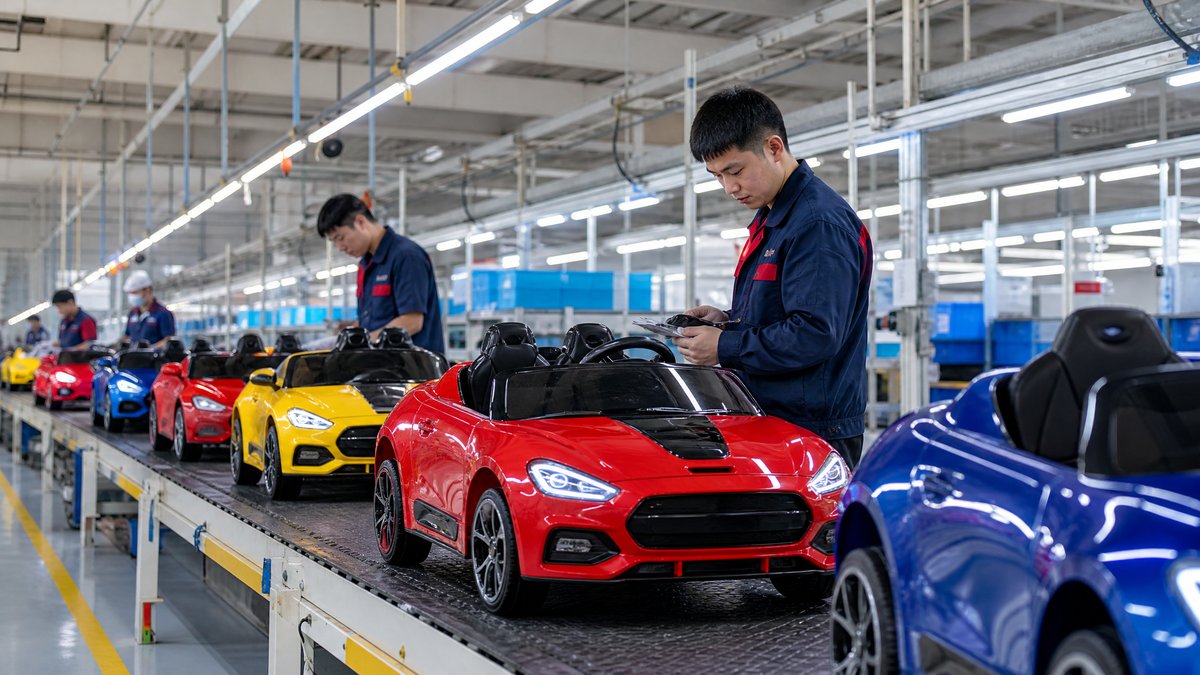
For professional importers, wholesale distributors, and retail procurement teams within the juvenile products sector, understanding the operational boundaries of four-wheel ride-on vehicles is fundamental to successful inventory management. The suitability of a specific model for various environments—ranging from polished indoor surfaces to expansive outdoor lawns—is not merely a matter of aesthetic design. Rather, it is the direct result of the mechanical and energy-delivery architecture chosen during the manufacturing process. A thorough grasp of these limitations is essential for selecting the right products for specific regional markets and for providing accurate guidance to end-users.
To address the primary inquiry directly: hard, level surfaces are appropriate for almost all electric ride-on vehicles, including those with basic energy systems and standard high-density plastic wheels. Conversely, the use of such vehicles on grass or more challenging outdoor landscapes is strictly dependent on the presence of high-torque propulsion configurations, multi-wheel engagement systems, and specialized tire materials that provide enhanced traction. Before authorizing or recommending use in any specific environment, procurement professionals must verify the written model documentation, current supplier evidence, appropriate product markings, and applicable destination-market requirements.
The Mechanical Foundation of Terrain Performance
The ability of a ride-on vehicle to navigate different surfaces is governed by the relationship between friction, rolling resistance, and rotational force. For a business-to-business buyer, recognizing these technical constraints is vital to avoid sourcing underpowered units for markets where outdoor play on natural surfaces is the expected norm.
Rolling resistance refers to the force that opposes motion when an object rolls across a surface. On smooth ground, such as polished concrete or indoor tile, this resistance is kept to a minimum. In such scenarios, the propulsion units require very little energy to maintain steady movement. However, natural surfaces like grass represent a soft and deformable medium that absorbs a significant amount of kinetic energy. This absorption drastically increases the workload on the internal energy system. A vehicle that appears to perform adequately on a flat showroom floor may encounter significant difficulties within moments of being placed on a suburban lawn if its energy-delivery components are not engineered to handle the increased demand.
Traction—the frictional grip between the tire and the surface—is another critical factor that limits acceleration and the ability to navigate inclines. Standard wheels made from hard plastic, while cost-effective for mass-market production, often lack the necessary grip for slippery grass or loose outdoor debris. For premium models intended for more rugged use, the transition to advanced materials like foam-based composites or specialized rubber is a necessary upgrade. These materials allow the vehicle to maintain progress on surfaces where plastic wheels would simply spin without moving the vehicle forward.
Categorizing Inventory by Environmental Suitability
Professional procurement agents should categorize their vehicle inventory into several distinct performance tiers based on their readiness for different environments. This classification system assists in establishing realistic price points and managing the expectations of the final consumer.
Primary Level: Smooth Surface Specialists
These models are engineered for controlled environments where the surface is flat, hard, and predictable. This category encompasses the majority of entry-level vehicles intended for indoor use or paved urban settings. The technical profile of these models typically includes single or dual propulsion units with modest energy requirements. The propulsion system is usually focused on the rear wheels, and the wheels themselves are crafted from high-density polymers. These items are high-volume products ideal for urban residential settings, city parks, and well-maintained paved driveways. Importers should focus on visual appeal and brand recognition for these models.
Operational limits for these vehicles must be clearly communicated. They should not be marketed for use on natural lawns. The combination of low rotational force and limited traction will likely cause the propulsion units to stall, leading to premature energy depletion and potential long-term issues with the internal components.
Intermediate Level: Multi-Surface Cruisers
This middle tier represents the most sought-after segment for suburban markets where children have access to private outdoor spaces. These vehicles are designed to handle the transition from a hard driveway to a well-maintained lawn without significant loss of performance. The technical profile for this category requires more robust energy systems and higher-output propulsion units. The inclusion of foam-based tires is highly recommended here to provide the necessary grip on individual blades of grass. These models offer a balance between cost and versatility. While they are capable of navigating flat, dry grass, they are not intended for steep hills or thick vegetation. Importers should verify that internal housings provide protection against moisture.
Advanced Level: Rugged Terrain Explorers
These represent the flagship products of a distributor’s catalog, engineered for high-performance play in rural or adventure-oriented settings. The technical profile involves high-energy systems and powerful propulsion units, often utilizing all-wheel engagement. They feature large-diameter wheels with aggressive tread patterns made from enhanced materials, supported by independent suspension systems on all four corners. These are premium products that command higher margins. The target audience includes families with large properties and those who prioritize mechanical durability. While these models are designed for gravel, dirt paths, and moderate slopes, they are still not intended for deep mud, loose sand, or crossing through water.
Technical Sourcing Criteria for Professional Buyers
When evaluating factory offerings, procurement professionals must look beyond simple marketing labels and examine the actual mechanical attributes that dictate real-world performance.
Rotational Force and Energy Delivery
In the context of juvenile vehicles, the ability to overcome resistance is more important than the maximum attainable pace. A vehicle requires significant rotational force to move through grass or to climb a small rise. High-energy systems naturally provide better efficiency for these demanding tasks. Importers should request detailed documentation regarding the internal gear ratios and the rotational output of the propulsion units. A configuration that prioritizes torque over pace often results in a vehicle that is much more capable on difficult terrain.
Material Science in Tire Selection
The choice of wheel material is a pivotal decision for any sourcing agent. The following table provides a comparison of common materials based on their performance characteristics:
| Material Type | Traction Capability | Durability Level | Optimal Environment |
|---|---|---|---|
| Hard Polymer | Minimal | High on hard surfaces | Indoor, Paved, Urban |
| Foam Composite | Moderate to High | Moderate | Grass, Gravel, Suburban |
| Enhanced Rubber | High | High | Rugged paths, Premium use |
Foam-based tires have become the industry standard for grass-capable vehicles because they offer a grip similar to rubber without the maintenance requirements of air-filled alternatives. However, for the most advanced models, rubber tires provide superior shock absorption and longevity on abrasive surfaces like gravel or crushed stone.
Physical Dimensions and Clearance
Suitability for different environments is also a function of the vehicle’s physical dimensions. A model with a low-profile design will likely encounter obstacles on grass or uneven ground, regardless of the power of its propulsion units. Importers should look for models that offer adequate clearance between the chassis and the ground. Furthermore, the angles at the front and rear of the vehicle are vital; they determine how steep a slope the vehicle can begin or end without the bodywork making contact with the surface.
Verification and Quality Assurance Protocols
Before committing to a large-scale order of rugged vehicles, professional buyers must conduct thorough due diligence. Manufacturers often look for ways to reduce costs, which can lead to performance issues in demanding environments.
Essential Documentation to Request
Procurement teams should ask for the following items to ensure product quality:
First, detailed reports on the rotational force output of the propulsion units. It is important to verify that the units are appropriate for the intended weight of the user and the resistance of the terrain.
Second, energy discharge reports that demonstrate the system can maintain a steady output during high-demand use on natural surfaces without a significant drop in performance.
Third, evidence of stability and balance, showing that the vehicle remains stable on moderate inclines according to applicable destination-market requirements.
Fourth, any available information regarding the protection of the internal control systems from dust and moisture.
External Quality Control Measures
During a non-destructive assessment or pre-shipment inspection, the following external visual checks should be performed:
Ensure that all wheels are correctly aligned and that they all make contact with the ground simultaneously. This prevents an uneven load on the propulsion units.
Verify that the suspension components move freely and provide the expected level of travel.
Observe the vehicle as it operates on a moderate incline while carrying a typical load to check for any signs of strain or automatic system shutdowns.
Risk Management and Safety Features
Operating a vehicle outdoors naturally involves different considerations than indoor play. Professional buyers are responsible for ensuring their inventory includes features that help manage these situations.
Assistance and Control Systems
For vehicles intended for outdoor use, a parental control system is highly recommended. This should include a priority function that allows an adult to take over control if the vehicle approaches an area that is not suitable for play. Additionally, the inclusion of a gradual start feature is important for maintaining control on high-traction surfaces, as it prevents sudden movements that could startle the user or lead to a loss of balance.
System Protection
All professional-grade vehicles should be equipped with self-resetting thermal protection or a similar energy-limiting system. This prevents the internal components from overheating if the vehicle is used in an environment that exceeds its designed capability, such as very thick grass or heavy mud. If a vehicle stops during use, the operator should stop use if there is a concern and consult the manual-led setup instructions or seek qualified support.
Strategic Sourcing by Market Geography
A successful business-to-business strategy involves matching the capabilities of the vehicle to the local geography of the target market. Markets where large suburban lawns are common will have a high demand for robust models with foam or rubber tires and high-energy systems. In contrast, urban markets dominated by paved public spaces may be better served by compact models with premium finishes and licensed branding. In regions where the infrastructure may be less predictable, durable models with high clearance and all-wheel propulsion are often the best choice to minimize the need for after-sales support.
Frequently Asked Questions
Q: Can a standard-power vehicle be used on a natural lawn?
A: While it is possible, the performance will depend heavily on the output of the propulsion units and the condition of the grass. A vehicle with standard energy levels and dual propulsion units can often handle short, dry, and level grass. However, it will likely struggle or stop moving on longer or damp grass. For consistent outdoor performance, procurement professionals should prioritize models with higher energy systems and specialized gear configurations.
Q: Are plastic wheels appropriate for outdoor use?
A: Plastic wheels are most effective on smooth, hard surfaces. While they are durable, they lack the necessary friction to move efficiently on grass and can be quite loud when used on gravel or stone paths. For mixed outdoor environments, foam or rubber tires are the preferred choice as they provide better grip, a quieter experience, and improved shock absorption.
Q: What should be done if a vehicle stops moving while on a slope?
A: The operator should immediately cease attempting to move the vehicle to prevent any potential strain on the internal systems. The situation should be evaluated based on the written model documentation. If the environment is within the vehicle's rated capabilities but it still fails to perform, the user should seek manufacturer-approved support or qualified support. No attempt should be made to inspect the internal energy systems or perform any mechanical work beyond what is described in the manual-led setup.
Conclusion
Selecting the right four-wheel ride-on car requires a careful alignment between the technical features of the vehicle and the intended environment of use. For importers and distributors, the objective is to offer a product range that meets the expectations of their customers while minimizing the need for after-sales assistance. By focusing on rotational force, tire materials, and physical clearance, and by verifying these attributes through proper documentation, businesses can establish a reputation for providing high-quality and reliable products. Always ensure that every vehicle is accompanied by a clear, model-specific guide that outlines the safe boundaries of operation and the necessary steps for adult supervision.
Request a wholesale quote
Official references
Explore these external resources for current regulatory and trade guidance. Confirm requirements with the relevant authority before placing an order.
Ready to Start?
Factory-Direct · CE & ASTM Certified · MOQ from 50 Units
Our export team works with buyers in 60+ countries. Get a quote within 24 hours.
KR
Written by KidsRideCar
China's leading kids electric ride-on car manufacturer. 500,000+ units shipped annually to 60+ countries. CE, ASTM & EN71 certified.