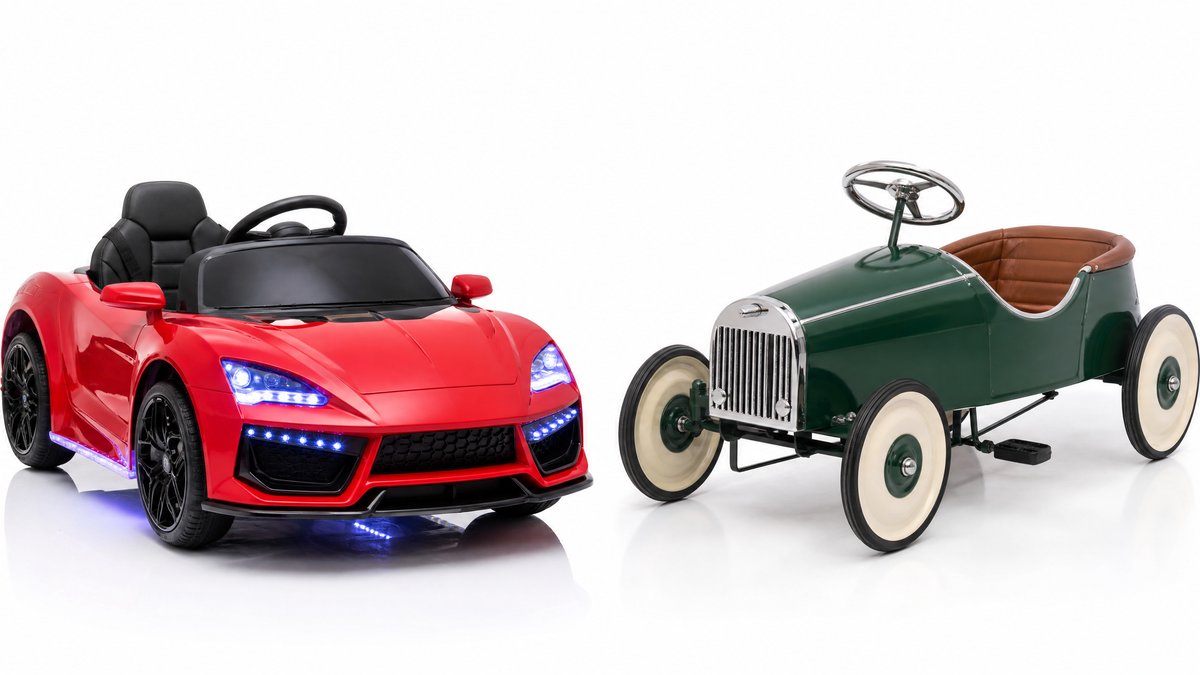
For toy retailers and wholesale buyers building a ride-on vehicle category, the choice between electric ride-on cars and pedal cars is one of the most consequential stocking decisions they will make. The two product types serve overlapping but distinct consumer segments, carry different margin profiles, and require different levels of supplier engagement. Getting this decision right can meaningfully improve category performance; getting it wrong leads to slow-moving inventory and missed sales.
This guide compares electric ride-on cars and pedal cars across the dimensions that matter most to retailers: demand trends, age suitability, price points and margins, operational complexity, and long-term category strategy. The goal is to give wholesale buyers a clear framework for making this decision based on their specific retail context.
Demand Trends: Electric Wins on Growth
The global market for kids electric ride-on vehicles has grown at a compound annual growth rate of approximately 8–12% over the past five years, driven by rising disposable incomes, the expansion of e-commerce, and increasing consumer preference for battery-powered products. Pedal cars, by contrast, have seen flat to modest growth in most markets, with demand concentrated in specific segments: premium wooden or retro-styled pedal cars for the gift market, and basic plastic pedal cars for the entry-level price tier.
Search volume data consistently shows higher consumer interest in electric ride-on cars than pedal cars across major markets including the US, UK, Germany, and Australia. For retailers building a category with growth potential, electric ride-on cars represent the stronger long-term bet.
Age Suitability: Different Strengths by Segment
| Age Group | Electric Ride-On Cars | Pedal Cars |
|---|---|---|
| 1–2 years | 6V models with parental remote — excellent fit | Not suitable (insufficient leg strength for pedaling) |
| 2–4 years | 6V–12V models — strong fit | Basic plastic pedal cars — moderate fit |
| 4–7 years | 12V models — strongest segment | Pedal cars — moderate fit for active children |
| 7–10 years | 24V performance models — good fit | Limited appeal; most children prefer powered vehicles |
| Gift market (all ages) | Licensed models — strong gift appeal | Premium retro designs — strong gift appeal |
The key insight from this comparison is that electric ride-on cars have a broader age range of strong suitability. Pedal cars have a narrower sweet spot — primarily ages 2–6 — and even within that range, they compete with electric alternatives that offer more features and greater child engagement.
Price Points and Margins
| Product Type | Wholesale Price Range | Retail Price Range | Gross Margin |
|---|---|---|---|
| Basic pedal car (plastic) | $8–$18 | $29–$59 | 45–55% |
| Premium pedal car (metal/wood) | $25–$55 | $89–$199 | 45–55% |
| 6V electric ride-on | $25–$45 | $79–$149 | 45–55% |
| 12V electric ride-on | $45–$85 | $149–$349 | 45–55% |
| 24V electric ride-on | $120–$200 | $399–$699 | 40–50% |
Gross margin percentages are broadly similar across both product types at the 45–55% level. However, the absolute dollar margin per unit is significantly higher for electric ride-on cars, particularly in the 12V and 24V segments. A retailer selling a 12V electric car at $249 with a 50% margin earns $124.50 per unit. The same margin on a $49 pedal car yields only $24.50. For retailers focused on maximizing dollar margin per square foot or per SKU, electric ride-on cars are the stronger choice.
Request our wholesale catalog with full pricing for 6V, 12V, and 24V electric ride-on cars. MOQ from 50 units.
Get Wholesale Catalog →Operational Complexity: Pedal Cars Are Simpler
Pedal cars have a genuine operational advantage: they have no batteries, no electronics, and no charging requirements. This simplicity translates to lower return rates (no battery failures, no charging issues), simpler customer service, and longer shelf life. A pedal car that sits in a warehouse for 18 months does not have a battery that has discharged and degraded.
Electric ride-on cars require more careful inventory management. Batteries should be charged before long-term storage. Customer service inquiries are more complex (battery issues, remote control pairing, motor problems). Return rates are typically 3–8% for electric ride-on cars versus 1–3% for pedal cars. These operational costs are real and should be factored into margin calculations.
Recommended Stocking Strategy
For most toy retailers, the optimal strategy is not an either/or choice but a tiered approach that uses both product types strategically. Electric ride-on cars should form the core of the category — 70–80% of SKUs and inventory investment — because they offer higher absolute margins, broader age appeal, and stronger demand growth. Pedal cars should serve as complementary products that fill specific gaps: the entry-level price point (under $50 retail), the gift market (premium retro designs), and the 2–4 year segment where some parents prefer non-powered options.
For online retailers, electric ride-on cars are particularly strong because their feature-richness (Bluetooth, remote control, LED lights) translates well to product listings and generates more customer reviews. Pedal cars are harder to differentiate online and tend to compete primarily on price.
Frequently Asked Questions
Which product has better sell-through rates — electric or pedal?
Electric ride-on cars generally have better sell-through rates in most retail environments because of their broader age appeal and higher perceived value. However, basic plastic pedal cars at the $29–$49 price point can have excellent sell-through in high-traffic discount retail environments where impulse purchase dynamics apply.
Are pedal cars becoming obsolete?
Not entirely, but their market position is narrowing. The premium end of the pedal car market — high-quality metal or wooden retro designs priced at $100–$200 — remains healthy as a gift and collector item. The mid-range plastic pedal car segment is under increasing pressure from affordable electric alternatives.
What is the minimum order quantity for electric ride-on cars?
Most reputable manufacturers have MOQs of 50–100 units per model for stock products. For retailers new to the category, starting with 2–3 models at 50 units each is a practical approach that allows market testing without excessive inventory commitment.
The data consistently supports electric ride-on cars as the stronger category investment for most retailers. Higher absolute margins, broader age appeal, and stronger demand growth make them the core product type to build around. Pedal cars remain relevant in specific niches — the gift market, the entry-level price point, and the preferences of parents who want non-powered options for young children — but they should be positioned as complementary rather than primary inventory.
Official references
Explore these external resources for current regulatory and trade guidance. Confirm requirements with the relevant authority before placing an order.
Ready to Start?
Factory-Direct · CE & ASTM Certified · MOQ from 50 Units
Our export team works with buyers in 60+ countries. Get a quote within 24 hours.
China's leading kids electric ride-on car manufacturer. 500,000+ units shipped annually to 60+ countries. CE, ASTM & EN71 certified.