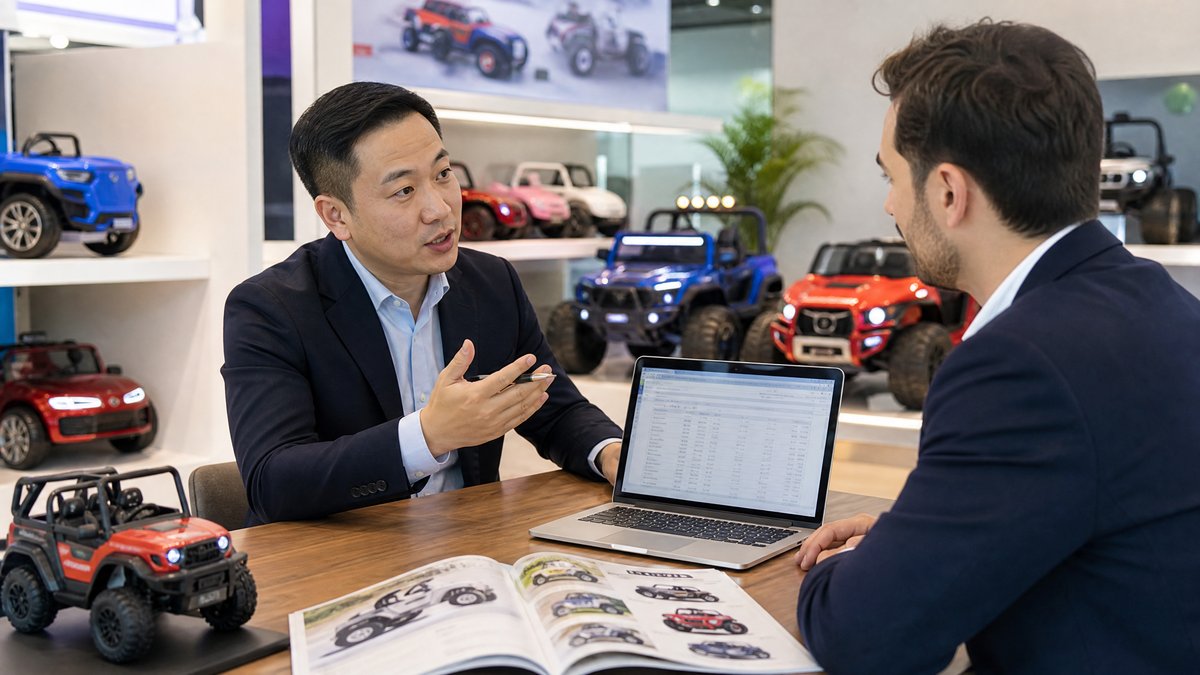
A vague message such as “please quote wheels and a remote” creates unnecessary risk. Similar kids ride-on cars can use different wheel fittings, colors, control systems, or connectors. The result can be a quote for a part that looks right but does not suit the intended version.
Concise answer: State the vehicle model or SKU, version and order/batch reference where available, part description, quantity, photos/labels, visible specifications, destination, and request purpose. Ask the supplier to confirm the part reference, compatibility, included items, packing, and availability in writing before approval.
For overseas importers, wholesalers, distributors, retailers, and OEM buyers, the objective is a traceable request that links to a warranty case, warehouse receipt, or customer-service record.
Why a structured parts request matters
“Motor,” “charger,” “remote,” and “rear wheel” are broad part descriptions, not always unique purchasing specifications. A structured request helps prevent three common problems:
- Incorrect fitment: The component should match the vehicle configuration, not simply resemble it.
- Delayed answers: Purchasing, after-sales, and supplier teams can work from the same evidence rather than exchange multiple clarification emails.
- Unrecorded substitutions: If the supplier proposes a revised reference, the buyer has a clear approval record.
For broader stocking guidance, see the [kids ride-on car spare parts guide](/blog/kids-electric-ride-on-car-spare-parts-guide). A request enables the supplier to quote and confirm a particular component.
1. Identify the vehicle before naming the part
Start with the parent product. A retail listing title may not match the factory’s model or component reference.
Vehicle details to include
Provide as many of these fields as are available:
- Your internal SKU and the supplier’s model number or item code
- Product name and variant, such as single-seat or two-seat configuration
- Color or trim version when a requested exterior part must match
- Related purchase order, invoice, shipment, or container reference
- Production date, batch number, carton marking, or product/reference label, if present
- Destination market and applicable language version of product documentation
- A full vehicle image, vehicle-label image, and relevant carton-marking image
Connect your sales-facing SKU to the supplier’s product reference and the version originally supplied, especially when variants share a marketing name.
If the model reference is missing
Do not guess. State that the supplier model is unknown and attach several clear images: the entire vehicle, the requested component in place, any visible part marking, and the mounting area. If you give dimensions, identify the measurement unit and describe exactly what was measured.
Ask the supplier to identify the vehicle and compatible part reference from the evidence, then wait for written confirmation before ordering. Photos are valuable, but they should support—not replace—a confirmed reference where one exists.
2. Describe every component as a verifiable line item
Each request line should explain what the part is, where it goes, and how it is distinguished. This avoids ambiguity between left and right, front and rear, or different versions of an assembly.
For every line item, include:
1. Supplier part number, if known; otherwise, a temporary internal reference.
2. Plain-language description, such as “rear wheel assembly” or “dashboard control panel.”
3. Position and orientation, for example, front-left, rear-right, driver side, or upper panel.
4. Target vehicle model(s) and version(s) that the component must fit.
5. Color, finish, trim, graphic, or visible material requirement for exterior components.
6. Connector, plug, mounting, or interface details when applicable, with photographs.
7. Quantity and unit of sale: piece, pair, set, kit, or assembly.
8. Marked reference photos that correspond to the line item.
Define vague terms. If “wheel” means the wheel plus hub cover and fixing hardware, say so. If you need only the visible cover, write that instead. Keep unlike components on separate lines even if they belong to the same service case.
Assemblies and electrical items need extra care
An assembly may include components that are not supplied separately; a loose part may require an associated cover or fastener. Ask the supplier to state whether the offered item is an individual part, set, kit, or assembly and what is included.
For a charger, battery-related item, remote control, controller, motor, or other electrical/electronic component, request the supplier’s exact reference and written model/version compatibility statement. Do not select an item based only on a similar-looking plug or a generic description. Never advise staff or end customers to bypass protections, alter wiring, solder connections, open battery cases, or perform internal repairs. Follow product instructions and use qualified service support where appropriate.
3. State why you need the parts and how quantities were derived
A supplier can prepare a more useful response when it understands whether the request is for verified claims, replenishment, or a new program. State one or more of the following purposes:
- Initial after-sales parts pack alongside a vehicle order
- Distributor or retailer service-stock replenishment
- Customer warranty or damage-claim support
- Warehouse discrepancy or transport-damage replacement
- Sample or compatibility evaluation
- OEM/private-label model support
- End-of-line service continuity planning
Then state the quantity basis. For example: “quantity for current verified cases,” “one service set per listed SKU,” or “forecasted replenishment, subject to supplier confirmation.” Keep urgent claim quantities separate from routine stock quantities. A forecast should not be described as a confirmed claim count.
Procurement example: a clear request table
This generic example shows the required level of detail. It is not a technical specification for every product.
| Request line | Information sent to supplier | Confirmation requested |
|---|---|---|
| 01 | Vehicle: buyer SKU KRC-___; supplier model to be confirmed; blue variant; related purchase-order reference; label and full vehicle images attached | Exact vehicle version and compatible supplier model code |
| 02 | Rear-left wheel assembly; black finish; marked image attached; quantity: ___ assemblies | Part number, included pieces, fitment, and pack configuration |
| 03 | Parental remote control; vehicle-label and current-remote images attached; quantity: ___ pieces | Exact remote reference, target-model compatibility, and any supplied instructions |
| 04 | Charger/power-adapter request; external label image attached; destination stated; quantity: ___ pieces | Compatible reference, applicable plug/market configuration, labeling, and shipment information |
The table gives the supplier an opportunity to correct an incomplete buyer reference instead of forcing a guess. It also provides a simple approval trail for the buyer.
4. Attach evidence that resolves ambiguity
Photos should identify a component, not merely show that a problem occurred. Use simple, consistent file names such as `PO-reference_model_front-view.jpg` or `internal-SKU_rear-left-wheel_marked.jpg` so the supplier can associate each image with a request line.
A useful evidence package may include:
- Full product images from more than one angle
- A close-up of the requested component installed on the vehicle
- A close-up of any visible part label, molded code, or package label
- Vehicle identification label and carton mark
- A picture of the connector, fixing point, or mounting location, where relevant
- A comparison with the matching undamaged component, if appropriate
- A short factual issue summary for a claim, without diagnosing an internal cause
Do not alter a product simply to get better evidence. Do not open sealed battery packs or disassemble electrical assemblies; rely on external labels, visible details, and the supplier’s supported service process.
5. Add commercial, packaging, and shipment requirements
The correct component is only part of a workable purchase. Include the information the supplier needs to give a usable commercial response: buyer company and contact, destination country, related order reference, and whether you need a quotation, pro forma invoice, sample confirmation, or warranty-replacement decision.
Ask for a line-by-line response showing the item reference, description, quantity, unit of sale, package configuration, and any applicable minimum-order requirement. If the supplier offers an “equivalent” item, do not approve it on that statement alone. Ask for the revised reference, exact fitment confirmation, relevant image or description, and written approval process.
Questions to ask about packaging and shipping
Include a short checklist in the original inquiry:
- Can the parts ship with vehicles, or should they be packed separately?
- What outer-carton and inner-pack information should the receiving team expect?
- Can the supplier apply the agreed SKU or warehouse labels?
- Are there special transport, handling, or documentation requirements for the proposed items?
- What consignee and destination details are needed for the freight response?
- What is the process if an item is unavailable, superseded, or no longer produced?
For a battery-related item or charger, give the exact item reference and destination, then ask the supplier which shipment information and documents apply. Avoid assumptions based on another model or shipping lane.
6. Ask for explicit compatibility confirmation
End the request with questions the supplier can answer line by line. Do not leave the inquiry as a general “please advise.” Request confirmation of the following:
- Exact part number for each requested item
- Compatibility with the stated vehicle model, version, and attached evidence
- Whether the item is original, revised, superseded, or an alternative reference
- Components included with each set, kit, or assembly
- Whether the part is available separately
- Quote, packing, labeling, and shipping information by line item
- An image or drawing of the offered item if it differs from the buyer’s evidence
Save the original request, attachments, supplier reply, quotation, and approval with the related purchase record. That record helps the next buyer, warehouse team member, or retailer support representative understand why a particular component was selected.
7. Use an internal approval path for claims and OEM programs
Multiple teams may hold different parts of the facts. Customer service may know the complaint; the warehouse may hold the carton data; purchasing may know the supplier reference. Assign one owner for the final request and follow a simple sequence:
1. Record the vehicle and issue details.
2. Gather evidence and connect it to the original purchase record.
3. Convert the request into distinct component lines.
4. Have a product or quality contact review vehicle identity and visible fitment evidence.
5. Obtain supplier confirmation of references and alternatives in writing.
6. Approve, reject, or seek clarification before ordering.
7. At receipt, check labels and quantities against the confirmed request.
For an OEM or private-label program, add approved artwork, color reference, packaging instruction, and change-control record when a visible or branded component is involved. A part used on a generic version should not automatically be assumed to match a branded or market-specific version.
Common mistakes importers should avoid
- Requesting “one wheel” without identifying position, color, model, and whether related covers or hardware are included
- Relying only on a consumer-facing listing name instead of a supplier model, order reference, label, or photo evidence
- Combining warranty replacements and stock replenishment in an unlabeled total quantity
- Sending unclear images without marking the requested part
- Ordering electrical items by appearance instead of written model/version confirmation
- Accepting an undocumented substitution that cannot later be traced
- Disclosing destination, labeling, packaging, or freight needs only after quotation
Copy-and-use spare-parts request template
> Subject: Spare Parts Request — [Buyer Company] — [Vehicle Model/SKU] — [Purpose]
>
> Buyer/company: [name]
> Contact and destination: [contact, country]
> Related vehicle: Buyer SKU [___]; supplier model [___ / to be confirmed]; variant/color [___]
> Related order: [PO, invoice, shipment, or batch reference]
> Purpose: [warranty / replenishment / OEM support / other]
> Attachments: [vehicle label, carton mark, full-product images, marked part images]
> Line items: [part reference if known; description; position; color/specification; quantity and unit]
> Please confirm: exact part number, target-model compatibility, included items, availability, quote details, packing/labeling, and shipment information.
> Substitutions: Please do not substitute without written confirmation and buyer approval.
When aligning a request with new vehicle purchasing, review the relevant [kids ride-on car products](/products/ride-on-cars) and maintain a consistent supplier-model-to-buyer-SKU map. It will simplify future support requests.
Frequently Asked Questions
What is the minimum information needed for a ride-on car spare-parts request?
Send the vehicle model or buyer SKU, part description and location, quantity, clear photos, and any product or carton label available. State the request purpose, then ask the supplier to confirm the exact reference and compatibility before purchase.
Can an importer request a replacement part using only a photo?
A photo is useful but may not prove fitment. Add vehicle identity, order references, variant details, and visible labels whenever possible. Obtain the supplier’s written confirmation rather than treating a similar-looking component as a compatible one.
How should I request a remote, charger, battery-related item, or other electrical component?
Provide the complete external label details, exact vehicle model/version, destination, and clear external images of the part and its visible connections. Ask the supplier for the compatible reference, included items, and applicable shipment information. Do not rewire, solder, open battery packs, bypass protections, or undertake internal repairs.
What should I do if the supplier proposes a revised part number?
Ask whether it supersedes the requested reference, which vehicle versions it fits, what is included, and how it differs from the original request. Keep the answer with the request record and approve the replacement in writing only after internal review.
Conclusion: build requests that can be confirmed
An effective kids ride-on car spare-parts request converts reliable vehicle identification into clear, line-by-line purchasing information. Include model and variant evidence, part position, quantities and purpose, photos and labels, destination details, and compatibility questions. The result is a better supplier response and a durable after-sales record.
Need help organizing an initial parts package, replenishment request, or OEM support list? [Send KidsRideCar your vehicle and parts details](/inquiry) or email info@kidsridecar.com to begin a structured inquiry.
Official references
Explore these external resources for current regulatory and trade guidance. Confirm requirements with the relevant authority before placing an order.
Ready to Start?
Factory-Direct · CE & ASTM Certified · MOQ from 50 Units
Our export team works with buyers in 60+ countries. Get a quote within 24 hours.
KR
Written by KidsRideCar
China's leading kids electric ride-on car manufacturer. 500,000+ units shipped annually to 60+ countries. CE, ASTM & EN71 certified.