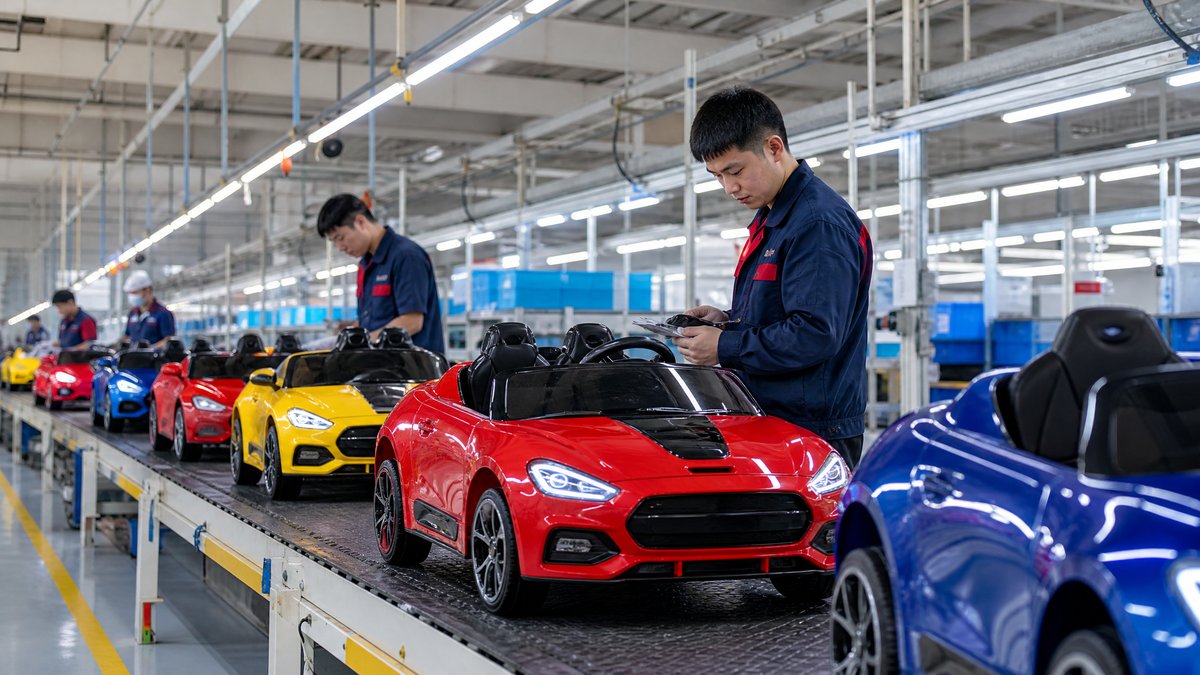
A buyer can compare kids electric ride-on car suppliers more reliably by translating requirements into a weighted, evidence-based scorecard before requesting final quotations. Score product fit, quality controls, documentation, communication, MOQ, after-sales service, packaging, and total commercial risk on the same scale; weight the categories that can damage market access or customer experience most heavily; and require evidence for every high score. The result is not simply the supplier with the lowest unit quote—it is the supplier with the most acceptable total commercial risk for the selected model, sales channel, and destination market.
> Buyer action: If you want a scorecard tailored to your target assortment, packaging channel, and destination country, email KidsRideCar with your model brief and buying plan.
This framework is designed for importers, wholesalers, distributors, and retailers sourcing electric ride-on cars. It is a commercial decision tool, not legal or compliance advice. Specifications, battery transport rules, and market requirements must be verified for the selected model and destination market before an order is released.
Why a weighted scorecard beats a quote comparison
A quotation answers only one question: what is the stated purchase price under stated terms? It does not show whether the model fits your age range and channel, whether product changes are controlled, whether documents match the exact configuration, or whether you can support a customer after the sale.
A weighted scorecard improves the comparison in three ways:
1. It makes priorities explicit. A retailer selling through a marketplace may weight packaging and document readiness more heavily than an importer serving independent stores. A private-label distributor may give more weight to change control and spare-parts support.
2. It separates evidence from promises. A supplier should earn points for model-specific files, clear responses, and documented processes—not for broad claims alone.
3. It exposes trade-offs early. A low MOQ can be attractive, but it may not offset weak packaging validation, unclear parts availability, or a document package that cannot be tied to the proposed model.
Use the scorecard after you have narrowed the field to comparable suppliers and a comparable brief. Do not award a score for a feature that has not been defined. For example, “good quality” is not a criterion; “pre-shipment inspection criteria agreed for the selected SKU” is.
Start with a one-page sourcing brief
The scorecard is only as useful as the brief behind it. Before inviting suppliers to quote, record the same inputs for every candidate:
- Selected product scope: ride-on car type, intended age positioning, single or multiple SKUs, color variants, accessory requirements, and any branded or customized elements.
- Sales channel: wholesale, brick-and-mortar retail, e-commerce, marketplace fulfillment, promotional program, or mixed channel.
- Destination: country or countries, importer of record, language/label needs, and the party responsible for reviewing market requirements.
- Order plan: trial order, forecast range, desired reorder pattern, target delivery window, and acceptable MOQ by SKU or color.
- Commercial scope: requested Incoterm, payment structure to be negotiated, inspection approach, warranty/service expectations, and spare-parts plan.
- Evidence requested: current model specifications, bill of materials where appropriate, packaging specification, production sample/change-control process, quality records, and the documents relevant to the destination market.
This brief prevents a false comparison in which one supplier quotes a basic configuration, another quotes a different battery or accessory set, and a third assumes generic export packaging. Ask every supplier to identify the exact model, variant, factory, document reference, and revision date behind its response.
Set non-negotiable gates before scoring
Some issues should be pass/fail gates rather than points. A high score in less critical categories must not compensate for an unresolved hard stop. Typical gates may include:
- The supplier can identify the exact proposed model and configuration.
- The product and documents can be reviewed against the intended destination and channel.
- Required warnings, labels, manuals, and language versions can be agreed for the selected market.
- Battery classification, transport preparation, packaging, and required shipping documents can be verified with the supplier and carrier or forwarder for the actual shipment.
- The proposed packaging can meet the retailer, fulfillment, and freight-handling requirements you have specified.
- The supplier accepts a written specification, approved sample, and agreed inspection/release process.
For EU-bound toys, the European Commission explains that toys must meet applicable safety requirements before being marketed and describes CE marking and conformity assessment routes.[EU toy safety] For U.S. children’s products subject to relevant rules, the CPSC describes third-party testing and a written Children’s Product Certificate (CPC) requirements.[CPSC CPC] These references do not determine the obligations for every ride-on configuration or market. Have the responsible importer, compliance professional, and destination-market authority guidance confirm what applies to your selected model.
Use a 100-point supplier comparison scorecard
The following example weights risk and execution rather than price alone. Adjust the weights to fit your business, but keep the total at 100. Score each category from 1 to 5 only after reviewing evidence:
- 1 = unacceptable or unverified
- 2 = material gaps
- 3 = acceptable with follow-up
- 4 = strong, supported response
- 5 = highly convincing, model-specific, and well-controlled
Weighted points = (supplier rating ÷ 5) × category weight. Add the weighted points for the total score out of 100.
| Criterion | Suggested weight | What a buyer should compare | Evidence or questions to request |
|---|---|---|---|
| Product fit | 18 | Match to target customer, channel, selected SKU range, feature configuration, customization feasibility, and product roadmap relevance | Model sheet with revision/date; photos or sample confirmation; configuration list; age/usage positioning; available options; change notice process |
| Quality system and consistency | 17 | Incoming materials, assembly control, functional checks, defect handling, traceability, and pre-shipment inspection approach | Quality checklist for the selected model; inspection records or process description; defect/escalation procedure; traceability method; sample-to-production controls |
| Documentation and market readiness | 16 | Completeness, currency, model/variant match, readable manuals/labels, and responsiveness to destination-market requests | Document index with model references and dates; test-report scope; declaration/certificate documents where applicable; label/manual artwork; responsible contact |
| Communication and project control | 10 | Clarity, response quality, ability to surface limits, quotation discipline, sample approvals, and change management | Written answers to the same brief; project timeline; named contact; approval workflow; examples of how changes are documented, with sensitive details redacted |
| MOQ and supply flexibility | 9 | MOQ by model, color, packaging, and customization; mixed-SKU options; repeat-order practicality; forecast discussion | MOQ schedule; quoted configuration assumptions; capacity and lead-time assumptions; MOQ effect of customization; reorder conditions |
| After-sales service and spare parts | 10 | Parts list, service response process, troubleshooting materials, service stock options, and support boundaries | Spare-parts list and identifiers; warranty/service terms proposed for review; fault-report workflow; user manual; repair guidance if available |
| Packaging and shipment readiness | 8 | Carton design, labeling, inner protection, pallet/container plan, marketplace or retailer needs, and damage-risk controls | Dieline/artwork approval process; carton dimensions/weights for the selected model; pack-out photos; handling marks; fulfillment requirement checklist |
| Total commercial risk | 12 | Quote completeness, dependency risk, contract clarity, payment/inspection alignment, change exposure, logistics assumptions, and exit options | Full quotation assumptions; Incoterm; payment proposal; inspection/rework process; change notification; ownership and tooling terms if relevant; freight/battery-document coordination plan |
Example of a blank scorecard calculation
Keep raw ratings, evidence links, and unresolved questions in the same sheet. A total score without an audit trail becomes difficult to defend internally.
| Criterion | Weight | Supplier A rating (1–5) | Supplier A weighted points | Evidence checked / open issue |
|---|---|---|---|---|
| Product fit | 18 | |||
| Quality system and consistency | 17 | |||
| Documentation and market readiness | 16 | |||
| Communication and project control | 10 | |||
| MOQ and supply flexibility | 9 | |||
| After-sales service and spare parts | 10 | |||
| Packaging and shipment readiness | 8 | |||
| Total commercial risk | 12 | |||
| Total | 100 | /100 | Decision / conditions to close |
A useful governance rule is: no category above 3 without evidence recorded in the last column. A second reviewer—such as the product, compliance, logistics, or service owner—should challenge the top scores before the decision meeting.
How to score each category without rewarding vague answers
1. Product fit: score the exact offer, not the catalogue
A broad catalogue may be useful, but a sourcing decision concerns a precise configuration. Compare the model’s intended positioning, selected features, variant control, visual fit, and packaging dimensions against your assortment plan. Identify optional features separately from the quoted base configuration.
Questions to ask:
- Which features are included in the quoted model, and which are optional?
- What version, color, accessory set, and packaging are covered by this quotation?
- What requires a new sample, new tooling, or a different MOQ?
- How will the supplier document an engineering, material, artwork, or packaging change after approval?
For help comparing product configurations, see the existing 12V vs 24V wholesale comparison. Treat it as a planning resource; verify the actual voltage, battery type, motor configuration, features, and instructions for the model you select.
2. Quality: test the control plan, not a single showroom sample
A sample can show design intent but may not demonstrate consistent production. Ask how the factory manages incoming components, assembly checkpoints, functional testing, cosmetic acceptance, rework, and final release. A credible answer defines who checks what, when, and how an exception is handled.
Build your own inspection plan around material points that matter to the selected SKU: correct configuration, assembly, operation, labels, manuals, accessories, packaging, and quantity. Set the criteria before production and align it with an approved sample and the purchase order. The KidsRideCar pre-shipment quality inspection guide can help frame buyer questions and an inspection checklist.
Do not treat a general quality-management claim, a facility tour, or an old report as proof that the exact model and order will meet your requirements. Match the evidence to the SKU, factory, production period, and destination-market specification.
3. Documentation: check relevance, scope, and traceability
Document readiness is more than a folder of certificates. A high score requires a document map showing what supports the selected model, variant, materials, labeling, and target market. Confirm dates, report scope, model identity, factory identity where relevant, and whether a change could invalidate the evidence.
Ask for a controlled index with at least:
- document name and reference number;
- issuing or responsible party;
- model/variant covered;
- issue or revision date;
- intended market or requirement addressed; and
- link to the current manual, labels, and packaging artwork.
Avoid accepting a document merely because it carries a familiar standard name. Requirements can differ by product configuration, destination, and route to market. In the United States, the CPSC notes that the CPC and supporting test reports for covered children’s products must be in English and describes the certificate information that is required.[CPSC CPC] Review the current official guidance and obtain appropriate professional advice for your shipment and role.
4. Communication: reward precision, transparency, and change control
Fast replies are helpful, but clear replies are more valuable. Score whether the supplier answers the same sourcing brief completely, identifies assumptions, gives document ownership, and flags constraints. A supplier that says “we will check” may be reasonable at an early stage; score it lower until the answer is confirmed in writing.
Use a short response test: send each supplier the same ten questions, including a deliberate request for an item that may have constraints (for example, alternate packaging or a small color run). Compare whether it clarifies the requirement, explains the trade-off, and documents the response.
5. MOQ: evaluate the inventory commitment behind the minimum
MOQ is not simply a number. Record whether it applies per model, color, packaging format, branding option, or order; whether mixed models are allowed; and which components create the limit. Compare the MOQ against your forecast, seasonal demand, warehouse capacity, and reorder ability.
A lower entry MOQ can reduce initial inventory exposure, while a higher MOQ may be workable if the SKU has a clear sales plan and supply conditions. The right score reflects the whole commitment—not only the first order. For a structured planning discussion, refer to MOQ Strategy for Kids Electric Ride-On Cars.
6. Service: define what happens after the container arrives
Service quality affects retailer confidence, customer reviews, and future buying time. Require a list of replaceable parts and identifiers, a proposed process for reporting faults, expected information needed for diagnosis, and clarity about what support is included or separately arranged. Ask whether manuals, troubleshooting guidance, and service materials can be supplied for the selected model.
Score service based on an executable plan. “Parts available” is weaker than a documented parts list, model compatibility, contact route, and agreed ordering process. The existing after-sales service guide for distributors offers additional questions to include in a service review.
7. Packaging: score shelf, fulfillment, and freight outcomes separately
Packaging must protect the item and work in the real sales path. A retail-ready carton, an e-commerce parcel, and a palletized wholesale shipment can have different needs. Explain your channel requirements early, including carton marks, barcodes, labels, assembly instructions, inserts, pallet standards, and fulfillment restrictions.
Ask for selected-model pack-out details rather than generic photos. Check that artwork, manual language, carton labeling, and final dimensions/weights are all controlled. For a channel-focused prompt list, see the Kids Electric Ride-On Car Packaging Guide.
8. Total commercial risk: make hidden exposure visible
Total commercial risk is where the scorecard brings the decision together. It includes ambiguity in the quotation, unpriced changes, unclear acceptance criteria, logistics dependencies, single-source components, late document delivery, and after-sales exposure. It is not a substitute for your legal, financial, customs, or insurance review.
Create a simple risk register alongside the scorecard:
| Risk question | What to capture | Potential control before order release |
|---|---|---|
| Does the quote cover the exact configuration? | Model revision, accessories, packaging, artwork, included/excluded items | Attach approved specification and packaging schedule to the PO or contract |
| Can changes be made without notice? | Change trigger, approval owner, record of revisions | Require written buyer approval for defined changes |
| Are inspection and remedies clear? | Timing, criteria, reporting, rework/replacement process | Agree inspection plan and nonconformity procedure in advance |
| Are batteries and shipment preparation understood? | Battery chemistry/configuration, packaging, carrier/forwarder requirements, documents | Verify selected-model requirements with the carrier/forwarder and applicable authorities before booking |
| Is post-sale support actionable? | Parts list, service contact, fault workflow, replenishment process | Include agreed service and parts process in the operating plan |
Lithium battery transport requirements can vary with the battery’s type, configuration, mode of transport, carrier, and route. The U.S. PHMSA states that lithium batteries are regulated as hazardous materials in transport and directs shippers to applicable requirements; IATA also publishes battery transport guidance for air cargo.[PHMSA lithium battery transport][IATA batteries] Therefore, do not apply a generic shipping assumption: verify battery transport rules and required documentation for the selected model and destination market with the carrier, forwarder, and relevant authority.
Turn the score into a practical buying decision
A weighted total is a discussion tool, not an automatic award. Use it in a decision meeting with the buyer, product owner, quality/compliance reviewer, logistics owner, and service owner as appropriate.
Apply score bands with conditions
You can use a simple internal interpretation, adapted to your risk tolerance:
- 80–100: strong candidate, subject to passing gates and closing recorded conditions.
- 65–79: potentially viable, but the buyer should resolve defined gaps before commitment.
- Below 65: material evidence or execution gaps; reconsider, defer, or seek another supplier.
Do not select a supplier whose score is high because of product appeal and low MOQ while it fails a documentation, safety, shipment, or packaging gate. Likewise, do not disqualify a supplier merely because it has one transparent limitation; a clear, controllable gap may be less risky than an unverified promise.
Run sensitivity checks before approving the supplier
Change the weights to test whether the result depends on one assumption. For example, increase packaging weight for marketplace fulfillment or service weight for a distributor that promises local repairs. If the winner changes easily, the decision is sensitive and needs better evidence or a smaller pilot order.
Also compare the top three unresolved risks for each supplier. The preferred supplier should have the most manageable open items, clear owners, and deadlines—not merely the highest rounded total.
Keep the scorecard alive after the first order
After sample approval, pre-shipment inspection, arrival, and early after-sales activity, update the sheet with actual observations. This creates a repeatable supplier-performance record and makes the next buying decision faster. It also tells you whether your initial criteria need revision.
Image planning
| Suggested dimensions | Placement | English caption | Alt text | English AI prompt |
|---|---|---|---|---|
| 1600 × 900 px | Hero image below the introduction | “A weighted scorecard helps buyers compare supplier capability beyond the unit quote.” | “Wholesale buyer reviewing a weighted supplier scorecard beside a kids electric ride-on car.” | “Professional B2B sourcing scene in a bright modern showroom: a wholesale buyer reviewing a printed supplier scorecard and specification sheets beside an unbranded kids electric ride-on car, neutral colors, realistic commercial photography, no visible logos, ample copy space on the left.” |
| 1400 × 875 px | After “Use a 100-point supplier comparison scorecard” | “Score the same evidence for every supplier before comparing totals.” | “Close-up of a supplier evaluation worksheet with weighted criteria for kids ride-on cars.” | “Top-down editorial photograph of a clean supplier evaluation worksheet, calculator, pen, packaging sample card, and small unbranded children’s electric ride-on car model, legible-looking but non-readable chart lines, professional import procurement style, no logos.” |
| 1400 × 875 px | After the packaging and shipment readiness section | “Packaging review should reflect the route from factory to final sales channel.” | “Export carton and protective packaging being checked for a children’s electric ride-on car.” | “Realistic warehouse quality-control scene: an inspector checking an unbranded export carton, protective inserts, labels and packaging checklist for a children’s electric ride-on car, clean organized environment, no brand marks, B2B logistics photography.” |
| 1400 × 875 px | Before the conclusion | “A shared risk register turns open supplier questions into assigned actions.” | “Procurement team discussing supplier risk register and purchase order documents.” | “Diverse B2B procurement team in a meeting room reviewing a supplier risk register, product specification, shipping paperwork, and tablet with a simple scorecard dashboard; professional, realistic, no visible logos, warm neutral palette.” |
Frequently asked questions
What is the best scorecard weight for kids electric ride-on car suppliers?
There is no universal best mix. For many buyers, product fit, quality, documentation, and total commercial risk deserve the most weight because weaknesses there can affect market readiness and downstream cost. Reweight packaging for marketplace or fulfillment programs, service for distributors, and MOQ for a trial-order strategy. Keep the combined total at 100 and document why the weights match your channel and destination.
Should unit price be a separate scorecard category?
It can be, but avoid letting price dominate the decision. Buyers often compare quoted cost and commercial terms separately after verifying that every quote covers the same model, configuration, packaging, and service scope. If price is scored, use a limited weight and accompany it with a written total-cost and risk review rather than awarding the lowest figure automatically.
What documents should an importer request from a ride-on car supplier?
Request a model-specific document index, current specifications, applicable test or conformity documentation, manuals, labels, packaging artwork, and battery/shipment information appropriate to the selected model and destination. Requirements depend on the market and product configuration. Confirm the required evidence with the responsible importer, relevant regulator, qualified adviser, and carrier or forwarder rather than relying on a generic list.
How can a buyer verify a supplier’s quality claims?
Ask for a defined quality-control process, selected-model inspection criteria, traceability approach, and sample-to-production change controls. Then verify what is contractually agreed through approved samples, inspections, document review, and records for the actual order. A claim or generic certificate alone should not receive the same score as model-specific, current, and traceable evidence.
How should battery transport affect supplier selection?
Treat it as a release gate as well as a risk criterion. Identify the battery used in the exact model, the shipping mode and route, packaging/marking/document needs, and the responsible parties. Because requirements can change and vary by circumstances, validate them with the carrier, forwarder, and applicable official guidance before shipment. PHMSA and IATA provide starting points for transport guidance.[PHMSA lithium battery transport][IATA batteries]
Conclusion: choose the supplier you can manage, not just the quote you can obtain
A strong kids electric ride-on car supplier scorecard makes every buying assumption visible. Begin with a shared product-and-market brief, use pass/fail gates for non-negotiables, score model-specific evidence on weighted criteria, and turn unresolved issues into owners and deadlines. This helps importers, wholesalers, distributors, and retailers select a supplier whose product, documentation, packaging, service, and commercial controls align with the business they intend to build.
Before releasing an order, verify all selected-model specifications, battery transport rules, and destination-market requirements with the appropriate responsible parties. For a practical review of your supplier comparison framework or a KidsRideCar product inquiry, contact the KidsRideCar team.
[EU toy safety]: https://single-market-economy.ec.europa.eu/sectors/toys/toy-safety_en "European Commission: Toy Safety in the EU (official overview of EU toy-safety legislation, conformity assessment, and CE marking information; accessed September 2026)"
[CPSC CPC]: https://www.cpsc.gov/Business--Manufacturing/Testing-Certification/Childrens-Product-Certificate "U.S. Consumer Product Safety Commission: Children’s Product Certificate (official CPC testing and certification guidance; accessed September 2026)"
[PHMSA lithium battery transport]: https://www.phmsa.dot.gov/lithiumbatteries "U.S. Department of Transportation PHMSA: Transporting Lithium Batteries (official shipper resources; accessed September 2026)"
[IATA batteries]: https://www.iata.org/en/programs/cargo/dgr/lithium-batteries/ "International Air Transport Association: Batteries (air-cargo battery guidance; accessed September 2026)"
Official references
Explore these external resources for current regulatory and trade guidance. Confirm requirements with the relevant authority before placing an order.
Ready to Start?
Factory-Direct · CE & ASTM Certified · MOQ from 50 Units
Our export team works with buyers in 60+ countries. Get a quote within 24 hours.
KR
Written by KidsRideCar
China's leading kids electric ride-on car manufacturer. 500,000+ units shipped annually to 60+ countries. CE, ASTM & EN71 certified.