Introduction
Private label kids ride-on cars can help an importer, retailer, or distributor build a recognizable product range without designing an entirely new vehicle platform. The commercial opportunity, however, depends on disciplined coordination. A logo printed on a carton is only one part of a private-label project. The buyer must also define the approved model, artwork, warning information, accessories, carton configuration, sample stages, and the records that control mass production.
This guide presents a practical workflow for sourcing private label kids ride on cars. Product capabilities, customization scope, minimum order policies, lead times, and document availability vary by supplier and model, so confirm each point in writing before placing an order.
For a broader supplier process, buyers can also review the [kids ride-on car supplier RFQ guide](/kids-ride-on-car-rfq-supplier-catalog-request), the [wholesale sourcing guide](/kids-ride-on-car-wholesale-for-retailers-and-rental-businesses), and the [replacement parts resource](/kids-ride-on-car-replacement-parts-catalog-distributors).
1. Define the private-label scope before requesting artwork
A clear scope prevents a branding project from becoming uncontrolled product development. Start with a model list and identify what will remain standard and what may be customized.
Separate the product platform from the brand layer
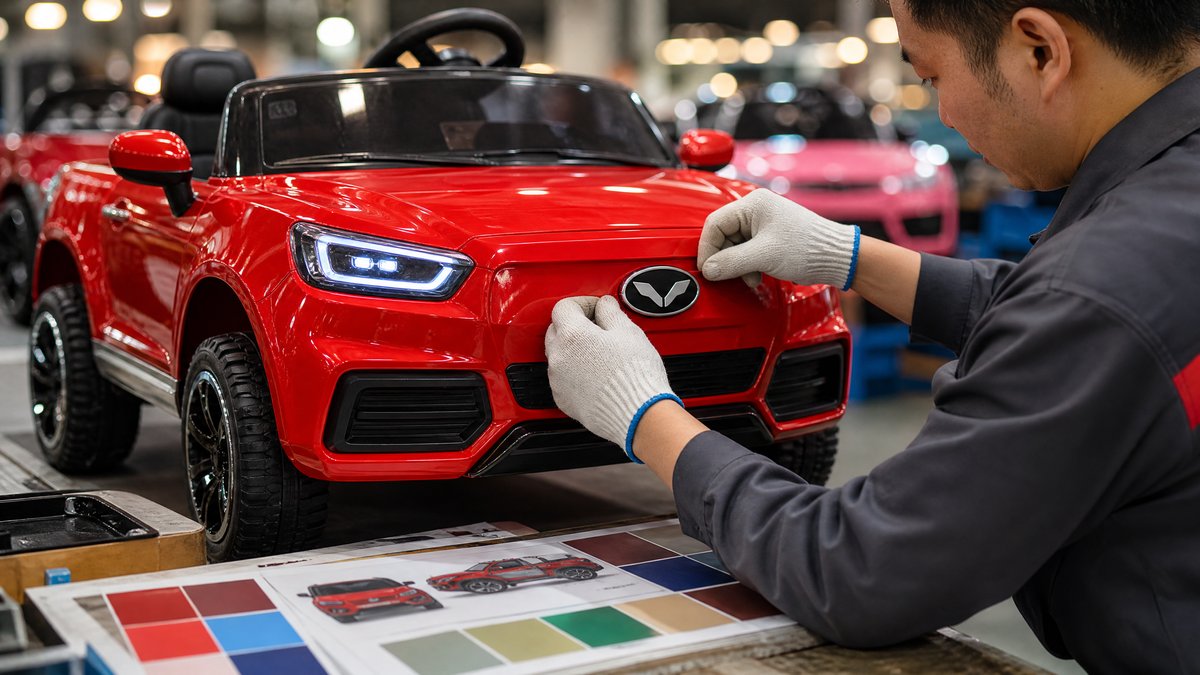
The vehicle platform may include the body, chassis, drive system, battery, charger, remote control, wheels, seat, dashboard, and standard accessories. The brand layer may include the logo, body graphics, carton artwork, instruction manual, labels, stickers, color selection, and retail inserts. Not every brand-layer element can change on every model.
Ask the supplier to classify each requested change as:
- Standard and available from an existing catalog.
- Custom artwork applied to an existing component.
- Color or material change subject to supplier review.
- New tooling, mold, or engineering work required.
- Not recommended or unavailable for the selected model.
This classification distinguishes a private-label order from broader OEM or ODM development.
Create a model and market brief
Before discussing packaging, record the intended sales channel and destination markets. A product sold through a toy retailer may need different carton content and product data from a unit supplied to a rental operator. List the target age grading, intended use, languages, sales countries, delivery channel, and whether the product will be sold as a single unit or in a multi-product assortment.
Review market-specific warnings, labels, manuals, conformity documents, and importer information for the actual model and destination. A supplier’s standard package is not automatically suitable for every country.
2. Prepare logo and packaging files correctly
A kids ride on car custom packaging manufacturer will usually need usable brand assets, not only a low-resolution image. File requirements differ, but buyers should prepare a controlled artwork package.
Logo handover checklist
Provide the brand name, approved logo versions, color references, clear-space rules, minimum-size guidance, and any restrictions on logo placement. Vector artwork is generally easier for production teams to scale than a compressed web image. Supply the preferred file format requested by the factory and label each file with a version number.
The handover should identify:
1. Primary logo and alternative one-color logo.
2. Approved colors and background treatments.
3. Placement on the vehicle, carton, manual, labels, and retail inserts.
4. Whether the logo is printed, applied as a sticker, molded, embroidered, or used only in packaging.
5. The person authorized to approve artwork changes.
Keep a master artwork folder under the buyer’s control. Do not rely on an informal chat message as the final approval record.
Packaging brief for private-label products
A useful packaging brief states the carton style, shipping marks, product name, SKU, model identifier, carton dimensions to be confirmed by the supplier, gross and net weight fields, barcode requirements, language versions, and required handling marks. It should also specify whether the carton is intended for e-commerce shipment, retail display, warehouse distribution, or a combination of these uses.
Ask the supplier to provide a dieline or packaging template before final artwork is created. The dieline should show cut lines, fold lines, glue areas, printing boundaries, and any areas that may be hidden by flaps or inserts. Artwork should be reviewed against this template rather than against a blank box illustration.
Private label kids ride on car packaging should also leave room for model-specific warnings, assembly information, charging instructions, importer details, and other information required by the destination market. Do not cover, delete, or rewrite safety information merely to make the design cleaner. Have the responsible compliance reviewer check the final copy before print.
3. Manage the sample order in stages
A kids ride on car sample order supplier should be asked to define what each sample represents. One sample may show the vehicle platform, while another is needed to check final graphics and packaging. Treat these as separate approval gates when necessary.
Stage 1: Reference or product sample
The first sample helps the buyer evaluate the selected model before private-label work is finalized. Record the model identifier, visible features, accessories, battery and charger information supplied with the sample, remote-control configuration, seat layout, wheels, and packaging condition.
The purpose is to confirm that the platform fits the brand’s channel and documentation plan. Photograph it consistently and record changes in a sample review sheet.
Stage 2: Branded sample or artwork proof
After the logo and packaging files are prepared, request a proof or branded sample according to the supplier’s process. Check logo position, color appearance, scale, surface finish, sticker edges, carton print, barcode placement, and the relationship between the product SKU and the packaging SKU.
If a physical sample is not practical for every artwork element, ask for a clearly identified digital proof and note which details still require physical verification. A rendering may not show actual print color, gloss, texture, or graphics on a curved panel.
Stage 3: Pre-production sample
A kids ride on car pre-production sample manufacturer should be asked to identify the pre-production sample as the intended reference for mass production. Review the product, packaging, accessories, labels, manual, and approved changes together.
Do not approve the pre-production sample using general language such as “looks good.” Record the approved model, revision, artwork files, component assumptions, packaging version, and open items. If an item remains unresolved, assign an owner and a deadline before production release.
4. Use an approval checklist that operations can audit
A structured checklist reduces disputes between the buyer, supplier, warehouse, and customer-service team.
Product identity and configuration
Confirm the model name, internal SKU, color, seat configuration, body graphics, drive configuration as documented by the supplier, battery and charger specification, remote-control version, accessory list, and user-manual version. Ask the supplier to flag any component that may vary by production batch or destination.
Visual and physical finish
Review color consistency, logo alignment, decal adhesion, visible scratches or marks, panel fit, seat and wheel appearance, switches, dashboard graphics, and the finish of high-visibility brand areas. This is not a substitute for a formal inspection plan.
Packaging and labeling
Check the carton artwork, model/SKU references, shipping marks, barcode or retail identifiers, language versions, warning placement, instruction references, accessory count, and carton protection. Confirm which labels are applied to the product, inner packaging, master carton, or documents.
Documentation and digital assets
Request the approved instruction manual, product specification sheet, assembly guidance, charging information, product photographs, dimensions, weights, and any market-specific compliance documents that apply to the selected configuration. The brand should not publish claims that are not supported by the current product and supplier documentation.
5. Control artwork, revisions, and change requests
Private-label projects often fail through version confusion. Use revision control from the first quotation to final shipment.
Name files with the SKU, document type, language, revision, and date. For example, a carton file should be distinguishable from a manual file, and the final approved file should be distinguishable from a concept. Keep a change log showing the request, reason, approver, supplier response, and effective production batch.
Before mass production, ask the supplier to confirm in writing which files and specifications are being used. If the supplier proposes a change to a material, component, charger, remote, packaging insert, or label, require a documented review. The change may affect product data, compatibility, safety information, testing evidence, or customer instructions.
A purchase order or quality agreement can reference the approved sample and document revisions. It should also describe the process for handling substitutions, artwork changes, and approval of future revisions. Exact contractual language should be reviewed by the buyer’s commercial or legal adviser where appropriate.
6. Build the supplier handover and launch file
A practical handover includes:
- Approved product and packaging photographs.
- Product data sheet with confirmed dimensions and weights.
- Model, SKU, color, and accessory list.
- Final logo, carton, label, manual, and insert files.
- Sample approval record and open-item closure notes.
- Packing list fields and shipping-mark instructions.
- Replacement-parts identification information.
- Supplier contact and escalation details.
- Applicable test reports, declarations, or technical documents supplied for review.
- Retail copy that has been checked against the actual configuration.
Keep compliance evidence separate from marketing claims. Whether a document is sufficient for market access depends on the destination, product configuration, current rules, and the importer’s obligations. Confirm those points with the relevant local authority or qualified adviser before launch.
7. RFQ fields for a private-label project
When approaching a supplier, send a complete RFQ instead of asking only for “logo and box customization.” Include:
1. Target countries and sales channels.
2. Candidate model numbers or required product type.
3. Expected order structure and whether multiple SKUs are involved.
4. Logo application method and requested locations.
5. Packaging format, languages, barcode, and shipping-mark requirements.
6. Manual, label, insert, and digital-asset requirements.
7. Sample stages requested and approval method.
8. Required product and packaging data for listing and logistics.
9. Document categories to be reviewed for the destination market.
10. Questions about customization limits, tooling, artwork fees, sample fees, lead-time assumptions, replacement parts, and change control.
Ask the supplier to return a line-by-line response. If a field is not applicable, request that it be marked “not applicable” rather than left blank. This makes quotations easier to compare and highlights assumptions that need confirmation.
Ready to turn your brand brief into a controlled sourcing request? Send your product requirements to KidsRideCar for a private-label discussion and a supplier response based on your selected models.
FAQ
What files does a private-label supplier need?
Usually, the supplier needs approved logo artwork, brand guidelines or placement instructions, packaging requirements, barcode or SKU information, language content, and any required manual or label copy. File formats and production templates vary, so ask the supplier for a dieline and technical artwork requirements before finalizing the design.
Should the sample use final packaging?
Ideally, the approval plan should include a final or near-final packaging review, especially when carton graphics, labels, instructions, or retail presentation are important. A product sample and a packaging proof may be reviewed separately, but the buyer should record which elements were physically checked and which were approved from digital proofs.
What should be recorded after sample approval?
Record the model and SKU, color, configuration, accessories, approved artwork revisions, packaging version, document versions, sample photographs, unresolved items, and the names or roles of the approvers. State whether approval releases mass production or only closes a particular review stage.
Can every ride-on car be fully customized under a private-label program?
No. Customization depends on the model, supplier capability, production method, tooling, order structure, destination-market requirements, and commercial terms. Ask the supplier to separate standard options, artwork applications, component changes, and new-development work before you make customer or launch promises.
How should an importer review compliance information in branded packaging?
Review the actual product configuration, intended market, labels, warnings, manuals, and available technical evidence together. A document from another model or market may not apply. Confirm the current requirements with the supplier and the relevant local authority or a qualified compliance professional before launch.
Need the next step after FAQ review? Ask for the KidsRideCar catalog or discuss OEM/ODM options with your target market, model range, and branding requirements.
Conclusion
A successful private-label kids ride-on car project is an approval system, not simply a logo application. Define the scope, separate the platform from the brand layer, prepare controlled artwork, review samples in stages, and document the exact standard released for production. Packaging, labels, manuals, accessories, product data, and compliance evidence should be checked against the same model and destination market.
For importers and distributors, this workflow creates a clearer RFQ, a more useful supplier handover, and a stronger basis for repeat orders. Confirm customization capability, sample policy, production timing, documents, and change-control terms with the supplier before committing to a launch.
References
- World Intellectual Property Organization (WIPO), Intellectual Property for Business
- European Commission, Product safety and conformity
- U.S. Consumer Product Safety Commission, Business and Manufacturing Guidance
Official references
Explore these external resources for current regulatory and trade guidance. Confirm requirements with the relevant authority before placing an order.
Ready to Start?
Factory-Direct · CE & ASTM Certified · MOQ from 50 Units
Our export team works with buyers in 60+ countries. Get a quote within 24 hours.
KR
Written by KidsRideCar
China's leading kids electric ride-on car manufacturer. 500,000+ units shipped annually to 60+ countries. CE, ASTM & EN71 certified.