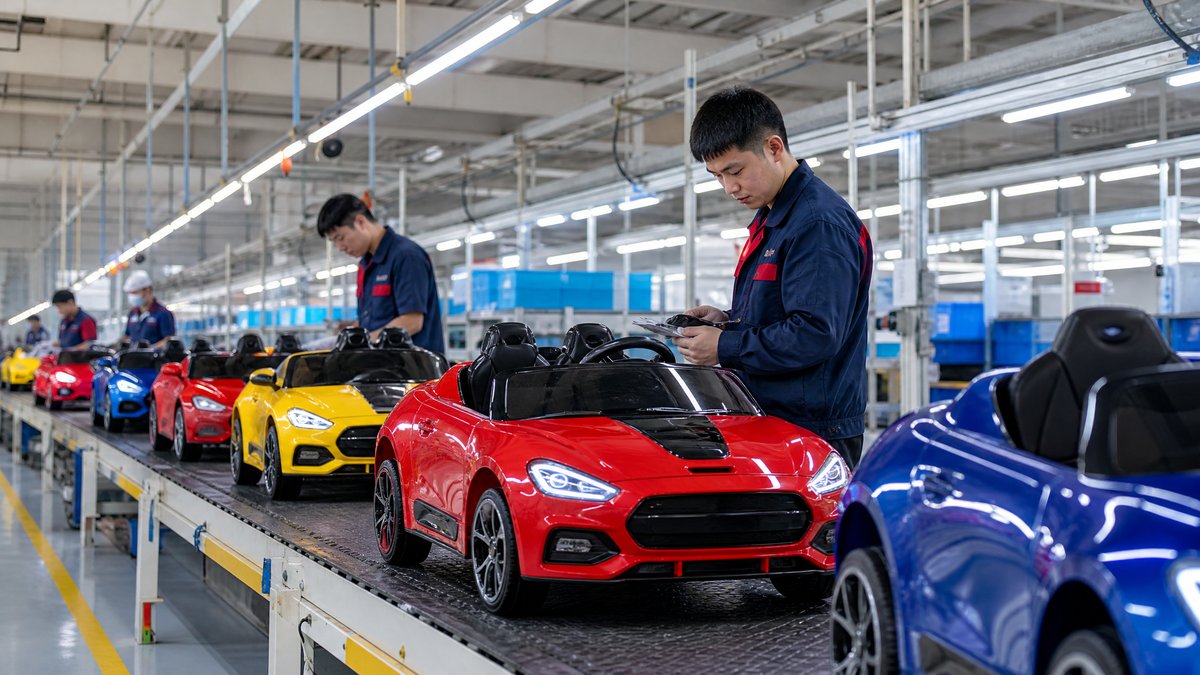
Short answer: audit the supplier against the *exact ride-on car model, battery configuration, destination market, and order specification*—not against a polished factory presentation. Before placing a deposit, request model-linked documents, follow the product flow from incoming parts to packed cartons, sample the factory’s records, and agree on inspection, traceability, packaging, and corrective-action expectations in writing.
For importers, wholesalers, distributors, and retailers, a factory audit is a risk-reduction exercise rather than a compliance guarantee. It can reveal whether a supplier’s declared capability is supported by observable processes and records. It does not replace product testing, destination-market obligations, cargo checks, or a pre-shipment inspection.
> Important: Specifications, battery transport rules, and market requirements must be verified for the selected model and destination market. A document or test report for a similar-looking ride-on car, a different battery pack, or an earlier production version may not support the product you plan to import.
Start with a model-specific audit brief
A useful audit begins before travel or a video call. Send the factory a one-page audit brief that identifies:
- The model code, approved product images or drawings, target age grade, and approved sample version.
- The proposed battery chemistry, battery-pack label details, charger, motor, remote-control option, electronics, and any accessories.
- Your destination market(s), sales channel, and any retailer, marketplace, or e-commerce packaging requirements.
- The intended product markings, manuals, language versions, warning labels, carton marks, and brand/OEM artwork.
- The expected inspection points: incoming materials, in-process assembly, functional checks, final inspection, rework, and packing.
- The documents you want to review and the production records you want sampled.
This turns vague questions such as “Are you certified?” into auditable questions such as “Which report, issue date, sample description, and production version support this specific model and its selected battery and charger?”
For a wider sourcing workflow, see KidsRideCar’s guide to sourcing kids electric ride-on cars from China.
Document review: verify relevance before relying on a certificate
Ask for documents early enough to compare them with the sample and purchase specification. The goal is not to collect the largest stack of PDFs; it is to establish whether the evidence belongs to the selected product and is controlled when the product changes.
Request these document groups
1. Supplier identity and production responsibility
- Business identity, factory address, and the legal entity that will manufacture or export the order.
- A clear statement of which operations are performed in-house and which are outsourced, including critical components or final assembly if applicable.
- A current organization chart or named contacts for engineering, quality, production, and export documentation.
2. Product definition and change control
- Model code, bill of materials or controlled component list, drawings/photos, and revision history.
- Approved sample record, color/material specification, key component specifications, and artwork approval process.
- A process for notifying the buyer before changes to the battery, charger, wiring, plastics, motors, remote-control electronics, suppliers, materials, labels, tooling, or packaging.
3. Safety and market evidence
- Test reports and declarations or certificates that the supplier says apply to the model and destination market.
- The report’s product description, photos, model identification, sample identity, test scope, issue date, laboratory identity, and any stated conditions or exclusions.
- Applicable instructions, warnings, age grading, producer/importer information, and required product or package markings.
4. Battery and transport paperwork
- Battery pack and charger identification, safety data where applicable, transport classification information supplied by the relevant parties, and packing/marking instructions proposed for the shipment.
- A clear statement of whether batteries ship installed, packed with equipment, separately, or are sourced locally.
5. Quality and shipment evidence
- Incoming inspection criteria, in-process and final inspection checklists, defect records, corrective-action records, packing specifications, and sample inspection reports.
- A proposed traceability method linking production lot, key components, carton, and shipment documents.
Buyer-facing evidence table
| Audit area | Ask to see | What to cross-check | Escalate when |
|---|---|---|---|
| Model identity | Controlled specification, sample record, model photos, revision log | Model code, battery/charger, accessories, colors, labels, and packaging match your order | The report or document names a different model, variant, battery, or an unclear sample |
| Test evidence | Full report or report summary with scope, laboratory details, and product identification | Scope and selected configuration match the target market and latest approved version | Only a logo, an undated certificate, or a cropped first page is offered |
| Component control | Approved supplier/component list and incoming inspection criteria | Battery, charger, wiring, electronics, wheels, plastics, and fasteners are specified and change-controlled | Critical parts can change without buyer notice or receiving checks |
| Quality system | Work instructions, inspection records, nonconformance log, corrective-action examples | Records have dates, responsible roles, acceptance criteria, and evidence of closure | Checklists are blank, generic, or appear to be completed after the fact |
| Traceability | Lot code rules, carton marks, production records, shipment records | A packed unit can be traced to production date/lot and key component batch where appropriate | The factory cannot demonstrate the chain with a live sample |
| Packaging | Dieline/specification, packing work instruction, packing test evidence where relevant | Carton, inserts, labels, palletization, manual, and battery documentation meet channel requirements | Packaging is defined only by a photo or changes are not formally approved |
How to read claims about standards and market access
Do not infer market access from a logo on a website, carton, or certificate. The applicable route depends on the product classification, selected configuration, destination rules, and the responsible economic operator.
For example, the U.S. Consumer Product Safety Commission (CPSC) states that ASTM F963 is a mandatory consumer product safety standard for children’s toys, and its business guidance discusses certification, labeling, and instructions for relevant products.[^cpsc-toy-safety] The European Commission explains that toys placed on the EU market must meet the applicable safety framework and carry CE marking; it also notes that the EU toy-safety regulatory framework is evolving, with Regulation (EU) 2025/2509 scheduled to apply after its transition period.[^eu-toy-safety]
These official pages are starting points, not a substitute for a market-specific compliance assessment. Ask the importer of record, qualified compliance adviser, testing laboratory, and/or destination-market regulator which rules and documents apply to the selected model.
Assess production capability from the process, not the showroom
A factory can have a convincing sample room while production capability is constrained elsewhere. Ask to follow one current or representative model through the production route.
Map the production flow
Request a walk-through in the same order a unit is built:
1. Incoming receiving and identification of critical parts.
2. Storage conditions and segregation of accepted, rejected, and uninspected materials.
3. Subassembly and main assembly stations.
4. Functional test station and any electrical/charging checks used by the factory.
5. Rework and repair area.
6. Final inspection, cleaning, and release to packing.
7. Packaging, carton marking, palletizing, and finished-goods storage.
At each step, look for a current work instruction, trained operator guidance, clear pass/fail status, and a way to prevent the wrong component or version from moving forward. If production is not running during the visit, ask for recent controlled records and arrange a follow-up observation during a live run. Do not assume that an idle line proves or disproves capacity.
Separate capacity from lead-time promises
Instead of accepting a general capacity statement, ask how the factory plans *your* order:
- Which line, shift, tooling, and critical components are allocated?
- Which operations are bottlenecks for the selected configuration?
- What is the purchasing lead time for the battery, charger, electronics, and branded packaging?
- How are production priorities changed when multiple buyers share a line?
- What happens if a key supplier misses a delivery or a quality hold is raised?
Request a production plan with milestones, but treat it as a planning input to be updated—not a guarantee. Your purchase order should define approved specifications, change-notification rules, inspection gates, and remedies appropriate to the commercial relationship.
Audit the quality system where defects are found and closed
A quality manual alone is weak evidence. A stronger audit samples real records and compares them with what is happening on the floor.
Review three layers of control
#### 1. Incoming quality control
Ask how the factory verifies key bought-in components before they reach assembly. Inspect whether parts such as battery packs, chargers, wiring harnesses, switches, circuit boards, motors, wheels, fasteners, labels, and packaging materials are identified against approved specifications. Check how a nonconforming delivery is isolated and dispositioned.
#### 2. In-process control
At assembly, observe whether operators have version-appropriate instructions and whether there are defined checks for the selected model. Ask who authorizes a change to an assembly method, component, or label. Where the factory uses gauges, fixtures, or testers, ask how it confirms that they remain suitable for their intended checks.
#### 3. Final inspection and corrective action
Review a recent final inspection record for a comparable product and trace several entries back to actual units or lots if possible. Then request an example of a defect that reached the corrective-action process. A credible example typically identifies the issue, containment action, root-cause investigation method, corrective action, responsible person, and evidence of effectiveness. The exact format can vary; what matters is that the system is used rather than merely documented.
Practical check: select a small, reasonable sample of records during the audit instead of accepting only documents preselected by the host. If privacy or customer confidentiality limits access, ask for redacted records and observe the control process without requesting sensitive commercial data.
Test and traceability: connect the unit, its evidence, and its shipment
Testing should be planned around the actual model and destination-market requirements, not treated as a last-minute paperwork task. Your audit should establish who owns the test plan, how samples are selected, what triggers retesting, and how the production version is kept aligned with the tested version.
Questions for the testing plan
- What hazards, functions, materials, labels, and instructions are covered by the intended evaluation for this configuration?
- Which model identifiers, battery pack, charger, remote-control version, accessories, and packaging were included in the sample definition?
- Is the laboratory and report acceptable for the destination market, customer, or marketplace? Confirm this independently where needed.
- How are failed, conditional, or out-of-scope results handled?
- What product, component, supplier, or artwork changes trigger a review of test relevance or a new evaluation?
- Who reviews destination-market labeling and instruction requirements before artwork is released?
For U.S.-bound children’s products, CPSC guidance explains that manufacturers and importers subject to CPSC-enforced requirements must issue a Children’s Product Certificate (CPC) where applicable, and it highlights tracking-label requirements for children’s products.[^cpsc-toy-safety] Confirm applicability and the current rule set for your product with the relevant authority or specialist.
Make traceability demonstrable
Traceability need not be complex, but it should work under pressure. During the audit, choose one packed unit or carton and ask the factory to demonstrate, using its normal records:
- Which finished-product lot or production date it belongs to.
- Which assembly line/shift or production record applies.
- The identity of key components and their incoming/lot information where the factory’s risk plan requires it.
- The inspection status and any rework record.
- The carton mark, shipping mark, and shipment record that would connect it to your order.
Then reverse the exercise: choose a component lot or inspection record and ask which finished units or cartons it could affect. If the chain cannot be shown without re-creating records, agree on an improvement plan before relying on it for a potential field action or recall response.
Confirm battery, electrical, and transport controls for the selected configuration
Battery-powered ride-on cars introduce product and logistics questions that must be managed together. Ask the factory to identify the exact battery pack and charger proposed for the order, their labels, supplier controls, packing arrangement, and document owners. Do not presume that a report or transport instruction applies if the pack’s chemistry, capacity, construction, installation state, or shipment arrangement changes.
The International Air Transport Association (IATA) notes that air carriage of lithium batteries depends on configuration and watt-hour rating for rechargeable batteries, and directs shippers to its battery guidance and Dangerous Goods Regulations resources.[^iata-batteries] This is not a universal shipping clearance. Verify the current requirements with the carrier, freight forwarder, and competent transport/compliance parties for the actual battery, route, and mode of transport. Sea, air, road, and warehouse rules can differ.
Ask the supplier:
- Who controls approval of the battery pack and charger, and how is substitution prevented?
- What incoming identification and inspection is performed for battery-related components?
- How are damaged, suspect, or rejected batteries segregated and handled?
- What documents, packing instructions, marks, labels, and declarations are proposed for your shipment?
- How is the chosen battery configuration locked into the purchase order, artwork, and packing specification?
Audit packaging as part of product quality
A product can leave final inspection in acceptable condition and still arrive with damage, missing parts, unreadable labels, or channel nonconformities. Include packaging in the audit scope.
What to inspect
- Pack-out sequence: Confirm that the correct manual, hardware pack, charger, remote-control accessory if ordered, protective materials, and labels are checked before carton closure.
- Carton specification: Review approved artwork, carton dimensions/board specification where relevant, internal supports, sealing method, shipping marks, barcode rules, and pallet pattern.
- Version control: Match carton and manual revision to the selected model, destination language, branding, warnings, and battery configuration.
- Handling damage feedback: Ask for examples of transit-damage or missing-part issues and how packaging was improved or verified afterward.
- Channel handoff: If selling through a retailer, marketplace, or fulfillment program, provide its latest inbound and labeling requirements. Have the factory confirm them against the final packing specification rather than relying on an old shipment.
For packaging planning beyond the audit, use KidsRideCar’s ride-on car packaging guide for Amazon FBA, retail, and export.
Responsible factory-visit questions that produce useful evidence
A good factory visit is firm on evidence and respectful of people, safety, and confidentiality. Give the supplier a reasonable agenda, comply with site safety rules and PPE requirements, avoid disrupting live work, and ask permission before taking photographs or recording. Do not request private employee information, proprietary customer designs, or confidential customer names. If worker interviews are appropriate to your audit program, use a safe, voluntary, and lawful approach that avoids management pressure or retaliation risk.
Questions to ask on the visit
About the order and change control
- “Please show the controlled specification and approved sample record for the configuration we are considering. Who approves a component or artwork change?”
- “How will we be notified if the battery, charger, electronics, or packaging supplier changes?”
About live production and quality
- “Can we follow a representative unit from receiving through packing, and see the work instructions used at each station?”
- “What is the most recent recurring quality issue on a comparable model, and what evidence shows the corrective action worked?”
- “Where are uninspected, rejected, and rework units physically controlled?”
About testing and records
- “Which document supports this selected model and configuration for our destination, and what is outside its scope?”
- “Please demonstrate the lot-to-carton traceability path using a normal record, with confidential details redacted if necessary.”
About logistics and serviceability
- “How is the battery shipment configuration confirmed with the freight plan and final packing specification?”
- “Which spare parts are identified for service, and how are replacements matched to product revisions?”
Questions to avoid or reframe
| Avoid | Reframe as |
|---|---|
| “Can you guarantee every market’s compliance?” | “What evidence supports this exact model for our target market, and which points must we verify independently?” |
| “Show us all your customer files and employee records.” | “Can you show redacted examples of comparable records and explain the control process?” |
| “Stop the line so we can inspect everything.” | “What is the safest, least disruptive way to observe the process and sample records?” |
| “Who is at fault for this defect?” | “How was the defect contained, investigated, corrected, and checked for effectiveness?” |
Turn the findings into a pre-order decision
Document audit findings in a simple action register. For each item, record the observation, evidence reviewed, risk to your selected order, owner, corrective action, due date, and verification method. Categorize issues in a way that fits your own risk policy, but do not let a verbal promise close a finding.
Before moving to mass production, consider requiring closure evidence for material gaps such as unclear model-to-report linkage, uncontrolled component substitution, missing traceability, unapproved packaging, or absent quality records. Depending on your risk profile, a follow-up remote review, production-stage inspection, independent pre-shipment inspection, or new sample approval may be appropriate.
For a complementary question set, read How to Choose a Kids Electric Car Manufacturer: 10 Questions to Ask Before You Order.
> CTA — plan your audit package: Email KidsRideCar at info@kidsridecar.com to request model-specific product, packaging, and factory-process information for your sourcing review.
Image plan for this article
| Placement | Suggested dimensions | English caption | Alt text | English AI prompt |
|---|---|---|---|---|
| Below the introduction | 1600 × 900 px | “A buyer audit follows the evidence from approved specification to packed shipment.” | “Importer reviewing a model-specific ride-on car factory audit checklist beside a packed kids electric ride-on car” | “Professional B2B editorial photograph, diverse importer and factory quality manager reviewing a printed model-specific audit checklist beside an unbranded kids electric ride-on car and export carton, clean modern factory, no visible brand logos, realistic documentary lighting, wide landscape composition, space for headline” |
| In the production-capability section | 1600 × 900 px | “Observe the production flow, status controls, and work instructions—not only the showroom.” | “Quality inspector observing assembly line status labels and work instructions for kids electric ride-on cars” | “Realistic industrial editorial image of a quality inspector in appropriate PPE observing an unbranded children’s electric ride-on car assembly line, visible but unreadable work instructions and accepted-rejected status areas, tidy factory, no logos, natural light, landscape” |
| In the traceability section | 1200 × 1200 px | “Traceability should connect a finished carton to normal production and inspection records.” | “Close-up of generic carton lot label, inspection record, and components used for ride-on car traceability” | “High-detail square B2B infographic-style still life, generic unbranded export carton with non-readable lot label, clipboard inspection sheet, barcode scanner, and ride-on car component tag, neutral blue and white palette, no claims, no logos” |
| In the packaging section | 1600 × 900 px | “Approved pack-out protects the product and keeps destination-market information aligned.” | “Open export carton showing protective inserts, manual, and unbranded ride-on car packing components” | “Professional warehouse editorial photograph of an open unbranded export carton for a kids electric ride-on car, protective inserts, instruction manual pages with unreadable text, accessory bag, careful pack-out demonstration, no logos, landscape composition” |
FAQ: auditing a kids electric ride-on car factory
Is a factory audit the same as product certification?
No. A factory audit examines processes, evidence, and controls at a point in time. Product conformity or certification requirements, where applicable, depend on the specific model, configuration, test scope, responsible parties, and destination market. Verify those matters separately with the appropriate authority, laboratory, or adviser.
What is the most important document to review first?
Start with the controlled product specification and the evidence linking it to the selected model: model code, version, battery and charger, accessories, labels, and packaging. This makes later review of test evidence, quality records, and shipping documents much more meaningful.
Can I accept a test report for a similar ride-on car?
Treat it as background information only until a qualified party confirms that its scope covers the selected model and configuration. Differences in components, battery/charger arrangement, materials, labels, instructions, or destination requirements can matter.
Should I audit packaging before the purchase order is finalized?
Yes. Packaging affects product protection, labeling, fulfillment, and transport planning. Confirm the final pack-out and artwork through the approved specification, especially if your order uses branded cartons, multiple language versions, or a different battery shipment arrangement.
What should I do if I cannot visit the factory in person?
Use a structured remote audit: request model-linked documents in advance, conduct a live walkthrough of the production and packing areas, sample time-stamped records, and arrange an appropriate third-party inspection or follow-up during production. Remote review is most useful when it is tied to the same evidence and audit brief used for an on-site visit.
Conclusion: audit the evidence chain, then verify the order configuration
The strongest pre-order audit asks one practical question repeatedly: can this factory show, with normal controlled records, that the selected ride-on car is built, checked, identified, packed, and shipped as specified? Review documents for relevance, observe the production flow, sample quality and traceability records, confirm testing and transport responsibilities, and make packaging part of the approval.
Keep the audit model-specific and destination-specific. Before ordering, verify the selected model’s specifications, battery transport rules, and applicable market requirements with the responsible parties for your shipment and sales market.
> CTA — discuss a model-specific review: contact the KidsRideCar team with your target market, proposed model, battery configuration, and packaging needs.
[^cpsc-toy-safety]: https://www.cpsc.gov/Business--Manufacturing/Business-Education/Toy-Safety "U.S. Consumer Product Safety Commission — Toy Safety Business Guidance"
[^eu-toy-safety]: https://single-market-economy.ec.europa.eu/sectors/toys/toy-safety_en "European Commission — Toy Safety in the EU"
[^iata-batteries]: https://www.iata.org/en/programs/cargo/dangerous-goods/lithium-batteries/ "International Air Transport Association — Batteries guidance"
Official references
Explore these external resources for current regulatory and trade guidance. Confirm requirements with the relevant authority before placing an order.
Ready to Start?
Factory-Direct · CE & ASTM Certified · MOQ from 50 Units
Our export team works with buyers in 60+ countries. Get a quote within 24 hours.
KR
Written by KidsRideCar
China's leading kids electric ride-on car manufacturer. 500,000+ units shipped annually to 60+ countries. CE, ASTM & EN71 certified.